
"We Are an Image from the Future: The Greek Revolt of December 2008", edited by A.G. Schwarz, Tasos Sagris and Void Network (AK Press, February 2010):
www.akpress.org/2010/items/weareanimagefromthefuture
Publisher's description: "What causes a city, then a whole country, to explode? How did one neighborhood's outrage over the tragic death of one teenager transform itself into a generalized insurrection against State and capital, paralyzing an entire nation for a month? This is a book about the murder of fifteen-year-old Alexis Grigoropoulos, killed by the police in the Exarchia neighborhood of Athens on December 6th, 2008, and of the revolution in the streets that followed, bringing business as usual in Greece to a screeching, burning halt for three marvelous weeks, and putting the fear of history back into the bureaucrats of Fortress Europe and beyond. We Are an Image From the Future delves into the December insurrection and its aftermath through interviews with those who witnessed and participated in it, alongside the communiqués and texts that circulated through the networks of revolt. It provides the on-the-ground facts needed to understand these historic events, and also dispels the myths activists outside of Greece have constructed around them. What emerges is not just the intensity of the riots, but the stories of organizing and solidarity, the questions of strategy and tactics: a desperately needed examination of the fabric of the Greek movements that made December possible."
Endorsement: "This dazzling collection is not a book about the great insurrection of 2008 – it is a living piece of it that can become a part of us, and through us, it opens the prospect of a universe we might never otherwise have imagined possible. Future historians may well conclude that the Revolution finally began in 2008. If they do, this book will have played a crucial role in that realization." (David Graeber, Goldsmiths, University of London)
The book contains texts such as "Their Democracy Murders – The Polytechnic University Occupation" and many writings by the "Ego Te Provoco" counter-information group, including the eponymous "We Are Here / We Are Everywhere / We Are an Image from the Future" (pp. 165-8), "The media as part of the counter-insurgency" (pp. 169-72), and "A Bedouin Anytime! A Citizen Never." (pp. 197-8; translators not named).
Excerpts: "The other thing we put forward was a discourse against democracy, because many people were saying, what kind of democracy kills children, we need more democracy, and we were trying to deconstruct this whole notion of democracy, to claim that this murder is not an exception, it is the rule of democracy, the rule of the nation-state, the rule of capitalism." (p. 170)
"We despise democracy more than anything else in this decadent world. For what is democracy other than a system of discriminations and coercions in the service of property and privacy? [...] The bourgeois, with a voice trembling from piety, promise: rights, justice, equality. And the revolted hear: repression, exploitation, looting. [...] Our contempt for democracy does not derive from some sort of idealism but rather from our very material animosity for a social entity in which value and organizing are centered around the product and the spectacle." (p. 198)
A.G. Schwarz is the assumed name of a North American living in exile abroad.
Tasos Sagris is a member of the Athens-based Void Network, an arts and action collective established in 1990.
Showing posts with label violence. Show all posts
Showing posts with label violence. Show all posts
12 November 2010

21 September 2010
Article: Manifesto of Affirmationism
The leftist French philosopher Alain Badiou's "Manifesto of Affirmationism" (trans. Barbara P. Fulks) was published in the New York-based biannual journal of critical theory, art, and fiction "Lacanian Ink" (24/25, spring 2005: no page numbers given).
The full text of the article can be read free of charge here:
www.lacan.com/frameXXIV5.htm
Excerpts: "We cannot understand what is gripping us and causing us to despair if we do not return again and again to the fact that our world is not at all a democracy, but rather an imperial conservatism under the guise of democratic phraseology. What to say of today's world? A solitary power whose army is terrorizing the entire planet dictates its law of the circulation of capital and images and proclaims everywhere, with the most extreme violence, the Duties and Rights of everyone. [...] Under the imposed name of 'terrorism,' those most violently opposed to this hegemony of the brutal West, for which 'democracy' is spiritual ornament, are in reality part of it [...]: the fury of inspired barbarism against sated imperialism. [...] Romantic formalism has always been an artistic orientation of ensconced and terminal dominations. And it is thus in our time: that of a unique and multiform doctrine (economic liberalism and political electoralism), integrating for the first time the quasi-totality of human species in the distribution and constraint of its fortune.
"Yes, our time is that of the unique doctrine and of the consensus which is created around it under the strange name of 'democracy.' Any unique doctrine of this type is desperate, nihilist, because it only proposes to the human multiplicity the absurd perpetuation of its obscene order. And the artistic subjectivity that it leads to is that of this nihilism and of this obscenity. [...] The only maxim of contemporary art is to not be 'Western.' Which means also that it should not be democratic, if democratic means: conforming to the Western idea of political liberty. [...] Yes, the only problem is to know if the artistic imperative can be detached from the Western imperative, which is that of marketing and communication. Western democracy, in effect, is marketing and communication. Thus true art is that which interrupts marketing, that which communicates nothing. Immobile and incommunicable, this is the art we need, the only one that addresses everyone, not circulating according to any pre-established network and not communicating with anyone in particular. Art should augment in everyone the non-democratic strength of one's liberty. [...]
"A non-Western art is necessarily an abstract art, in the following sense: it abstracts from all particularity and formalizes this gesture of abstraction. In order to combat expressivity, to combat Romantic formalism, there is only the dynamic of abstraction. [...] The abstraction in art which is and which is to come does not consider any particular public [...]: it does what it says, without needing acceptance from anyone. We affirm that all sociological and institutional speculations about the audience for the arts must be abandoned. Sociology, and criticism itself, is only and always the auxiliary of Western democracy. [...] Convinced of controlling the entire extent of the visible and of the audible through commercial laws of marketing and the democratic laws of communication, contemporary power no longer needs censorship. It says: 'Everything is possible.' Which also might mean that nothing is. Abandoning itself to this authorization to jouir [enjoy, delight in] is the ruin of all art, as well as all thought. We should be our own pitiless censors. [...] It is better to do nothing than to work officially in the visibility of what the West declares to exist."
Alain Badiou was formerly chair of Philosophy at the École Normale Supérieure (ENS) in Paris.
17 September 2010
Article: An alternative to the new wave of ecofascism
Micah White, a US activist and contributing editor at the Canada-based anti-consumerist magazine "Adbusters", is the author of an op-ed article titled "An alternative to the new wave of ecofascism", published on 16 September 2010 on the website of the British "Guardian" newspaper.
The full text of the article can be read free of charge here:
www.guardian.co.uk/commentisfree/cif-green/2010/sep/16/authoritarianism-ecofascism-alternative
Excerpts: "It is time to acknowledge that mainstream environmentalism has failed to prevent climate catastrophe. Its refusal to call for an immediate consumption reduction has backfired and its demise has opened the way for a wave of fascist environmentalists who reject democratic freedom. One well-known example of the authoritarian turn in environmentalism is James Lovelock, the first scientist to discover the presence of ozone-depleting chlorofluorocarbons in the atmosphere. Earlier this year he told the Guardian that democracies are incapable of adequately addressing climate change. [...] His words may be disturbing, but other ecologists have gone much further. Take for example Pentti Linkola, a Finnish fisherman and ecological philosopher. Whereas Lovelock puts his faith in advanced technology, Linkola proposes a turn to fascistic primitivism. Their only point of agreement is on the need to suspend democracy.
"Linkola has built an environmentalist following by calling for an authoritarian, ecological regime that ruthlessly suppresses consumers. Largely unknown outside of Finland until the first English translation of his work was published last year, Linkola represents environmentalism pushed to its totalitarian extreme. [...] His bold political programme includes [...] 're-education' in eco-gulags [...]. In Linkola's dystopian vision, the resources of the state are mobilised to clamp down on individual liberty. But there is no need to suspend democracy if it is returned to the people. Democratic, anti-fascist environmentalism means marshalling the strength of humanity to suppress corporations. Only by silencing the consumerist forces will both climate catastrophe and ecological tyranny be averted."
White calls for "the criminalisation of advertising" and "the possibility of death penalties for corporations". While he claims that this would be done "voluntarily and joyously", it is hard to see just how the measures he proposes are more democratic than those of the ecofascists. He too appears to be seeking to mobilize the resources of the (democratic) state to clamp down on consumerism.
Linkola, the son of a former Rector of the University of Helsinki and grandson of a former Chancellor of that same university, has had a "Fansite" dedicated to him:
www.penttilinkola.com/pentti_linkola/ecofascism/
On that site, he is quoted as saying (presumably originally in Finnish): "Any dictatorship would be better than modern democracy. There cannot be so incompetent dictator, [sic] that he would show more stupidity than a majority of the people. Best dictatorship would be one where lots of heads would roll and government would prevent any economical growth." / "A minority can never have any other effective means to influence the course of matters but through the use of violence." / "We will have to ... learn from the history of revolutionary movements – the [N]ational [S]ocialists, the Finnish Stalinists, from the many stages of the Russian revolution, from the methods of the Red Brigades – and forget our narcissistic selves." / "[D]emocracy and parliamentary system [...] are the most mindless and desperate experiments of the mankind ... [sic]"
The links on the website to other ecofascist resources and groups appear not to be working.
17 July 2010
Report: Indonesia: The Dark Side of Jama'ah Ansharut Tauhid (JAT)
The International Crisis Group (ICG), a non-governmental organization that surprisingly receives most of its funding from governments (54%, according to its own website), on 6 July 2010 released a report titled "Indonesia: The Dark Side of Jama'ah Ansharut Tauhid (JAT)" (Asia Briefing no. 107).
The full text of the report can be read free of charge here:
www.crisisgroup.org/~/media/Files/asia/south-east-asia/indonesia/B107-Indonesia%20The%20Dark%20Side%20of%20Jamaah%20Ansharut%20Tauhid%20JAT.ashx
Excerpts: "Jama'ah Ansharut Tauhid (JAT), led by Indonesia's best-known radical [Muslim] cleric Abu Bakar Ba'asyir, has been an enigma since its founding in 2008. An ostensibly aboveground organisation, it has embraced individuals with known ties to fugitive extremists. It has welcomed many members of the militant Jema'ah Islamiyah (JI) but clashed with the JI leadership over strategy and tactics. It preaches jihad against Islam's enemies but insists it stays within the law – though it rejects man-made laws as illegitimate. [...] It recruits through mass rallies and smaller religious instruction sessions in which Ba'asyir and other JAT figures fulminate against democracy, advocate full application of Islamic law, and preach a militant interpretation of jihad. [...]
"The [...] challenge for Indonesia is to manage the aspirations of the thousands who join JAT rallies for its public message: that democracy is antithetical to Islam, that only an Islamic state can uphold the faith, and that Islamic law must be the source of all justice. [...] Islamic teachings, according to JAT, are the absolute, most modern and most scientific truth and will be so until the end of time. Anyone who believes otherwise is a deviant, including followers of secularism, pluralism, liberalism and all other ideologies under their banners such as nationalism, communism, socialism and democracy. [...] For their own good now and in the hereafter, Muslims are required to live under a caliphate that applies Islamic law."
10 June 2010
CONF: American Political Science Association annual meeting 2010
106th Annual Meeting of the American Political Science Association (APSA), Washington, DC, USA, 2-5 September 2010
http://apsanet.org/content_65547.cfm?navID=193
The programme of this year's APSA meeting features a panel on "Democratic Ethics in a Post-Democratic World", organized by APSA's "Normative Political Theory" section (2 September, 4.15 pm). The participants are Stephen Macedo (Princeton), Melissa A. Orlie (University of Illinois, Urbana-Champaign), Nancy L. Rosenblum (Harvard), and Ian Shapiro (Yale).
Also of interest, but unfortunately scheduled at the same time: The panel "Women, Authoritarianism, and Conflict", organized by APSA's "Comparative Politics" section and "Comparative Politics of Developing Countries" division, includes a paper by Dara Kay Cohen (University of Minnesota) and Amelia Hoover Green (Yale), "Are Non-Democracies Better for Women in Wartime? Regime Type, Sexual Violence, and Conflict" (2 September, 4.15 pm).
Further information and the full programme are to be found on APSA's website.
09 June 2010
Book: Freedom of Speech and Incitement Against Democracy
The (expensive) contributed volume "Freedom of Speech and Incitement Against Democracy" was edited by David Kretzmer and Francine Kershman Hazan and is based on papers presented at a 1996 conference organized by the Minerva Center for Human Rights at the Hebrew University of Jerusalem and the German Friedrich Ebert Foundation (Kluwer Law International, 2000):
www.springer.com/law/international/book/978-90-411-1341-2
Back cover description: "While the protection of political speech is essential to the preservation of a democratic legal order, events of political violence and assassinations highlight the need to rethink questions relating to the boundaries of free speech in a democratic society. To what extent should democratic countries committed to freedom of speech limit those forms of extreme speech that may be considered as incitement to violence? This is a question that has long divided academics and activists alike. It has become even more relevant today, with the recent rise of extreme right-wing parties in various European democracies. In this book, leading scholars of constitutional law, human rights and criminal law, from various countries with divergent philosophies on freedom of speech, address the question of whether we can, and should, regulate speech in order to protect democracy and, if so, how."
The book is fully searchable on Google Book Search (including table of contents):
http://books.google.com/books?id=vayFsNouXEAC&printsec=frontcover
David Kretzmer is now Louis Marshall Professor Emeritus of Environmental Law at the Hebrew University of Jerusalem.
Francine Kershman Hazan was, at the time of publication, Executive Director of the Minerva Center for Human Rights. She appears now to hold another administrative position at the Hebrew University.
30 May 2010
Article: Jamaica's Bloody Democracy
Orlando Patterson's op-ed article "Jamaica's Bloody Democracy" appeared in today's "New York Times".
The full text of the article can be read free of charge here:
www.nytimes.com/2010/05/30/opinion/30patterson.html?adxnnl=1&adxnnlx=1275246029-vntRFyWcAi/EOR3a8ai/Iw
Excerpts: "The violence tearing apart Jamaica, a democratic state, raises serious questions not only about its government's capacity to provide basic security but, more broadly and disturbingly, the link between violence and democracy itself. The specific causes of the turmoil are well known. For decades political leaders have used armed local gangs to mobilize voters in their constituencies; the gangs are rewarded with the spoils of power, in particular housing and employment contracts they can dole out. Opposition leaders counter with their own gangs, resulting in chronic violence during election seasons. These gangs eventually moved into international drug trafficking, with their leaders, called 'dons,' becoming ever more powerful. The tables turned quite some time ago, with the politicians becoming dependent on the dons for their survival. [...]
"Yet Jamaica, to its credit, has by global standards achieved a robust democracy. [...] Freedom House has continuously categorized the island as a 'free' country. [...] It may or may not be true that democracies do not wage war with each other, but a growing number of analysts have concluded that, domestically, democracies are in fact more prone to violence than authoritarian states, measured by incidence of civil wars, communal conflict and homicide. There are many obvious examples of this: India has far more street crime than China; the countries of the former Soviet Union are more violent now than they were under Communism; the streets of South Africa became more dangerous after apartheid was dismantled; Brazil was safer before 1985 under its military rule."
Orlando Patterson is John Cowles Professor of Sociology at Harvard.
25 May 2010
Book: Maoism: A Critique from the Left
Just published: Prasenjit Bose is the editor of the contributed volume "Maoism: A Critique from the Left" (LeftWord Books, May 2010):
www.leftword.com/bookdetails.php?BkId=279&type=PB
Publisher's description: "What is 'Maoism'? What are its roots, and who are the forces waging a war in its name? The Indian Prime Minister characterizes them as our gravest internal security threat. The Maoists, on the other hand, claim they are the only revolutionary force in India today. The debate in India seems polarized between the hardline advocates of a military response to leftwing extremism on the one hand, and those who sympathize with the Maoists on the other. There is need, however, to look at the roots and origins of left sectarianism and critique it from a Marxist standpoint. In articulating a Left critique of 'Maoism', this book adds a crucial dimension to the ongoing debate in India. [...] P.M.S. Grewal makes a detailed, careful critique of the Indian Maoists' history, their programme and praxis. Nilotpal Basu unravels 'Maoism' as an anti-thesis of Mao Zedong thought. Vijay Prashad takes a critical look at the international experience of left extremism, especially in Latin America."
From the introduction: "Following independence, alongside the emergence of the Communist party as a major opposition force to the ruling Congress party within the parliamentary democratic set up, ideological debates also intensified within the Left on the road to revolution in India. [...] The Communist Party of India (Marxist) [...] arrived at a programmatic understanding that the [...] revolution, directed against the big bourgeoisie, landlordism and imperialism, is to be achieved by combining parliamentary and extra-parliamentary struggles. This overall understanding, however, was questioned by a small section, which considered participation in the parliamentary democratic process – just as the left sectarians did during Lenin's time – to be revisionist and non-revolutionary in principle. [...] Nilotpal Basu's essay [...] makes a robust critique of the anti-democratic practices of the Maoists and their hypocritical sympathizers. He also argues that Maoists can be effectively dealt with, not by means of imposing bans or security measures alone, but by ensuring their political isolation and addressing the developmental needs of the tribal areas where the Maoists operate."
Prasenjit Bose is Convenor of the Research Unit of the Communist Party of India (Marxist).
20 May 2010
Afghan poll likely to be undemocratic, says EU ambassador
The "Irish Examiner" published today an article by Juno McEnroe titled "Ambassador: Afghan poll likely to be undemocratic":
www.irishexaminer.com/business/ambassador-afghan-poll-likely-to-be-undemocratic-120218.html
Excerpts: "The EU ambassador to Afghanistan has admitted the upcoming parliamentary elections are likely to be undemocratic as a circle of bloody violence continues to cripple the country. Having pumped $75 million (€61m) of EU taxpayers' money [...] into elections in the war-torn nation, [...] EU ambassador Vygaudas Usackas said [...:] 'We wish to have them [the elections] fair and transparent, but it won't be democratic. It won't. I want to be honest with the taxpayers. We won't have the elections we wish to have. Afghanistan has never had a traditional democracy, it has been 30 years in war and they are surrounded by many undemocratic countries in the region. The West, the EU and Americans, we have been exaggerating the expectations in terms of the circumstances we face.'
"About 80% of Afghans are illiterate, according to the EU. Concerns about the September elections include fraudulent or double voting as well as coerced voting, coming on the back of widespread accusations that last year's presidential elections were partially rigged. The ambassador added: '[...] We don't have a voter register. Maybe there's 25, 35 or 40 million voters.' A robust system for voting checks and complaints was needed, he said. EU funding for both elections has included paying for printing, salaries, transportation, training of voting officers as well as security for female candidates."
19 May 2010
Article: The End of Democracy in Thailand?
Andrew Walker and Nicholas Farrelly are the authors of an article titled "The End of Democracy in Thailand?" that was published on 18 May 2010 on the website of the Australian Broadcasting Corporation (ABC).
The article can be read free of charge here:
www.abc.net.au/unleashed/stories/s2902350.htm
Excerpts: "Thailand's fledgling democracy is now all but dead; bloodied and battered on the streets of Bangkok. How did this happen? [...] In the country's rural heartlands Thaksin [Shinawatra]'s policies of universal health care, infrastructure investment, local economic stimulus, and agricultural debt relief were wildly popular. Even the murders that punctuated his bloody 'war on drugs' were applauded by many rural Thais who were fed up with the nightmare of narcotic abuse. To succeed at the ballot box, Thaksin learned to speak the language of rural Thailand in a cadence that alternated between populism and brutality. [...] He was eventually overthrown in the coup of September 2006 and another election was held in December 2007. Thaksin was in exile, but his political allies won again, falling just short of an absolute majority. But the anti-Thaksin forces could not accept this result either and they managed to manoeuvre Abhisit Vejjaiva into power on the back of the yellow shirt occupation of Bangkok's international airport and the dissolution of the pro-Thaksin governing party. [...]
"[T]he underlying motivation of the protesters is clear: they are fed up with having election results overturned. They have gone peacefully to the ballot box three times since 2005 and each time elite forces associated with the palace, the military, the judiciary and Abhisit's Democrat Party, have disregarded their decision. The red shirts have been told that their votes don't count, that they are uneducated country bumpkins, and that they sell their votes to the highest bidder. It is unsurprising that many of them were suspicious about Abhisit's offer to hold yet another election on November 14. There were even more suspicious about the willingness of the forces that back Abhisit to respect its result. [...] Decades of national faith invested in an unelected monarch as the ultimate source of authority and salvation in times of crisis has stunted the development of robust democratic institutions. [...] There is considerable truth to the old joke that Thailand is the world's longest lasting fledgling democracy, and that truth owes much to the fact that the symbolic power of the monarch has overshadowed opportunities for elected politicians to manage national affairs."
Andrew Walker is a Senior Fellow and Nicholas Farrelly is Associate Lecturer in the Department of Political and Social Change at the Australian National University's College of Asia and the Pacific.
04 May 2010
Book: The Rule of Law without the State
The late Michael van Notten's book "The Law of the Somalis: A Stable Foundation for Economic Development in the Horn of Africa" was published posthumously, edited by Spencer Heath MacCallum (Red Sea Press, 2005):
www.africaworldpressbooks.com/servlet/Detail?no=9
Publisher's description: "Written by a trained and sympathetic observer, this book shows how Somali customary law differs fundamentally from most statutory law. Lawbreakers, instead of being punished, are simply required to compensate their victim. Because every Somali is insured by near kin against his or her liabilities under the law, a victim seldom fails to receive compensation. Somali law, being based on custom, has no need of legislation or legislators. It is therefore happily free of political influences. The author notes some specific areas that stand in need of change, but finds such change already implicit in further economic development. Somali politics is based on consensus. The author explains how it works and shows why any attempt to establish democracy, which would divide the population into two classes – those who rule and those who are ruled – must inevitably produce chaos. Viewed in global perspective, Somali law stands with the Latin and Medieval laws and the English common law against the statutory law that became prominent in Europe with the modern nation-state. This book explains many seeming anomalies about present-day Somalia and describes its prospects as well as the dangers facing it."
Dutch-born libertarian Michael van Notten (1933-2002), a Law graduate of Leiden University, spent the last twelve years of his life promoting economic development in Awdal, Somalia.
The book's editor, Spencer Heath MacCallum, is also the author of a number of articles on Somalia, among them "The Rule of Law without the State", published by the libertarian Ludwig von Mises Institute in its "Mises Daily" on 12 September 2007.
The article can be read free of charge here:
http://mises.org/daily/2701
Excerpts: "Were there such a category, Somalia would hold a place in Guinness World Records as the country with the longest absence of a functioning central government. When the Somalis dismantled their government in 1991 and returned to their precolonial political status, the expectation was that chaos would result – and that, of course, would be the politically correct thing to expect. Imagine if it were otherwise. Imagine any part of the globe not being dominated by a central government and the people there surviving, even prospering. If such were to happen and the idea spread to other parts of Africa or other parts of the world, the mystique of the necessity of the state might be irreparably damaged, and many politicians and bureaucrats might find themselves walking about looking for work. [...]
"[A] study published last year by Benjamin Powell of the Independent Institute, concludes: 'We find that Somalia's living standards have improved generally ... not just in absolute terms, but also relative to other African countries since the collapse of the Somali central government.' Somalia's pastoral economy is now stronger than that of either neighboring Kenya or Ethiopia. It is the largest exporter of livestock of any East African country. Telecommunications have burgeoned in Somalia; a call from a mobile phone is cheaper in Somalia than anywhere else in Africa. [...] All of this is terribly politically incorrect for the reason I suggested. Consequently, the United Nations has by now spent well over two billion dollars attempting to re-establish a central government in Somalia. But here is the irony: it is the presence of the United Nations that has caused virtually all of the turbulence we have seen in Somalia. [...]
"Like most of precolonial Africa, Somalia is traditionally a stateless society. When the colonial powers withdrew, in order to better serve their purposes, they hastily trained local people and set up European-style governments in their place. These were supposed to be democratic. But they soon devolved into brutal dictatorships. Democracy is unworkable in Africa for several reasons. The first thing that voting does is to divide a population into two groups – a group that rules and a group that is ruled. This is completely at variance with Somali tradition. Second, if democracy is to work, it depends in theory, at least, upon a populace that will vote on issues. But in a kinship society such as Somalia, voting takes place not on the merit of issues but along group lines; one votes according to one's clan affiliation. Since the ethic of kinship requires loyalty to one's fellow clansmen, the winners use the power of government to benefit their own members, which means exploitation of the members of other clans.
"Consequently when there exists a governmental apparatus with its awesome powers of taxation and police and judicial monopoly, the interests of the clans conflict. Some clan will control that apparatus. To avoid being exploited by other clans, each must attempt to be that controlling clan. The turmoil in Somalia consists in the clans maneuvering to position themselves to control the government whenever it might come into being, and this has been exacerbated by the governments of the world, especially the United States, keeping alive the expectation that a government will soon be established and supplying arms to whoever seems at present most likely to be able to 'bring democracy' to Somalia. [...]
"A [...] point about the Xeer [customary law] is that there is no monopoly of police or judicial services. Anyone is free to serve in those capacities as long as he is not at the same time a religious or political dignitary, since that would compromise the sharp separation of law, politics, and religion. Also, anyone performing in such a role is subject to the same laws as anyone else – and more so: if he violates the law, he must pay heavier damages or fines than would apply to anyone else. Public figures are expected to show exemplary conduct. [...] Michael van Notten's book describing this system of law deserves to be better known and widely read. It is the first study of any customary law to treat it not as a curiosity of the past, but as potentially instructive for a future free society."
Spencer Heath MacCallum, a social anthropologist and business consultant, is a Research Fellow at the libertarian Independent Institute.
28 April 2010
Article: Against the Myth of Democratic Rights and Liberties
"Communism", the "[c]entral review in English of the Internationalist Communist Group (ICG)", twice published an English translation of the same unsigned (quite likely collectively authored) article originally written in Spanish. While I don't know the date or title of the original article, the first translation was published in November 1983 in issue No. 1 of that review. An improved translation, titled "Against the Myth of Democratic Rights and Liberties", was published in issue No. 8 in July 1993.
The second version of the article can be read free of charge here:
http://gci-icg.org/english/communism8.htm#mythdemo
Excerpts: "In the same way as two opposite classes exist, there are two fundamental conceptions of workers' struggle. One is bourgeois, where one criticizes the lack of equality, of democracy, where one should fight for more rights and liberties. The other is proletarian, based on an understanding of the fact that the roots of all those liberties, rights and equalities are essentially of anti-worker type. This leads to the total practical destruction of the democratic State with its equality, rights and liberties. These two opposite conceptions show the contradiction between, on one hand, passive criticism – to improve, reform, and in this way, reiinforce [sic] the exploitation system – and, on the other hand, active criticismm [sic] , our criticism – the destruction of that exploitation system. [...]
"[T]he mass of human rights and liberties correspond exactly to the ideal form of the reproduction of capitalist oppression. Let's see what this ideal form of democracy is and where it comes from. [...] The party of order, the general party of Capital, or in other words, all the bourgeois parties, is totally unable to face the proletariat [...] as an autonomous force and there is nothing more efficient for the bourgeoisie than the mass of human rights and liberties to drown the working-class, to dissolve it in the false concept of the 'people'. When the proletariat stops existing as a class, when each worker is a good citizen, with his liberties, rights and duties, he accepts all the rules of the game that atomize him and drown him in the mass where his specific class interests disappear. As a good citizen, he does not exist as a class, this is the condition for democracy to work. [...]
"Some people will point out that nowhere such rights and liberties can be found, that everywhere there are prisoners, everywhere the right to strike is limited, that in this country the right of property is limited and that in that country only one party is allowed, etc. All this is obvious. Nevertheless, in all these countries, there is a faction of the bourgeoisie that will criticize the lack of democracy of different governments, and to do so, it must have a democratic ideal as reference. This is exactly what we want to explain and denounce. It is the only way to break with the bourgeois criticism of democracy and to recognize the enemy in all the defenders of a pure and perfect democracy. Indeed, as well as democracy being the product and the reflection of the mercantile basis of capitalist society, it is also the reference of all bourgeois criticisms which only aim at correcting the imperfections of democracy [...].
"The right of election means that every 4, 5, 6, 7, ... years, the worker can dress as a citizen to go and choose his oppressors freely. [...] The so-called rights and liberties even give the workers the 'privilege' to choose between the self-named 'worker parties': to choose the one that will be the most capable of directing the State of Capital and to organize the massacre of the proletarians who would tend to ignore the directives of the big 'worker' parties and who would refuse what the majority has decided. [...] The parties never hesitate in using white terror against the workers' class movement, and always in the name of democracy and liberty, of the right to work, of the respect of the trade-union's decisions ... Without any doubt, the same thing will happen every time the workers' association will become a school for communism, every time the question of socialism will stop being a question of words and a struggle will be carried on, not only for the increase in wages, but for the abolition of wage-labour. [...]
"Repression is democratic because it strikes when the workers leave their uniform of citizenship to act as a class, when they stop accepting being a well disciplined army for the valorization of Capital, for which the bourgeoisie had given them these rights and liberties. [...] Repression of all those who do not accept to behave as good citizens is the logical answer to the bourgeois desire for a democratic paradise. [...] As soon as the proletariat organises as a class, tries to attack the Capital dictatorship, democracy shows its terrorist face; as long as its dictatorship holds on firmly, democracy can show its liberal face to the stupid mass. [...] In the same way that, under capitalism, every worker is potentially unemployed, any worker who does not accept the rules of the citizenship game is, potentially, a prisoner. Repression, torture, murder are only applications of democracy. [...]
"For all these reasons, the communist position [...] is to assert without doubt that the organization of the proletariat is based on no right, no law, no liberty conceded by its enemy but on the contrary, is based on illegal action [....] That does not mean that we abandon a strike when it becomes legal, or that we do not publish and distribute revolutionary press when it can circulate legally or that we refuse to get out of prison when a judge sets us free. That would simply be reacting antithetically on the same legal field. [...] To fight on the illegal field means assuming all tasks independently of all democratic rights and liberties, which are only decisions of our enemy and therefore a strategy of the bourgeoisie to fight us." (all italics originally underline)
04 April 2010
Article: Electorial Regimes and the Proscription of Anti-Democratic Parties
John Finn, "Electorial Regimes and the Proscription of Anti-Democratic Parties" ("Terrorism and Political Violence", 12 [3-4], autumn 2000:
pp. 51-77):
www.informaworld.com/smpp/content~content=a788818810&db=all
Abstract: "Elections are central to the theory and practice of constitutional democracy. A decision to exclude particular groups from the political process represents a fundamental choice about the nature and character of legitimate political conflict. Whether in the form of a constitutional ban, as in the case of Article 21 of the Federal Republic of Germany's Basic Law, or in statutory form, as in the US Internal Security Act of 1950, the exclusion of anti-democratic parties constrains the universe of what a people may will and determines who is entitled to participate in the political sphere. Assessing how such proscriptions affect the level and likelihood of political violence requires strict, systematic scrutiny. It leads us to ask a series of questions about which factors motivate exclusion, on what rational grounds such restrictions may be justified, and if and under what conditions the democratic experiment is advanced by such bans. Moreover, the exclusion of anti-democratic parties in transitional states, where democracy is still in its nascent and therefore tenuous stage, may provide for interesting case studies in addressing the issue of how limits on self-governance affect the strategies of political parties as well as regime legitimacy."
Excerpts: "Elections provide much of the political and moral capital behind the state's condemnation of political violence as a means of securing legitimate political change [...], especially in a political universe where non-democratic means of legitimation, such as monarchic rule or appeals to communism, no longer provide a certain or reliable means to legitimacy. [...] I consider one aspect of electoral design, largely overlooked by lawyers and political scientists alike, namely constitutional provisions that proscribe anti-democratic political parties and organizations. Such bans are a common feature of twentieth century constitutions. [...] In every case, the inclusion of such provisions is predicated on the claim that some points of political conflict are no longer open to discussion (e.g., the adoption of democratic and constitutional forms themselves). Continued contest over those forms is a type of political activity that cannot be subsumed, in other words, within the confines of those constitutional forms. Proscription rules, like other rules that regulate the electoral process, thus represent an effort to end or, more often, to change the nature of the conflict. [...]
"[Proscription] rests upon a claim that some kinds of political choices and norms (those that embrace democratic processes) are inherently superior to others. [...] Proscription is typically applied to political parties – and sometimes to other organizations – that advance anti-democratic programmes. In the normal course, [...] it may be difficult to come to any shared, much less principled, understanding of what constitutes an 'anti-democratic' ideology or programme. Most constitutional provisions speak in grand generalities [...]. Proscribing antidemocratic political parties may help to contribute to the stability of otherwise fragile democratic regimes [...]. On the other hand, exclusion can work in ways that undercut the integrating and binding functions attributed to democratic elections. Excluding opponents may contribute to their sense of alienation and isolation, making them more likely to resort to violence. [...]
"[T]he use of such provisions may have a chilling effect on political dialogue more generally. This may take the form of self-censorship by timid parties or a fearful populace, or it may provide the basis for more aggressive state efforts to clamp down on dissidence. [...] The many possibilities for abuse, coupled with the ease with which banned parties manage to circumvent their bans, either by going underground, by forming party militias, or by simply reincorporating themselves, suggests that proscription provisions are unlikely to contribute meaningfully to democratic consolidation and maintenance. [...] As a matter of abstract democratic or constitutional theory, these provisions present no insurmountable problems, especially if (1) there is included in those theories a recognition that democracies are inherently fragile not only in space but also in time; and (2) a more sophisticated understanding is adopted, also temporal, of the people that constitute the democratic community."
John E. Finn is Professor of Government at Wesleyan University.
17 March 2010
Article: Winter in America: Democracy Gone Rogue
"Winter in America: Democracy Gone Rogue" is an op-ed article by Henry A. Giroux that was published on the alternative news website "Truthout" on 4 March:
www.truthout.org/winter-america-democracy-gone-rogue57353
Excerpts: "Democracy in the United States is experiencing both a crisis of meaning and a legitimation crisis. As the promise of an aspiring democracy is sacrificed more and more to corporate and military interests, democratic spheres have largely been commercialized and democratic practices have been reduced to market relations, stripped of their worth and subject to the narrow logics of commodification and profit making. [...] When not equated with the free market capitalism, democracy is reduced to the empty rituals of elections largely shaped by corporate money and indifferent to relations of power that make a mockery out of equality, democratic participation and collective deliberation. [...] As part of the crisis of legitimation, democracy's undoing can be seen in the anti-democratic nature of governance that has increasingly shaped domestic and foreign policy in the United States [...]. What is often missed is how such anti-democratic forces work at home in ways that are less visible and when they are visible seem to become easily normalized, removed from any criticism as they settle into that ideological fog called common sense. [...]
"[D]emocracy is [...] transformed from a mode of politics that subverts authoritarian tendencies to one that reproduces them. [...] Used to gift wrap the interests and values of an authoritarian culture, the rhetoric of democracy is now invoked to legitimate its opposite, a discourse of security and a culture of fear [...]. When tied to the discourse of democracy, such practices seem beyond criticism [...] – beyond ethical and political reproach. As the country undermines its own democratic values, violence and anti-democratic practices become institutionalized throughout American culture, their aftershocks barely noticed, testifying to how normalized they have become. [...] Emerging out of this void and shaping a more militaristic anti-politics are the anti-public intellectuals and their corporate sponsors, eager to fill the air with populist anger by supporting right-wing groups [...] and self-styled patriots that bear an eerie resemblance to the beliefs and violent politics of the late Timothy McVeigh, who bombed a federal building in Oklahoma in 1995. [...]
"Under its common-sense rubric, homelessness and poverty are now criminalized, schools are dominated by zero-tolerance policies that turn public schools into a low-intensity war zone, school lockdowns are the new fire drills, the welfare state morphs into the warfare state, and university research is increasingly funded by the military and designed for military and surveillance purposes. [...] Zombie politics loves to depoliticize any vestige of individual agency and will. [...] Under such circumstances, memory is lost, history is erased, knowledge becomes militarized and education becomes more of a tool of domination rather than empowerment. One result is not merely a collective ignorance over the meaning, nature and possibilities of politics, but a disdain for democracy itself that provides the condition for a lethal combination of political apathy and cynicism on the one hand and a populist anger and an ethical hardening of the culture on the other. [...] [U]nderlying [...] is a hatred not merely for government, but for democracy itself. [...] Going rogue is now a metaphor for the death of democratic values and support for modes of symbolic and potentially real violence in which all vestiges of thought, self-reflection and dialogue are destroyed."
Henry A. Giroux is the prime example of a chronologist of the failure of democracy in the United States. With increasing frequency he publishes books and articles (on "Truthout" and elsewhere) that show how democracy is the problem. He has not been able to make the mental leap, though, to realizing that the problems caused by democracy can only be overcome by opposing and overcoming democracy itself. Democracy (not the abuse of it) is the root cause of the ills Giroux keeps highlighting.
American-born Henry A. Giroux is Professor of English and Cultural Studies and Global TV Network Chair in Communications at McMaster University, Canada.
28 February 2010
Report: Blood & Honour: Britain's Far-Right Militants
The Centre for Social Cohesion (CSC), a right-leaning UK think tank, and Nothing British, an organization that "seeks to promote [liberal democratic] British values and combat political extremism and racism", this week released a report (dated January 2010) under the title "Blood & Honour: Britain's Far-Right Militants", authored by Alexander Meleagrou-Hitchens and Edmund Standing, with a foreword by Denis MacShane, a Labour Party member of parliament and former Minister of State for Europe.
The full text is available free of charge here:
www.socialcohesion.co.uk/files/1266837784_1.pdf
Excerpts: "Blood & Honour (B&H) is an international neo-Nazi network that has evolved from its original incarnation as a neo-Nazi music scene into a far-right franchise. Through music CDs and ideological texts, the B&H network reinforces and disseminates a violent 'white power' supremacist ideology. This ideology derives from Third Reich Nazism and, unlike some other far-right organisations, B&H seeks the creation of a 'Fourth Reich'. While it is not an organisation with official membership, B&H acts as a very effective international network through which to spread violent neo-Nazism [...], a number of recently convicted far-right terrorists were found to be followers of B&H music and literature [...].
"However, unlike Islamist terror, the neo-Nazi equivalent is still in an immature and ineffectual stage in the UK. [...] B&H is ostensibly a 'political' movement; but arguably it has far more in common with other violent ideological forms of extremism than it does with what is generally understood as 'politics', even of a nationalist variety. Certainly, as an explicitly anti-democratic, anti-liberal, fascist organisation, B&H constitutes an atavistic manifestation [...] outside the bounds of normal social and political interaction. The group, therefore, acts as a magnet to those who feel disenfranchised".
Endorsement: "This well-researched and forcefully written exposure of the threat to democracy posed by Blood & Honour is a wake-up call to all those liberals who complacently assume the militant far-right died with the National Front." (Roger Griffin, Oxford Brookes University)
Another CSC publication of possible interest in this context is "The BNP and the Online Fascist Network: an investigation into the online activities of British National Party members and online activists" by Edmund Standing, with an introduction by Alexander Meleagrou-Hitchens (July 2009).
The full text is available free of charge here:
www.douglasmurray.co.uk/TheBNPandtheOnlineFascistNetwork.pdf
The full text is available free of charge here:
www.socialcohesion.co.uk/files/1266837784_1.pdf
Excerpts: "Blood & Honour (B&H) is an international neo-Nazi network that has evolved from its original incarnation as a neo-Nazi music scene into a far-right franchise. Through music CDs and ideological texts, the B&H network reinforces and disseminates a violent 'white power' supremacist ideology. This ideology derives from Third Reich Nazism and, unlike some other far-right organisations, B&H seeks the creation of a 'Fourth Reich'. While it is not an organisation with official membership, B&H acts as a very effective international network through which to spread violent neo-Nazism [...], a number of recently convicted far-right terrorists were found to be followers of B&H music and literature [...].
"However, unlike Islamist terror, the neo-Nazi equivalent is still in an immature and ineffectual stage in the UK. [...] B&H is ostensibly a 'political' movement; but arguably it has far more in common with other violent ideological forms of extremism than it does with what is generally understood as 'politics', even of a nationalist variety. Certainly, as an explicitly anti-democratic, anti-liberal, fascist organisation, B&H constitutes an atavistic manifestation [...] outside the bounds of normal social and political interaction. The group, therefore, acts as a magnet to those who feel disenfranchised".
Endorsement: "This well-researched and forcefully written exposure of the threat to democracy posed by Blood & Honour is a wake-up call to all those liberals who complacently assume the militant far-right died with the National Front." (Roger Griffin, Oxford Brookes University)
Another CSC publication of possible interest in this context is "The BNP and the Online Fascist Network: an investigation into the online activities of British National Party members and online activists" by Edmund Standing, with an introduction by Alexander Meleagrou-Hitchens (July 2009).
The full text is available free of charge here:
www.douglasmurray.co.uk/TheBNPandtheOnlineFascistNetwork.pdf
18 February 2010
Article: The End of Democracy? Curtailing Political and Civil Rights in Ethiopia
Lovise Aalen and Kjetil Tronvoll, "The End of Democracy? Curtailing Political and Civil Rights in Ethiopia" ("Review of African Political Economy", 36 [120], June 2009: pp. 193-207):
www.informaworld.com/smpp/content~db=all~content=a913252524
Abstract: "This article assesses political developments in Ethiopia after its 2005 federal and regional watershed elections. Although an unprecedented liberalisation took place ahead of the contested and controversial 2005 polls, a crack-down occurred in the wake of the elections, when the opposition was neutralised. Subsequently, the government rolled out a deliberate plan to prevent any future large-scale protest against their grip on power by establishing an elaborate administrative structure of control, developing new legislative instruments of suppression and, finally, curbing any electoral opposition as seen in the conduct of the 2008 local elections. As a result, Ethiopia has by 2008 returned firmly into the camp of authoritarian regimes."
Some excerpts: "Supported by a growing body of literature on electoral authoritarian regimes [...] Ethiopia is seen as a case which demonstrates how elections can be instruments of political control rather than devices of liberalisation [...]: the political consequences of elections [...] depend on the interaction with a range of extra-electoral factors, which in the end determine whether elections are supportive of democracy or authoritarianism. [...]
"The ruling party [...] justified the use of force by the need to contain 'anti-peace and anti-democratic elements'. [...] It has attempted to ascribe the events following the 2005 elections to the 'infancy of the democratic system of the country' [...], indicating that massive human rights violations should be considered as a natural part of the development towards a more democratic society. [...] However, [...] such an approach may lead to under-estimation of the suppressive capacities and objectives of an authoritarian regime. Ethiopia is not an incomplete democracy; it is rather an authoritarian state draped in democratic window-dressing in which manipulated multiparty elections are a means to sustain power. [...]
"These incidents imparted a strong message to the [international] donor group in Addis Ababa, which could either stay quiescent on internal human rights violations and lack of democracy or face the consequences. [...] Furthermore, by not supporting or deploying [election] observers, the donor community could justifiably keep quiet in the aftermath of the elections as they supposedly did not have any 'substantial' and 'independent' observations to pass judgement. [...] By suppressing criticism from the donor assistance group, the Ethiopian Government has managed to silence or contain all opposition. The only opposition avenue remaining open appears to be that of armed struggle."
Lovise Aalen is a Senior Researcher at the Chr. Michelsen Institute, Bergen, Norway.
Kjetil Tronvoll is Professor of Human Rights at the University of Oslo, Norway.
12 February 2010
Article: Demo-skepticism and Genocide
Daniele Conversi, "Demo-skepticism and Genocide" ("Political Studies Review", 4 [3], September 2006: pp. 247-62).
Abstract: "Genocide studies have expanded rapidly over the last twenty years, impelled by events such as the Bosnian and Rwandan tragedies and aided by the interdisciplinary confluence between comparative politics, history, anthropology and other social sciences. The challenge from historical sociology is particularly meaningful and few scholars are better equipped to achieve this task than Michael Mann. His explanation, linking genocide to 'democracy', is a relatively novel one. However, while scholars from various disciplines broadly agree on the link between genocide and modernity, the description of ethnic cleansing as the 'dark side of democracy' is more controversial. This article assesses Mann's claim, contrasting it with recent research in the field: after situating Mann's contribution within the structure-agency debate, I question whether causality and human responsibility are lost. I then explore the broader, recent trend of 'demo-skepticism' to which the book belongs. Its main weakness is a contraction of the concept of democracy into that of 'majority rule'. This is accompanied by an intermittent overlap between the concepts of democracy, liberalism and neoliberalism, under the umbrella term 'liberal democracy'."
The full text of the article can be read free of charge here:
www.sissco.it/fileadmin/user_upload/Risorse/biblioteca_digitale/pdf/Demoskepticism.pdf
Some excerpts: "Rarely in recent history has the faith in democracy become so debilitated as in the current dawning of the twenty-first century. Terrorism and counter-terrorism have demolished many certitudes. [...] In several Western countries, the lack of governments' responsiveness accompanied by the introductions of new 'anti-terror' legislation often sacrificing human rights in the name of 'security', have led many to question whether we still live in a democratic age. 'Liberal democracies' are facing a legitimacy crisis, while disenchantment, even cynicism, with our very political systems has gained ground. [...]
"[Academic thinking has been] expanding into a general critique of democratic theory and the very idea of 'liberal democracy'. It has combined with a much larger onslaught on the very notion of democracy, emerging in various areas and disciplines [...,] a rapidly growing circle of scholars, a larger, fashionable 'anti-democratic' trend which I define hereby as demo-skepticism. [...] US academics of different ideological persuasions [...] argue that mass democracy coupled with neoliberal globalization imperil multi-ethnic coexistence. [...] [T]he critics' true targets are not democracies per se, but more specifically globalizing market democracies. [...]
"Colin Crouch [...] has recently argued that we already live in a post-democratic age, where government slips away from popular control while big business and multinational corporations rule unchallenged. With globalizing neoliberalism, the era of popular sovereignty has come to an end, and with it the very meaning of democracy. The very fact that we begin to feel that we no longer live in 'democratic' societies could account for the rise of demo-skepticism. Long before the demo-skeptic turn, the Italian sociologist Franco Ferrarotti [...] had warned that the death of democracy is always a suicide, never a murder."
Italian-born Daniele Conversi is now Research Professor in the School of Social and Communication Sciences at the University of the Basque Country and at Ikerbasque, the Basque Foundation for Science.
10 February 2010
Book: World on Fire: How Exporting Free Market Democracy Breeds Ethnic Hatred and Global Instability
Amy Chua, "World on Fire: How Exporting Free Market Democracy Breeds Ethnic Hatred and Global Instability" (Doubleday, 2002):
www.randomhouse.com/catalog/display.pperl?isbn=9780385721868
From the publisher's description: "For over a decade now, the reigning consensus has held that the combination of free markets and democracy would transform the third world and sweep away the ethnic hatred and religious zealotry associated with underdevelopment. In this astute, original, and surprising investigation of the true impact of globalization, [...] Amy Chua explains why many developing countries are in fact consumed by ethnic violence after adopting free market democracy. Chua shows how in non-Western countries around the globe, free markets have concentrated starkly disproportionate wealth in the hands of a resented ethnic minority. These 'market-dominant minorities' – Chinese in Southeast Asia, Croatians in the former Yugoslavia, whites in Latin America and South Africa, Indians in East Africa, Lebanese in West Africa, Jews in post-communist Russia – become objects of violent hatred. At the same time, democracy empowers the impoverished majority, unleashing ethnic demagoguery, confiscation, and sometimes genocidal revenge."
Reviews: "Chua blames the West for promoting a version of capitalism and democracy that Westerners have never adopted themselves. Western capitalism wisely implemented redistributive mechanisms to offset potential ethnic hostilities, a practice that has not accompanied the political and economic transitions in the developing world. As a result, Chua explains, we will continue to witness violence and bloodshed within the developing nations struggling to adopt the free markets and democratic policies exported by the West." ("Publishers Weekly")
"By way of illustration, Chua offers, imagine that Chinese-Americans, representing about two percent of the US population, controlled the country's largest banks and most of its productive real estate, while the 75 percent of the population considered 'white' owned no land and, worse, 'had experienced no upward mobility as far back as anyone can remember': transfer the scenario abroad, 'and you will have approximated the core social dynamic that characterizes much of the non-Western world.' [...] Democratization in the Middle East, for instance, would likely mean only the rise of nationalist and fundamentalist regimes; corrupt and autocratic though they may be, the region's kings are still more liberal than those who would replace them should the majority rule." ("Kirkus Review")
Amy Chua is the John M. Duff, Jr. Professor of Law at Yale Law School.
19 January 2010
Article: The Freedom Industry and Student Politics in Bangladesh
An author who has repeatedly written critically about democracy and seeks to draw attention to what democracy and the violence it promotes have done to his native Bangladesh is Iftekhar Sayeed.
While his short essays may appear somewhat repetitive over the years, employing the ever-same quotations and examples, and lacking in focus, a good overview of his major concerns is offered by the 2006 article "The Freedom Industry and Student Politics in Bangladesh", published (with an introduction by the editor) in the e-zine "Axis of Logic":
www.axisoflogic.com/artman/publish/article_23393.shtml
Excerpts: "The role of students in establishing and maintaining democracy in Bangladesh has never received careful scrutiny. Student politics has been a deadly, internecine affair. Today, student groups are used by political parties as private armies: they are given guns, told to extort money – 'taxes' and 'tolls' – and bring down the government through [violence]. They have become a highly criminalised group. [...] The headlines reveal that around 4 student activists are murdered by other student activists every month in gangland wars. [...]
"The role of foreign donors, such as USAID and DFID [UK], in promoting such a state of affairs deserves careful scrutiny. These organisations fund local NGOs. [...] The total silence of the NGOs on the subject of student politicians killing each other over turf can be explained in terms of their eagerness to please donors: the students are an integral part of the democratic process. If these boys did not take to the streets [...], the parties would not rotate in power. [...] The disturbing picture of a 'freedom industry' emerges, with crime (on the part of the local parties) as the base of the pyramid and the donors as the apex."
Iftekhar Sayeed is a widely published poet and freelance journalist as well as a teacher of English and Economics.
Remember also the recent article by Jalal Alamgir (University of Massachusetts at Boston), "State(ments) of Emergency: Anti-Democratic Narratives in Bangladesh", published in the collection
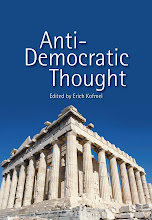
"Anti-Democratic Thought", ed. Erich Kofmel (Imprint Academic, 2008).
The full text of the paper can be read here:
http://books.google.com/books?printsec=frontcover&id=KkMdJtaaeOYC#PPA141,M1
From January 2007 through early 2009, Bangladesh stood under military rule after "the norms of democracy had decayed so much that the Bangladesh Nationalist Party (BNP), the centre-right party that was in power, began openly to change electoral rules and institutions in order to engineer the coming national elections in its favour". The elections were held only in 2009. "The state of emergency that gagged independent political voices and action was accompanied by statements of emergency, essentially anti-democratic narratives marketed deliberately to discredit democracy as a political system in the context of Bangladesh. These narratives emanated from a variety of sources that sprung up to take advantage of the political void. These sources included the military patrons and their clients, regime collaborators or 'reformists' within political parties, and sections of the urban civil society."
Subscribe to:
Posts (Atom)

 Posts

