
Abraham Diskin, Hanna Diskin, and Reuven Y. Hazan, "Why Democracies Collapse: The Reasons for Democratic Failure and Success" ("International Political Science Review", 26 [3], July 2005: pp. 291-309):
http://ips.sagepub.com/content/26/3/291
Abstract: "Most studies of democratic stability are based within either the socioeconomic or the politico-institutional tradition, but usually not on both. This article combines the two approaches. In all, 11 variables associated with democratic stability are divided into four groups (institutional, societal, mediating, and extraneous) and examined in 30 cases of democratic collapse and 32 cases of stable democracies. Five variables prove to be the most influential on the fate of democracies. When a country scores negatively on four of these five variables it is almost doomed to collapse. Some of the variables prove to be correlated in an opposite way to that which has been suggested in the literature."
Unfortunately, I could not access the full text of the article.
Abraham Diskin is Professor and Reuven Y. Hazan is Associate Professor, both in the Department of Political Science at the Hebrew University of Jerusalem. Hanna Diskin, the Director General of Maggie Publishers, Jerusalem, also lectures in that department.
Showing posts with label collapse of democracy. Show all posts
Showing posts with label collapse of democracy. Show all posts
19 September 2010

29 June 2010
CFP: Breakdowns of Democracy Revisited
12th Mediterranean Research Meeting of the Robert Schuman Centre for Advanced Studies, European University Institute (EUI), Florence and Montecatini Terme, Italy, 6-9 April 2011
Call for papers for Workshop 7: "Breakdowns of Democracy Revisited: Transitions from Liberal-Democratic to Authoritarian Regimes around the Mediterranean Littoral"
www.eui.eu/DepartmentsAndCentres/RobertSchumanCentre/Research/InternationalTransnationalRelations/MediterraneanProgramme/MRM/MRM2011/Index.aspx
From the workshop description: "Studies of democratization have matured greatly over the last two decades [...]. Nevertheless, early expectations that new democracies would survive and flourish have run up against significant cases in which political reform has quickly stalled out or regressed to liberalized authoritarian rule. This development has opened the door to systematic investigations of the circumstances under which initial liberalization programs have failed to gain momentum, most notably in Tunisia and Jordan. Such studies raise the crucial question of whether democratization can be assumed to move in only one direction. History suggests that liberal democracies on occasion collapse and get replaced by highly illiberal regimes. Classic cases of democratic breakdown include Italy in the early 1920s and Germany a decade later.
"Less fully investigated are parallel instances of democratic collapse in Spain, Greece and Turkey. Completely ignored are countries whose brief liberal-democratic eras have been overlooked by political scientists and historians. A number of important examples of the transition away from liberal democracy can be found in the MENA [Middle East and North Africa region]. Among these stand Egypt, Syria, Iraq and perhaps even Libya, not to mention the aborted transition to illiberal governance in Lebanon of the late 1950s. Focused comparisons between well-studied episodes of the breakdown of liberal political orders along the northern shores of the Mediterranean and largely overlooked instances to the south and east are certain to enhance our understanding of the causal factors and processes that lead democracies to be supplanted by authoritarian regimes.
"Scholarship on the topic has lain virtually dormant since the late 1970s. [...] This workshop proposes not only to bring a wide range of additional, long-overlooked cases into the literature on democratic collapse but also to begin the crucial task of formulating well-structured comparisons across different empirical examples. Contributions which focus on countries that have so far been ignored in the academic literature, particularly ones situated in the MENA region, will be expected to make reference to analyses of better-studied examples. Given the peculiarities of the German model, the organizers anticipate that the experience of Italy during the first two decades of the twentieth century is likely to prove particularly thought-provoking, and would therefore welcome proposals from specialists in Italian history and politics. Contributions intended primarily to advance the theory of liberal-democratic breakdown are certainly encouraged, but will be expected to rest on a firm empirical foundation.
"Liberal experiments in the MENA during the 1920s and 1930s are routinely dismissed as too imperfect to be included in discussions of the structure, workings and transformation of democratic governance. The workshop organizers firmly reject such dismissiveness toward the variety of party-based, electoral systems that one finds throughout the Arab world in the decades before the wave of military-led revolutions washed across the region. Instead, they hope that detailed explorations of the liberal-democratic moment in the MENA, unbiased by what E.P. Thompson might call 'the enormous condescension of posterity,' will offer new insight into the dynamics of politics in this part of the world, while at the same time reinvigoring conceptual debates about the dynamics of democratization on the basis of evidence drawn from all shores of the Mediterranean."
Please find detailed instructions on how to submit a paper proposal for this workshop on the conference website (see particularly full call for papers and online form). The procedures and requirements are uncommonly stringent.
Deadline: 15 July 2010
Only for workshop-related questions, contact directly the workshop directors, Fred Lawson (Mills College, California): lawson@mills.edu
and Abdelwahab Shaker (Bibliotheca Alexandrina, Egypt): abdelwahab.shaker@bibalex.org
Call for papers for Workshop 7: "Breakdowns of Democracy Revisited: Transitions from Liberal-Democratic to Authoritarian Regimes around the Mediterranean Littoral"
www.eui.eu/DepartmentsAndCentres/RobertSchumanCentre/Research/InternationalTransnationalRelations/MediterraneanProgramme/MRM/MRM2011/Index.aspx
From the workshop description: "Studies of democratization have matured greatly over the last two decades [...]. Nevertheless, early expectations that new democracies would survive and flourish have run up against significant cases in which political reform has quickly stalled out or regressed to liberalized authoritarian rule. This development has opened the door to systematic investigations of the circumstances under which initial liberalization programs have failed to gain momentum, most notably in Tunisia and Jordan. Such studies raise the crucial question of whether democratization can be assumed to move in only one direction. History suggests that liberal democracies on occasion collapse and get replaced by highly illiberal regimes. Classic cases of democratic breakdown include Italy in the early 1920s and Germany a decade later.
"Less fully investigated are parallel instances of democratic collapse in Spain, Greece and Turkey. Completely ignored are countries whose brief liberal-democratic eras have been overlooked by political scientists and historians. A number of important examples of the transition away from liberal democracy can be found in the MENA [Middle East and North Africa region]. Among these stand Egypt, Syria, Iraq and perhaps even Libya, not to mention the aborted transition to illiberal governance in Lebanon of the late 1950s. Focused comparisons between well-studied episodes of the breakdown of liberal political orders along the northern shores of the Mediterranean and largely overlooked instances to the south and east are certain to enhance our understanding of the causal factors and processes that lead democracies to be supplanted by authoritarian regimes.
"Scholarship on the topic has lain virtually dormant since the late 1970s. [...] This workshop proposes not only to bring a wide range of additional, long-overlooked cases into the literature on democratic collapse but also to begin the crucial task of formulating well-structured comparisons across different empirical examples. Contributions which focus on countries that have so far been ignored in the academic literature, particularly ones situated in the MENA region, will be expected to make reference to analyses of better-studied examples. Given the peculiarities of the German model, the organizers anticipate that the experience of Italy during the first two decades of the twentieth century is likely to prove particularly thought-provoking, and would therefore welcome proposals from specialists in Italian history and politics. Contributions intended primarily to advance the theory of liberal-democratic breakdown are certainly encouraged, but will be expected to rest on a firm empirical foundation.
"Liberal experiments in the MENA during the 1920s and 1930s are routinely dismissed as too imperfect to be included in discussions of the structure, workings and transformation of democratic governance. The workshop organizers firmly reject such dismissiveness toward the variety of party-based, electoral systems that one finds throughout the Arab world in the decades before the wave of military-led revolutions washed across the region. Instead, they hope that detailed explorations of the liberal-democratic moment in the MENA, unbiased by what E.P. Thompson might call 'the enormous condescension of posterity,' will offer new insight into the dynamics of politics in this part of the world, while at the same time reinvigoring conceptual debates about the dynamics of democratization on the basis of evidence drawn from all shores of the Mediterranean."
Please find detailed instructions on how to submit a paper proposal for this workshop on the conference website (see particularly full call for papers and online form). The procedures and requirements are uncommonly stringent.
Deadline: 15 July 2010
Only for workshop-related questions, contact directly the workshop directors, Fred Lawson (Mills College, California): lawson@mills.edu
and Abdelwahab Shaker (Bibliotheca Alexandrina, Egypt): abdelwahab.shaker@bibalex.org
15 June 2010
Article: "Democracy could disappear" in Greece, Spain, and Portugal, warns Barroso
The UK newspaper "Daily Mail" yesterday published an article online, by its political correspondent Jason Groves, titled "Nightmare vision for Europe as EU chief warns 'democracy could disappear' in Greece, Spain and Portugal".
The full text of the article can be read free of charge here:
www.dailymail.co.uk/news/worldnews/article-1286480/EU-chief-warns-democracy-disappear-Greece-Spain-Portugal.html
Excerpts: "Democracy could 'collapse' in Greece, Spain and Portugal unless urgent action is taken to tackle the debt crisis, the head of the European Commission has warned. In an extraordinary briefing to trade union chiefs last week, Commission President Jos[é] Manuel Barroso set out an 'apocalyptic' vision in which crisis-hit countries in southern Europe could fall victim to military coups or popular uprisings as interest rates soar and public services collapse because their governments run out of money. [...] John Monks, former head of the TUC [UK Trades Union Congress], said he had been 'shocked' by the severity of the warning from Mr Barroso, who is a former prime minister of Portugal. Mr Monks, now head of the European TUC, said: '[...] [H]is message was blunt: "Look, if they do not carry out these austerity packages, these countries could virtually disappear in the way that we know them as democracies. They've got no choice, this is it." [...]'
"Greece, Spain and Portugal, which only became democracies in the 1970s, are all facing dire problems with their public finances. All three countries have a history of military coups. [...] Mr Barroso's warning lays bare the concern at the highest level in Brussels that the economic crisis could lead to the collapse of not only the beleaguered euro, but the EU itself, along with a string of fragile democracies. [...] Mr Monks yesterday warned that the new austerity measures themselves could take the continent 'back to the 1930s'. In an interview with the Brussels-based magazine EU Observer he said: 'This is extremely dangerous. This is 1931, we're heading back to the 1930s, with the Great Depression and we ended up with militarist dictatorship. I'm not saying we're there yet, but it's potentially very serious, not just economically, but politically as well.'"
I can't figure out whether the article appeared in print today.
The full text of the article can be read free of charge here:
www.dailymail.co.uk/news/worldnews/article-1286480/EU-chief-warns-democracy-disappear-Greece-Spain-Portugal.html
Excerpts: "Democracy could 'collapse' in Greece, Spain and Portugal unless urgent action is taken to tackle the debt crisis, the head of the European Commission has warned. In an extraordinary briefing to trade union chiefs last week, Commission President Jos[é] Manuel Barroso set out an 'apocalyptic' vision in which crisis-hit countries in southern Europe could fall victim to military coups or popular uprisings as interest rates soar and public services collapse because their governments run out of money. [...] John Monks, former head of the TUC [UK Trades Union Congress], said he had been 'shocked' by the severity of the warning from Mr Barroso, who is a former prime minister of Portugal. Mr Monks, now head of the European TUC, said: '[...] [H]is message was blunt: "Look, if they do not carry out these austerity packages, these countries could virtually disappear in the way that we know them as democracies. They've got no choice, this is it." [...]'
"Greece, Spain and Portugal, which only became democracies in the 1970s, are all facing dire problems with their public finances. All three countries have a history of military coups. [...] Mr Barroso's warning lays bare the concern at the highest level in Brussels that the economic crisis could lead to the collapse of not only the beleaguered euro, but the EU itself, along with a string of fragile democracies. [...] Mr Monks yesterday warned that the new austerity measures themselves could take the continent 'back to the 1930s'. In an interview with the Brussels-based magazine EU Observer he said: 'This is extremely dangerous. This is 1931, we're heading back to the 1930s, with the Great Depression and we ended up with militarist dictatorship. I'm not saying we're there yet, but it's potentially very serious, not just economically, but politically as well.'"
I can't figure out whether the article appeared in print today.
11 May 2010
Article: The Mechanics of Regime Instability in Latin America
Adam Przeworski, "The Mechanics of Regime Instability in Latin America" ("Journal of Politics in Latin America", 1 [1], 2009: pp. 5-36).
The full text of the article can be read free of charge here:
http://hup.sub.uni-hamburg.de/giga/jpla/article/viewFile/20/20
Abstract: "The paper is narrowly addressed to a single puzzle: How did it happen that countries that attempted to install democracy earlier enjoyed it less frequently? Regime dynamics are driven by two mechanisms: (1) Democracies become more durable as per capita income increases, and (2) Past experiences with democracy destabilize both democracies and autocracies. As a result, countries that experiment with democracy at lower income levels experience more regime instability. Moreover, until they reach some income threshold, at any time such countries are less likely to be democratic than countries that first enter democracy when they have higher incomes. Hence, paradoxically, the resistance of European monarchies against democracy resulted in democracies that were more stable than those following post-independence attempts in Latin America."
Excerpts: "Now, the claim that Latin American countries tried democracy earlier and, most importantly, at lower levels of economic development than Europe and North America is not original, even if it often evokes surprise among ethnocentric North American and Europeans. [...] To some extent, this timing is due to the fact that several parts of Latin America participated in the 1809 election to the Cortes of Cádiz, thus launching the idea of representative institutions at the time when many European countries were involved in the Napoleonic wars and elections were still rare. But a more general reason was that Latin American wars of independence were at the same time directed against monarchical rule, while most European countries experienced a gradual devolution of power from monarchs to parliaments. [...]
"Latin Americans had to constitute their institutions anew. And they were traversing a terra incognita. Monarchies, republics with predominantly hereditary collective governing bodies, and one republic with an elected legislature and an indirectly elected president were the choices known when first Haiti in 1804 and then Venezuela in 1811 proclaimed independence. In several new countries the first form of the government was a collective body that exercised both the legislative and the executive function. Triumvirates governed Argentina from 1811 to 1814 and Venezuela in 1811-12. [...] In the end institutions based on the United States pattern prevailed – in time all Latin American political systems would have elected legislatures while placing executive function in the hands of presidents – but this alternative became complicated from the onset by Bolívar's itch to keep the position for life. [...]
"The most creative was Dr. José Gaspár Rodriguez de Francia who, having become one of two consuls who were to alternate every four months in 1813, then a dictator appointed for three years, in 1816 proclaimed himself El Dictador Perpetuo of Paraguay and ruled it until 1840 as El Supremo. While this story may sound anecdotal, Francia's innovation was both radical and durable, deserving to be placed on par with Lenin's invention of the one-party state. It was radical since the only model of dictatorship known at the time was the Roman one, and in this model dictatorship was a power that was delegated, exceptional, and limited in duration. 'Perpetual Dictator' was an oxymoron. Moreover, the last attempt to make dictatorship permanent, almost twenty centuries earlier, did not bode well for Dr. Francia's fate. Yet this invention turned out to be durable: Francia set the precedent for such illustrious gentlemen as Mussolini, Hitler, Franco, Kim Il-sung, al-Gaddafi, or Castro. [...]
"Now, how is it possible that Latin American countries attempted to institute democracies at lower income levels but ended up with fewer of them at all levels? [...] [A]t a low income [...] level, the probability of democracy falling is quite high. Suppose this democracy falls. The probability that the subsequent autocracy survives is then lower, so that the probability that this country will try democracy again is higher, but the probability that the second democracy survives is also lower. This sequence can be repeated several times, so that if per capita income were constant, both regimes would become increasingly unstable. But income matters: if the economy grows in the meantime, the probability that a democracy dies declines in spite of the past regime instability. And at one time, income passes a threshold above which democracy is impregnable [...].
"Note that the reasons autocratic spells become shorter and democratic spells longer at higher incomes are different. Autocratic spells are shorter almost exclusively because countries that have higher incomes have accumulated more visits to democracy, and such visits destabilize the subsequent autocracies. Democratic spells are longer, however, only because democracy lasts longer at higher income levels. Although past visits to democracy do destabilize subsequent democratic regimes, this effect is small, while the effect of income is powerful."
Polish-born Adam Przeworski is Carroll and Milton Petrie Professor of Politics and (by courtesy) of Economics at New York University.
The full text of the article can be read free of charge here:
http://hup.sub.uni-hamburg.de/giga/jpla/article/viewFile/20/20
Abstract: "The paper is narrowly addressed to a single puzzle: How did it happen that countries that attempted to install democracy earlier enjoyed it less frequently? Regime dynamics are driven by two mechanisms: (1) Democracies become more durable as per capita income increases, and (2) Past experiences with democracy destabilize both democracies and autocracies. As a result, countries that experiment with democracy at lower income levels experience more regime instability. Moreover, until they reach some income threshold, at any time such countries are less likely to be democratic than countries that first enter democracy when they have higher incomes. Hence, paradoxically, the resistance of European monarchies against democracy resulted in democracies that were more stable than those following post-independence attempts in Latin America."
Excerpts: "Now, the claim that Latin American countries tried democracy earlier and, most importantly, at lower levels of economic development than Europe and North America is not original, even if it often evokes surprise among ethnocentric North American and Europeans. [...] To some extent, this timing is due to the fact that several parts of Latin America participated in the 1809 election to the Cortes of Cádiz, thus launching the idea of representative institutions at the time when many European countries were involved in the Napoleonic wars and elections were still rare. But a more general reason was that Latin American wars of independence were at the same time directed against monarchical rule, while most European countries experienced a gradual devolution of power from monarchs to parliaments. [...]
"Latin Americans had to constitute their institutions anew. And they were traversing a terra incognita. Monarchies, republics with predominantly hereditary collective governing bodies, and one republic with an elected legislature and an indirectly elected president were the choices known when first Haiti in 1804 and then Venezuela in 1811 proclaimed independence. In several new countries the first form of the government was a collective body that exercised both the legislative and the executive function. Triumvirates governed Argentina from 1811 to 1814 and Venezuela in 1811-12. [...] In the end institutions based on the United States pattern prevailed – in time all Latin American political systems would have elected legislatures while placing executive function in the hands of presidents – but this alternative became complicated from the onset by Bolívar's itch to keep the position for life. [...]
"The most creative was Dr. José Gaspár Rodriguez de Francia who, having become one of two consuls who were to alternate every four months in 1813, then a dictator appointed for three years, in 1816 proclaimed himself El Dictador Perpetuo of Paraguay and ruled it until 1840 as El Supremo. While this story may sound anecdotal, Francia's innovation was both radical and durable, deserving to be placed on par with Lenin's invention of the one-party state. It was radical since the only model of dictatorship known at the time was the Roman one, and in this model dictatorship was a power that was delegated, exceptional, and limited in duration. 'Perpetual Dictator' was an oxymoron. Moreover, the last attempt to make dictatorship permanent, almost twenty centuries earlier, did not bode well for Dr. Francia's fate. Yet this invention turned out to be durable: Francia set the precedent for such illustrious gentlemen as Mussolini, Hitler, Franco, Kim Il-sung, al-Gaddafi, or Castro. [...]
"Now, how is it possible that Latin American countries attempted to institute democracies at lower income levels but ended up with fewer of them at all levels? [...] [A]t a low income [...] level, the probability of democracy falling is quite high. Suppose this democracy falls. The probability that the subsequent autocracy survives is then lower, so that the probability that this country will try democracy again is higher, but the probability that the second democracy survives is also lower. This sequence can be repeated several times, so that if per capita income were constant, both regimes would become increasingly unstable. But income matters: if the economy grows in the meantime, the probability that a democracy dies declines in spite of the past regime instability. And at one time, income passes a threshold above which democracy is impregnable [...].
"Note that the reasons autocratic spells become shorter and democratic spells longer at higher incomes are different. Autocratic spells are shorter almost exclusively because countries that have higher incomes have accumulated more visits to democracy, and such visits destabilize the subsequent autocracies. Democratic spells are longer, however, only because democracy lasts longer at higher income levels. Although past visits to democracy do destabilize subsequent democratic regimes, this effect is small, while the effect of income is powerful."
Polish-born Adam Przeworski is Carroll and Milton Petrie Professor of Politics and (by courtesy) of Economics at New York University.
19 April 2010
Article: Democracy Is Dead
Commenting on the recent parliamentary elections in the country, Sri Lanka's "The Sunday Leader" newspaper on 11 April 2010 published an unsigned editorial titled "Democracy Is Dead".
The article can be read free of charge here:
www.thesundayleader.lk/2010/04/11/democracy-is-dead/
Excerpts: "It is time to go into mourning. An old and ailing relative – democracy [–], has died an inevitable death. Dead at barely 60 years old though the abuse it suffered during its short life span made it appear much older. Like the aunt who lingers on long after most of the family believe she is already dead, this week's death was a quiet one, it was long expected, some would say even overdue. There was no shock, no sudden loss. Democracy in this country wasn't overthrown by a dictator, nor shattered suddenly by the chaos of war and revolution. Instead it died a painful, slow death. Strangled by corruption, stifled by authoritarianism and finally snuffed out by the disinterest and apathy of the general public. And while it somehow lingered on despite being savaged by decades of war, riots, and attempted revolutions, this week we finally saw democracy die in the hearts and minds of voters.
"The turn out for the 2010 general election stands as the lowest in history [...]. While some will criticise the voters' apathy, in reality you can only marvel at the patience of a people who voted regularly for six decades. At the devotion of a population who after years of false promises and disappointment continued to vote until finally a lack of credible candidates, tangible issues and the impossibility of effecting real change finally destroyed their interest in democracy. Of course the truth is and always has been that regardless of the final results of this election, thugs, cronies and criminals will continue to rule this country. [...] Seeing the ugliness of the government, the impotence of the opposition and the hypocrisy of the institutions – police, courts, charged with safeguarding democracy [–] the people were inevitably disgusted. And at a crucial moment in the country's history they chose to hide their faces from this mockery of the democratic process. They looked away from the hideous posters, meaningless slogans and the futile opposition and refused to make the effort to vote.
"Figures indicate that the UPFA will receive nearly two-thirds of the votes cast. And with this majority comes nothing less than absolute power. The ability to amend the constitution, the very basis of the nation's law. The checks and balances that are the key to democracy have disappeared. [...] Democracy in Sri Lanka is beyond revival. And in its place we now have just one party or more accurately, one family. And the country's citizens have just one choice, either demonstrate their loyalty, obedience and gratitude to the ruling family or risk detention, death or worse the utter irrelevance of powerlessness. [...] This is no longer a criticism or a warning, it is simply reality. One chapter of the country's history is now closed – the flickering light of democracy has gone out. The ailing opposition [...] will never be able to restore the people's right to democracy. Instead if it is ever to return, democracy in this country will have to be reborn. Instead of being imposed by colonial masters it will have to take hold again in the hearts and minds of the people."
The article can be read free of charge here:
www.thesundayleader.lk/2010/04/11/democracy-is-dead/
Excerpts: "It is time to go into mourning. An old and ailing relative – democracy [–], has died an inevitable death. Dead at barely 60 years old though the abuse it suffered during its short life span made it appear much older. Like the aunt who lingers on long after most of the family believe she is already dead, this week's death was a quiet one, it was long expected, some would say even overdue. There was no shock, no sudden loss. Democracy in this country wasn't overthrown by a dictator, nor shattered suddenly by the chaos of war and revolution. Instead it died a painful, slow death. Strangled by corruption, stifled by authoritarianism and finally snuffed out by the disinterest and apathy of the general public. And while it somehow lingered on despite being savaged by decades of war, riots, and attempted revolutions, this week we finally saw democracy die in the hearts and minds of voters.
"The turn out for the 2010 general election stands as the lowest in history [...]. While some will criticise the voters' apathy, in reality you can only marvel at the patience of a people who voted regularly for six decades. At the devotion of a population who after years of false promises and disappointment continued to vote until finally a lack of credible candidates, tangible issues and the impossibility of effecting real change finally destroyed their interest in democracy. Of course the truth is and always has been that regardless of the final results of this election, thugs, cronies and criminals will continue to rule this country. [...] Seeing the ugliness of the government, the impotence of the opposition and the hypocrisy of the institutions – police, courts, charged with safeguarding democracy [–] the people were inevitably disgusted. And at a crucial moment in the country's history they chose to hide their faces from this mockery of the democratic process. They looked away from the hideous posters, meaningless slogans and the futile opposition and refused to make the effort to vote.
"Figures indicate that the UPFA will receive nearly two-thirds of the votes cast. And with this majority comes nothing less than absolute power. The ability to amend the constitution, the very basis of the nation's law. The checks and balances that are the key to democracy have disappeared. [...] Democracy in Sri Lanka is beyond revival. And in its place we now have just one party or more accurately, one family. And the country's citizens have just one choice, either demonstrate their loyalty, obedience and gratitude to the ruling family or risk detention, death or worse the utter irrelevance of powerlessness. [...] This is no longer a criticism or a warning, it is simply reality. One chapter of the country's history is now closed – the flickering light of democracy has gone out. The ailing opposition [...] will never be able to restore the people's right to democracy. Instead if it is ever to return, democracy in this country will have to be reborn. Instead of being imposed by colonial masters it will have to take hold again in the hearts and minds of the people."
10 April 2010
Book: Democracy Denied, 1905-1915: Intellectuals and the Fate of Democracy
Charles Kurzman, "Democracy Denied, 1905-1915: Intellectuals and the Fate of Democracy" (Harvard University Press, December 2008):
www.hup.harvard.edu/catalog/KURDEM.html
Publisher's description: "In the decade before World War I, a wave of democratic revolutions swept the globe, consuming more than a quarter of the world's population. Revolution transformed Russia, Iran, the Ottoman Empire, Portugal, Mexico, and China. In each case, a
pro-democracy movement unseated a long-standing autocracy with startling speed. The nascent democratic regime held elections, convened parliament, and allowed freedom of the press and freedom of association. But the new governments failed in many instances to uphold the rights and freedoms that they proclaimed. Coups d'état soon undermined the democratic experiments. How do we account for these unexpected democracies, and for their rapid extinction?
"In Democracy Denied, Charles Kurzman proposes that the collective agent most directly responsible for democratization was the emerging class of modern intellectuals, a group that had gained a global identity and a near-messianic sense of mission following the Dreyfus Affair of 1898. Each chapter of Democracy Denied focuses on a single angle of this story, covering all six cases by examining newspaper accounts, memoirs, and government reports. This thoroughly interdisciplinary treatment of the early-twentieth-century upheavals promises to reshape debates about the social origins of democracy, the causes of democratic collapse, the political roles of intellectuals, and the international flow of ideas."
Reviews: "The intellectuals of 1905-1915 were, Kurzman amply shows, deluded about their peoples' readiness for democracy. They were ahead of their time, a misfortune not just their own, but their countries'." (Adam Kirsch, "City Journal")
"This book is a major contribution to the study of democracy in the modern world. While it deals with developments at the beginning of the twentieth century, it will be important for understanding democratization at the beginning of the twenty-first century as well." (John Voll, Georgetown University)
The book is fully searchable on Google Book Search (including table of contents):
http://books.google.com/books?id=HQhsG9v0umsC&printsec=frontcover
Charles Kurzman is Professor of Sociology at the University of North Carolina at Chapel-Hill.
www.hup.harvard.edu/catalog/KURDEM.html
Publisher's description: "In the decade before World War I, a wave of democratic revolutions swept the globe, consuming more than a quarter of the world's population. Revolution transformed Russia, Iran, the Ottoman Empire, Portugal, Mexico, and China. In each case, a
pro-democracy movement unseated a long-standing autocracy with startling speed. The nascent democratic regime held elections, convened parliament, and allowed freedom of the press and freedom of association. But the new governments failed in many instances to uphold the rights and freedoms that they proclaimed. Coups d'état soon undermined the democratic experiments. How do we account for these unexpected democracies, and for their rapid extinction?
"In Democracy Denied, Charles Kurzman proposes that the collective agent most directly responsible for democratization was the emerging class of modern intellectuals, a group that had gained a global identity and a near-messianic sense of mission following the Dreyfus Affair of 1898. Each chapter of Democracy Denied focuses on a single angle of this story, covering all six cases by examining newspaper accounts, memoirs, and government reports. This thoroughly interdisciplinary treatment of the early-twentieth-century upheavals promises to reshape debates about the social origins of democracy, the causes of democratic collapse, the political roles of intellectuals, and the international flow of ideas."
Reviews: "The intellectuals of 1905-1915 were, Kurzman amply shows, deluded about their peoples' readiness for democracy. They were ahead of their time, a misfortune not just their own, but their countries'." (Adam Kirsch, "City Journal")
"This book is a major contribution to the study of democracy in the modern world. While it deals with developments at the beginning of the twentieth century, it will be important for understanding democratization at the beginning of the twenty-first century as well." (John Voll, Georgetown University)
The book is fully searchable on Google Book Search (including table of contents):
http://books.google.com/books?id=HQhsG9v0umsC&printsec=frontcover
Charles Kurzman is Professor of Sociology at the University of North Carolina at Chapel-Hill.
27 February 2010
Book: The Failure of Democracy in the Republic of Congo
John F. Clark, "The Failure of Democracy in the Republic of Congo" (Lynne Rienner, 2008):
www.rienner.com/title/The_Failure_of_Democracy_in_the_Republic_of_Congo
Publisher's description: "Why did the democratic experiment launched in the Republic of Congo in 1991 fail so dramatically in 1997? Why has it not been seriously resumed since then? In tackling these complex questions, John Clark provides a thorough analysis of more than fifteen years of Congolese politics. Clark explores a series of logical hypotheses regarding why democracy failed to take root in Congo, moving from political culture to economic performance, ethnoregional identities, French foreign policy, the role of militias, and institutional design. He also discusses the country's present 'electoral authoritarian' regime. His conclusions shed light not only on the nature of Congolese politics, but also on the utility of the scientific approach to understanding the social world."
Reviews: "Clark has provided us with a sure-footed account of Congolese politics, a carefully considered discussion of the most important factors determining the failure of Congolese democratization efforts, a perceptive critique of the ways that the complexities of such processes elude current scholarship on democratization, and a useful guidepost to promising directions of future research." (Nelson Kasfir, "Perspectives on Politics")
"Clark provides one of the most detailed and theoretically informed accounts of recent Congolese politics of any that can be found. He also brings a welcome new realism to the study of democracy." (William S. Reno, Northwestern University)
"This valuable study not only chronicles one of the most interesting examples of 'democratic failure' in Africa, but also provides insight into the politics of one of the less well known, but strategically important, African states." (Victor T. Le Vine, Washington University in St. Louis)
John F. Clark is Professor in the Department of Politics and International Relations at Florida International University.
www.rienner.com/title/The_Failure_of_Democracy_in_the_Republic_of_Congo
Publisher's description: "Why did the democratic experiment launched in the Republic of Congo in 1991 fail so dramatically in 1997? Why has it not been seriously resumed since then? In tackling these complex questions, John Clark provides a thorough analysis of more than fifteen years of Congolese politics. Clark explores a series of logical hypotheses regarding why democracy failed to take root in Congo, moving from political culture to economic performance, ethnoregional identities, French foreign policy, the role of militias, and institutional design. He also discusses the country's present 'electoral authoritarian' regime. His conclusions shed light not only on the nature of Congolese politics, but also on the utility of the scientific approach to understanding the social world."
Reviews: "Clark has provided us with a sure-footed account of Congolese politics, a carefully considered discussion of the most important factors determining the failure of Congolese democratization efforts, a perceptive critique of the ways that the complexities of such processes elude current scholarship on democratization, and a useful guidepost to promising directions of future research." (Nelson Kasfir, "Perspectives on Politics")
"Clark provides one of the most detailed and theoretically informed accounts of recent Congolese politics of any that can be found. He also brings a welcome new realism to the study of democracy." (William S. Reno, Northwestern University)
"This valuable study not only chronicles one of the most interesting examples of 'democratic failure' in Africa, but also provides insight into the politics of one of the less well known, but strategically important, African states." (Victor T. Le Vine, Washington University in St. Louis)
John F. Clark is Professor in the Department of Politics and International Relations at Florida International University.
13 February 2010
Article: Is the Age of Democracy Over?
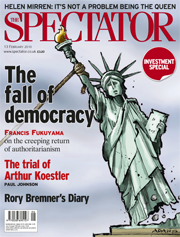 The cover of this week's edition of the major conservative UK magazine "The Spectator" announces in big black letters: "The fall of democracy".
Inside, the magazine carries an article by Francis Fukuyama titled "Is the age of democracy over?"
The article can be read free of charge here:
www.spectator.co.uk/spectator/thisweek/5766228/is-the-age-of-democracy-over.thtml
Lead: "Twenty years ago, Francis Fukuyama forecast the final triumph of liberal democracy and the 'end of history'. As pro-democracy movements falter from Ukraine to China, he revisits his thesis – and asks if history has a few more surprises to spring."
Excerpts: "Over the last decade we have seen the collapse or discrediting of not just the 'Orange' movement, but many of the other so-called 'rainbow revolutions' across eastern Europe: the 'Rose' revolution in Georgia, the 'Cedar' revolution in Lebanon [sic]. Then there's Vladimir Putin's transformation of Russia into an 'electoral authoritarian' state, the undermining of democratic institutions by Hugo Chavez in Venezuela, and the rise of China as a successful authoritarian moderniser. [...]
"Americans let the collapse of communism go to their heads. [...] They saw the events of 1989 as a triumph, not just for the cause of liberty but of loosely regulated markets at home and muscular self-assertion abroad, unconstrained by international institutions. [...] As the hegemonic power for much of the 1990s and 2000s, the United States was bound to incur a lot of resentment from countries and people who felt they had no way of holding the US accountable for what it did to them economically. [...] So the United State [sic] itself became an obstacle to the spread of its own ideals. [...]
"[D]emocracy remains, in Amartya Sen's words, the 'default' political condition: [...] today's would-be authoritarians all have to stage elections and manipulate the media from behind the scenes to legitimate themselves."
This shoddy little article is summed up nicely in a comment left by a reader: "I was immediately drawn to the interesting-sounding header of this piece. Then amazed at how it could be followed by such a boring, point-missing and turgid article!"
Francis Fukuyama is Bernard L. Schwartz Professor of International Political Economy and Director of the International Development Program at Johns Hopkins University.
18 January 2010
Book: The Citizenry and the Collapse of Democracy
Currently on sale with a 34% discount (US and Canada only): Nancy Bermeo, "Ordinary People in Extraordinary Times: The Citizenry and the Collapse of Democracy" (Princeton University Press, 2003):
http://press.princeton.edu/titles/7663.html
Publisher's description: "For generations, influential thinkers – often citing the tragic polarization that took place during Germany's Great Depression – have suspected that people's loyalty to democratic institutions erodes under pressure and that citizens gravitate toward antidemocratic extremes in times of political and economic crisis. But do people really defect from democracy when times get tough? Do ordinary people play a leading role in the collapse of popular government?
"Based on extensive research, this book overturns the common wisdom. It shows that the German experience was exceptional, that people's affinity for particular political positions are surprisingly stable, and that what is often labeled polarization is the result not of vote switching but of such factors as expansion of the franchise, elite defections, and the mobilization of new voters. Democratic collapses are caused less by changes in popular preferences than by the actions of political elites who polarize themselves and mistake the actions of a few for the preferences of the many. These conclusions are drawn from the study of twenty cases, including every democracy that collapsed in the aftermath of the Russian Revolution in interwar Europe, every South American democracy that fell to the Right after the Cuban Revolution, and three democracies that avoided breakdown despite serious economic and political challenges.
"Unique in its historical and regional scope, this book offers unsettling but important lessons about civil society and regime change".
Nancy Bermeo is Nuffield Professor of Comparative Politics at Oxford and Professor of Politics at Princeton.
http://press.princeton.edu/titles/7663.html
Publisher's description: "For generations, influential thinkers – often citing the tragic polarization that took place during Germany's Great Depression – have suspected that people's loyalty to democratic institutions erodes under pressure and that citizens gravitate toward antidemocratic extremes in times of political and economic crisis. But do people really defect from democracy when times get tough? Do ordinary people play a leading role in the collapse of popular government?
"Based on extensive research, this book overturns the common wisdom. It shows that the German experience was exceptional, that people's affinity for particular political positions are surprisingly stable, and that what is often labeled polarization is the result not of vote switching but of such factors as expansion of the franchise, elite defections, and the mobilization of new voters. Democratic collapses are caused less by changes in popular preferences than by the actions of political elites who polarize themselves and mistake the actions of a few for the preferences of the many. These conclusions are drawn from the study of twenty cases, including every democracy that collapsed in the aftermath of the Russian Revolution in interwar Europe, every South American democracy that fell to the Right after the Cuban Revolution, and three democracies that avoided breakdown despite serious economic and political challenges.
"Unique in its historical and regional scope, this book offers unsettling but important lessons about civil society and regime change".
Nancy Bermeo is Nuffield Professor of Comparative Politics at Oxford and Professor of Politics at Princeton.
Subscribe to:
Posts (Atom)

 Posts
Posts

