
Please circulate widely!
CALL FOR PAPERS
Anti-Democracy Agenda Symposium 2011
Organized by: Sussex Centre for the Individual and Society (SCIS)
Mode: Online by Google+ video conference
Date: 15-16 November 2011
The "Anti-Democracy Agenda" is the premier resource on the net for the study of anti-democratic thought and practice across the boundaries of various traditions and academic disciplines. First introduced by the Sussex Centre for the Individual and Society (SCIS) as a blog in January 2010, it has since been reconstituted as a circle (with associated public posts, much like a blog) on the new social network Google+. An archive of the blog is to be found here: http://anti-democracy-agenda.blogspot.com
For the new circle, see here:
https://plus.google.com/109507108125539761871/posts
The Anti-Democracy Agenda Symposium 2011 will be the third event we organize to advance the research agenda on anti-democratic thought and practice as well as old and new criticisms of democracy. It will build up on a highly successful workshop on anti-democratic thought SCIS organized at the Annual Conference Workshops in Political Theory in Manchester, England, in September 2007, as well as the Anti-Democracy Agenda Symposium 2010, taking place at the Swiss Federal Institute of Technology (ETH) Zurich in November last year. Both events drew participants from the world over. The Manchester workshop led to the publication of an edited volume on "Anti-Democratic Thought" (Imprint Academic, 2008).
The Anti-Democracy Agenda Symposium 2011 is set to be equally international and interdisciplinary in scope. We invite affiliated academics, independent scholars, and doctoral students and candidates from a wide range of disciplines, such as Philosophy, Political Theory, Political Science, International Relations, Development Studies, Security Studies, Law, Economics, Sociology, Anthropology, Psychology, Literature, History, Classics, Theology, Religious Studies, Education, and so on. Papers may not only cover any and all aspects of criticisms of democracy and anti-democratic thought and practice, from perspectives including anarchism, libertarianism, conservatism, communism, Islamism, the extreme right, and others, but also related concepts such as authoritarianism, dictatorship, military rule, monarchy, chieftaincy, mixed constitution, the backlash against democracy promotion, terrorism, post-democracy, voter apathy, voter ignorance, etc. Have a look at the blog to see what might be of interest and falls within our remit. Papers may be theoretical and/or empirical in nature. Work in progress is welcome too.
This symposium may be the first academic conference to make use of the “Hangouts” video conference facility that is an integral part of Google+. Due to technical restrictions, the number of participants in the Anti-Democracy Agenda Symposium 2011 is limited to 10. All accepted participants will be required to create a profile on Google+ in order to be able to participate in the event. While we encourage the participation of scholars from developing countries, please only apply if you have access to a stable Internet connection. As in our previous physical events, over the course of two days, each presenter will have 60 minutes to present his or her paper and discuss it with all others. Due to the small size of the symposium, all participants are expected to attend both days fully.
As with all SCIS events, no fees will be charged from participants, and no funding is available to cover participants' expenses (if any). We will be glad to issue letters of acceptance on request to assist participants in securing leave from work. Detailed instructions on how to set up a Google+ profile and join the video conference will be provided to confirmed participants.
Please send your proposal to: erichkofmel@gmail.com
Deadline: 15 October 2011
Later submissions may still be accepted, but early submission is strongly advised and proposals may be accepted as they come in.
Cordially,
Erich Kofmel
Managing Director / Research Professor of Political Theory
Sussex Centre for the Individual and Society (SCIS)
https://plus.google.com/109507108125539761871
E-mail: erichkofmel@gmail.com
Postal address:
Sussex Centre for the Individual and Society
1200 Geneva
Switzerland
SCIS is an international association under Swiss law.
Founded 2006 at the University of Sussex.
Showing posts with label political theory. Show all posts
Showing posts with label political theory. Show all posts
16 August 2011

17 February 2011
CFP: Democracy and its Critics: Ancient and Modern
One-day conference "Democracy and its Critics: Ancient and Modern" of the Political Thought Specialist Group of the Political Studies Association (PSA), Oxford, UK (precise venue to be confirmed), October 2011 (possible date: 22 October)
Call for papers
Description: "Most of the countries of the world are now democracies in that they have representative governmental institutions controlled by freely elected officials which operate under the rule of law and guarantee a wide array of individual rights, including equality and non-discrimination, personal liberty, freedom of expression, association and conscience, fair trials and a variety of social benefits. If a country's democratic system works tolerably well, the large majority of its citizens would not want to live under a very different political system, such as an absolute monarchy, communism, fascism, one-party dictatorship or anarchism, and this provides some indication of the relationship between citizenry and democracy. Nevertheless, in the past century or so democracies have had their critics and in some cases powerful enemies who have argued that democracy does not provide society the security, economic development, welfare and the other goods it 'really' needs.
"Some critics, for example, argue that modern liberal democracy is not a 'real' democracy as power is actually exercised not by the people, but by an oligarchy or a bureaucratic elite, and they compare this system unfavourably with the direct democracy of Athens and other Greek city-states in the 5th and 4th centuries BC where the body of citizens actually participated, on an equal footing, in making decisions on public issues. However, ancient democracy also had its critics, including great thinkers like Plato and Aristotle. Similar republican forms of government in ancient Rome also had their critics and enemies. The aim of the conference is to bring together and encourage discussion among scholars who are interested in the main features of ancient and modern forms of democracy, and seek to assess the purposes and methods of their governments by reference to the wishes and needs of the people."
Papers are invited that deal with any of the above issues. Please send an abstract to both Evangelia Sembou (Study group convenor): evangelia.sembou@hotmail.com
and Zenon Stavrinides (University of Leeds): z.stavrinides@leeds.ac.uk
Deadline: 30 April 2011
An early expression of interest would be appreciated, as it would help determine numbers.
Call for papers
Description: "Most of the countries of the world are now democracies in that they have representative governmental institutions controlled by freely elected officials which operate under the rule of law and guarantee a wide array of individual rights, including equality and non-discrimination, personal liberty, freedom of expression, association and conscience, fair trials and a variety of social benefits. If a country's democratic system works tolerably well, the large majority of its citizens would not want to live under a very different political system, such as an absolute monarchy, communism, fascism, one-party dictatorship or anarchism, and this provides some indication of the relationship between citizenry and democracy. Nevertheless, in the past century or so democracies have had their critics and in some cases powerful enemies who have argued that democracy does not provide society the security, economic development, welfare and the other goods it 'really' needs.
"Some critics, for example, argue that modern liberal democracy is not a 'real' democracy as power is actually exercised not by the people, but by an oligarchy or a bureaucratic elite, and they compare this system unfavourably with the direct democracy of Athens and other Greek city-states in the 5th and 4th centuries BC where the body of citizens actually participated, on an equal footing, in making decisions on public issues. However, ancient democracy also had its critics, including great thinkers like Plato and Aristotle. Similar republican forms of government in ancient Rome also had their critics and enemies. The aim of the conference is to bring together and encourage discussion among scholars who are interested in the main features of ancient and modern forms of democracy, and seek to assess the purposes and methods of their governments by reference to the wishes and needs of the people."
Papers are invited that deal with any of the above issues. Please send an abstract to both Evangelia Sembou (Study group convenor): evangelia.sembou@hotmail.com
and Zenon Stavrinides (University of Leeds): z.stavrinides@leeds.ac.uk
Deadline: 30 April 2011
An early expression of interest would be appreciated, as it would help determine numbers.
30 December 2010
CFP: Freedom and Power
"Theoria: A Journal of Social and Political Theory", based out of the Faculty of Humanities, Development and Social Sciences at the University of KwaZulu-Natal, South Africa, is planning an issue on "Freedom and Power".
Call for papers
Description: "Ever since Livy proclaimed that 'freedom is to be in one's own power', if not from a long time before, the relationship between freedom and power has been an enduring concern of political theorists. It has withstood even Berlin's sharp distinctions between seemingly irreconcilable kinds of freedom and the subsequent diversion via debates about 'negative['], 'positive' and 'republican' freedom. With greater historical purview it is possible to see that the fault line between various competing conceptions of freedom is clearest with regard to how social and political theorists conceive of the relationship between freedom and power. While some thinkers have opposed freedom and power, arguing that liberty can only be truly attained free from power and domination (republicans) or in the absence of external impediments imposed by other human beings (liberals), others have identified a close and intriguing link between them, especially in the sphere of politics. A motley crew of radicals, Marxists and conservatives occupy the latter camp, including Livy, Machiavelli, Montaigne, Marx, Nietzsche and Foucault. Moreover, those in the former camp tend to think of freedom in formal and abstract terms, while proponents of the latter eschew this now normal tendency in political philosophy and instead think of freedom in fully substantive, concrete and even materialist terms. (Hobbes is an unusual and unique figure as his account of freedom inspires members of both parties in this debate.)
"Several important questions arise concerning freedom and power: What is freedom?; What is the relationship between freedom and power?; How, if at all, are freedom and domination related?; Is there a categorical or insurmountable conflict between freedom and discipline?; Does freedom depend upon being free from interference or being able to achieve certain desired or desirable goals or ends?; Are these two conditions – freedom from interference and the ability or power to achieve certain ends – related in some sense?; Can we measure freedom, and, if so, how?; What forms or degrees of freedom are possible in modern representative democracies?; How does representation affect freedom?; Is our freedom dependent on the power of our representatives?; How does the degradation of the planetary environment affect our views on freedom?; Given the dire need for self-control and self-discipline, especially regarding levels of consumption in the developed North, is the concept of freedom even still relevant?; Does the concept of freedom need to be reconfigured to accommodate constraint, austerity and self-control? If so, how?; What do the experiences of relatively recently liberated states teach us about freedom?; What is the relationship between freedom and power in the 'Global South'?; How, if at all, does poverty affect freedom?
"The editors of Theoria ask contributors to think about these questions in and of themselves and in the light of the various arguments from any of the proponents of the various conceptions of freedom. These can be written about in term of furthering our understanding of the nature of personal and political freedom within modern representative democracies or in order to develop novel arguments that propose conceptions of freedom for different possible future political organizations and forms of power. While abstract theoretical insights and arguments are welcome, we urge contributors to try and think about freedom and power within and between particular political contexts, especially within the 'Global South', where often freedom is a nascent and precarious achievement, and sometimes only for the lucky few, and between the 'Global South' and the 'Global North', either in relational or comparative terms. Given the changing power relations that exist within and between existing states, there is also much room for utopian thought regarding new forms of freedom in as yet un-experienced contexts of political power and moral conflict."
Submission must be sent in MS Word format to the Managing Editor, Sherran Clarence (University of the Western Cape): sherranclarence@gmail.com
Deadline: 31 August 2011
Call for papers
Description: "Ever since Livy proclaimed that 'freedom is to be in one's own power', if not from a long time before, the relationship between freedom and power has been an enduring concern of political theorists. It has withstood even Berlin's sharp distinctions between seemingly irreconcilable kinds of freedom and the subsequent diversion via debates about 'negative['], 'positive' and 'republican' freedom. With greater historical purview it is possible to see that the fault line between various competing conceptions of freedom is clearest with regard to how social and political theorists conceive of the relationship between freedom and power. While some thinkers have opposed freedom and power, arguing that liberty can only be truly attained free from power and domination (republicans) or in the absence of external impediments imposed by other human beings (liberals), others have identified a close and intriguing link between them, especially in the sphere of politics. A motley crew of radicals, Marxists and conservatives occupy the latter camp, including Livy, Machiavelli, Montaigne, Marx, Nietzsche and Foucault. Moreover, those in the former camp tend to think of freedom in formal and abstract terms, while proponents of the latter eschew this now normal tendency in political philosophy and instead think of freedom in fully substantive, concrete and even materialist terms. (Hobbes is an unusual and unique figure as his account of freedom inspires members of both parties in this debate.)
"Several important questions arise concerning freedom and power: What is freedom?; What is the relationship between freedom and power?; How, if at all, are freedom and domination related?; Is there a categorical or insurmountable conflict between freedom and discipline?; Does freedom depend upon being free from interference or being able to achieve certain desired or desirable goals or ends?; Are these two conditions – freedom from interference and the ability or power to achieve certain ends – related in some sense?; Can we measure freedom, and, if so, how?; What forms or degrees of freedom are possible in modern representative democracies?; How does representation affect freedom?; Is our freedom dependent on the power of our representatives?; How does the degradation of the planetary environment affect our views on freedom?; Given the dire need for self-control and self-discipline, especially regarding levels of consumption in the developed North, is the concept of freedom even still relevant?; Does the concept of freedom need to be reconfigured to accommodate constraint, austerity and self-control? If so, how?; What do the experiences of relatively recently liberated states teach us about freedom?; What is the relationship between freedom and power in the 'Global South'?; How, if at all, does poverty affect freedom?
"The editors of Theoria ask contributors to think about these questions in and of themselves and in the light of the various arguments from any of the proponents of the various conceptions of freedom. These can be written about in term of furthering our understanding of the nature of personal and political freedom within modern representative democracies or in order to develop novel arguments that propose conceptions of freedom for different possible future political organizations and forms of power. While abstract theoretical insights and arguments are welcome, we urge contributors to try and think about freedom and power within and between particular political contexts, especially within the 'Global South', where often freedom is a nascent and precarious achievement, and sometimes only for the lucky few, and between the 'Global South' and the 'Global North', either in relational or comparative terms. Given the changing power relations that exist within and between existing states, there is also much room for utopian thought regarding new forms of freedom in as yet un-experienced contexts of political power and moral conflict."
Submission must be sent in MS Word format to the Managing Editor, Sherran Clarence (University of the Western Cape): sherranclarence@gmail.com
Deadline: 31 August 2011
13 November 2010
Report on the Anti-Democracy Agenda Symposium 2010: Setting the example for the debate of the future
The first event held by the Geneva-based Sussex Centre for the Individual and Society (SCIS) in conjunction with its "Anti-Democracy Agenda" blog, the Anti-Democracy Agenda Symposium 2010, took place to great acclaim on 8 and 9 November 2010 at the Swiss Federal Institute of Technology (ETH) Zurich.
Keynotes to the symposium were contributed by Professor Doh Chull Shin, a native of Korea, director of the Korea Democracy Barometer, and core partner in the Asian Barometer Survey (an ongoing research project monitoring democratization in Asian countries), who is based in the Department of Political Science at the University of Missouri, a leading public research university in the United States, and Professor Kuldip Singh, Head of the Department of Political Science at Guru Nanak Dev University in Amritsar, India.
The Anti-Democracy Agenda Symposium 2010 attracted twelve papers submitted by participants from institutions such as the National University of Singapore, the University of the Philippines, the Technical University of Lisbon (Portugal), Ankara University (Turkey), the University of the Punjab, Quaid-i-Azam University (both Pakistan), the University of Central Oklahoma (USA), and the Islamic Azad University (Iran). Other countries and territories of origin or residence represented include Palestine, Hong Kong, New Zealand, the UK, Switzerland, Nigeria, Korea, and India.
Participants – from doctoral candidates to full professors – came from the disciplines of Political Science, Philosophy, Political Theory, Islamic Studies, Defence and Strategic Studies, Law, and Media Studies, giving theoretical as well as empirical presentations under the titles "Is Confucianism Anti-democratic?", "Islamic Philosophy and Criticizing Democracy", "Against Liberal Democracy", "Anti-Democracy Is Created By Means of Media", "Twenty-First Century Anti-Democracy: Theory and Practice in the World", "A Critique of Western Discourses of Sovereignty and Democracy from Chinese Lenses", "Reflecting on Anti-Democracy Forces in Arab Politics", "'Democracy' in Kazakhstan: Political System Managed from Above", "Pakistan’s Road to Democracy: Islam, Military and Silent Majority", "Democracy: A Form of Government or an Instinct?", "The Role of Ethics in Shaping Democracy: An Examination of Unethical Actions among House of Assembly Members in Nigeria", and "Pekan Anti Otoritarian: Some Observations on Anarchist Gathering at Indonesia".
After a workshop on "Anti-Democratic Thought" in Manchester in 2007, this was the second symposium on anti-democracy organized by the Sussex Centre for the Individual and Society and, once more, it opened up new frontiers for the study of anti-democratic thought and practice. Bringing together scholars from both sides of the debate, advocates of democracy as well as critics and opponents, it set the example for the proper academic conduct of a discussion that does not take place anywhere else, yet. Focusing on twenty-first century anti-democracy, rather than historical expressions and criticisms, it shone the way toward the most important debate of the near future. Asia will play as central a role in that debate as participants from Asia did in our symposium.
The Anti-Democracy Agenda blog and the Sussex Centre for the Individual and Society will continue to be at the forefront of these developments.

Keynotes to the symposium were contributed by Professor Doh Chull Shin, a native of Korea, director of the Korea Democracy Barometer, and core partner in the Asian Barometer Survey (an ongoing research project monitoring democratization in Asian countries), who is based in the Department of Political Science at the University of Missouri, a leading public research university in the United States, and Professor Kuldip Singh, Head of the Department of Political Science at Guru Nanak Dev University in Amritsar, India.
The Anti-Democracy Agenda Symposium 2010 attracted twelve papers submitted by participants from institutions such as the National University of Singapore, the University of the Philippines, the Technical University of Lisbon (Portugal), Ankara University (Turkey), the University of the Punjab, Quaid-i-Azam University (both Pakistan), the University of Central Oklahoma (USA), and the Islamic Azad University (Iran). Other countries and territories of origin or residence represented include Palestine, Hong Kong, New Zealand, the UK, Switzerland, Nigeria, Korea, and India.
Participants – from doctoral candidates to full professors – came from the disciplines of Political Science, Philosophy, Political Theory, Islamic Studies, Defence and Strategic Studies, Law, and Media Studies, giving theoretical as well as empirical presentations under the titles "Is Confucianism Anti-democratic?", "Islamic Philosophy and Criticizing Democracy", "Against Liberal Democracy", "Anti-Democracy Is Created By Means of Media", "Twenty-First Century Anti-Democracy: Theory and Practice in the World", "A Critique of Western Discourses of Sovereignty and Democracy from Chinese Lenses", "Reflecting on Anti-Democracy Forces in Arab Politics", "'Democracy' in Kazakhstan: Political System Managed from Above", "Pakistan’s Road to Democracy: Islam, Military and Silent Majority", "Democracy: A Form of Government or an Instinct?", "The Role of Ethics in Shaping Democracy: An Examination of Unethical Actions among House of Assembly Members in Nigeria", and "Pekan Anti Otoritarian: Some Observations on Anarchist Gathering at Indonesia".
After a workshop on "Anti-Democratic Thought" in Manchester in 2007, this was the second symposium on anti-democracy organized by the Sussex Centre for the Individual and Society and, once more, it opened up new frontiers for the study of anti-democratic thought and practice. Bringing together scholars from both sides of the debate, advocates of democracy as well as critics and opponents, it set the example for the proper academic conduct of a discussion that does not take place anywhere else, yet. Focusing on twenty-first century anti-democracy, rather than historical expressions and criticisms, it shone the way toward the most important debate of the near future. Asia will play as central a role in that debate as participants from Asia did in our symposium.
The Anti-Democracy Agenda blog and the Sussex Centre for the Individual and Society will continue to be at the forefront of these developments.

07 November 2010
Book: The Chinese Communist Party as Organizational Emperor
Zheng Yongnian, "The Chinese Communist Party as Organizational Emperor: Culture, reproduction and transformation" (Routledge, December 2009):
www.routledge.com/books/details/9780415559652/
Publisher's description: "The Chinese Communist Party (CCP) is the largest and one of the most powerful, political organizations in the world today, which has played a crucial role in initiating most of the major reforms of the past three decades in China. China's rapid rise has enabled the CCP to extend its influence throughout the globe, but the West remains uncertain whether the CCP will survive China's ongoing socio-economic transformation and become a democratic country [sic]. With rapid socio-economic transformation, the CCP has itself experienced drastic changes. Zheng Yongnian argues that whilst the concept of political party in China was imported, the CCP is a Chinese cultural product: it is an entirely different breed of political party from those in the West – an organizational emperor, wielding its power in a similar way to Chinese emperors of the past. Using social and political theory, this book examines the CCP's transformation in the reform era, and how it is now struggling to maintain the continuing domination of its imperial power. The author argues that the CCP has managed these changes as a proactive player throughout, and that the nature of the CCP implies that as long as the party is transforming itself in accordance to socio-economic changes, the structure of party dominion over the state and society will not be allowed to change."
Review: "Throughout his book, Zheng makes the case that the CCP's approach to power is contingent on historical continuity and draws from practices implemented back when the country was ruled by emperors. Though this argument could be exploited to make a case against democratization, it nevertheless makes a valid contribution to our understanding of the party's resistance to Western-style democracy and the ostensible lack of widespread calls for such democracy among ordinary Chinese. [...] Ironically, as Zheng points out, historical continuity, i.e., the reproduction of the organizational emperorship, is also the main driver behind the CCP's need to adapt and embrace Marxism's nemeses, such as capitalism and democratic elements, as Chinese history is rife with examples of rigid systems being overthrown by a counter-hegemonic force. As such, to avoid a similar fate, the CCP has no choice but to open up, which in turn empowers other social classes that must be kept in check lest they overturn the system. 'As long as the CCP is able to reproduce itself as an organizational emperor,' Zheng concludes, 'it is unlikely that China will develop into a Western style of democracy.'" (J. Michael Cole, "Taipei Times")
Zheng Yongnian is Professor and Director of the East Asian Institute at the National University of Singapore.
www.routledge.com/books/details/9780415559652/
Publisher's description: "The Chinese Communist Party (CCP) is the largest and one of the most powerful, political organizations in the world today, which has played a crucial role in initiating most of the major reforms of the past three decades in China. China's rapid rise has enabled the CCP to extend its influence throughout the globe, but the West remains uncertain whether the CCP will survive China's ongoing socio-economic transformation and become a democratic country [sic]. With rapid socio-economic transformation, the CCP has itself experienced drastic changes. Zheng Yongnian argues that whilst the concept of political party in China was imported, the CCP is a Chinese cultural product: it is an entirely different breed of political party from those in the West – an organizational emperor, wielding its power in a similar way to Chinese emperors of the past. Using social and political theory, this book examines the CCP's transformation in the reform era, and how it is now struggling to maintain the continuing domination of its imperial power. The author argues that the CCP has managed these changes as a proactive player throughout, and that the nature of the CCP implies that as long as the party is transforming itself in accordance to socio-economic changes, the structure of party dominion over the state and society will not be allowed to change."
Review: "Throughout his book, Zheng makes the case that the CCP's approach to power is contingent on historical continuity and draws from practices implemented back when the country was ruled by emperors. Though this argument could be exploited to make a case against democratization, it nevertheless makes a valid contribution to our understanding of the party's resistance to Western-style democracy and the ostensible lack of widespread calls for such democracy among ordinary Chinese. [...] Ironically, as Zheng points out, historical continuity, i.e., the reproduction of the organizational emperorship, is also the main driver behind the CCP's need to adapt and embrace Marxism's nemeses, such as capitalism and democratic elements, as Chinese history is rife with examples of rigid systems being overthrown by a counter-hegemonic force. As such, to avoid a similar fate, the CCP has no choice but to open up, which in turn empowers other social classes that must be kept in check lest they overturn the system. 'As long as the CCP is able to reproduce itself as an organizational emperor,' Zheng concludes, 'it is unlikely that China will develop into a Western style of democracy.'" (J. Michael Cole, "Taipei Times")
Zheng Yongnian is Professor and Director of the East Asian Institute at the National University of Singapore.
25 September 2010
Book: In Defense of Lost Causes
Slavoj Žižek, "In Defense of Lost Causes" (Verso, 2008):
www.versobooks.com/books/431-in-defense-of-lost-causes
Publisher's description: "In this combative major new work, philosophical sharpshooter Slavoj Zizek looks for the kernel of truth in the totalitarian politics of the past. Examining Heidegger's seduction by fascism and Foucault's flirtation with the Iranian Revolution, he suggests that these were the 'right steps in the wrong direction.' On the revolutionary terror of Robespierre, Mao and the bolsheviks, Zizek argues that while these struggles ended in historic failure and horror, there was a valuable core of idealism lost beneath the bloodshed. A redemptive vision has been obscured by the soft, decentralized politics of the liberal-democratic consensus. Faced with the coming ecological crisis, Zizekk [sic] argues the case for revolutionary terror and the dictatorship of the proletariat. A return to past ideals is needed despite the risks. In the words of Samuel Beckett: 'Try again. Fail again. Fail better.'"
Review: "Zizek [...] addresses the limits of liberal democratic approaches to politics and the possibility of benefit in totalitarian approaches to statehood. [...] Scholars of political theory and modern philosophy will find much here to consider and argue for or against." ("Library Journal")
Slavoj Žižek is a Slovenian philosopher and psychoanalyst, Senior Researcher at the Institute of Sociology, University of Ljubljana, and International Director of the Birkbeck Institute for the Humanities at Birkbeck College, University of London.
Matthew Sharpe's article "'Then We Will Fight Them in the Shadows!': Seven Parataxic Views, On Žižek's Style", which appeared recently in the online publication "International Journal of Žižek Studies" (4 [2], 2010), draws on this book.
The full text of the article can be downloaded free of charge here:
www.zizekstudies.org/index.php/ijzs/article/view/261
Excerpts: "Žižek's commitment to the egalitarian-revolutionary Idea places him on a continuum with the radical democratic political tradition with which his earlier work is usually associated. Democracy, rule of and by the people, implies some minimal commitment to egalitarianism, however conceived. Yet, following Badiou, and associating democracy with contemporary liberal-democracy, Žižek at several points indicates that faith in democracy today is the Enemy to be overcome: 'What, today, prevents the radical questioning of capitalism itself is precisely the belief in the democratic form of the struggle against capitalism.' (Žižek 2008, p. 183) [...] Žižek is unconditionally, or rather profoundly, attracted to [...] the utopian moment of radical negativity, in which the old regime is overthrown and suddenly we confront an indefinite, open future, shorn of any 'big Other' defining what is possible and impossible, permitted and prohibited ('Nothing should be accepted as inviolable in this new re-foundation, neither the need for economic "modernisation" nor the most sacred liberal and democratic fetishes' (Žižek 2008, p. 276)"
Matthew Sharpe and Geoff M. Boucher are the authors of a book on "Žižek and Politics: A Critical Introduction" (Edinburgh University Press, March 2010) that also seeks to highlight "Žižek's shift from his earlier, radical-democratic politics, to his later [that is, current], revolutionary, authoritarian vanguardism":
www.euppublishing.com/book/9780748638048
Publisher's description: "In Zizek and Politics, Geoff Boucher and Matthew Sharpe go beyond standard introductions to spell out a new approach to reading Zizek, one that can be highly critical as well as deeply appreciative. They show that Zizek has a raft of fundamental positions that enable his theoretical positions to be put to work on practical problems. Explaining these positions with clear examples, they outline why Zizek's confrontation with thinkers such as Derrida, Foucault and Deleuze has so radically changed how we think about society. They then go on to track Zizek's own intellectual development during the last twenty years, as he has grappled with theoretical problems and the political climate of the War on Terror. This book is a major addition to the literature on Zizek and a crucial critical introduction to his thought." (bold removed)
This book is fully searchable on Google Book Search (including table of contents):
http://books.google.com/books?id=OHDgjpvREnMC&printsec=frontcover
Matthew Sharpe is a Lecturer in the School of International and Political Studies and Geoff M. Boucher is a Lecturer in the School of Communication and Creative Arts, both at Deakin University, Geelong, Australia.
www.versobooks.com/books/431-in-defense-of-lost-causes
Publisher's description: "In this combative major new work, philosophical sharpshooter Slavoj Zizek looks for the kernel of truth in the totalitarian politics of the past. Examining Heidegger's seduction by fascism and Foucault's flirtation with the Iranian Revolution, he suggests that these were the 'right steps in the wrong direction.' On the revolutionary terror of Robespierre, Mao and the bolsheviks, Zizek argues that while these struggles ended in historic failure and horror, there was a valuable core of idealism lost beneath the bloodshed. A redemptive vision has been obscured by the soft, decentralized politics of the liberal-democratic consensus. Faced with the coming ecological crisis, Zizekk [sic] argues the case for revolutionary terror and the dictatorship of the proletariat. A return to past ideals is needed despite the risks. In the words of Samuel Beckett: 'Try again. Fail again. Fail better.'"
Review: "Zizek [...] addresses the limits of liberal democratic approaches to politics and the possibility of benefit in totalitarian approaches to statehood. [...] Scholars of political theory and modern philosophy will find much here to consider and argue for or against." ("Library Journal")
Slavoj Žižek is a Slovenian philosopher and psychoanalyst, Senior Researcher at the Institute of Sociology, University of Ljubljana, and International Director of the Birkbeck Institute for the Humanities at Birkbeck College, University of London.
Matthew Sharpe's article "'Then We Will Fight Them in the Shadows!': Seven Parataxic Views, On Žižek's Style", which appeared recently in the online publication "International Journal of Žižek Studies" (4 [2], 2010), draws on this book.
The full text of the article can be downloaded free of charge here:
www.zizekstudies.org/index.php/ijzs/article/view/261
Excerpts: "Žižek's commitment to the egalitarian-revolutionary Idea places him on a continuum with the radical democratic political tradition with which his earlier work is usually associated. Democracy, rule of and by the people, implies some minimal commitment to egalitarianism, however conceived. Yet, following Badiou, and associating democracy with contemporary liberal-democracy, Žižek at several points indicates that faith in democracy today is the Enemy to be overcome: 'What, today, prevents the radical questioning of capitalism itself is precisely the belief in the democratic form of the struggle against capitalism.' (Žižek 2008, p. 183) [...] Žižek is unconditionally, or rather profoundly, attracted to [...] the utopian moment of radical negativity, in which the old regime is overthrown and suddenly we confront an indefinite, open future, shorn of any 'big Other' defining what is possible and impossible, permitted and prohibited ('Nothing should be accepted as inviolable in this new re-foundation, neither the need for economic "modernisation" nor the most sacred liberal and democratic fetishes' (Žižek 2008, p. 276)"
Matthew Sharpe and Geoff M. Boucher are the authors of a book on "Žižek and Politics: A Critical Introduction" (Edinburgh University Press, March 2010) that also seeks to highlight "Žižek's shift from his earlier, radical-democratic politics, to his later [that is, current], revolutionary, authoritarian vanguardism":
www.euppublishing.com/book/9780748638048
Publisher's description: "In Zizek and Politics, Geoff Boucher and Matthew Sharpe go beyond standard introductions to spell out a new approach to reading Zizek, one that can be highly critical as well as deeply appreciative. They show that Zizek has a raft of fundamental positions that enable his theoretical positions to be put to work on practical problems. Explaining these positions with clear examples, they outline why Zizek's confrontation with thinkers such as Derrida, Foucault and Deleuze has so radically changed how we think about society. They then go on to track Zizek's own intellectual development during the last twenty years, as he has grappled with theoretical problems and the political climate of the War on Terror. This book is a major addition to the literature on Zizek and a crucial critical introduction to his thought." (bold removed)
This book is fully searchable on Google Book Search (including table of contents):
http://books.google.com/books?id=OHDgjpvREnMC&printsec=frontcover
Matthew Sharpe is a Lecturer in the School of International and Political Studies and Geoff M. Boucher is a Lecturer in the School of Communication and Creative Arts, both at Deakin University, Geelong, Australia.
04 July 2010
Journal "Theory & Event" special issue questioning democracy
The journal "Theory & Event" just published a special issue carrying a symposium of papers, first presented at a roundtable at last year's annual meeting of the American Political Science Association (APSA), under the heading "We Are All Democrats Now" (13 [2], 2010):
http://muse.jhu.edu/journals/theory_and_event/toc/tae.13.2.html
The journal's editors, Jodi Dean (Hobart and William Smith Colleges) and Davide Panagia (Trent University), write in their introduction to this issue: "Wendy Brown guest edits our symposium, 'We are All Democrats Now.' From ancient Greece to contemporary Israel, from a deep aspiration worth saving to a barrier demanding its own overcoming, democracy appears in these discussions not only as being in question but also as a concept in need of being questioned."
The following articles are included:
Wendy Brown (Berkeley), "Editor's Introduction We are all democrats now ..." (page numbers not given).
Excerpt: "Democracy today experiences historically unparalleled global popularity, including among political theorists. Yet, in practice, democracy has never been more conceptually footloose, substantively thin or semiotically manipulated for undemocratic domestic and foreign exploits. What accounts for this schism? And what are the specific difficulties for democracy in a world contoured by civilizational conflict, eroding nation-state sovereignty, settler colonialism by 'democracies,' unprecedentedly large mergers of state and capital, ascending neoliberal rationality, and invasions and occupations conducted in the name of democratization? [...] [G]iven the disrepair and misuse into which it has fallen, ought democracy to be abandoned for other visions and practices of popular justice and shared power? The contributors to this symposium [...] approach democracy cautiously, curiously, even skeptically, [...] and query the cultural, social, economic, political and even intellectual conditions that would nurture or erode it."
Wendy Brown (Berkeley), "We Are All Democrats Now ..." (page numbers not given).
Excerpt: "Perhaps democracy's current popularity depends on the openness and even vacuity of its meaning and practice – an empty signifier to which any and all can attach their dreams and hopes. Or perhaps capitalism, modern democracy's non-identical birth twin and always the more robust and wily of the two, has finally reduced democracy to a 'brand,' that late modern twist on commodity fetishism which wholly severs a product's saleable image from its content. Or perhaps, in the joke on Whiggish history wherein the twenty-first century features godheads warring with an intensity presumed vanquished by modernity, democracy has emerged as a new world religion – not a specific form of political power and culture but an alter before which the West and its admirers worship and the divine purpose through which Western imperial crusades are shaped and legitimated. Democracy is not only exalted across the globe today but across the political spectrum. Along with post-Cold War regime changers, former Soviet subjects still reveling in entrepreneurial bliss, apostles of neoliberalism, and never-say-die liberals, we of the EuroAtlantic Left are also mesmerized [...]."
John R. Wallach (Hunter College/CUNY), "None of Us is a Democrat Now" (page numbers not given).
Excerpt: "The title of the panel, 'We are all democrats now ...,' is self-subverting: it notes a common political belief, and it subjects it to questioning. 'People may say it's so, but that can't be the case: so what’s going on?' It's both curious and provocative. It is curious, because one of the sources of the panel is Sheldon Wolin's most recent book, [...] in which he argues that democracy has been hollowed out by the forces of capitalism, bureaucracy, and state-power to become a one-dimensional political form that is connivingly, ultimately, anti-democratic. Wolin would say that there are strikingly few democrats now. [...] Dutifully provoked, I have chosen to signal my remarks by negating the panel's title, affirming that 'none of us is a democrat now.'"
Neve Gordon (Ben-Gurion University of the Negev), "Democracy and Colonialism" (page numbers not given).
Excerpt: "I contend that colonialism has served as a crucial component in the historical processes through which modern democracies were created and sustained. Focusing on the production of 'the people' – namely, those who are acknowledged as citizens and consequently have been granted the right to participate in political decisions – I maintain that colonialism has been deployed by democracy as a force that unifies, limits, and stabilizes the people within the metropole by employing violent forms of exclusion."
Antonio Y. Vázquez-Arroyo (University of Minnesota), "Democracy Today: Four Maxims" (page numbers not given).
Excerpt: "Worldwide, the summer of 2009 was a throwback. The world witnessed Manuel Zelaya getting ousted in Honduras – in what seemed an anachronism in the post-cold war era – by a coup d'état, with a mild reproach by the United States. [...] Coeval with this, an election, the minimal marker of democracy, was blatantly stolen in Iran, with Ayatollahs in tow, to the temporary outrage of the west; of course, the same west that scolded the Afghan elites was silent about the fact that [...] US drones killed 60 people in Pakistan, including women and children. [...] And this is without dwelling on the collusion of western democracies with on-going anti-democratic practices that their very ordinariness and dreariness render invisible, such as the apartheid occupation in Israel that effectively keeps the Palestinian population at the threshold of a humanitarian catastrophe [...]."
Anne Norton (University of Pennsylvania), "Democracy and the Divine" (page numbers not given).
Excerpt: "There are few democrats now, fewer still, I suspect, in the academy. Philosophers we might have trusted have fled from the defense of democracy. Derrida's late work exiled democracy to an uncertain, always deferred future. Democracy could be found only in the company of the rioting shebab of the banlieux, who were, those rogues, that canaille, too 'close to democracy.' Their society was suspect. Democracy had to be saved from these, the poor and disenfranchised, who were closest to it. Derrida's project should be familiar to us, since it has been seen often enough. His advice followed the example set by the Turkish, Argentine Chilean and Pakistani militaries: to save democracy from itself by taking up arms against the democrats. Derrida was hardly alone in this. The democratic politics of Muslims in Europe and the Middle East have been opposed by philosophers from Rawls to Zizek; few questions have so united this intellectually diverse assembly."
I wasn't able to access the full text of any of the longer articles. The full text of Brown's short introduction can be read free of charge.
http://muse.jhu.edu/journals/theory_and_event/toc/tae.13.2.html
The journal's editors, Jodi Dean (Hobart and William Smith Colleges) and Davide Panagia (Trent University), write in their introduction to this issue: "Wendy Brown guest edits our symposium, 'We are All Democrats Now.' From ancient Greece to contemporary Israel, from a deep aspiration worth saving to a barrier demanding its own overcoming, democracy appears in these discussions not only as being in question but also as a concept in need of being questioned."
The following articles are included:
Wendy Brown (Berkeley), "Editor's Introduction We are all democrats now ..." (page numbers not given).
Excerpt: "Democracy today experiences historically unparalleled global popularity, including among political theorists. Yet, in practice, democracy has never been more conceptually footloose, substantively thin or semiotically manipulated for undemocratic domestic and foreign exploits. What accounts for this schism? And what are the specific difficulties for democracy in a world contoured by civilizational conflict, eroding nation-state sovereignty, settler colonialism by 'democracies,' unprecedentedly large mergers of state and capital, ascending neoliberal rationality, and invasions and occupations conducted in the name of democratization? [...] [G]iven the disrepair and misuse into which it has fallen, ought democracy to be abandoned for other visions and practices of popular justice and shared power? The contributors to this symposium [...] approach democracy cautiously, curiously, even skeptically, [...] and query the cultural, social, economic, political and even intellectual conditions that would nurture or erode it."
Wendy Brown (Berkeley), "We Are All Democrats Now ..." (page numbers not given).
Excerpt: "Perhaps democracy's current popularity depends on the openness and even vacuity of its meaning and practice – an empty signifier to which any and all can attach their dreams and hopes. Or perhaps capitalism, modern democracy's non-identical birth twin and always the more robust and wily of the two, has finally reduced democracy to a 'brand,' that late modern twist on commodity fetishism which wholly severs a product's saleable image from its content. Or perhaps, in the joke on Whiggish history wherein the twenty-first century features godheads warring with an intensity presumed vanquished by modernity, democracy has emerged as a new world religion – not a specific form of political power and culture but an alter before which the West and its admirers worship and the divine purpose through which Western imperial crusades are shaped and legitimated. Democracy is not only exalted across the globe today but across the political spectrum. Along with post-Cold War regime changers, former Soviet subjects still reveling in entrepreneurial bliss, apostles of neoliberalism, and never-say-die liberals, we of the EuroAtlantic Left are also mesmerized [...]."
John R. Wallach (Hunter College/CUNY), "None of Us is a Democrat Now" (page numbers not given).
Excerpt: "The title of the panel, 'We are all democrats now ...,' is self-subverting: it notes a common political belief, and it subjects it to questioning. 'People may say it's so, but that can't be the case: so what’s going on?' It's both curious and provocative. It is curious, because one of the sources of the panel is Sheldon Wolin's most recent book, [...] in which he argues that democracy has been hollowed out by the forces of capitalism, bureaucracy, and state-power to become a one-dimensional political form that is connivingly, ultimately, anti-democratic. Wolin would say that there are strikingly few democrats now. [...] Dutifully provoked, I have chosen to signal my remarks by negating the panel's title, affirming that 'none of us is a democrat now.'"
Neve Gordon (Ben-Gurion University of the Negev), "Democracy and Colonialism" (page numbers not given).
Excerpt: "I contend that colonialism has served as a crucial component in the historical processes through which modern democracies were created and sustained. Focusing on the production of 'the people' – namely, those who are acknowledged as citizens and consequently have been granted the right to participate in political decisions – I maintain that colonialism has been deployed by democracy as a force that unifies, limits, and stabilizes the people within the metropole by employing violent forms of exclusion."
Antonio Y. Vázquez-Arroyo (University of Minnesota), "Democracy Today: Four Maxims" (page numbers not given).
Excerpt: "Worldwide, the summer of 2009 was a throwback. The world witnessed Manuel Zelaya getting ousted in Honduras – in what seemed an anachronism in the post-cold war era – by a coup d'état, with a mild reproach by the United States. [...] Coeval with this, an election, the minimal marker of democracy, was blatantly stolen in Iran, with Ayatollahs in tow, to the temporary outrage of the west; of course, the same west that scolded the Afghan elites was silent about the fact that [...] US drones killed 60 people in Pakistan, including women and children. [...] And this is without dwelling on the collusion of western democracies with on-going anti-democratic practices that their very ordinariness and dreariness render invisible, such as the apartheid occupation in Israel that effectively keeps the Palestinian population at the threshold of a humanitarian catastrophe [...]."
Anne Norton (University of Pennsylvania), "Democracy and the Divine" (page numbers not given).
Excerpt: "There are few democrats now, fewer still, I suspect, in the academy. Philosophers we might have trusted have fled from the defense of democracy. Derrida's late work exiled democracy to an uncertain, always deferred future. Democracy could be found only in the company of the rioting shebab of the banlieux, who were, those rogues, that canaille, too 'close to democracy.' Their society was suspect. Democracy had to be saved from these, the poor and disenfranchised, who were closest to it. Derrida's project should be familiar to us, since it has been seen often enough. His advice followed the example set by the Turkish, Argentine Chilean and Pakistani militaries: to save democracy from itself by taking up arms against the democrats. Derrida was hardly alone in this. The democratic politics of Muslims in Europe and the Middle East have been opposed by philosophers from Rawls to Zizek; few questions have so united this intellectually diverse assembly."
I wasn't able to access the full text of any of the longer articles. The full text of Brown's short introduction can be read free of charge.
10 June 2010
CONF: American Political Science Association annual meeting 2010
106th Annual Meeting of the American Political Science Association (APSA), Washington, DC, USA, 2-5 September 2010
http://apsanet.org/content_65547.cfm?navID=193
The programme of this year's APSA meeting features a panel on "Democratic Ethics in a Post-Democratic World", organized by APSA's "Normative Political Theory" section (2 September, 4.15 pm). The participants are Stephen Macedo (Princeton), Melissa A. Orlie (University of Illinois, Urbana-Champaign), Nancy L. Rosenblum (Harvard), and Ian Shapiro (Yale).
Also of interest, but unfortunately scheduled at the same time: The panel "Women, Authoritarianism, and Conflict", organized by APSA's "Comparative Politics" section and "Comparative Politics of Developing Countries" division, includes a paper by Dara Kay Cohen (University of Minnesota) and Amelia Hoover Green (Yale), "Are Non-Democracies Better for Women in Wartime? Regime Type, Sexual Violence, and Conflict" (2 September, 4.15 pm).
Further information and the full programme are to be found on APSA's website.
http://apsanet.org/content_65547.cfm?navID=193
The programme of this year's APSA meeting features a panel on "Democratic Ethics in a Post-Democratic World", organized by APSA's "Normative Political Theory" section (2 September, 4.15 pm). The participants are Stephen Macedo (Princeton), Melissa A. Orlie (University of Illinois, Urbana-Champaign), Nancy L. Rosenblum (Harvard), and Ian Shapiro (Yale).
Also of interest, but unfortunately scheduled at the same time: The panel "Women, Authoritarianism, and Conflict", organized by APSA's "Comparative Politics" section and "Comparative Politics of Developing Countries" division, includes a paper by Dara Kay Cohen (University of Minnesota) and Amelia Hoover Green (Yale), "Are Non-Democracies Better for Women in Wartime? Regime Type, Sexual Violence, and Conflict" (2 September, 4.15 pm).
Further information and the full programme are to be found on APSA's website.
03 June 2010
CFP: Democracy, History, Universality: Beyond the Decline of the West
Sixth General Conference of the European Consortium for Political Research (ECPR), University of Iceland, Reykjavik, 25-27 August 2011
Call for panels and papers for a section on "Democracy, History, Universality: Beyond the Decline of the West"
www.ecprnet.eu/conferences/general_conference/Reykjavik/section_details.asp?sectionID=84
Description: "The global debate about the universal significance of democracy represents one of the defining features of our time. Democracy is accepted by nearly everyone as the only legitimate form of government. At the same time, the appeal of the democratic values is weakened both by an ever greater degree of alienation between the population and the democratic institutions in the quintessentially democratic societies of Europe and North America and by the fact that in the more peripheral countries the pro-democracy rhetoric is often cynically used to justify some of the most undemocratic decisions and practices.
"Another crucial dimension of the debate is the increasing recognition that liberal democracy is indeed rooted in the historical experience and cultural particularity of the West. This tension between universalism and particularism has several dimensions. In Europe, it is reflected in the clash between universalist ambitions associated with the European democratic model and the rise of xenophobic politics that strive to redefine Europe in cultural or religious terms. At the same time, accepting the fact that democracy is historically conditioned immediately opens it up to the relativist challenge.
"The western community is often accused of monopolising the power to define what democracy means in political practice, which arguably exposes the Eurocentric nature of democracy promotion undertaken by democratic governments. Political leaders of many nations that explicitly define themselves as non-western now offer their respective political regimes as possible alternative models of democratic development. These claims have to be taken seriously despite their underlying instrumental motives, because what makes them possible in the first place are genuine grassroots concerns about western unilateralism, shared by many people all over the world.
"The panels within this section will be focused around the tension between the supposedly universal value of democracy and its embeddedness in a particular historical experience. The following questions will be discussed, among others: Can we think of truly universal democracy, or must the universal, as some theorists argue, be cleared of any positive predicates? What is happening to the idea of the West as a model democratic community? Does the universal appeal of the European idea give way to xenophobic particularism? What are the consequences of the internal tensions within the West and external challenges to its alleged domination? Can the criticism of democracy as 'too western' pave the way towards truly generic emancipation of humankind?"
Instructions on how to submit proposals for panels and papers are to be found here:
www.ecprnet.eu/conferences/general_conference/Reykjavik/documents/Panel_Chair_Guidelines_and_Deadlines.pdf
Currently, only proposals for panels will be accepted. Proposals for papers can be submitted from 1 November 2010, when a list of the panels accepted for this section will be published on the ECPR website. All proposals are to be submitted online.
Deadline for panel proposals: 1 September 2010
Deadline for paper proposals: 1 February 2011
For further information, please contact the section convenors:
Viatcheslav Morozov (University of Tartu): viacheslav.morozov@ut.ee
Christopher S. Browning (University of Warwick): c.s.browning@warwick.ac.uk
Pertti Joenniemi (Danish Institute for International Studies): pjo@diis.dk
Please note that conference participants may only appear in the academic programme once in any one capacity. That is, they may only chair one section, they may only chair one panel, they may only present one paper, they may only act once as a discussant.
Call for panels and papers for a section on "Democracy, History, Universality: Beyond the Decline of the West"
www.ecprnet.eu/conferences/general_conference/Reykjavik/section_details.asp?sectionID=84
Description: "The global debate about the universal significance of democracy represents one of the defining features of our time. Democracy is accepted by nearly everyone as the only legitimate form of government. At the same time, the appeal of the democratic values is weakened both by an ever greater degree of alienation between the population and the democratic institutions in the quintessentially democratic societies of Europe and North America and by the fact that in the more peripheral countries the pro-democracy rhetoric is often cynically used to justify some of the most undemocratic decisions and practices.
"Another crucial dimension of the debate is the increasing recognition that liberal democracy is indeed rooted in the historical experience and cultural particularity of the West. This tension between universalism and particularism has several dimensions. In Europe, it is reflected in the clash between universalist ambitions associated with the European democratic model and the rise of xenophobic politics that strive to redefine Europe in cultural or religious terms. At the same time, accepting the fact that democracy is historically conditioned immediately opens it up to the relativist challenge.
"The western community is often accused of monopolising the power to define what democracy means in political practice, which arguably exposes the Eurocentric nature of democracy promotion undertaken by democratic governments. Political leaders of many nations that explicitly define themselves as non-western now offer their respective political regimes as possible alternative models of democratic development. These claims have to be taken seriously despite their underlying instrumental motives, because what makes them possible in the first place are genuine grassroots concerns about western unilateralism, shared by many people all over the world.
"The panels within this section will be focused around the tension between the supposedly universal value of democracy and its embeddedness in a particular historical experience. The following questions will be discussed, among others: Can we think of truly universal democracy, or must the universal, as some theorists argue, be cleared of any positive predicates? What is happening to the idea of the West as a model democratic community? Does the universal appeal of the European idea give way to xenophobic particularism? What are the consequences of the internal tensions within the West and external challenges to its alleged domination? Can the criticism of democracy as 'too western' pave the way towards truly generic emancipation of humankind?"
Instructions on how to submit proposals for panels and papers are to be found here:
www.ecprnet.eu/conferences/general_conference/Reykjavik/documents/Panel_Chair_Guidelines_and_Deadlines.pdf
Currently, only proposals for panels will be accepted. Proposals for papers can be submitted from 1 November 2010, when a list of the panels accepted for this section will be published on the ECPR website. All proposals are to be submitted online.
Deadline for panel proposals: 1 September 2010
Deadline for paper proposals: 1 February 2011
For further information, please contact the section convenors:
Viatcheslav Morozov (University of Tartu): viacheslav.morozov@ut.ee
Christopher S. Browning (University of Warwick): c.s.browning@warwick.ac.uk
Pertti Joenniemi (Danish Institute for International Studies): pjo@diis.dk
Please note that conference participants may only appear in the academic programme once in any one capacity. That is, they may only chair one section, they may only chair one panel, they may only present one paper, they may only act once as a discussant.
22 May 2010
Article: Democracy vs Desire: Beyond the Politics of Measure
Andy Robinson's article "Democracy vs Desire: Beyond the Politics of Measure" was published in "Anarchy: A Journal of Desire Armed"
(issue 60, 23 [2], fall/winter 2005-06: page numbers not given).
The full text of the article can be read free of charge here:
www.theanarchistlibrary.org/HTML/Andy_Robinson__Democracy_vs_Desire__Beyond_the_Politics_of_Measure.html
Excerpts: "My contention in this article is that anarchy and democracy are incompatible, because anarchy is based on an active politics of desire whereas democracy is necessarily reactive and thus plays into the repressive logics of industrial society and especially, of contemporary capitalism. [...] Democracy and the politics of desire may seem complementary, but in fact they run contrary to each other. [...] That minorities be prevented from expressing themselves with wildness and immediacy – that they remain always the 'loyal opposition' within the confines of a system in which the majority gets its way – is a necessary part of the idea of democracy. For this reason, democracy goes against the emancipation of desire, operating simply as a particularly powerful ideology of recuperation with especially effective, and therefore insidious, ways of excusing social repression. [...] [D]emocracy is a specific instance of state power – and not, as implied by some anarchists, a critique of state power or a form of anarchy. [...]
"The people – the 'decent' or 'law-abiding' or 'hard-working' ordinary folk or 'citizens' invoked to justify crackdowns and repression – are the agent of repression, while the excluded, the new barbarians, defined as criminal, indecent, and 'anti-social,' are the object. It is thus 'rule by the people' at its most brutal – a violent tyranny by those who define themselves as the authentic people, over those who are excluded from it. It is also, of course, a self-policing of capitalism and industrial society – but this is unsurprising, since the 'people', after all, are not defined externally to this society but rather are constructed by it. [...] Reactive psychology, which expresses itself in the ethics of self-deadening 'shoulds,' transmutes the internal repression of desire (itself necessary for one to subordinate oneself to the majority) into a hostility against the expression of active desires by others, thus drawing social repression as the consequence of psychological repression. Where the majority have such character-structures, democracy can be nothing more than a dictatorship by bigots. Where they do not, democracy is unstable, undermined in its calculative finality by desires that overflow it. [...]
"Is it a coincidence that the same self-styled anarchists who identify anarchism with democracy are also often insufficiently rigorous in opposing the new form of capitalist control expressed through the crackdown culture? [...] Everywhere, 'class struggle' anarchists rally behind the calls to oppose 'anti-social' activities, even to the point of critically supporting crackdowns (always, of course, with the usual supplements, denouncing the existing state even while forming the working-class itself into a parallel state with its own repressive force and its own conformity-imposing closures). One thus finds these would-be anarchists cast as the last defenders of the state. For the state, in its last instance, is not the macro-social aggregate; it is the logic of control and policing of life from above, which is epitomised locally in policing agencies (whether those of the official state police or of vigilantes, snoops, and busybodies), and psychologically in repressively formulated ethics (whether those of a liberal or aristocratic elite, or those of a self-righteous 'decent people' fixated on its own decency). Without a rejection of the fixed identities and categories that operate as cops in our heads, there can be no destruction of the state – only its transmutation, fragmentation, and ultimate revival ih [sic] new, and maybe stronger, forms.
"The 'people' who rule must after all be a determinate entity, and in order to be conceived as such, the 'people' must be given fixity as what Max Stirner terms a spook – an ideological construction to which actual people subordinate themselves, and of which one is a part only to the extent that one conforms. [...] 'Rule by the people' thus turns out not to be self-determination by actual people at all, but rather, to be the tyrannical imposition of a normative conception of an essence of peoplehood by those whose own identity is constructed around this category. What is excluded is the 'un-people' to misquote Stirner – the flows of desire and activity which exceed and overflow the fixed category, which are unspeakable in terms of its representations. [...] The adherents of anarchy, the opponents of despotic gestures of this kind, must necessarily be on the side of the excluded, indeed, among the excluded, and thus, against the imposition of conformity, and radically exterior to the imagined 'community' their fixed categories construct. [...]
"Democracy is not an inclusion of all those who vote; it is a means of silencing those who are left in the minority. [...] Active desire is not capable of accepting the a priori insistence that it conform to the result of a majority decision. [...] Thus, desire is minoritarian not simply in that it can often end up in the minority when a vote is taken; it is minoritarian in that it is non-denumerable, it cannot be reduced to something to be counted and weighed on a scale with other desires or with other entities of whatever kind. To reject the aspiration to be the majority – not only in the numerical sense but in the ideological sense, to reject the aspiration for one's own desires and contingencies to be classified as decent and normal to the exclusion of others – is a logical extension of active desire. Active desire, wildness, is unconditional and irreducible. It cannot, therefore, find expression in a system which reduces it to its representation, as one among many elements to be counted."
Andy Robinson is a Leverhulme Fellow in the Centre for the Study of Social and Global Justice at the University of Nottingham, from which he holds a PhD in Political Theory.
(issue 60, 23 [2], fall/winter 2005-06: page numbers not given).
The full text of the article can be read free of charge here:
www.theanarchistlibrary.org/HTML/Andy_Robinson__Democracy_vs_Desire__Beyond_the_Politics_of_Measure.html
Excerpts: "My contention in this article is that anarchy and democracy are incompatible, because anarchy is based on an active politics of desire whereas democracy is necessarily reactive and thus plays into the repressive logics of industrial society and especially, of contemporary capitalism. [...] Democracy and the politics of desire may seem complementary, but in fact they run contrary to each other. [...] That minorities be prevented from expressing themselves with wildness and immediacy – that they remain always the 'loyal opposition' within the confines of a system in which the majority gets its way – is a necessary part of the idea of democracy. For this reason, democracy goes against the emancipation of desire, operating simply as a particularly powerful ideology of recuperation with especially effective, and therefore insidious, ways of excusing social repression. [...] [D]emocracy is a specific instance of state power – and not, as implied by some anarchists, a critique of state power or a form of anarchy. [...]
"The people – the 'decent' or 'law-abiding' or 'hard-working' ordinary folk or 'citizens' invoked to justify crackdowns and repression – are the agent of repression, while the excluded, the new barbarians, defined as criminal, indecent, and 'anti-social,' are the object. It is thus 'rule by the people' at its most brutal – a violent tyranny by those who define themselves as the authentic people, over those who are excluded from it. It is also, of course, a self-policing of capitalism and industrial society – but this is unsurprising, since the 'people', after all, are not defined externally to this society but rather are constructed by it. [...] Reactive psychology, which expresses itself in the ethics of self-deadening 'shoulds,' transmutes the internal repression of desire (itself necessary for one to subordinate oneself to the majority) into a hostility against the expression of active desires by others, thus drawing social repression as the consequence of psychological repression. Where the majority have such character-structures, democracy can be nothing more than a dictatorship by bigots. Where they do not, democracy is unstable, undermined in its calculative finality by desires that overflow it. [...]
"Is it a coincidence that the same self-styled anarchists who identify anarchism with democracy are also often insufficiently rigorous in opposing the new form of capitalist control expressed through the crackdown culture? [...] Everywhere, 'class struggle' anarchists rally behind the calls to oppose 'anti-social' activities, even to the point of critically supporting crackdowns (always, of course, with the usual supplements, denouncing the existing state even while forming the working-class itself into a parallel state with its own repressive force and its own conformity-imposing closures). One thus finds these would-be anarchists cast as the last defenders of the state. For the state, in its last instance, is not the macro-social aggregate; it is the logic of control and policing of life from above, which is epitomised locally in policing agencies (whether those of the official state police or of vigilantes, snoops, and busybodies), and psychologically in repressively formulated ethics (whether those of a liberal or aristocratic elite, or those of a self-righteous 'decent people' fixated on its own decency). Without a rejection of the fixed identities and categories that operate as cops in our heads, there can be no destruction of the state – only its transmutation, fragmentation, and ultimate revival ih [sic] new, and maybe stronger, forms.
"The 'people' who rule must after all be a determinate entity, and in order to be conceived as such, the 'people' must be given fixity as what Max Stirner terms a spook – an ideological construction to which actual people subordinate themselves, and of which one is a part only to the extent that one conforms. [...] 'Rule by the people' thus turns out not to be self-determination by actual people at all, but rather, to be the tyrannical imposition of a normative conception of an essence of peoplehood by those whose own identity is constructed around this category. What is excluded is the 'un-people' to misquote Stirner – the flows of desire and activity which exceed and overflow the fixed category, which are unspeakable in terms of its representations. [...] The adherents of anarchy, the opponents of despotic gestures of this kind, must necessarily be on the side of the excluded, indeed, among the excluded, and thus, against the imposition of conformity, and radically exterior to the imagined 'community' their fixed categories construct. [...]
"Democracy is not an inclusion of all those who vote; it is a means of silencing those who are left in the minority. [...] Active desire is not capable of accepting the a priori insistence that it conform to the result of a majority decision. [...] Thus, desire is minoritarian not simply in that it can often end up in the minority when a vote is taken; it is minoritarian in that it is non-denumerable, it cannot be reduced to something to be counted and weighed on a scale with other desires or with other entities of whatever kind. To reject the aspiration to be the majority – not only in the numerical sense but in the ideological sense, to reject the aspiration for one's own desires and contingencies to be classified as decent and normal to the exclusion of others – is a logical extension of active desire. Active desire, wildness, is unconditional and irreducible. It cannot, therefore, find expression in a system which reduces it to its representation, as one among many elements to be counted."
Andy Robinson is a Leverhulme Fellow in the Centre for the Study of Social and Global Justice at the University of Nottingham, from which he holds a PhD in Political Theory.
06 May 2010
CFP: Anti-Democracy Agenda Symposium 2010
Please circulate widely!
CALL FOR PAPERS
Anti-Democracy Agenda Symposium 2010
Organized by: Sussex Centre for the Individual and Society (SCIS)
Location: Gottfried-Semper Villa Garbald, part of the Collegium Helveticum of the Swiss Federal Institute of Technology (ETH) Zurich and the University of Zurich, at Castasegna, in the Swiss Alps
Date: 8-10 November 2010
The "Anti-Democracy Agenda" (www.anti-democracy-agenda.blogspot.com) has been run by the Sussex Centre for the Individual and Society since January 2010. The blog is the premier resource on the net for the study of anti-democratic thought and practice across the boundaries of various traditions and academic disciplines.
The Anti-Democracy Agenda Symposium 2010 will be the first event we organize in conjunction with the blog. It will build up though on a highly successful event on anti-democratic thought SCIS organized earlier, at the Annual Conference Workshops in Political Theory in Manchester, England, in September 2007, drawing participants from the world over. That workshop led to the publication of an edited volume, "Anti-Democratic Thought" (Imprint Academic), in December 2008.
The Anti-Democracy Agenda Symposium 2010 is set to be equally international and interdisciplinary in scope. We invite affiliated academics, independent scholars, and doctoral students and candidates from a wide range of disciplines, such as Philosophy, Political Theory, Political Science, International Relations, Development Studies, Security Studies, Law, Economics, Sociology, Anthropology, Psychology, Literature, History, Classics, Theology, Religious Studies, Education, and so on. Papers may not only cover any and all aspects of criticisms of democracy and anti-democratic thought and practice, from perspectives including anarchism, libertarianism, conservatism, communism, Islamism, the extreme right, and others, but also related concepts such as authoritarianism, dictatorship, military rule, monarchy, chieftaincy, mixed constitution, the backlash against democracy promotion, terrorism, post-democracy, voter apathy, voter ignorance, etc. Have a look at the blog to see what might be of interest and falls within our remit. Papers may be theoretical and/or empirical in nature. Work in progress is welcome too.
We expect that 10-15 participants will be attending the workshop-style Anti-Democracy Agenda Symposium 2010. Over the course of two and a half days, each presenter will have 60 minutes to present his or her paper and discuss it with all others.
As with all SCIS events, no fees will be charged from participants, and no funding is available to cover participants' travel and accommodation expenses. We will be glad to issue letters of invitation on request to assist participants in securing funding from their usual sources. The charges payable directly to the Villa Garbald (approx. $510 half-board/$570 full-board per person) cover accommodation for three nights and food and drink (except alcohol and minibar) throughout your stay. Participants will be arriving on Sunday, taking in the magnificent scenery of the Swiss Alps on a spectacular 5-hour train journey from Zurich airport (via St. Moritz) to a remote Italian-speaking Swiss valley (Val Bregaglia), home to Europe's largest chestnut forest, and leave on Wednesday after lunch, on the same way (cost of a return ticket approx. $115). Alternatively, you can get there in 3-4 hours by train from Milano airport, passing Lake Como. During the symposium there will be ample time to explore the surroundings. Please feel free to contact us with any questions. Detailed travel instructions will be provided to confirmed participants. Don't miss this unique opportunity.
The Italian-style Villa Garbald was built by German star architect Gottfried Semper (of Semper Opera in Dresden and Vienna Burgtheater fame) during his exile in Switzerland. A pro-democracy activist in aristocratic mid-19th century Germany, his experiences with direct-democratic government in Switzerland turned him in later life increasingly against democracy.
Please send your proposal to: e.kofmel@sussexcentre.org
Deadline: 31 July 2010
Later submissions may still be accepted, but early submission is strongly advised and proposals may be accepted as they come in.

Cordially,
Erich Kofmel
Managing Director / Research Professor of Political Theory
Sussex Centre for the Individual and Society (SCIS)
www.sussexcentre.org
E-mail: e.kofmel@sussexcentre.org
Postal address:
Sussex Centre for the Individual and Society
1200 Geneva
Switzerland
SCIS is an international association under Swiss law.
Founded 2006 at the University of Sussex.
CALL FOR PAPERS
Anti-Democracy Agenda Symposium 2010
Organized by: Sussex Centre for the Individual and Society (SCIS)
Location: Gottfried-Semper Villa Garbald, part of the Collegium Helveticum of the Swiss Federal Institute of Technology (ETH) Zurich and the University of Zurich, at Castasegna, in the Swiss Alps
Date: 8-10 November 2010
The "Anti-Democracy Agenda" (www.anti-democracy-agenda.blogspot.com) has been run by the Sussex Centre for the Individual and Society since January 2010. The blog is the premier resource on the net for the study of anti-democratic thought and practice across the boundaries of various traditions and academic disciplines.
The Anti-Democracy Agenda Symposium 2010 will be the first event we organize in conjunction with the blog. It will build up though on a highly successful event on anti-democratic thought SCIS organized earlier, at the Annual Conference Workshops in Political Theory in Manchester, England, in September 2007, drawing participants from the world over. That workshop led to the publication of an edited volume, "Anti-Democratic Thought" (Imprint Academic), in December 2008.
The Anti-Democracy Agenda Symposium 2010 is set to be equally international and interdisciplinary in scope. We invite affiliated academics, independent scholars, and doctoral students and candidates from a wide range of disciplines, such as Philosophy, Political Theory, Political Science, International Relations, Development Studies, Security Studies, Law, Economics, Sociology, Anthropology, Psychology, Literature, History, Classics, Theology, Religious Studies, Education, and so on. Papers may not only cover any and all aspects of criticisms of democracy and anti-democratic thought and practice, from perspectives including anarchism, libertarianism, conservatism, communism, Islamism, the extreme right, and others, but also related concepts such as authoritarianism, dictatorship, military rule, monarchy, chieftaincy, mixed constitution, the backlash against democracy promotion, terrorism, post-democracy, voter apathy, voter ignorance, etc. Have a look at the blog to see what might be of interest and falls within our remit. Papers may be theoretical and/or empirical in nature. Work in progress is welcome too.
We expect that 10-15 participants will be attending the workshop-style Anti-Democracy Agenda Symposium 2010. Over the course of two and a half days, each presenter will have 60 minutes to present his or her paper and discuss it with all others.
As with all SCIS events, no fees will be charged from participants, and no funding is available to cover participants' travel and accommodation expenses. We will be glad to issue letters of invitation on request to assist participants in securing funding from their usual sources. The charges payable directly to the Villa Garbald (approx. $510 half-board/$570 full-board per person) cover accommodation for three nights and food and drink (except alcohol and minibar) throughout your stay. Participants will be arriving on Sunday, taking in the magnificent scenery of the Swiss Alps on a spectacular 5-hour train journey from Zurich airport (via St. Moritz) to a remote Italian-speaking Swiss valley (Val Bregaglia), home to Europe's largest chestnut forest, and leave on Wednesday after lunch, on the same way (cost of a return ticket approx. $115). Alternatively, you can get there in 3-4 hours by train from Milano airport, passing Lake Como. During the symposium there will be ample time to explore the surroundings. Please feel free to contact us with any questions. Detailed travel instructions will be provided to confirmed participants. Don't miss this unique opportunity.
The Italian-style Villa Garbald was built by German star architect Gottfried Semper (of Semper Opera in Dresden and Vienna Burgtheater fame) during his exile in Switzerland. A pro-democracy activist in aristocratic mid-19th century Germany, his experiences with direct-democratic government in Switzerland turned him in later life increasingly against democracy.
Please send your proposal to: e.kofmel@sussexcentre.org
Deadline: 31 July 2010
Later submissions may still be accepted, but early submission is strongly advised and proposals may be accepted as they come in.
Cordially,
Erich Kofmel
Managing Director / Research Professor of Political Theory
Sussex Centre for the Individual and Society (SCIS)
www.sussexcentre.org
E-mail: e.kofmel@sussexcentre.org
Postal address:
Sussex Centre for the Individual and Society
1200 Geneva
Switzerland
SCIS is an international association under Swiss law.
Founded 2006 at the University of Sussex.
26 April 2010
Article: Capital and Democracy
In 2006, the Hungarian anarchist "Barricade Collective" wrote an introduction and commentary, titled "Capital and Democracy", to a 1969 text by French communist theorist Jacques Camatte ("La mystification démocratique").
Both an undated English translation of the original text by Camatte, "The Democratic Mystification", and the more recent introduction and commentary (which may or may not have been written in Hungarian initially) can be read free of charge here:
www.anarkismo.net/article/4454
Excerpts from the introduction: "The dead labour's independence [as value] and its dominance over living productive activity – this necrophilia of capital – yields the present disgusting relationship between individuals and the loathsome ideology which adheres to it: the practice and the theory of bourgeois democracy. [...] Democracy assumes different forms according to the forms of productive labour and the extension of commodity production. Ancient democracy was an internal affair of the ruling class, because only free citizens were commodity owners (namely owners of the land, the slaves and their products). In modern bourgeois democracy everybody is a commodity owner, and the key commodity for the bourgeoisie – labour force – is put on the market by the working class. Hence, democracy is total now. [...] Political parties – i.e. the parties of the bourgeoisie, including the social democratic parties – have never represented more than the alternatives of the development of capital, in other words the interests of some ruling class groups. The democratic (parliamentary) principle was the guarantee that the political management would not separate from the interests of aggregate capital. [...]
"When capital comes to a profound crisis, it seems to break with the democratic principle. During the crisis, a huge mass of constant capital loses its value and is unable to function further as capital, to produce surplus value by absorbing variable capital. So the crisis of constant capital is also the crisis of variable capital, which manifests itself in the fall of (real) wages and massive unemployment. Capitalism is unable to handle such crises through the usual reconciliation of interests between capitals (parliamentarism) and the reconciliation of interests between capital and the working class (trade unionism). In such cases, the strongest representative of capital undertakes the task of capitalism's re-structuring, for capital's survival. The main elements of this are the destruction of those capitals which have lost their value and the destruction of the unnecessary labour force – open or hidden war. [...] Facing this phenomenon, leftists shout: 'Capitalism betrays democracy! Capital is capable of sacrificing democracy for its own interests!' Some go so far as to try to prove theoretically that capitalism can never be democratic.
"In contrast to this, it is extremely important to emphasize that the 'anti-democratism' of capital during crises is an absolutely democratic phenomenon. The case is exactly that it tries to maintain the commodity-owner individuals, private property. Capital is obliged to infringe the political rights proclaimed by capital itself (freedom of press, assembly and speech) if they hinder the process of capital's reproduction (production, circulation or both), and democracy between the people is the first precondition for this reproduction. A revolutionary situation is the peak of capitalism's crisis. [...] Revolutionaries who want to fight consistently against capitalism cannot make any compromise with democracy. Democracy is the form of existence of those who have been alienated from the human community, 'of those who have lost their original organic unity with the community'
(Camatte). Therefore the communist revolution which means the creation of human community cannot be victorious without the total destruction of this way of existence." (italics removed)
Both an undated English translation of the original text by Camatte, "The Democratic Mystification", and the more recent introduction and commentary (which may or may not have been written in Hungarian initially) can be read free of charge here:
www.anarkismo.net/article/4454
Excerpts from the introduction: "The dead labour's independence [as value] and its dominance over living productive activity – this necrophilia of capital – yields the present disgusting relationship between individuals and the loathsome ideology which adheres to it: the practice and the theory of bourgeois democracy. [...] Democracy assumes different forms according to the forms of productive labour and the extension of commodity production. Ancient democracy was an internal affair of the ruling class, because only free citizens were commodity owners (namely owners of the land, the slaves and their products). In modern bourgeois democracy everybody is a commodity owner, and the key commodity for the bourgeoisie – labour force – is put on the market by the working class. Hence, democracy is total now. [...] Political parties – i.e. the parties of the bourgeoisie, including the social democratic parties – have never represented more than the alternatives of the development of capital, in other words the interests of some ruling class groups. The democratic (parliamentary) principle was the guarantee that the political management would not separate from the interests of aggregate capital. [...]
"When capital comes to a profound crisis, it seems to break with the democratic principle. During the crisis, a huge mass of constant capital loses its value and is unable to function further as capital, to produce surplus value by absorbing variable capital. So the crisis of constant capital is also the crisis of variable capital, which manifests itself in the fall of (real) wages and massive unemployment. Capitalism is unable to handle such crises through the usual reconciliation of interests between capitals (parliamentarism) and the reconciliation of interests between capital and the working class (trade unionism). In such cases, the strongest representative of capital undertakes the task of capitalism's re-structuring, for capital's survival. The main elements of this are the destruction of those capitals which have lost their value and the destruction of the unnecessary labour force – open or hidden war. [...] Facing this phenomenon, leftists shout: 'Capitalism betrays democracy! Capital is capable of sacrificing democracy for its own interests!' Some go so far as to try to prove theoretically that capitalism can never be democratic.
"In contrast to this, it is extremely important to emphasize that the 'anti-democratism' of capital during crises is an absolutely democratic phenomenon. The case is exactly that it tries to maintain the commodity-owner individuals, private property. Capital is obliged to infringe the political rights proclaimed by capital itself (freedom of press, assembly and speech) if they hinder the process of capital's reproduction (production, circulation or both), and democracy between the people is the first precondition for this reproduction. A revolutionary situation is the peak of capitalism's crisis. [...] Revolutionaries who want to fight consistently against capitalism cannot make any compromise with democracy. Democracy is the form of existence of those who have been alienated from the human community, 'of those who have lost their original organic unity with the community'
(Camatte). Therefore the communist revolution which means the creation of human community cannot be victorious without the total destruction of this way of existence." (italics removed)
16 April 2010
CFP: Deconstructing Democracy
Call for papers: Deconstructing Democracy
The November 2011 issue of the journal "Derrida Today" will be a special issue on "Deconstructing Democracy". Jacques Derrida's evocation of a "democracy-to-come" is most famously associated with global politics immediately after the fall of the Berlin Wall and the announcement of a new world order. Over subsequent years, the term recurred in Derrida's discussions of religion, sovereignty, justice, human rights, and the war on terror. How adaptable was this deconstructive construction of democracy, and how well has it survived into the era after both established communism and evangelical neo-conservatism, the era of stalemate in Iraq and Afghanistan, of the global financial crisis and climate change?
Far from being a mere restatement or celebration of Derrida's own discussions of democracy, this issue will hope to encourage a critical re-appraisal of the relationship between deconstruction and the democratic: What are the horizons of the deconstruction of democracy with, beyond or against Derrida; with, beyond or against democracy? Does "democracy-to-come" have an enduring legacy? What does deconstruction have to offer democratic thinking now? Does deconstruction help us re-think the strengths and limitations of democracy both as it is currently practiced and as an idea? Whatever happened to the "New International"? Is deconstruction democratic?
Possible contributors should send a 250-word proposal to Nick Mansfield and Nicole Anderson (both Macquarie University): dteditors@gmail.com
Deadline: 30 June 2010
Complete papers will be due by 31 December 2010.
Additional information about the journal is to be found here:
www.euppublishing.com/journal/drt
The November 2011 issue of the journal "Derrida Today" will be a special issue on "Deconstructing Democracy". Jacques Derrida's evocation of a "democracy-to-come" is most famously associated with global politics immediately after the fall of the Berlin Wall and the announcement of a new world order. Over subsequent years, the term recurred in Derrida's discussions of religion, sovereignty, justice, human rights, and the war on terror. How adaptable was this deconstructive construction of democracy, and how well has it survived into the era after both established communism and evangelical neo-conservatism, the era of stalemate in Iraq and Afghanistan, of the global financial crisis and climate change?
Far from being a mere restatement or celebration of Derrida's own discussions of democracy, this issue will hope to encourage a critical re-appraisal of the relationship between deconstruction and the democratic: What are the horizons of the deconstruction of democracy with, beyond or against Derrida; with, beyond or against democracy? Does "democracy-to-come" have an enduring legacy? What does deconstruction have to offer democratic thinking now? Does deconstruction help us re-think the strengths and limitations of democracy both as it is currently practiced and as an idea? Whatever happened to the "New International"? Is deconstruction democratic?
Possible contributors should send a 250-word proposal to Nick Mansfield and Nicole Anderson (both Macquarie University): dteditors@gmail.com
Deadline: 30 June 2010
Complete papers will be due by 31 December 2010.
Additional information about the journal is to be found here:
www.euppublishing.com/journal/drt
06 April 2010
Article: Democratic Polities and Anti-democratic Politics
David Plotke's article "Democratic Polities and Anti-democratic Politics" was published in "Theoria: A Journal of Social and Political Theory", based in South Africa (53 [111], December 2006: pp. 6-44).
Abstract: "What if anything should democratic polities do with respect to political forces and citizens who oppose democratic practices? One strategy is toleration, understood as non-interference. A second approach is repression, aimed at marginalizing or breaking up non-democratic political forces. I argue for a third approach: democratic states and citizens should respond to non-democratic political forces and ideas mainly through efforts at political incorporation. This strategy can protect democratic practices while respecting citizens' rights; its prospects are enhanced by the diverse political composition of most contemporary anti-democratic projects and the integrative effects of democratic procedures."
The full text of the article can be read free of charge here:
www.newschool.edu/uploadedfiles/tcds/democracy_and_diversity_institutes/plotke_dem.%20polities%20and%20antidem%20politics.pdf
Excerpts: "What if one imagines a polity with a large population of sincere and committed anti-democrats? [...] A democratic state is part of a constitutional arrangement that expresses a choice among citizens about how they want to govern themselves. What is the standing, in this context, of citizens who want a different kind of state, and aim to make the requisite changes? [...] The authors of the bombings in Oklahoma City and the al-Qaeda attacks deserve a large place in any account of the dangers of anti-democratic politics. Yet it is misleading to take such forces to exemplify anti-democratic politics in the contemporary world. [...] Opposition to democracy can be more or less coherent and committed. [...] Anti-democratic declarations are often complicated, and those who make them have more to say than proposing to wreck democracy. [...] Yet it would be wrong to abandon the category of anti-democratic ideas and projects on grounds of complexity. [...]
"Where democracies have achieved a significant degree of stability, anti-democratic forces do not normally threaten the general existence of a democratic state. [...] The contrast between incorporation and repression should be clear, although in practice a strategy of incorporation might include the repression of elements of anti-democratic political forces that radicalize and escalate their opposition to democratic practices. [...] No unconditional assent to the virtues of democracy is required. [...] It is reasonable to expect anti-democratic forces to start with a double strategy of participating in and opposing democratic procedures. Yet democrats can respond by naming this strategy and confronting it [...]. A strategy of incorporation, which aims to bring anti-democrats into normal politics while isolating a core of intransigent opponents of democracy, may reduce the frequency and scale of anti-democratic efforts."
In this overly wordy, highly speculative article, Plotke claims that most democratic societies keep "strict neutrality as between democratic and anti-democratic political forces". Examples of such countries would have been very welcome. I can't think of any. It also remains unclear why groups that are truly anti-democratic (rather than non- or not-yet-democratic) should wish or agree to be incorporated by democracy. His largely unsubstantiated "cases", among them the post-fascist Alleanza Nazionale in Italy, the Catholic Church in the United States, and Islamists in Turkey contesting and winning elections, are not anti-democratic by any meaningful definition. They all belong at most to his category of "political hybrids".
David Plotke is Professor of Political Science at the New School for Social Research.
Abstract: "What if anything should democratic polities do with respect to political forces and citizens who oppose democratic practices? One strategy is toleration, understood as non-interference. A second approach is repression, aimed at marginalizing or breaking up non-democratic political forces. I argue for a third approach: democratic states and citizens should respond to non-democratic political forces and ideas mainly through efforts at political incorporation. This strategy can protect democratic practices while respecting citizens' rights; its prospects are enhanced by the diverse political composition of most contemporary anti-democratic projects and the integrative effects of democratic procedures."
The full text of the article can be read free of charge here:
www.newschool.edu/uploadedfiles/tcds/democracy_and_diversity_institutes/plotke_dem.%20polities%20and%20antidem%20politics.pdf
Excerpts: "What if one imagines a polity with a large population of sincere and committed anti-democrats? [...] A democratic state is part of a constitutional arrangement that expresses a choice among citizens about how they want to govern themselves. What is the standing, in this context, of citizens who want a different kind of state, and aim to make the requisite changes? [...] The authors of the bombings in Oklahoma City and the al-Qaeda attacks deserve a large place in any account of the dangers of anti-democratic politics. Yet it is misleading to take such forces to exemplify anti-democratic politics in the contemporary world. [...] Opposition to democracy can be more or less coherent and committed. [...] Anti-democratic declarations are often complicated, and those who make them have more to say than proposing to wreck democracy. [...] Yet it would be wrong to abandon the category of anti-democratic ideas and projects on grounds of complexity. [...]
"Where democracies have achieved a significant degree of stability, anti-democratic forces do not normally threaten the general existence of a democratic state. [...] The contrast between incorporation and repression should be clear, although in practice a strategy of incorporation might include the repression of elements of anti-democratic political forces that radicalize and escalate their opposition to democratic practices. [...] No unconditional assent to the virtues of democracy is required. [...] It is reasonable to expect anti-democratic forces to start with a double strategy of participating in and opposing democratic procedures. Yet democrats can respond by naming this strategy and confronting it [...]. A strategy of incorporation, which aims to bring anti-democrats into normal politics while isolating a core of intransigent opponents of democracy, may reduce the frequency and scale of anti-democratic efforts."
In this overly wordy, highly speculative article, Plotke claims that most democratic societies keep "strict neutrality as between democratic and anti-democratic political forces". Examples of such countries would have been very welcome. I can't think of any. It also remains unclear why groups that are truly anti-democratic (rather than non- or not-yet-democratic) should wish or agree to be incorporated by democracy. His largely unsubstantiated "cases", among them the post-fascist Alleanza Nazionale in Italy, the Catholic Church in the United States, and Islamists in Turkey contesting and winning elections, are not anti-democratic by any meaningful definition. They all belong at most to his category of "political hybrids".
David Plotke is Professor of Political Science at the New School for Social Research.
18 March 2010
Article: What's So Good About Democracy?
The article "What's So Good About Democracy?" by Norman Barry was published in "The Freeman: Ideas on Liberty" (53 [5], May 2003: pp. 44-8), the near-monthly magazine of the Foundation for Economic Education (FEE).
The article can be read free of charge here:
www.thefreemanonline.org/featured/whats-so-good-about-democracy/
Excerpts: "Some words convey descriptive information about the world – like those used in the weather forecast – while others are designed not to tell us anything factually important but to act on our emotions and garner our support, such as advertising slogans and political words. This is true of democracy: If anybody confesses to being anti-democratic he is likely to be called a fascist. In its emotive sense, all sorts of good things, such as liberty, rights, majority rule, and the public interest, are bundled up and marketed under the label 'democracy.' [...] A modern critique of democracy must proceed from [...] nineteenth-century skeptical insights – but with one crucially important qualification: the threat to civilization has not actually come from the unfettered mob but from the uncontrollable influence of pressure groups ([James] Madison's 'factions') on the social and economic process. They are much more dangerous than majoritarianism precisely because they can claim the imprimatur of liberal democracy for their anti-individualistic and anti-market effects. [...]
"It was the Italian theorists of elitism who first produced a powerful, theoretical critique of democracy, and some of their strictures are relevant to modern considerations. [...] Although [Joseph] Schumpeter had the key to a wholesale critique of democracy, he still supported it. Democracy could work, he thought, if a society were reasonably homogeneous, had a reliable bureaucracy [...], and not too many affairs were subject to political, as opposed to private economic, decision-making. He thought that the level of rationality fell as soon as people left the marketplace and played politics, either as voters or activists. This seems to be true. Just watch the supreme rationality of the housewife quickly responding to price changes at Wal-Mart, compared to her ignorance of the policy proposals of political parties at an election. [...] The problem is that it is not in her interest to be well-informed about politics. It is simply in no one's rational self-interest to be informed about what is in the 'public interest.' Least of all is it in anyone's interest to sacrifice his well-being for the 'common good.' Democratic theorists have never solved the problem of why rational people vote at all, given the nugatory effect a single vote can have on the result of an election. [...]
"A coherent critique of democracy requires things of which Schumpeter never dreamt: first, a logical explanation of why the public good cannot often be transmitted through the voting mechanism (not merely the casual observation that it rarely happens) and, second, a theory of why, in practice, democratic politics degenerates into a squabble over benefits among rival interest groups. [...] In fact, a democracy would work better if the people voted directly on separate issues rather than having their representatives vote on bundles produced by the parties. Contra conventional conservatism, direct democracy is actually better than representative government. [...] Because of its emotive appeal, selling an anti-democratic idea is politically difficult. Various alternatives have been suggested, but most are infeasible whatever their internal logic. As suggested above, an effective approach, paradoxically, might be to demand more democracy, with choices put to the people rather than to their elected representatives. [...] All of this is rather tame for an anti-democrat. Even the Swiss [model's] constraints are not insurmountable; they have failed to resist some advances of centralized government. But they do constitute a model from which further dents in the edifice of conventional majority rule and almost unlimited sovereignty might be made."
Personal experience from Switzerland tells me that there is no significant difference in outcomes between representative democracy and direct democracy.
The late Norman Barry (1944-2008) was a libertarian Professor of Social and Political Theory at the University of Buckingham.
The article can be read free of charge here:
www.thefreemanonline.org/featured/whats-so-good-about-democracy/
Excerpts: "Some words convey descriptive information about the world – like those used in the weather forecast – while others are designed not to tell us anything factually important but to act on our emotions and garner our support, such as advertising slogans and political words. This is true of democracy: If anybody confesses to being anti-democratic he is likely to be called a fascist. In its emotive sense, all sorts of good things, such as liberty, rights, majority rule, and the public interest, are bundled up and marketed under the label 'democracy.' [...] A modern critique of democracy must proceed from [...] nineteenth-century skeptical insights – but with one crucially important qualification: the threat to civilization has not actually come from the unfettered mob but from the uncontrollable influence of pressure groups ([James] Madison's 'factions') on the social and economic process. They are much more dangerous than majoritarianism precisely because they can claim the imprimatur of liberal democracy for their anti-individualistic and anti-market effects. [...]
"It was the Italian theorists of elitism who first produced a powerful, theoretical critique of democracy, and some of their strictures are relevant to modern considerations. [...] Although [Joseph] Schumpeter had the key to a wholesale critique of democracy, he still supported it. Democracy could work, he thought, if a society were reasonably homogeneous, had a reliable bureaucracy [...], and not too many affairs were subject to political, as opposed to private economic, decision-making. He thought that the level of rationality fell as soon as people left the marketplace and played politics, either as voters or activists. This seems to be true. Just watch the supreme rationality of the housewife quickly responding to price changes at Wal-Mart, compared to her ignorance of the policy proposals of political parties at an election. [...] The problem is that it is not in her interest to be well-informed about politics. It is simply in no one's rational self-interest to be informed about what is in the 'public interest.' Least of all is it in anyone's interest to sacrifice his well-being for the 'common good.' Democratic theorists have never solved the problem of why rational people vote at all, given the nugatory effect a single vote can have on the result of an election. [...]
"A coherent critique of democracy requires things of which Schumpeter never dreamt: first, a logical explanation of why the public good cannot often be transmitted through the voting mechanism (not merely the casual observation that it rarely happens) and, second, a theory of why, in practice, democratic politics degenerates into a squabble over benefits among rival interest groups. [...] In fact, a democracy would work better if the people voted directly on separate issues rather than having their representatives vote on bundles produced by the parties. Contra conventional conservatism, direct democracy is actually better than representative government. [...] Because of its emotive appeal, selling an anti-democratic idea is politically difficult. Various alternatives have been suggested, but most are infeasible whatever their internal logic. As suggested above, an effective approach, paradoxically, might be to demand more democracy, with choices put to the people rather than to their elected representatives. [...] All of this is rather tame for an anti-democrat. Even the Swiss [model's] constraints are not insurmountable; they have failed to resist some advances of centralized government. But they do constitute a model from which further dents in the edifice of conventional majority rule and almost unlimited sovereignty might be made."
Personal experience from Switzerland tells me that there is no significant difference in outcomes between representative democracy and direct democracy.
The late Norman Barry (1944-2008) was a libertarian Professor of Social and Political Theory at the University of Buckingham.
21 February 2010
Journal special issue on political ignorance in democracy
In autumn 1998, "Critical Review: A Journal of Politics and Society" carried a symposium on "Public Ignorance and Democracy" (12 [4]). In winter 2006, it carried another one on "Democratic Competence", also with some articles of possible interest (18 [1-3]). On occasion of the last but one annual meeting of the American Political Science Association (APSA) in Boston, then, the Critical Review Foundation convened a "Conference on Political Ignorance and Dogmatism" titled "Homo Politicus: Ignorant, Dogmatic, Irrational?" on 31 August 2008. The conference comprised five hour-long roundtables, the transcripts of which were published again in a special issue of "Critical Review" (20 [4], December 2008):
www.informaworld.com/smpp/title~db=all~content=g908384773
Contents:
Jeffrey Friedman (University of Texas, Austin/Editor, "Critical Review"), "Preface" (p. 415), "Introductory Remarks" (pp. 417-21), and "Closing Remarks" (pp. 527-33).
Scott Althaus (University of Illinois, Urbana-Champaign; moderator), Bryan Caplan (George Mason University), Jeffrey Friedman, Ilya Somin (University of Pennsylvania), and Nassim Nicholas Taleb (New York University; discussant), "Roundtable 1: Public Ignorance: Rational, Irrational, or Inevitable?" (pp. 423-44).
Excerpts: "[Friedman:] [A]mazingly little – as far as I know – survey research has been done asking people why they do or don't vote. Do people not vote because they realize that their vote doesn't really count, given the large size of the electorate? [...] [I]t's hard to [...] explain the political ignorance of voters, who by virtue of voting seem to think that their vote does count. [...] The fact that they vote [...] suggests that many hundreds of millions of voters around the world don't know the odds against their vote making any difference, and probably have never even thought about that. [...] [Somin:] [A] recent survey shows that over 70 percent of the public can name all three of the Three Stooges. [...] On the other hand, only about 40 percent can name the three branches of the federal government. [...] Similarly, most people cannot name more than one of the rights that are in the Bill of Rights, but most people can name multiple characters on 'The Simpsons.' [...] [Y]ou probably spend much more time deciding what car you're going to buy or what television you're going to buy than deciding who you're going to vote for for president. It's not because the presidency is less important than these other things, it's because you know that your choice is individually decisive on the car or the house but is not going to be decisive on the presidency."
Scott Althaus (discussant), John Bullock (Yale), Jeffrey Friedman (moderator), Arthur Lupia (University of Michigan), and Paul Quirk (University of British Columbia), "Roundtable 2: Ignorance and Error" (pp. 445-61).
Excerpts: "[Lupia:] How should we measure voter competence? To measure competence, it has to be competence with respect to something, such as a task. [...] For now, we can think of the task to be voting. [...] What I want to point out to you first, is that if you take a chimpanzee and you give it a fair coin and you make its vote based on the outcome of that coin toss, the chimp gets the answer right half the time. [...] So the question you might want to ask yourself is, 'Is the voter in a binary-choice situation dumber than a chimp with a coin?' [...] [Quirk:] Why should we say, or why do I say in the things that I write, that the public is prone to error or maybe that it lacks competence in public-policy judgments? [...] There is no SAT on public policy where people need to score a 600 in order to get into the voting booth. [...] One could imagine, and attribute to a scholar like me, such views as that we ought to find ways to limit voting participation, or that we should delegate absolutely as much policy making as we can to expert commissions, or that possibly we should limit the frequency of elections, or endorse vast increases in the amount of secrecy that the government uses: these are some of the recommendations you could make on the grounds that the public was not competent about judging policies. [...] I think it's reasonable to oppose the expansion of direct democracy – that is, to oppose more use of referendums or teledemocracy and so forth. [...] [Althaus:] [L]ook at what those so-called 'classical democratic theorists' had to say, none of them presumed that democracy required an informed citizenry. Quite the contrary, they were writing before universal education. Most people were ignorant, according to conventional standards; they could not read. The problem of democracy was how to design a system that worked despite the fact that most people who would have had the power under universal suffrage to choose the government might lack the competence to carry out this task."
Samuel DeCanio (Georgetown University), Jeffrey Friedman (moderator), David R. Mayhew (Yale; discussant), Michael H. Murakami (Yale), and Nick Weller (University of Southern California), "Roundtable 3: Political Ignorance, Empirical Realities" (pp. 463-80).
Excerpts: "[DeCanio:] [M]ost voters [...] cannot name their elected officials, much less describe what these individuals are doing once they're in power. [...] [Murakami:] [R]ecent papers highlight the public's inability to distinguish between the outcomes of policy and the outcomes of random chance. [...] I'm actually arguing against a popular political environment, including journalism, where it's assumed that citizens should be making these kind of very sophisticated, knowledgeable decisions, which is unrealistic. [...] I think that there is a bridge that needs to be built [...] to overcome the misinterpretation of people who are highly critical of the competence of citizens as attacking democracy."
Scott Althaus (moderator), David Barash (University of Washington), Jeffrey Friedman (discussant), George E. Marcus (Williams College), and Charles S. Taber (State University of New York, Stony Brook), "Roundtable 4: Political Dogmatism" (pp. 481-98).
Jeffrey Friedman (moderator/discussant), Tom Hoffman (Spring Hill College), Russell Muirhead (University of Texas, Austin), Mark Pennington (Queen Mary, University of London), and Ilya Somin, "Roundtable 5: Normative Implications" (pp. 499-525).
Excerpts: "[Muirhead:] 'How should democracy take stock of the fact of voter ignorance?' [...] We inhabit, as you know, a commercial republic, not the Greek polis, and the commercial republic asks for much less of citizens than did the participatory democracy of ancient Athens. It asks that citizens work regularly and vote only very occasionally. [...] So the problem of citizen ignorance is less acute for commercial republics than it would be for a participatory republic or a participatory democracy. It's less acute for us than it would be if we filled our Supreme Court by lottery or if we filled the Senate by lottery. It's less acute for a representative democracy, where citizens are basically engaged in commerce, than it would be for others. [...] [Pennington:] I think the major normative implication to arise from this work on public ignorance is the notion that we should actually limit the scope of democratic collective-choice mechanisms."
While probably none of the speakers in this conference would call themselves anti-democratic, it has been suggested by others (such as Bruce Gilley) that in fact they are.
www.informaworld.com/smpp/title~db=all~content=g908384773
Contents:
Jeffrey Friedman (University of Texas, Austin/Editor, "Critical Review"), "Preface" (p. 415), "Introductory Remarks" (pp. 417-21), and "Closing Remarks" (pp. 527-33).
Scott Althaus (University of Illinois, Urbana-Champaign; moderator), Bryan Caplan (George Mason University), Jeffrey Friedman, Ilya Somin (University of Pennsylvania), and Nassim Nicholas Taleb (New York University; discussant), "Roundtable 1: Public Ignorance: Rational, Irrational, or Inevitable?" (pp. 423-44).
Excerpts: "[Friedman:] [A]mazingly little – as far as I know – survey research has been done asking people why they do or don't vote. Do people not vote because they realize that their vote doesn't really count, given the large size of the electorate? [...] [I]t's hard to [...] explain the political ignorance of voters, who by virtue of voting seem to think that their vote does count. [...] The fact that they vote [...] suggests that many hundreds of millions of voters around the world don't know the odds against their vote making any difference, and probably have never even thought about that. [...] [Somin:] [A] recent survey shows that over 70 percent of the public can name all three of the Three Stooges. [...] On the other hand, only about 40 percent can name the three branches of the federal government. [...] Similarly, most people cannot name more than one of the rights that are in the Bill of Rights, but most people can name multiple characters on 'The Simpsons.' [...] [Y]ou probably spend much more time deciding what car you're going to buy or what television you're going to buy than deciding who you're going to vote for for president. It's not because the presidency is less important than these other things, it's because you know that your choice is individually decisive on the car or the house but is not going to be decisive on the presidency."
Scott Althaus (discussant), John Bullock (Yale), Jeffrey Friedman (moderator), Arthur Lupia (University of Michigan), and Paul Quirk (University of British Columbia), "Roundtable 2: Ignorance and Error" (pp. 445-61).
Excerpts: "[Lupia:] How should we measure voter competence? To measure competence, it has to be competence with respect to something, such as a task. [...] For now, we can think of the task to be voting. [...] What I want to point out to you first, is that if you take a chimpanzee and you give it a fair coin and you make its vote based on the outcome of that coin toss, the chimp gets the answer right half the time. [...] So the question you might want to ask yourself is, 'Is the voter in a binary-choice situation dumber than a chimp with a coin?' [...] [Quirk:] Why should we say, or why do I say in the things that I write, that the public is prone to error or maybe that it lacks competence in public-policy judgments? [...] There is no SAT on public policy where people need to score a 600 in order to get into the voting booth. [...] One could imagine, and attribute to a scholar like me, such views as that we ought to find ways to limit voting participation, or that we should delegate absolutely as much policy making as we can to expert commissions, or that possibly we should limit the frequency of elections, or endorse vast increases in the amount of secrecy that the government uses: these are some of the recommendations you could make on the grounds that the public was not competent about judging policies. [...] I think it's reasonable to oppose the expansion of direct democracy – that is, to oppose more use of referendums or teledemocracy and so forth. [...] [Althaus:] [L]ook at what those so-called 'classical democratic theorists' had to say, none of them presumed that democracy required an informed citizenry. Quite the contrary, they were writing before universal education. Most people were ignorant, according to conventional standards; they could not read. The problem of democracy was how to design a system that worked despite the fact that most people who would have had the power under universal suffrage to choose the government might lack the competence to carry out this task."
Samuel DeCanio (Georgetown University), Jeffrey Friedman (moderator), David R. Mayhew (Yale; discussant), Michael H. Murakami (Yale), and Nick Weller (University of Southern California), "Roundtable 3: Political Ignorance, Empirical Realities" (pp. 463-80).
Excerpts: "[DeCanio:] [M]ost voters [...] cannot name their elected officials, much less describe what these individuals are doing once they're in power. [...] [Murakami:] [R]ecent papers highlight the public's inability to distinguish between the outcomes of policy and the outcomes of random chance. [...] I'm actually arguing against a popular political environment, including journalism, where it's assumed that citizens should be making these kind of very sophisticated, knowledgeable decisions, which is unrealistic. [...] I think that there is a bridge that needs to be built [...] to overcome the misinterpretation of people who are highly critical of the competence of citizens as attacking democracy."
Scott Althaus (moderator), David Barash (University of Washington), Jeffrey Friedman (discussant), George E. Marcus (Williams College), and Charles S. Taber (State University of New York, Stony Brook), "Roundtable 4: Political Dogmatism" (pp. 481-98).
Jeffrey Friedman (moderator/discussant), Tom Hoffman (Spring Hill College), Russell Muirhead (University of Texas, Austin), Mark Pennington (Queen Mary, University of London), and Ilya Somin, "Roundtable 5: Normative Implications" (pp. 499-525).
Excerpts: "[Muirhead:] 'How should democracy take stock of the fact of voter ignorance?' [...] We inhabit, as you know, a commercial republic, not the Greek polis, and the commercial republic asks for much less of citizens than did the participatory democracy of ancient Athens. It asks that citizens work regularly and vote only very occasionally. [...] So the problem of citizen ignorance is less acute for commercial republics than it would be for a participatory republic or a participatory democracy. It's less acute for us than it would be if we filled our Supreme Court by lottery or if we filled the Senate by lottery. It's less acute for a representative democracy, where citizens are basically engaged in commerce, than it would be for others. [...] [Pennington:] I think the major normative implication to arise from this work on public ignorance is the notion that we should actually limit the scope of democratic collective-choice mechanisms."
While probably none of the speakers in this conference would call themselves anti-democratic, it has been suggested by others (such as Bruce Gilley) that in fact they are.
17 February 2010
Book chapter: Žižek against democracy
Jodi Dean's book "Žižek's Politics” (Routledge, August 2006) includes a chapter on "Democratic Fundamentalism" (pp. 95-133):
www.routledge.com/books/Zizeks-Politics-isbn9780415951753
That chapter seems to be largely identical to an article titled "Zizek against Democracy" Dean published in the journal "Law, Culture, and the Humanities" a year earlier (1 [2], June 2005: pp. 154-77):
http://lch.sagepub.com/cgi/content/abstract/1/2/154
From the abstract: "This article takes up [the Slovenian philosopher and psychoanalyst] Slavoj Zizek's critical interrogation of democracy, defending Zizek's position as an alternative left politics, indeed, as that position most attuned to the loss of the political today. Whereas liberal and pragmatic approaches to politics and political theory accept the diminishment of political aspirations as realistic accommodation to the complexities of late capitalist societies as well as preferable to the dangers of totalitarianism accompanying Marxist and revolutionary theories, Zizek's psychoanalytic philosophy confronts directly the trap involved in acquiescence to a diminished political field, that is to say, to a political field constituted through the exclusion of the economy: within the ideological matrix of liberal democracy, any move against nationalism, fundamentalism, or ethnic violence ends up reinforcing Capital and guaranteeing democracy's failure. Arguing that formal democracy is irrevocably and necessarily 'stained' by a particular content that conditions and limits its universalizability, he challenges his readers to relinquish our attachment to democracy. I argue that critical Left theory should take up this challenge."
Some excerpts (from the book): "[D]emocracy is the form our attachment to Capital takes; it is the way we organize our enjoyment. He writes, 'what prevents the radical question of "capitalism" itself is precisely belief in the democratic form of the struggle against capitalism.' Faithful to democracy, we eschew the demanding task of politicizing the economy and envisioning a different political order. Some theorists think Žižek's position here is mere posturing. [...] [Ernesto] Laclau implies that Žižek's antidemocratic stance is something new. Attention to Žižek's writing shows, to the contrary, that a skepticism toward democracy has long been a crucial component of his project. [...]
"In a number of his early books published in English, Žižek voices a sense of betrayal at the bait and switch occurring in Eastern Europe when they 'went for' democracy and got capitalism and nationalism instead [...], what Žižek calls a 'scoundrel time' when capitalism appears as democracy and democracy as and through capitalism. [...] In subsequent work, Žižek names the limit to current thinking 'democratic fundamentalism'. [...] [D]emocracy binds our thinking – anything that is not democratic is necessarily horrible, totalitarian, and unacceptable to any rational person. [...] Are we destined to fetishize democracy [...]?"
The book is fully searchable on Google Book Search (including full table of contents):
http://books.google.com/books?id=NXfzZ9omaQwC&printsec=frontcover
While I haven't been able to access the 2005 journal article, yet another version of this text is available from Dean's blog (I don't know/didn't check, however, to what extent the text may or may not be identical with that published in either the journal or the book):
http://jdeanicite.typepad.com/i_cite/files/zizek_against_democracy_new_version.doc
I couldn't shake the feeling that Dean is a whole lot more anti-democratic than Žižek, and Žižek's writings merely serve her as a prop to expound her own ideas. But, then, that's how Žižek works too.
Jodi Dean is Professor of Political Science at Hobart and William Smith Colleges and Erasmus Professor of the Humanities in the Faculty of Philosophy at Erasmus University Rotterdam.
www.routledge.com/books/Zizeks-Politics-isbn9780415951753
That chapter seems to be largely identical to an article titled "Zizek against Democracy" Dean published in the journal "Law, Culture, and the Humanities" a year earlier (1 [2], June 2005: pp. 154-77):
http://lch.sagepub.com/cgi/content/abstract/1/2/154
From the abstract: "This article takes up [the Slovenian philosopher and psychoanalyst] Slavoj Zizek's critical interrogation of democracy, defending Zizek's position as an alternative left politics, indeed, as that position most attuned to the loss of the political today. Whereas liberal and pragmatic approaches to politics and political theory accept the diminishment of political aspirations as realistic accommodation to the complexities of late capitalist societies as well as preferable to the dangers of totalitarianism accompanying Marxist and revolutionary theories, Zizek's psychoanalytic philosophy confronts directly the trap involved in acquiescence to a diminished political field, that is to say, to a political field constituted through the exclusion of the economy: within the ideological matrix of liberal democracy, any move against nationalism, fundamentalism, or ethnic violence ends up reinforcing Capital and guaranteeing democracy's failure. Arguing that formal democracy is irrevocably and necessarily 'stained' by a particular content that conditions and limits its universalizability, he challenges his readers to relinquish our attachment to democracy. I argue that critical Left theory should take up this challenge."
Some excerpts (from the book): "[D]emocracy is the form our attachment to Capital takes; it is the way we organize our enjoyment. He writes, 'what prevents the radical question of "capitalism" itself is precisely belief in the democratic form of the struggle against capitalism.' Faithful to democracy, we eschew the demanding task of politicizing the economy and envisioning a different political order. Some theorists think Žižek's position here is mere posturing. [...] [Ernesto] Laclau implies that Žižek's antidemocratic stance is something new. Attention to Žižek's writing shows, to the contrary, that a skepticism toward democracy has long been a crucial component of his project. [...]
"In a number of his early books published in English, Žižek voices a sense of betrayal at the bait and switch occurring in Eastern Europe when they 'went for' democracy and got capitalism and nationalism instead [...], what Žižek calls a 'scoundrel time' when capitalism appears as democracy and democracy as and through capitalism. [...] In subsequent work, Žižek names the limit to current thinking 'democratic fundamentalism'. [...] [D]emocracy binds our thinking – anything that is not democratic is necessarily horrible, totalitarian, and unacceptable to any rational person. [...] Are we destined to fetishize democracy [...]?"
The book is fully searchable on Google Book Search (including full table of contents):
http://books.google.com/books?id=NXfzZ9omaQwC&printsec=frontcover
While I haven't been able to access the 2005 journal article, yet another version of this text is available from Dean's blog (I don't know/didn't check, however, to what extent the text may or may not be identical with that published in either the journal or the book):
http://jdeanicite.typepad.com/i_cite/files/zizek_against_democracy_new_version.doc
I couldn't shake the feeling that Dean is a whole lot more anti-democratic than Žižek, and Žižek's writings merely serve her as a prop to expound her own ideas. But, then, that's how Žižek works too.
Jodi Dean is Professor of Political Science at Hobart and William Smith Colleges and Erasmus Professor of the Humanities in the Faculty of Philosophy at Erasmus University Rotterdam.
Book: Democracy and Other Neoliberal Fantasies
Jodi Dean, "Democracy and Other Neoliberal Fantasies: Communicative Capitalism and Left Politics" (Duke University Press, July 2009):
www.dukeupress.edu/books.php3?isbn=978-0-8223-4505-3
From the publisher's description: "Through an assessment of the ideologies underlying contemporary political culture, Jodi Dean [...] argues that the left's ability to develop and defend a collective vision of equality and solidarity has been undermined [...]. As Dean explains, communicative capitalism is enabled and exacerbated by the Web and other networked communications media, which reduce political energies to the registration of opinion and the transmission of feelings. The result is a psychotic politics where certainty displaces credibility and the circulation of intense feeling trumps the exchange of reason. Dean's critique ranges from her argument that the term democracy has become a meaningless cipher invoked by the left and right alike to [...] confronting the marriage of neoliberalism and democracy".
Under the title "W(h)ither the State", she yesterday wrote on her blog: "In a discussion of Democracy and Other Neoliberal Fantasies today some students pressed a point of weakness in my discussion: namely, the critique of democracy in all or nothing terms. Rather than considering the multiplicity of forms of local action and community engagement, I reject the democratic 'system,' its liberal-democratic justifications, and its materialization in communicative capitalism. The state is rotten and thus the only solution is revolution."
Reviews: "Her diagnosis of 'communicative capitalism' discloses how our 'really existing democracies' curtail prospects of radical emancipatory politics. Dean demonstrates this status of democracy as a political fantasy not through cheap, pseudo-Marxist denunciations but through a detailed examination of social, symbolic, and libidinal mechanisms and practices. To anyone who continues to dwell on illusions about liberal democracy, one should simply say: 'Hey, didn't you read Democracy and Other Neoliberal Fantasies?'" (Slavoj Žižek, University of Ljubljana/Birkbeck College, London)
"Jodi Dean provides an incredibly lucid explanation of what neoliberalism has been in terms of both policy and collective fantasies regarding the relation of markets to freedom." (Lauren Berlant, University of Chicago)
Dean is also the author of a number of articles apparently opposed to democracy. Among those I haven't been able to access (and that were published in journals that many university libraries may not be subscribed to) is "The Democratic Deadlock" ("Theory & Event", 10 [4], 2007: pp. not given):
http://muse.jhu.edu/login?uri=/journals/theory_and_event/v010/10.4dean.html
Excerpt: "A commonplace of media punditry in the middle years of the first decade of the twenty-first century concerns the deep divide in American politics. Whether in terms of political parties, red states and blue states, support or opposition to US militarism in Afghanistan and Iraq, or the ongoing culture war between the religious right and the secular left, the United States is depicted as a nation split in its fundamental ethico-political self-understanding. This depiction is misleading. It occludes the way these seeming opponents continue to appeal to democracy. Thus, the administration of George W. Bush presents itself as actively engaged in bringing democracy to the Middle East, as encouraging countries throughout the world to strengthen their democratic institutions. The Left, although seemingly opposed to the Bush administration, also appeals to democracy as that which it wishes to restore, redeem, or reach. Why does the Left continue to appeal to democracy? Is democracy, as Slavoj Žižek asks, the ultimate horizon of political thought? For Žižek, to accept this horizon is to accept an impoverished political field, a diminishment of aspirations to something better. We accept the limitation of democracy, convinced that this is as good as it gets. Real existing constitutional democracies privilege the wealthy. They exclude, exploit, and oppress the poor. Crucial determinants of our lives and conditions remain outside the frame of political deliberation and response."
I also had no access to her article "Feminism, Communicative Capitalism, and the Inadequacies of Radical Democracy", published as a chapter in the contributed volume "Radical Democracy and the Internet: Interrogating Theory and Practice", eds. Lincoln Dahlberg and Eugenia Siapera (Palgrave Macmillan, July 2007).
Presumably the book covers most of the arguments she made in her earlier articles.
Jodi Dean is Professor of Political Science at Hobart and William Smith Colleges and Erasmus Professor of the Humanities in the Faculty of Philosophy at Erasmus University Rotterdam.
www.dukeupress.edu/books.php3?isbn=978-0-8223-4505-3
From the publisher's description: "Through an assessment of the ideologies underlying contemporary political culture, Jodi Dean [...] argues that the left's ability to develop and defend a collective vision of equality and solidarity has been undermined [...]. As Dean explains, communicative capitalism is enabled and exacerbated by the Web and other networked communications media, which reduce political energies to the registration of opinion and the transmission of feelings. The result is a psychotic politics where certainty displaces credibility and the circulation of intense feeling trumps the exchange of reason. Dean's critique ranges from her argument that the term democracy has become a meaningless cipher invoked by the left and right alike to [...] confronting the marriage of neoliberalism and democracy".
Under the title "W(h)ither the State", she yesterday wrote on her blog: "In a discussion of Democracy and Other Neoliberal Fantasies today some students pressed a point of weakness in my discussion: namely, the critique of democracy in all or nothing terms. Rather than considering the multiplicity of forms of local action and community engagement, I reject the democratic 'system,' its liberal-democratic justifications, and its materialization in communicative capitalism. The state is rotten and thus the only solution is revolution."
Reviews: "Her diagnosis of 'communicative capitalism' discloses how our 'really existing democracies' curtail prospects of radical emancipatory politics. Dean demonstrates this status of democracy as a political fantasy not through cheap, pseudo-Marxist denunciations but through a detailed examination of social, symbolic, and libidinal mechanisms and practices. To anyone who continues to dwell on illusions about liberal democracy, one should simply say: 'Hey, didn't you read Democracy and Other Neoliberal Fantasies?'" (Slavoj Žižek, University of Ljubljana/Birkbeck College, London)
"Jodi Dean provides an incredibly lucid explanation of what neoliberalism has been in terms of both policy and collective fantasies regarding the relation of markets to freedom." (Lauren Berlant, University of Chicago)
Dean is also the author of a number of articles apparently opposed to democracy. Among those I haven't been able to access (and that were published in journals that many university libraries may not be subscribed to) is "The Democratic Deadlock" ("Theory & Event", 10 [4], 2007: pp. not given):
http://muse.jhu.edu/login?uri=/journals/theory_and_event/v010/10.4dean.html
Excerpt: "A commonplace of media punditry in the middle years of the first decade of the twenty-first century concerns the deep divide in American politics. Whether in terms of political parties, red states and blue states, support or opposition to US militarism in Afghanistan and Iraq, or the ongoing culture war between the religious right and the secular left, the United States is depicted as a nation split in its fundamental ethico-political self-understanding. This depiction is misleading. It occludes the way these seeming opponents continue to appeal to democracy. Thus, the administration of George W. Bush presents itself as actively engaged in bringing democracy to the Middle East, as encouraging countries throughout the world to strengthen their democratic institutions. The Left, although seemingly opposed to the Bush administration, also appeals to democracy as that which it wishes to restore, redeem, or reach. Why does the Left continue to appeal to democracy? Is democracy, as Slavoj Žižek asks, the ultimate horizon of political thought? For Žižek, to accept this horizon is to accept an impoverished political field, a diminishment of aspirations to something better. We accept the limitation of democracy, convinced that this is as good as it gets. Real existing constitutional democracies privilege the wealthy. They exclude, exploit, and oppress the poor. Crucial determinants of our lives and conditions remain outside the frame of political deliberation and response."
I also had no access to her article "Feminism, Communicative Capitalism, and the Inadequacies of Radical Democracy", published as a chapter in the contributed volume "Radical Democracy and the Internet: Interrogating Theory and Practice", eds. Lincoln Dahlberg and Eugenia Siapera (Palgrave Macmillan, July 2007).
Presumably the book covers most of the arguments she made in her earlier articles.
Jodi Dean is Professor of Political Science at Hobart and William Smith Colleges and Erasmus Professor of the Humanities in the Faculty of Philosophy at Erasmus University Rotterdam.
15 February 2010
Article: A Contribution to the Critique of Actually Existing Democracy
Nancy Fraser's article "Rethinking the Public Sphere: A Contribution to the Critique of Actually Existing Democracy" was published in the contributed volume "Habermas and the Public Sphere", ed. Craig Calhoun (MIT Press, 1992: pp. 109-42).
The article can be found (and partly read) at this link:
http://books.google.com/books?id=5F8qjMkoxZ0C&pg=PT109&dq
Some excerpts: "Today in the United States we hear a great deal of ballyhoo about 'the triumph of liberal democracy' and even 'the end of history.' Yet there is still quite a lot to object to in our own actually existing democracy, and the project of a critical theory of the limits of democracy in late-capitalist societies remains as relevant as ever. In fact, this project seems to me to have acquired a new urgency at a time when 'liberal democracy' is being touted as the ne plus ultra of social systems [...].
"[Jürgen] Habermas's idea of the public sphere is indispensable to critical social theory and democratic political practice. I assume that no attempt to understand the limits of actually existing late-capitalist democracy can succeed without in some way or another making use of it. I assume that the same goes for urgently needed constructive efforts to project alternative models of democracy. [...] According to Habermas, the idea of a public sphere is that of a body of 'private persons' assembled to discuss matters of 'public concern' or 'common interest.' [...] The result of such discussion would be public opinion in the strong sense of a consensus about the common good. [...]
"[W]ith the emergence of welfare-state mass democracy, society and the state became mutually intertwined; publicity in the sense of critical scrutiny of the state gave way to public relations, mass-mediated staged displays and the manufacture and manipulation of public opinion. [...] I do not mean to suggest that subaltern counterpublics are always necessarily virtuous. Some of them, alas, are explicitly antidemocratic and antiegalitarian, and even those with democratic and egalitarian intentions are not always above practicing their own modes of informal exclusion and marginalization. Still, insofar as these counterpublics emerge in response to exclusions within dominant publics, they help expand discursive space. In principle, assumptions that were previously exempt from contestation will now have to be publicly argued out. [...]
"[M]y argument enjoins four corresponding tasks on the critical theory of actually existing democracy. First, this theory should render visible the ways in which social inequality taints deliberation within publics in late-capitalist societies. Second, it should show how inequality affects relations among publics in late-capitalist societies, how publics are differentially empowered or segmented, and how some are involuntarily enclaved and subordinated to others. Next, a critical theory should expose ways in which the labeling of some issues and interests as 'private' limits the range of problems, and of approaches to problems, that can be widely contested in contemporary societies. Finally, the theory should show how the overly weak character of some public spheres in late-capitalist societies denudes 'public opinion' of practical force.
"In all these ways the theory should expose the limits of the specific form of democracy we enjoy in late capitalist societies. Perhaps it can thereby help inspire us to try to push back those limits, while also cautioning people in other parts of the world against heeding the call to install them."
It appears that an earlier version of this article had been published previously in the journal "Social Text" (25/26, 1990: pp. 56-80), although I couldn't find an acknowledgement in the book. The text of the journal article (which differs somewhat from the version in the book) is available free of charge here:
www.apass.be/dpt/APT/3564-rethinking_the_public_sphere.pdf
Nancy Fraser is Henry A. and Louise Loeb Professor of Political and Social Science and Chair of the Department of Political Science at the New School for Social Research.
The article can be found (and partly read) at this link:
http://books.google.com/books?id=5F8qjMkoxZ0C&pg=PT109&dq
Some excerpts: "Today in the United States we hear a great deal of ballyhoo about 'the triumph of liberal democracy' and even 'the end of history.' Yet there is still quite a lot to object to in our own actually existing democracy, and the project of a critical theory of the limits of democracy in late-capitalist societies remains as relevant as ever. In fact, this project seems to me to have acquired a new urgency at a time when 'liberal democracy' is being touted as the ne plus ultra of social systems [...].
"[Jürgen] Habermas's idea of the public sphere is indispensable to critical social theory and democratic political practice. I assume that no attempt to understand the limits of actually existing late-capitalist democracy can succeed without in some way or another making use of it. I assume that the same goes for urgently needed constructive efforts to project alternative models of democracy. [...] According to Habermas, the idea of a public sphere is that of a body of 'private persons' assembled to discuss matters of 'public concern' or 'common interest.' [...] The result of such discussion would be public opinion in the strong sense of a consensus about the common good. [...]
"[W]ith the emergence of welfare-state mass democracy, society and the state became mutually intertwined; publicity in the sense of critical scrutiny of the state gave way to public relations, mass-mediated staged displays and the manufacture and manipulation of public opinion. [...] I do not mean to suggest that subaltern counterpublics are always necessarily virtuous. Some of them, alas, are explicitly antidemocratic and antiegalitarian, and even those with democratic and egalitarian intentions are not always above practicing their own modes of informal exclusion and marginalization. Still, insofar as these counterpublics emerge in response to exclusions within dominant publics, they help expand discursive space. In principle, assumptions that were previously exempt from contestation will now have to be publicly argued out. [...]
"[M]y argument enjoins four corresponding tasks on the critical theory of actually existing democracy. First, this theory should render visible the ways in which social inequality taints deliberation within publics in late-capitalist societies. Second, it should show how inequality affects relations among publics in late-capitalist societies, how publics are differentially empowered or segmented, and how some are involuntarily enclaved and subordinated to others. Next, a critical theory should expose ways in which the labeling of some issues and interests as 'private' limits the range of problems, and of approaches to problems, that can be widely contested in contemporary societies. Finally, the theory should show how the overly weak character of some public spheres in late-capitalist societies denudes 'public opinion' of practical force.
"In all these ways the theory should expose the limits of the specific form of democracy we enjoy in late capitalist societies. Perhaps it can thereby help inspire us to try to push back those limits, while also cautioning people in other parts of the world against heeding the call to install them."
It appears that an earlier version of this article had been published previously in the journal "Social Text" (25/26, 1990: pp. 56-80), although I couldn't find an acknowledgement in the book. The text of the journal article (which differs somewhat from the version in the book) is available free of charge here:
www.apass.be/dpt/APT/3564-rethinking_the_public_sphere.pdf
Nancy Fraser is Henry A. and Louise Loeb Professor of Political and Social Science and Chair of the Department of Political Science at the New School for Social Research.
14 February 2010
Article: A Contribution to the Critique of Political Autonomy
French communist political theorist Gilles Dauvé wrote his essay "A Contribution to the Critique of Political Autonomy" for the fifth annual "Vår Makt" seminar, organized by the Swedish group Motarbetaren in Malmö on 1-2 November 2008. The text surveys various theories and criticisms of democracy and discusses their respective limitations.
The article can be read free of charge here:
www.motarbetaren.se/vm08/dauve.pdf
Excerpts: "Public opinion dislikes but understands those who despise democracy from a reactionary or elitist point of view. Someone who denies the common man's or woman's ability to organize and run himself or herself, logically will oppose democracy. But someone who firmly believes in this ability, and yet regards democracy as unfit for human emancipation, [...] gets the reputation of a warped mind who'll end up in the poor company of the arch-enemies of democracy: the fascists. [...] For all these reasons, the critique of democracy is a lost or forgotten battle. [...]
"Still, while most people go on at length about the failings of democracy, very few are willing to discuss its nature, because it appears as the best framework for human emancipation, and the only way to get it. [...] Communism opposes democracy because it is anti-State. Fascism only opposes democracy, because it is pro-State. We take on democracy as a form of the State, whereas reactionaries take it on as a political form they consider too feeble to defend the State. [...] Communists have had to deal with parliamentarianism as one of the forms (and not a feeble one) of government and repression. [...]
"[R]ejecting parliament does not sum up nor define our perspective, no more than despising the rich or hating money. [...] Dictatorship is the opposite of democracy. The opposite of democracy is not a critique of democracy. [...] [D]emocracy has been a distorted word ever since its return in the mouth of bourgeois revolutionaries from the 18th century onwards, and of most (but not all) socialists in the 19th and 20th centuries. [...] Democracy is not to be denounced and smashed, but superseded. Like other essential critiques, the critique of democracy will only become effective by the communizing of society. [...]
"The partial, confused yet deep communist movement that developed in the first half of the 19th century initiated an equally confused yet persistent critique of democracy. Both movement and critique were soon pushed in the background by the rise of organized labour that tried to make the most of bourgeois democracy. Yet every time the movement re-emerged, it got back to basics, and revived some aspects of the critique of democracy. [...] In the first half of the 20th century, new proletarian shock waves led to a reborn critique that (re)discovered these long-forgotten intuitions, but failed to be up to them. [...] The theoretical inroads made over 150 years ago have yet to be taken up. [...]
"Democracy is the most adequate political capitalist form. Whether we like it or not, democracy is an excellent expression of life under capitalism. It helps maintaining the degree of liberty and equality required by capitalist production and consumption and, up to a point, also required by the necessary forced relationship between labour and capital. [...] To put it bluntly, there's no practical critique of democracy unless there's a critique of capitalism. Accepting or trying to reform capitalism implies accepting or trying to reform its most adequate political form. [...]
"There's no point in sorting out bad (bourgeois) democracy and good (direct, worker, popular) democracy. But there's no point either in declaring oneself an anti-democrat. [...] There are no 'anti-democratic' specific actions to be invented, no more than systematic campaigns against advertising billboards or tv – both closely linked to democracy, actually. [...] So, in future troubled times, our best contribution will be to push for the most radical possible changes, which include the destruction of the State machinery, and this 'communization' process will eventually help people realize that democracy is an alienated form of freedom. [...] Democracy is the separation between action and decision."
In French, Gilles Dauvé and Karl Nesic in February 2009 published a book titled "Au-delà de la démocratie" (Beyond Democracy; my translation) with Éditions L'Harmattan:
www.editions-harmattan.fr/index.asp?navig=catalogue&obj=livre&no=28049
The arguments of the book appear to be very similar to those of the above article.
The article can be read free of charge here:
www.motarbetaren.se/vm08/dauve.pdf
Excerpts: "Public opinion dislikes but understands those who despise democracy from a reactionary or elitist point of view. Someone who denies the common man's or woman's ability to organize and run himself or herself, logically will oppose democracy. But someone who firmly believes in this ability, and yet regards democracy as unfit for human emancipation, [...] gets the reputation of a warped mind who'll end up in the poor company of the arch-enemies of democracy: the fascists. [...] For all these reasons, the critique of democracy is a lost or forgotten battle. [...]
"Still, while most people go on at length about the failings of democracy, very few are willing to discuss its nature, because it appears as the best framework for human emancipation, and the only way to get it. [...] Communism opposes democracy because it is anti-State. Fascism only opposes democracy, because it is pro-State. We take on democracy as a form of the State, whereas reactionaries take it on as a political form they consider too feeble to defend the State. [...] Communists have had to deal with parliamentarianism as one of the forms (and not a feeble one) of government and repression. [...]
"[R]ejecting parliament does not sum up nor define our perspective, no more than despising the rich or hating money. [...] Dictatorship is the opposite of democracy. The opposite of democracy is not a critique of democracy. [...] [D]emocracy has been a distorted word ever since its return in the mouth of bourgeois revolutionaries from the 18th century onwards, and of most (but not all) socialists in the 19th and 20th centuries. [...] Democracy is not to be denounced and smashed, but superseded. Like other essential critiques, the critique of democracy will only become effective by the communizing of society. [...]
"The partial, confused yet deep communist movement that developed in the first half of the 19th century initiated an equally confused yet persistent critique of democracy. Both movement and critique were soon pushed in the background by the rise of organized labour that tried to make the most of bourgeois democracy. Yet every time the movement re-emerged, it got back to basics, and revived some aspects of the critique of democracy. [...] In the first half of the 20th century, new proletarian shock waves led to a reborn critique that (re)discovered these long-forgotten intuitions, but failed to be up to them. [...] The theoretical inroads made over 150 years ago have yet to be taken up. [...]
"Democracy is the most adequate political capitalist form. Whether we like it or not, democracy is an excellent expression of life under capitalism. It helps maintaining the degree of liberty and equality required by capitalist production and consumption and, up to a point, also required by the necessary forced relationship between labour and capital. [...] To put it bluntly, there's no practical critique of democracy unless there's a critique of capitalism. Accepting or trying to reform capitalism implies accepting or trying to reform its most adequate political form. [...]
"There's no point in sorting out bad (bourgeois) democracy and good (direct, worker, popular) democracy. But there's no point either in declaring oneself an anti-democrat. [...] There are no 'anti-democratic' specific actions to be invented, no more than systematic campaigns against advertising billboards or tv – both closely linked to democracy, actually. [...] So, in future troubled times, our best contribution will be to push for the most radical possible changes, which include the destruction of the State machinery, and this 'communization' process will eventually help people realize that democracy is an alienated form of freedom. [...] Democracy is the separation between action and decision."
In French, Gilles Dauvé and Karl Nesic in February 2009 published a book titled "Au-delà de la démocratie" (Beyond Democracy; my translation) with Éditions L'Harmattan:
www.editions-harmattan.fr/index.asp?navig=catalogue&obj=livre&no=28049
The arguments of the book appear to be very similar to those of the above article.
Subscribe to:
Comments (Atom)
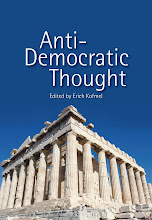

 Posts
Posts

