
The Russian English-language daily newspaper "The Moscow Times" today published on its website a report titled "Mikhalkov Takes Jab at Medvedev" by staff writer Alexander Bratersky.
The full text of the article can be read free of charge here:
www.themoscowtimes.com/news/article/mikhalkov-takes-jab-at-medvedev/421291.html
Excerpts: "Nikita Mikhalkov, the Oscar-winning film director and a monarchist with close ties to the ruling elite, set the political classes chattering Wednesday with the release of a nearly 10,000-word political manifesto [in Russian] promoting 'enlightened conservatism.' The document, written in a flowery language and titled 'Right and Truth,' attacks Western-styled democracy in an indirect dig at President Dmitry Medvedev, but stops short of outright condemning the capitalist reforms of the past two decades. 'Euphoria of liberal democracy has come to an end. Now it is time to do the job,' Mikhalkov said in the manifesto, copies of which were provided to 'state leaders,' Ekho Moskvy radio reported. The manifesto, which cites pre-revolutionary conservative thinkers such as Pyotr Struve and Konstantin Pobedonostsev to support its theses, describes the current state of affairs in the country as 'a mix of West-chasing liberal modernization, nepotism of local authorities and widespread corruption.' [...] The manifesto caused a flurry of reactions but left many politicians and analysts skeptical [...]. A self-proclaimed monarchist, Mikhalkov has made a number of political U-turns in the past. He voiced support for former Vice President Alexander Rutskoi, a friend who staged a failed coup against Yeltsin in 1993, but then campaigned for Yeltsin's Our Home Is Russia party [...] just two years later."
I can't figure out whether the article appeared in print too.
Showing posts with label conservatism. Show all posts
Showing posts with label conservatism. Show all posts
28 October 2010

01 October 2010
Article: On Democracy and Kings
John C. Médaille is the author of an article titled "On Democracy and Kings", which appeared on 15 September 2010 as the first of a series of articles in the fortnightly traditionalist Roman Catholic US newspaper "The Remnant" (43 [15]: no page numbers given).
The full text of the article can be read free of charge here:
www.remnantnewspaper.com/Archives/2010-0915-medaille-monarchy.htm
Excerpts: "[I]t is clear to me, especially in this late date of our democracy, that it enthrones the will of determined and well-financed minorities, that it dissolves the customs and traditions of the people, and that it has no concern for the future. And a king may indeed be a tyrant, but such is the exception rather than the rule. [...] A king, no less than a president, must consider the forces and interests in his kingdom. But a king is free to judge the justice of the arguments; a president is free only to count the votes. And while the president might attempt to engage in persuasion, in the end he himself can only be persuaded by power, that is, by whoever controls the votes, which is very likely to be the one who controls the money. A king may also be persuaded by power and money, but he is always free to be persuaded by justice. And even when a king is a tyrant, he is an identifiable tyrant; much worse is when a people live in a tyranny they may not name, a system where the forms of democracy serve as cover for the reality of tyranny. And that, I believe, is our situation today. [...]
"Modern democracy has come to mean, in preference to all other possible forms, electoral democracy [...]. Since this democracy is something we are willing to both kill and die for, it assumes the status of a religion, albeit a secular one. Like all religions, electoral democracy has its central sacrament, its central liturgy, and its central dogma; its sacrament is the secret ballot, its liturgy is the election campaign, and its dogma is that the election will represent the will of the people. But is this dogma true in any sense? [...] One might respond that it is the will of the people who cared enough to vote. However, that ignores the fact that there are people (like myself) who care enough not to vote; people who find no party acceptable, or worse, find that both parties are really the same party with cosmetic differences for the entertainment and manipulation of the public. [...] Further, we can ask if a bare majority is actually a sufficient margin for any really important decision, one that commits everyone to endorse serious and abiding actions. For example, should 51% be allowed to drag the rest into war? [...]
"[D]emocracies tend to erode traditions by pandering to current desires. [...] In abandoning the past, democracy also abandons the future. We pile the children with debts they cannot pay, wars they cannot win, obligations they cannot meet [...]. In truth, elections are markets with very high entry costs. [...] Indeed, in the 2008 elections, campaign costs were a staggering $5.3 billion, and that was just for the national races. There are very limited sources for that kind of money, and the political process must, perforce, be dominated by those sources. [...] And why is so much money needed? Because the political arts in a democracy are not the arts of deliberation and persuasion, which are relatively inexpensive, but are the arts of manipulation and propaganda, which are extremely costly. The appeal is almost never to the intelligence, but to raw passion and emotion. The path to power in a democracy, the surest way to ensure the loyalty of one's followers, is to exaggerate small differences into great 'issues.' [...]
"A thing is known by its proper limits, and a thing without limits becomes its own opposite. Thus democracy, sacralized and absolutized, becomes its own opposite, a thinly disguised oligarchy of power which uses all the arts of propaganda to convince the public that their votes matter. There is precedent for this. The Western Roman Empire maintained the Republican form and offices. Consul, quaestor, aedile, and tribune remained and there were hotly contested and highly expensive campaigns for these offices. The army still marched under the banner not of the emperor, but of the SPQR, 'The Senate and People of Rome.' But of course it was all a sham; real power lay with the emperor and with the army and the merchant/landowning classes whose interests he largely represented, while buying off the plebs with the world's largest welfare state. But at least the Romans could see their emperor, could know his name, could love him or hate him. We are not permitted to see our real rulers, and never permitted to name them. The democratic sham covers the oligarchic reality."
The second installment of the series, an article titled "A Real Catholic Monarchy", appeared in "The Remnant" on 30 September 2010 (43 [16]: no page numbers given).
Excerpt: "A modern bureaucrat, in the normal course of his day, exercises more power than a medieval king; the bureaucrat can, with a stroke of a pen, take away your business or your children, thereby making tyranny a sort of daily routine; the bureaucrat's writ does indeed run as law, as long as the proper forms are filled out ..."
The full text of this article is only accessible to subscribers of the paper (available in print or as e-edition).
I was not able to ascertain whether there will be further installments in future issues of "The Remnant".
John C. Médaille is Adjunct Instructor of Theology at the University of Dallas.
The full text of the article can be read free of charge here:
www.remnantnewspaper.com/Archives/2010-0915-medaille-monarchy.htm
Excerpts: "[I]t is clear to me, especially in this late date of our democracy, that it enthrones the will of determined and well-financed minorities, that it dissolves the customs and traditions of the people, and that it has no concern for the future. And a king may indeed be a tyrant, but such is the exception rather than the rule. [...] A king, no less than a president, must consider the forces and interests in his kingdom. But a king is free to judge the justice of the arguments; a president is free only to count the votes. And while the president might attempt to engage in persuasion, in the end he himself can only be persuaded by power, that is, by whoever controls the votes, which is very likely to be the one who controls the money. A king may also be persuaded by power and money, but he is always free to be persuaded by justice. And even when a king is a tyrant, he is an identifiable tyrant; much worse is when a people live in a tyranny they may not name, a system where the forms of democracy serve as cover for the reality of tyranny. And that, I believe, is our situation today. [...]
"Modern democracy has come to mean, in preference to all other possible forms, electoral democracy [...]. Since this democracy is something we are willing to both kill and die for, it assumes the status of a religion, albeit a secular one. Like all religions, electoral democracy has its central sacrament, its central liturgy, and its central dogma; its sacrament is the secret ballot, its liturgy is the election campaign, and its dogma is that the election will represent the will of the people. But is this dogma true in any sense? [...] One might respond that it is the will of the people who cared enough to vote. However, that ignores the fact that there are people (like myself) who care enough not to vote; people who find no party acceptable, or worse, find that both parties are really the same party with cosmetic differences for the entertainment and manipulation of the public. [...] Further, we can ask if a bare majority is actually a sufficient margin for any really important decision, one that commits everyone to endorse serious and abiding actions. For example, should 51% be allowed to drag the rest into war? [...]
"[D]emocracies tend to erode traditions by pandering to current desires. [...] In abandoning the past, democracy also abandons the future. We pile the children with debts they cannot pay, wars they cannot win, obligations they cannot meet [...]. In truth, elections are markets with very high entry costs. [...] Indeed, in the 2008 elections, campaign costs were a staggering $5.3 billion, and that was just for the national races. There are very limited sources for that kind of money, and the political process must, perforce, be dominated by those sources. [...] And why is so much money needed? Because the political arts in a democracy are not the arts of deliberation and persuasion, which are relatively inexpensive, but are the arts of manipulation and propaganda, which are extremely costly. The appeal is almost never to the intelligence, but to raw passion and emotion. The path to power in a democracy, the surest way to ensure the loyalty of one's followers, is to exaggerate small differences into great 'issues.' [...]
"A thing is known by its proper limits, and a thing without limits becomes its own opposite. Thus democracy, sacralized and absolutized, becomes its own opposite, a thinly disguised oligarchy of power which uses all the arts of propaganda to convince the public that their votes matter. There is precedent for this. The Western Roman Empire maintained the Republican form and offices. Consul, quaestor, aedile, and tribune remained and there were hotly contested and highly expensive campaigns for these offices. The army still marched under the banner not of the emperor, but of the SPQR, 'The Senate and People of Rome.' But of course it was all a sham; real power lay with the emperor and with the army and the merchant/landowning classes whose interests he largely represented, while buying off the plebs with the world's largest welfare state. But at least the Romans could see their emperor, could know his name, could love him or hate him. We are not permitted to see our real rulers, and never permitted to name them. The democratic sham covers the oligarchic reality."
The second installment of the series, an article titled "A Real Catholic Monarchy", appeared in "The Remnant" on 30 September 2010 (43 [16]: no page numbers given).
Excerpt: "A modern bureaucrat, in the normal course of his day, exercises more power than a medieval king; the bureaucrat can, with a stroke of a pen, take away your business or your children, thereby making tyranny a sort of daily routine; the bureaucrat's writ does indeed run as law, as long as the proper forms are filled out ..."
The full text of this article is only accessible to subscribers of the paper (available in print or as e-edition).
I was not able to ascertain whether there will be further installments in future issues of "The Remnant".
John C. Médaille is Adjunct Instructor of Theology at the University of Dallas.
25 September 2010
Article: Neo-Liberalism and the End of Liberal Democracy
Wendy Brown, "Neo-Liberalism and the End of Liberal Democracy" ("Theory & Event", 7 [1], 2003: no page numbers given):
http://muse.jhu.edu/journals/theory_and_event/summary/v007/7.1brown.html
Excerpt: "For the American Left, the wake of 9/11, the War on Terrorism, practices of 'homeland security,' and the recent invasions of Afghanistan and Iraq together produce a complex set of questions about what to think, what to stand for, and what to organize. These questions are contoured both by our diagnosis of the current orders of power and rule and by our vision of alternatives to these orders. This essay aims to contribute to our necessarily collaborative intellectual effort – no single analysis can be comprehensive – at diagnosing the present and formulating alternatives by reflecting on the political rationality taking shape in the U.S. over the past quarter century. It is commonplace to speak of the present regime in the United States as a neo-conservative one, and to cast as a consolidated 'neo-con' project present efforts to intensify U.S. military capacity, increase U.S. global hegemony, dismantle the welfare state, retrench civil liberties, eliminate the right to abortion and affirmative action, re-Christianize the state, de-regulate corporations, gut environmental protections, reverse progressive taxation, reduce education spending while increasing prison budgets, and feather the nests of the rich while criminalizing the poor."
I had no access to the full text of the article.
Wendy Brown is Heller Professor of Political Science at the University of California, Berkeley.
http://muse.jhu.edu/journals/theory_and_event/summary/v007/7.1brown.html
Excerpt: "For the American Left, the wake of 9/11, the War on Terrorism, practices of 'homeland security,' and the recent invasions of Afghanistan and Iraq together produce a complex set of questions about what to think, what to stand for, and what to organize. These questions are contoured both by our diagnosis of the current orders of power and rule and by our vision of alternatives to these orders. This essay aims to contribute to our necessarily collaborative intellectual effort – no single analysis can be comprehensive – at diagnosing the present and formulating alternatives by reflecting on the political rationality taking shape in the U.S. over the past quarter century. It is commonplace to speak of the present regime in the United States as a neo-conservative one, and to cast as a consolidated 'neo-con' project present efforts to intensify U.S. military capacity, increase U.S. global hegemony, dismantle the welfare state, retrench civil liberties, eliminate the right to abortion and affirmative action, re-Christianize the state, de-regulate corporations, gut environmental protections, reverse progressive taxation, reduce education spending while increasing prison budgets, and feather the nests of the rich while criminalizing the poor."
I had no access to the full text of the article.
Wendy Brown is Heller Professor of Political Science at the University of California, Berkeley.
23 September 2010
Article: Toppling democracy
Thongchai Winichakul, "Toppling democracy" ("Journal of Contemporary Asia", 38 [1], February 2008: pp. 11-37).
The full text of the article can be read free of charge here:
www.sameskybooks.org/wp-content/uploads/2008/02/j-of-contem-asia-2008-thongchai-winichakul-toppling-democracy.pdf
Abstract: "Thailand's 2006 royalist coup is best understood by reference to the historical context of democratisation. The dominant historiography of Thai democratisation is either a simplistic liberal view of anti-military democracy or a royalist one that is ultimately anti-democratic. This article offers a serial history of democratisation that allows us to see the long duration of layered historical processes. As democratisation is fundamentally a break from the centralised absolute monarchy, the monarchy and the monarchists, despite their up and down political fortunes, have probably played the most significant role in shaping Thai democracy since 1932. Despite that, their role and place in history has been overlooked due to the perception that they are 'above politics.' This article argues that, since 1973 in particular, the monarchists have assumed the status of the superior realm in Thai politics that claims the high moral ground above politicians and normal politics. With distaste for electoral politics, and in tacit collaboration with the so-called people's sector, activists and intellectuals, they have undermined electoral democracy in the name of 'clean politics' versus the corruption of politicians. The 2006 coup that toppled democracy was the latest effort of the monarchists to take control of the democratisation process."
Excerpts: "The fight against corruption and money politics seems indisputably a good cause. It should contribute to democracy with no harm whatsoever. In the context of Thai democratisation of the past thirty years, however, the repercussions and consequences of clean politics against elected politicians significantly contributed to the coup in 2006. [...] To understand the effects of the discourse of clean politics on democratisation, I shall elaborate its four constitutive discourses and point out how each of them has ramified to become anti-democratic. They are (i) politicians are extremely corrupt; (ii) politicians come to power by vote-buying; (iii) an election does not equal democracy; and (iv) democracy means a moral, ethical rule. [...] If a 'communist threat' was the usual reason for many military coups during the Cold War, corruption has been the usual reason for coups after the end of the communist threat in Thailand since the early 1980s. [...]
"From the 1980s, people have believed that vote-buying is rampant at every level of election. It is considered a political pandemic. [...] Given the distrust of politicians and parliament's assumed lack of legitimacy due to vote-buying, Thailand's democracy has been seriously undermined. The public as well as many intellectuals question the legitimacy of the election as a trustworthy means to democracy. [...] While these public intellectuals may support civic movements or people's power, the supporters of clean politics adopted the rhetoric to undermine the electoral and parliamentary system. During the political crisis in 2006, the royalists and the anti-Thaksin activists alike often called the Thaksin government an 'electocracy' and his rule 'monetocracy.' After the coup, as critics of the coup insisted on electoral legitimacy in democracy, the coup defenders and apologists, including the royalist activists, military leaders and many leading intellectuals, kept repeating that the staging of an election does not equal democracy. [...]
"The distrust of elections in fact goes a long way back and is deeper than the rhetoric above. It is rooted in the nationalistic conservatism that distrusts democracy for being alien to Thai culture which honours hierarchical relations and venerates the monarchy as the highest authority in the land. [...] These conservatives often remind us that a constitution, thereby democracy as well, is merely a Western object. It is not necessarily good for Thai political culture. [...] In 2005 and 2006, the anti-Thaksin movement called for the return of power to the monarchy, arguing that it fits Thai political culture, unlike electoral democracy, which is an alien political system. [...] Not only could politicians and elections not be trusted, but democracy itself is also suspect. This is the ideological basis for the royalist distaste of elections. It is compatible with the anti-electocracy discourse of liberal intellectuals, thanks to their shared distrust of the existing 'democracy.'"
Thongchai Winichakul is Professor of History at the University of Wisconsin-Madison.
The full text of the article can be read free of charge here:
www.sameskybooks.org/wp-content/uploads/2008/02/j-of-contem-asia-2008-thongchai-winichakul-toppling-democracy.pdf
Abstract: "Thailand's 2006 royalist coup is best understood by reference to the historical context of democratisation. The dominant historiography of Thai democratisation is either a simplistic liberal view of anti-military democracy or a royalist one that is ultimately anti-democratic. This article offers a serial history of democratisation that allows us to see the long duration of layered historical processes. As democratisation is fundamentally a break from the centralised absolute monarchy, the monarchy and the monarchists, despite their up and down political fortunes, have probably played the most significant role in shaping Thai democracy since 1932. Despite that, their role and place in history has been overlooked due to the perception that they are 'above politics.' This article argues that, since 1973 in particular, the monarchists have assumed the status of the superior realm in Thai politics that claims the high moral ground above politicians and normal politics. With distaste for electoral politics, and in tacit collaboration with the so-called people's sector, activists and intellectuals, they have undermined electoral democracy in the name of 'clean politics' versus the corruption of politicians. The 2006 coup that toppled democracy was the latest effort of the monarchists to take control of the democratisation process."
Excerpts: "The fight against corruption and money politics seems indisputably a good cause. It should contribute to democracy with no harm whatsoever. In the context of Thai democratisation of the past thirty years, however, the repercussions and consequences of clean politics against elected politicians significantly contributed to the coup in 2006. [...] To understand the effects of the discourse of clean politics on democratisation, I shall elaborate its four constitutive discourses and point out how each of them has ramified to become anti-democratic. They are (i) politicians are extremely corrupt; (ii) politicians come to power by vote-buying; (iii) an election does not equal democracy; and (iv) democracy means a moral, ethical rule. [...] If a 'communist threat' was the usual reason for many military coups during the Cold War, corruption has been the usual reason for coups after the end of the communist threat in Thailand since the early 1980s. [...]
"From the 1980s, people have believed that vote-buying is rampant at every level of election. It is considered a political pandemic. [...] Given the distrust of politicians and parliament's assumed lack of legitimacy due to vote-buying, Thailand's democracy has been seriously undermined. The public as well as many intellectuals question the legitimacy of the election as a trustworthy means to democracy. [...] While these public intellectuals may support civic movements or people's power, the supporters of clean politics adopted the rhetoric to undermine the electoral and parliamentary system. During the political crisis in 2006, the royalists and the anti-Thaksin activists alike often called the Thaksin government an 'electocracy' and his rule 'monetocracy.' After the coup, as critics of the coup insisted on electoral legitimacy in democracy, the coup defenders and apologists, including the royalist activists, military leaders and many leading intellectuals, kept repeating that the staging of an election does not equal democracy. [...]
"The distrust of elections in fact goes a long way back and is deeper than the rhetoric above. It is rooted in the nationalistic conservatism that distrusts democracy for being alien to Thai culture which honours hierarchical relations and venerates the monarchy as the highest authority in the land. [...] These conservatives often remind us that a constitution, thereby democracy as well, is merely a Western object. It is not necessarily good for Thai political culture. [...] In 2005 and 2006, the anti-Thaksin movement called for the return of power to the monarchy, arguing that it fits Thai political culture, unlike electoral democracy, which is an alien political system. [...] Not only could politicians and elections not be trusted, but democracy itself is also suspect. This is the ideological basis for the royalist distaste of elections. It is compatible with the anti-electocracy discourse of liberal intellectuals, thanks to their shared distrust of the existing 'democracy.'"
Thongchai Winichakul is Professor of History at the University of Wisconsin-Madison.
11 April 2010
Article: Democracy Delusion
Peter Hitchens' article "Democracy Delusion" appears in the May 2010 issue of the magazine "The American Conservative". The article's subtitle or lead reads: "The West's interests aren't always best served by one man, one vote".
Already the article can be read free of charge here:
www.amconmag.com/article/2010/may/01/00038/
Excerpts: "I have in the past few years visited several countries where democracy will, if unfettered, favor political Islam. The supposed Cedar Revolution in Lebanon received gushing praise from Western commentators. There was even talk of genuine elections in Egypt, where the Muslim Brotherhood would be the most likely beneficiary of majority rule. As for the Palestinian entity, the angry irredentists of Hamas undoubtedly won the democratic contest, and their control of Gaza is a clear expression of the people's will. Did the United States really want a Shia Muslim state in Iraq? [...] Pakistan has been seething with Islamic revolt. [...] Kemal and Stalin are the only modern rulers who have subjugated militant political Islam, unveiled women, and controlled the mullahs. But their ferocity would be impossible now. If there is a middle way between such repression and the return of Turkey to its Muslim past, nobody has yet found it. If they do, it may be incompatible with the 21st-century belief in the goodness of democracy and the sanctity of human rights. [...]
"But the real issue goes far deeper and rebounds on the democratic West. If our desire to establish democracy as the test of goodness succeeds, it is bound in some cases to lead to the creation of states we like even less than we liked them when they were despotic. Is it possible that we have misunderstood our own societies and wrongly thought that the exercise of majority rule through democratic vote was the key to their success? Ever since I observed Russia's tragicomic transformation from corrupt Soviet state to corrupt gangster democracy, I have wondered if elections are really quite as liberating as we imagine. [...] Democracy has in fact done Western nations few favors in recent years. It has not kept them from embarking on foolish wars. It has not restrained them from suicidal economic blunders. It has done little to empower the people's desire for less mass immigration or more effective schools. It has above all been feeble when called upon to defend established liberties. In fact, it has often been the enemy of those liberties, as demagogues have sought to win mass support for the excesses of Guantanamo, the reintroduction of torture, and the extension of intrusive surveillance. [...]
"It is striking that the war on terror has spoken so strongly about democracy and had so little to say about liberty. This must partly be because the alleged war required a suspension, even abolition, of many of the rules of liberty and demanded a new relationship between the individual and the state [...]. Manipulated democracies, 'color' revolutions – in which mob rule is rechristened 'people power' because it does what we want it to – are a good way of interfering in sovereign nations without appearing to do so. The evisceration of our own liberties is easier if it is done under a democratic label and seems less significant if democracy is identified as the main safeguard of our rights. Do those who have supported these processes really understand what they are doing or are they just homeless utopians, disappointed in all their previous longings for a better world, seduced by yet another false hope, unintentionally aiding the very cause they claim to be most deeply against? If this is the triumph of democracy, they can keep it."
Peter Hitchens is a conservative British journalist and book author.
Already the article can be read free of charge here:
www.amconmag.com/article/2010/may/01/00038/
Excerpts: "I have in the past few years visited several countries where democracy will, if unfettered, favor political Islam. The supposed Cedar Revolution in Lebanon received gushing praise from Western commentators. There was even talk of genuine elections in Egypt, where the Muslim Brotherhood would be the most likely beneficiary of majority rule. As for the Palestinian entity, the angry irredentists of Hamas undoubtedly won the democratic contest, and their control of Gaza is a clear expression of the people's will. Did the United States really want a Shia Muslim state in Iraq? [...] Pakistan has been seething with Islamic revolt. [...] Kemal and Stalin are the only modern rulers who have subjugated militant political Islam, unveiled women, and controlled the mullahs. But their ferocity would be impossible now. If there is a middle way between such repression and the return of Turkey to its Muslim past, nobody has yet found it. If they do, it may be incompatible with the 21st-century belief in the goodness of democracy and the sanctity of human rights. [...]
"But the real issue goes far deeper and rebounds on the democratic West. If our desire to establish democracy as the test of goodness succeeds, it is bound in some cases to lead to the creation of states we like even less than we liked them when they were despotic. Is it possible that we have misunderstood our own societies and wrongly thought that the exercise of majority rule through democratic vote was the key to their success? Ever since I observed Russia's tragicomic transformation from corrupt Soviet state to corrupt gangster democracy, I have wondered if elections are really quite as liberating as we imagine. [...] Democracy has in fact done Western nations few favors in recent years. It has not kept them from embarking on foolish wars. It has not restrained them from suicidal economic blunders. It has done little to empower the people's desire for less mass immigration or more effective schools. It has above all been feeble when called upon to defend established liberties. In fact, it has often been the enemy of those liberties, as demagogues have sought to win mass support for the excesses of Guantanamo, the reintroduction of torture, and the extension of intrusive surveillance. [...]
"It is striking that the war on terror has spoken so strongly about democracy and had so little to say about liberty. This must partly be because the alleged war required a suspension, even abolition, of many of the rules of liberty and demanded a new relationship between the individual and the state [...]. Manipulated democracies, 'color' revolutions – in which mob rule is rechristened 'people power' because it does what we want it to – are a good way of interfering in sovereign nations without appearing to do so. The evisceration of our own liberties is easier if it is done under a democratic label and seems less significant if democracy is identified as the main safeguard of our rights. Do those who have supported these processes really understand what they are doing or are they just homeless utopians, disappointed in all their previous longings for a better world, seduced by yet another false hope, unintentionally aiding the very cause they claim to be most deeply against? If this is the triumph of democracy, they can keep it."
Peter Hitchens is a conservative British journalist and book author.
17 February 2010
Article: The Failure of Democracy in Africa
Mukui Waruiru's article "The Failure of Democracy in Africa", published on 31 October 2007 online in "Taki's Magazine", voices a sentiment that I have personally heard expressed by other black Africans too.
www.takimag.com/site/article/the_failure_of_democracy_in_africa/
Excerpts: "Pure democracy is a system that works well in particular cultures, and not all cultures are equally capable of building harmonious democratic societies. [...] [In] Sub-Saharan Africa, [...] the introduction of pure democracy 50 years ago resulted in disaster for the people of the region. [...] If anything, in many countries, Africans enjoyed greater personal freedom and prosperity under colonial rule, than they do today under independent governments. [...] Putting restrictions on the vote using poll taxes, literacy tests, and property ownership qualifications, has helped many Western nations to preserve liberty and order for centuries. [...] Universal suffrage is a very recent development in the West. [...] Given that Britain and the US took so long to build well-functioning democratic systems, it is unrealistic to expect African nations to have set up successful democratic societies, given the high poverty rates and the low levels of civilization of most of the population. [...]
"Ian Douglas Smith, the former Prime Minister of Rhodesia, [...] was falsely labeled as a racist and white supremacist [...], unlike the architects of apartheid in neighboring South Africa, [...] Smith recognized that the low levels of education and cultural development of most of the blacks, made the establishment of a successful pure democracy a difficult undertaking. [...] Facing a possible future of either a Marxist dictatorship or anarchy, the Rhodesian leadership declared independence and prevented Britain from imposing majority rule in the colony. [...] Blacks were allowed to have 16 seats in the 66 member Rhodesian parliament, [...] [e]ventually, white and black Rhodesians would share power in the Rhodesian Parliament, under a 50-50 arrangement. [...] But the international community would not accept anything less than black majority rule. [...] Smith can accurately be described as a prophet, because he predicted disaster for Rhodesia [now called Zimbabwe] once it came under the control of the communist terrorist, Robert Mugabe."
Mukui Waruiru is the founder of the African Conservative Forum, a Christian human rights and public policy organization based in Nairobi, Kenya.
www.takimag.com/site/article/the_failure_of_democracy_in_africa/
Excerpts: "Pure democracy is a system that works well in particular cultures, and not all cultures are equally capable of building harmonious democratic societies. [...] [In] Sub-Saharan Africa, [...] the introduction of pure democracy 50 years ago resulted in disaster for the people of the region. [...] If anything, in many countries, Africans enjoyed greater personal freedom and prosperity under colonial rule, than they do today under independent governments. [...] Putting restrictions on the vote using poll taxes, literacy tests, and property ownership qualifications, has helped many Western nations to preserve liberty and order for centuries. [...] Universal suffrage is a very recent development in the West. [...] Given that Britain and the US took so long to build well-functioning democratic systems, it is unrealistic to expect African nations to have set up successful democratic societies, given the high poverty rates and the low levels of civilization of most of the population. [...]
"Ian Douglas Smith, the former Prime Minister of Rhodesia, [...] was falsely labeled as a racist and white supremacist [...], unlike the architects of apartheid in neighboring South Africa, [...] Smith recognized that the low levels of education and cultural development of most of the blacks, made the establishment of a successful pure democracy a difficult undertaking. [...] Facing a possible future of either a Marxist dictatorship or anarchy, the Rhodesian leadership declared independence and prevented Britain from imposing majority rule in the colony. [...] Blacks were allowed to have 16 seats in the 66 member Rhodesian parliament, [...] [e]ventually, white and black Rhodesians would share power in the Rhodesian Parliament, under a 50-50 arrangement. [...] But the international community would not accept anything less than black majority rule. [...] Smith can accurately be described as a prophet, because he predicted disaster for Rhodesia [now called Zimbabwe] once it came under the control of the communist terrorist, Robert Mugabe."
Mukui Waruiru is the founder of the African Conservative Forum, a Christian human rights and public policy organization based in Nairobi, Kenya.
13 February 2010
Article: Is the Age of Democracy Over?
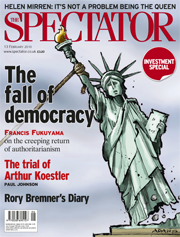 The cover of this week's edition of the major conservative UK magazine "The Spectator" announces in big black letters: "The fall of democracy".
Inside, the magazine carries an article by Francis Fukuyama titled "Is the age of democracy over?"
The article can be read free of charge here:
www.spectator.co.uk/spectator/thisweek/5766228/is-the-age-of-democracy-over.thtml
Lead: "Twenty years ago, Francis Fukuyama forecast the final triumph of liberal democracy and the 'end of history'. As pro-democracy movements falter from Ukraine to China, he revisits his thesis – and asks if history has a few more surprises to spring."
Excerpts: "Over the last decade we have seen the collapse or discrediting of not just the 'Orange' movement, but many of the other so-called 'rainbow revolutions' across eastern Europe: the 'Rose' revolution in Georgia, the 'Cedar' revolution in Lebanon [sic]. Then there's Vladimir Putin's transformation of Russia into an 'electoral authoritarian' state, the undermining of democratic institutions by Hugo Chavez in Venezuela, and the rise of China as a successful authoritarian moderniser. [...]
"Americans let the collapse of communism go to their heads. [...] They saw the events of 1989 as a triumph, not just for the cause of liberty but of loosely regulated markets at home and muscular self-assertion abroad, unconstrained by international institutions. [...] As the hegemonic power for much of the 1990s and 2000s, the United States was bound to incur a lot of resentment from countries and people who felt they had no way of holding the US accountable for what it did to them economically. [...] So the United State [sic] itself became an obstacle to the spread of its own ideals. [...]
"[D]emocracy remains, in Amartya Sen's words, the 'default' political condition: [...] today's would-be authoritarians all have to stage elections and manipulate the media from behind the scenes to legitimate themselves."
This shoddy little article is summed up nicely in a comment left by a reader: "I was immediately drawn to the interesting-sounding header of this piece. Then amazed at how it could be followed by such a boring, point-missing and turgid article!"
Francis Fukuyama is Bernard L. Schwartz Professor of International Political Economy and Director of the International Development Program at Johns Hopkins University.
09 January 2010
Article: Another God That Failed
Is the American right giving up on democracy (promotion)?
Conservative commentator and former presidential candidate Patrick J. (Pat) Buchanan yesterday had an article in the online publication Townhall.com titled "Another God That Failed" – he means democracy.
http://townhall.com/columnists/PatBuchanan/2010/01/08/another_god_that_failed
Quote Buchanan: "If democracy, from Latin America to Africa to the Middle East, brings to power parties and politicians who, for reasons religious, racial or historic, detest the 'white, rich Western world,' why are we pushing democracy in these regions?
"Our forefathers were not afflicted with this infantile disorder. John Winthrop, whose 'city on a hill' inspired Ronald Reagan, declared that, among civil nations, 'a democracy is ... accounted the meanest and worst of all forms of government.'
"'Remember, democracy never lasts long,' said [John] Adams. 'It soon wastes, exhausts and murders itself. There never was a democracy yet that did not commit suicide.'
"Added Jefferson, 'A democracy is nothing more than mob rule, where 51 percent of the people may take away the rights of the other 49.' [James] Madison agreed: 'Democracy is the most vile form of government.' [The founding fathers of course viewed the US as a republic as opposed to a democracy, which for them equalled anarchy.]
"The questions raised here are crucial.
"If racial and religious bonds and ancient animosities against the West trump any democratic solidarity with the West, of what benefit to America is democracy in the Third World? And if one-person, one-vote democracy in multiethnic countries leads to dispossession and persecution of the market-dominant minority, why would we promote democracy there?
"Why would we promote a system in an increasingly anti-American world that empowers enemies and imperils friends?
"Is democratism our salvation – or an ideology of Western suicide?"
Strong words.
Pat Buchanan is a political author, columnist, commentator, and broadcaster. As a politician, he was a senior advisor to Richard Nixon, Gerald Ford, and Ronald Reagan, and Reform Party presidential candidate in 2000.
Conservative commentator and former presidential candidate Patrick J. (Pat) Buchanan yesterday had an article in the online publication Townhall.com titled "Another God That Failed" – he means democracy.
http://townhall.com/columnists/PatBuchanan/2010/01/08/another_god_that_failed
Quote Buchanan: "If democracy, from Latin America to Africa to the Middle East, brings to power parties and politicians who, for reasons religious, racial or historic, detest the 'white, rich Western world,' why are we pushing democracy in these regions?
"Our forefathers were not afflicted with this infantile disorder. John Winthrop, whose 'city on a hill' inspired Ronald Reagan, declared that, among civil nations, 'a democracy is ... accounted the meanest and worst of all forms of government.'
"'Remember, democracy never lasts long,' said [John] Adams. 'It soon wastes, exhausts and murders itself. There never was a democracy yet that did not commit suicide.'
"Added Jefferson, 'A democracy is nothing more than mob rule, where 51 percent of the people may take away the rights of the other 49.' [James] Madison agreed: 'Democracy is the most vile form of government.' [The founding fathers of course viewed the US as a republic as opposed to a democracy, which for them equalled anarchy.]
"The questions raised here are crucial.
"If racial and religious bonds and ancient animosities against the West trump any democratic solidarity with the West, of what benefit to America is democracy in the Third World? And if one-person, one-vote democracy in multiethnic countries leads to dispossession and persecution of the market-dominant minority, why would we promote democracy there?
"Why would we promote a system in an increasingly anti-American world that empowers enemies and imperils friends?
"Is democratism our salvation – or an ideology of Western suicide?"
Strong words.
Pat Buchanan is a political author, columnist, commentator, and broadcaster. As a politician, he was a senior advisor to Richard Nixon, Gerald Ford, and Ronald Reagan, and Reform Party presidential candidate in 2000.
Subscribe to:
Comments (Atom)

 Posts
Posts

