
Gerasimos Santas, "Plato's Criticisms of Democracy in the Republic" ("Social Philosophy and Policy", 24 [2], July 2007: pp. 70-89):
http://journals.cambridge.org/action/displayAbstract?fromPage=online&aid=1031868
Abstract: "Plato's antidemocratic theory of social justice is instructive once we distinguish between the abstract parts of his theory and the empirical or other assumptions he uses in applying that theory. His application may have contained empirical mistakes, and it may have been burdened too much with a prolific metaphysics and a demanding epistemology. An attempt is made to look at his theory of social justice in imaginary isolation from empirical mistakes and from his metaphysics and epistemology. It is then argued that some of Plato's proposals and criticisms of democracy are well worth our attention, especially in the case of governing. His attempt to separate ruling and wealth and to establish economic floors and ceilings for his ideal city seems especially instructive in view of problems in these areas that modern democracies have experienced. Isolating his theory of social justice from his epistemology and metaphysics may be more problematic. Still, Plato's insistence that superior wisdom is the central virtue of rulers is instructive, and in this respect some modern defenders of democratic justice, such as J.S. Mill and John Rawls, have leaned some in Plato's direction. Finally, Plato's criticism of democratic free choice of occupation is less persuasive."
Once again, I had no access to the full text of this article.
Gerasimos X. Santas is Professor Emeritus of Philosophy at the University of California, Irvine.
Showing posts with label Plato. Show all posts
Showing posts with label Plato. Show all posts

13 February 2010
Articles: "Sceptical Democracy" and sceptical authoritarianism
Vittorio Bufacchi, "Sceptical Democracy" ("Politics", 21 [1], February 2001: pp. 23-30):
http://www3.interscience.wiley.com/journal/119018484/abstract
Abstract: "Two extreme philosophical positions pose a constant threat to democracy. Those who believe in the certainty of their beliefs (totalitarianism) and those who deny the existence of any truth (nihilism and post-modernity) uphold these anti-democratic positions. Squeezed between these two polarities we find liberal democracy. One of the distinctive properties of liberal democracy is its endorsement of a political definition of scepticism. The aim of this article is to explore the relationship between liberal democracy and scepticism."
Excerpt: "It is regrettable that for many sympathisers of liberal democracy, scepticism is a dirty word. The aim of this article is to suggest that the rehabilitation of scepticism is long overdue. If democracy is going to defend itself from anti-democratic threats, it is imperative for democratic theory to embrace a political definition of scepticism. [...] On one side, anti-democratic thought is entertained by those who attack the spiritual decay of democracy for its inability to ground society on infallible foundations. At the other extreme, democracy is dismissed for being at best a culturally relative notion, and at worst an instrument of Western cultural imperialism. [...] Nihilism, cynicism and relativism are as cancerous to democracy as the arrogance or nostalgia for certainty."
Bufacchi's article spurred a number of responses, among them Thom Brooks' "A Defence of Sceptical Authoritarianism" ("Politics", 22 [3], September 2002: pp. 152-62):
http://www3.interscience.wiley.com/journal/118915467/abstract
Abstract: "Vittorio Bufacchi argued in this journal that democracy was under threat from two extreme philosophical positions: totalitarianism and nihilism. Sandwiched between these polarities is liberal democracy. Bufacchi believes that one of liberal democracy's distinctive properties is an endorsement of scepticism, which he then attempts to illuminate. In contrast, this article will argue that an authoritarian government bound by a constitution permitting civil liberties might also adopt political scepticism. This removes the aforementioned distinctiveness of liberal democracy in this regard and, in addition, leads us toward a rethinking of the possibility of a more plausible consideration of democracy."
I haven't been able to access the full text of the latter article.
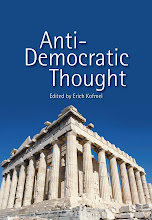
In 2008, Thom Brooks also contributed a chapter asking "Is Plato's Political Philosophy Anti-Democratic?" to my edited volume "Anti-Democratic Thought", published by Imprint Academic. The full text can be read here:
http://books.google.com/books?printsec=frontcover&id=KkMdJtaaeOYC#PPA17,M1
Vittorio Bufacchi is a Lecturer in the Department of Philosophy at University College Cork.
Thom Brooks is now Reader in Political and Legal Philosophy at the University of Newcastle.
12 February 2010
Book: The Open Society and Its Enemies
A short notice for a two-volume work that is, I believe, grossly overrated and hopelessly outdated: Karl Popper's "The Open Society and Its Enemies" (first published by Routledge in 1945, and still available in the latest revised edition of 2002):
Volume 1, subtitled "The Spell of Plato":
www.routledge.com/books/The-Open-Society-and-its-Enemies-isbn9780415237314
Volume 2, subtitled "The High Tide of Prophecy: Hegel, Marx and the Aftermath":
www.routledge.com/books/The-Open-Society-and-its-Enemies-isbn9780415278423
Publisher's description: "Written in political exile [in New Zealand] during the Second World War [...], Karl Popper's The Open Society and Its Enemies is one of the most influential books of the twentieth century. Hailed by Bertrand Russell as a 'vigorous and profound defence of democracy', its now legendary attack on the philosophies of Plato, Hegel and Marx exposed the dangers inherent in centrally planned political systems. Popper's highly accessible style, his erudite and lucid explanations of the thought of great philosophers and the recent resurgence of totalitarian regimes around the world are just three of the reasons for the enduring popularity of The Open Society and Its Enemies, and for why it demands to be read both today and in years to come."
Review: "[A] work of first-class importance which ought to be widely read for its masterly criticism of the enemies of democracy, ancient and modern. His attack on Plato [whom he denounces as a totalitarian], while unorthodox, is in my opinion thoroughly justified. His analysis of Hegel is deadly. Marx is dissected with equal acumen, and given his due share of responsibility for modern misfortunes." (Bertrand Russell, 1872-1970)
Austrian-born Sir Karl Raimund Popper (1902-1994) was a philosopher and Professor of Logic and Scientific Method at the London School of Economics.
02 February 2010
Book: Classical Political Philosophy and the Limits of Democracy
Not anti-democratic, but may be of interest to some: Gerald M. Mara's "The Civic Conversations of Thucydides and Plato: Classical Political Philosophy and the Limits of Democracy" (SUNY Press, 2008):
www.sunypress.edu/p-4643-the-civic-conversations-of-thuc.aspx
From the publisher's description: "This book argues that classical political philosophy, represented in the works of Thucydides and Plato, is an important resource for both contemporary democratic political theory and democratic citizens. By placing the Platonic dialogues and Thucydides' History in conversation with four significant forms of modern democratic theory – the rational choice perspective, deliberative democratic theory, the interpretation of democratic culture, and postmodernism – Gerald M. Mara contends that these classical authors are not enemies of democracy."
Review: "He shows that an active reading of Plato and Thucydides can provide a way out of some of the central dilemmas and dead ends that seem to plague various forms of modern and postmodern democratic political theory." (Stephen G. Salkever, Bryn Mawr College)
Excerpts: "Within the more confined realm of political theory, the effects of democratization have been even more decisive. It is now virtually axiomatic that constructive theorizations about politics must take their bearings from an acceptance of the priorities and principles of democratic theory. Whatever departs from these premises is either relegated to the history of political thought or dismissed as antidemocratic. [...] The first broad thesis of this book is that the power and justice of democratic institutions are in need of continued reexamination. [...]
"[W]hile classical political theory's treatment of democracy is generally critical, there are important differences and nuances, both historical and theoretical, within this literature. The antidemocratic criticisms leveled by the author known as the "old oligarch" or by Isocrates [...] are not those of Thucydides, Plato, or Aristotle. [...] Practical criticisms of democratic practice, including those that point to attractive nondemocratic alternatives, may be offered to improve rather than to replace democratic forms of governance, problematizing rather than simply condemning democracy."
The book is fully searchable on Google Book Search (including table of contents):
http://books.google.com/books?id=JH5bLK1sC_EC&printsec=frontcover
Gerald M. Mara is Executive Associate Dean of the Graduate School of Arts and Sciences and Professorial Lecturer in Government at Georgetown University.
28 January 2010
Articles: Wolff's (Plato's) argument that democracy is irrational
The Royal Institute of Philosophy's journal "Think" has published a string of three articles of possible interest (hard to say as I can't get access to them without paying $45/£30 each – for 4, 6, and 7 pages, respectively, that is!).
Most recently, they published "Reply to Wolff, Plato, Smith, Churchill and Aristotle on Democracy" by Timothy Childers (8 [22], June 2009: pp. 93-9):
http://journals.cambridge.org/action/displayAbstract?fromPage=online&aid=5101968
Abstract: "Fraser Smith (THINK 16) argues that Plato's argument against democracy as reconstructed by Jonathon [sic] Wolff is flawed because in a 'modern' democracy the people do not rule, but instead elect officials subject to a system of checks and balances. Smith's conception of democracy is much like Churchill's (and Popper's). I will argue that Smith's reply does not address Wolff and Plato's argument. I will then point out that Aristotle replied to Plato's argument in an appealing – and strikingly modern – fashion. Aristotle, I conclude, did justify to at least some degree democracy, and hence did address Plato's argument."
Timothy Childers is a member of the Institute of Logic of the Academy of Sciences of the Czech Republic, Prague.
The article by Fraser W. Smith that Childers refers to is "A Short Reply to Wolff's (Plato's) Argument that Democracy is Irrational" (6 [16], December 2008: pp. 49-52):
http://journals.cambridge.org/action/displayAbstract?fromPage=online&aid=3224368
Abstract: "Wolff suggests by way of the following argument (adapted by Wolff from Plato's Republic) that democracy appears to be irrational. Here is the argument given: 1) Ruling is a skill. 2) It is rational to leave the exercise of skills to experts [sic] 3) In a democracy the people rule. 4) The people are not experts. Therefore: 5) Democracy is irrational."
Fraser W. Smith's affiliation is not mentioned by the journal.
The original article by Jonathan Wolff is titled "Are We Good Enough for Democracy?" (1 [2], September 2002: pp. 29-34):
http://journals.cambridge.org/action/displayAbstract?fromPage=online&aid=3194964
Abstract: "Is democracy a good thing? Most of us think so. And yet, as Jonathan Wolff here explains, Plato thought democracy was a very bad idea. If you favour democracy (and I'm guessing you do), then your challenge is to explain what, if anything, is wrong with Plato's argument. So can you?"
The arguments in that article were taken from Wolff's book "Introduction to Political Philosophy" (Oxford University Press, 1996), chapter 3 "Who Should Rule?", section "Plato against democracy"
(pp. 66-77 in the revised edition of 2006):
http://ukcatalogue.oup.com/product/9780199296095.do
Excerpts (2006 edition): "On the latter understanding, then, democracy is mob rule: the rule of the rabble, the vulgar, the unwashed, the unfit. But this insult to democracy is a mere preliminary to Plato's main anti-democratic arguments. His basic weapon is the so-called 'craft analogy'. The point is very simple. If you were ill, and wanted advice on your health, you would go to an expert – the doctor. [...] The last thing you would do is to assemble a crowd, and ask them to vote on the correct remedy. The health of the state is a matter of no less importance than the health of any given individual. [...]
"If the people are allowed to decide they will be swayed by those who speak loudest and with most conviction [...]. Meanwhile, those who are truly skilled [...] will be ignored. [...] Ruling, like medicine, navigation, or even farming, is a skill. [...] Just as medicine should be left to the experts, and a medical training only given to those most suited, so should ruling, and a training to rule. [...] Plato's argument against democracy seems devastating. If ruling is a skill, and a skill that can only be attained by the few, then democracy seems plainly absurd or irrational. [...]
"[Plato's experts, the philosopher-kings,] agree to rule, not for the intrinsic or external rewards of the role, but because they would otherwise find themselves ruled by others. Rather than allow other people – worse still, all other people – to rule, they grudgingly accept this necessary duty."
Jonathan Wolff is Professor of Philosophy at University College London.
Subscribe to:
Posts (Atom)

 Posts

