Please circulate widely!
CALL FOR PAPERS
Anti-Democracy Agenda Symposium 2011
Organized by: Sussex Centre for the Individual and Society (SCIS)
Mode: Online by Google+ video conference
Date: 15-16 November 2011
The "Anti-Democracy Agenda" is the premier resource on the net for the study of anti-democratic thought and practice across the boundaries of various traditions and academic disciplines. First introduced by the Sussex Centre for the Individual and Society (SCIS) as a blog in January 2010, it has since been reconstituted as a circle (with associated public posts, much like a blog) on the new social network Google+. An archive of the blog is to be found here: http://anti-democracy-agenda.blogspot.com
For the new circle, see here:
https://plus.google.com/109507108125539761871/posts
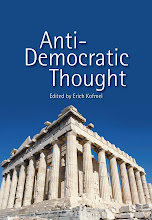
The Anti-Democracy Agenda Symposium 2011 will be the third event we organize to advance the research agenda on anti-democratic thought and practice as well as old and new criticisms of democracy. It will build up on a highly successful workshop on anti-democratic thought SCIS organized at the Annual Conference Workshops in Political Theory in Manchester, England, in September 2007, as well as the Anti-Democracy Agenda Symposium 2010, taking place at the Swiss Federal Institute of Technology (ETH) Zurich in November last year. Both events drew participants from the world over. The Manchester workshop led to the publication of an edited volume on "Anti-Democratic Thought" (Imprint Academic, 2008).
The Anti-Democracy Agenda Symposium 2011 is set to be equally international and interdisciplinary in scope. We invite affiliated academics, independent scholars, and doctoral students and candidates from a wide range of disciplines, such as Philosophy, Political Theory, Political Science, International Relations, Development Studies, Security Studies, Law, Economics, Sociology, Anthropology, Psychology, Literature, History, Classics, Theology, Religious Studies, Education, and so on. Papers may not only cover any and all aspects of criticisms of democracy and anti-democratic thought and practice, from perspectives including anarchism, libertarianism, conservatism, communism, Islamism, the extreme right, and others, but also related concepts such as authoritarianism, dictatorship, military rule, monarchy, chieftaincy, mixed constitution, the backlash against democracy promotion, terrorism, post-democracy, voter apathy, voter ignorance, etc. Have a look at the blog to see what might be of interest and falls within our remit. Papers may be theoretical and/or empirical in nature. Work in progress is welcome too.
This symposium may be the first academic conference to make use of the “Hangouts” video conference facility that is an integral part of Google+. Due to technical restrictions, the number of participants in the Anti-Democracy Agenda Symposium 2011 is limited to 10. All accepted participants will be required to create a profile on Google+ in order to be able to participate in the event. While we encourage the participation of scholars from developing countries, please only apply if you have access to a stable Internet connection. As in our previous physical events, over the course of two days, each presenter will have 60 minutes to present his or her paper and discuss it with all others. Due to the small size of the symposium, all participants are expected to attend both days fully.
As with all SCIS events, no fees will be charged from participants, and no funding is available to cover participants' expenses (if any). We will be glad to issue letters of acceptance on request to assist participants in securing leave from work. Detailed instructions on how to set up a Google+ profile and join the video conference will be provided to confirmed participants.
Please send your proposal to: erichkofmel@gmail.com
Deadline: 15 October 2011
Later submissions may still be accepted, but early submission is strongly advised and proposals may be accepted as they come in.
Cordially,
Erich Kofmel
Managing Director / Research Professor of Political Theory
Sussex Centre for the Individual and Society (SCIS)
https://plus.google.com/109507108125539761871
E-mail: erichkofmel@gmail.com
Postal address:
Sussex Centre for the Individual and Society
1200 Geneva
Switzerland
SCIS is an international association under Swiss law.
Founded 2006 at the University of Sussex.
Showing posts with label criticism of democracy. Show all posts
Showing posts with label criticism of democracy. Show all posts
16 August 2011

17 February 2011
CFP: Democracy and its Critics: Ancient and Modern
One-day conference "Democracy and its Critics: Ancient and Modern" of the Political Thought Specialist Group of the Political Studies Association (PSA), Oxford, UK (precise venue to be confirmed), October 2011 (possible date: 22 October)
Call for papers
Description: "Most of the countries of the world are now democracies in that they have representative governmental institutions controlled by freely elected officials which operate under the rule of law and guarantee a wide array of individual rights, including equality and non-discrimination, personal liberty, freedom of expression, association and conscience, fair trials and a variety of social benefits. If a country's democratic system works tolerably well, the large majority of its citizens would not want to live under a very different political system, such as an absolute monarchy, communism, fascism, one-party dictatorship or anarchism, and this provides some indication of the relationship between citizenry and democracy. Nevertheless, in the past century or so democracies have had their critics and in some cases powerful enemies who have argued that democracy does not provide society the security, economic development, welfare and the other goods it 'really' needs.
"Some critics, for example, argue that modern liberal democracy is not a 'real' democracy as power is actually exercised not by the people, but by an oligarchy or a bureaucratic elite, and they compare this system unfavourably with the direct democracy of Athens and other Greek city-states in the 5th and 4th centuries BC where the body of citizens actually participated, on an equal footing, in making decisions on public issues. However, ancient democracy also had its critics, including great thinkers like Plato and Aristotle. Similar republican forms of government in ancient Rome also had their critics and enemies. The aim of the conference is to bring together and encourage discussion among scholars who are interested in the main features of ancient and modern forms of democracy, and seek to assess the purposes and methods of their governments by reference to the wishes and needs of the people."
Papers are invited that deal with any of the above issues. Please send an abstract to both Evangelia Sembou (Study group convenor): evangelia.sembou@hotmail.com
and Zenon Stavrinides (University of Leeds): z.stavrinides@leeds.ac.uk
Deadline: 30 April 2011
An early expression of interest would be appreciated, as it would help determine numbers.
13 November 2010
Report on the Anti-Democracy Agenda Symposium 2010: Setting the example for the debate of the future
The first event held by the Geneva-based Sussex Centre for the Individual and Society (SCIS) in conjunction with its "Anti-Democracy Agenda" blog, the Anti-Democracy Agenda Symposium 2010, took place to great acclaim on 8 and 9 November 2010 at the Swiss Federal Institute of Technology (ETH) Zurich.
Keynotes to the symposium were contributed by Professor Doh Chull Shin, a native of Korea, director of the Korea Democracy Barometer, and core partner in the Asian Barometer Survey (an ongoing research project monitoring democratization in Asian countries), who is based in the Department of Political Science at the University of Missouri, a leading public research university in the United States, and Professor Kuldip Singh, Head of the Department of Political Science at Guru Nanak Dev University in Amritsar, India.
The Anti-Democracy Agenda Symposium 2010 attracted twelve papers submitted by participants from institutions such as the National University of Singapore, the University of the Philippines, the Technical University of Lisbon (Portugal), Ankara University (Turkey), the University of the Punjab, Quaid-i-Azam University (both Pakistan), the University of Central Oklahoma (USA), and the Islamic Azad University (Iran). Other countries and territories of origin or residence represented include Palestine, Hong Kong, New Zealand, the UK, Switzerland, Nigeria, Korea, and India.
Participants – from doctoral candidates to full professors – came from the disciplines of Political Science, Philosophy, Political Theory, Islamic Studies, Defence and Strategic Studies, Law, and Media Studies, giving theoretical as well as empirical presentations under the titles "Is Confucianism Anti-democratic?", "Islamic Philosophy and Criticizing Democracy", "Against Liberal Democracy", "Anti-Democracy Is Created By Means of Media", "Twenty-First Century Anti-Democracy: Theory and Practice in the World", "A Critique of Western Discourses of Sovereignty and Democracy from Chinese Lenses", "Reflecting on Anti-Democracy Forces in Arab Politics", "'Democracy' in Kazakhstan: Political System Managed from Above", "Pakistan’s Road to Democracy: Islam, Military and Silent Majority", "Democracy: A Form of Government or an Instinct?", "The Role of Ethics in Shaping Democracy: An Examination of Unethical Actions among House of Assembly Members in Nigeria", and "Pekan Anti Otoritarian: Some Observations on Anarchist Gathering at Indonesia".
After a workshop on "Anti-Democratic Thought" in Manchester in 2007, this was the second symposium on anti-democracy organized by the Sussex Centre for the Individual and Society and, once more, it opened up new frontiers for the study of anti-democratic thought and practice. Bringing together scholars from both sides of the debate, advocates of democracy as well as critics and opponents, it set the example for the proper academic conduct of a discussion that does not take place anywhere else, yet. Focusing on twenty-first century anti-democracy, rather than historical expressions and criticisms, it shone the way toward the most important debate of the near future. Asia will play as central a role in that debate as participants from Asia did in our symposium.
The Anti-Democracy Agenda blog and the Sussex Centre for the Individual and Society will continue to be at the forefront of these developments.

12 November 2010
Article: Democracy is not everything: A plea for non-democratic enclaves
Jonathan van Tongeren is the author of an article titled "Democracy is not everything: A plea for non-democratic enclaves", published on 8 November 2010 on the "Christians and Politics Portal" website.
The full text of the article can be read free of charge here:
www.cpportal.org/k/n22654/news/view/455708/383320
Excerpts: "As we all know, there is no clear cut case for democracy in the Bible. At best some basic principles about government can be derived from scripture. This explains why some Christians are convinced democrats, while others only tactically accept the democratic rules or principally oppose democracy altogether. [...] Engelbert Dollfuss [...] was the leader of the Austrian Christian Social Party. Now, as a Christian Democrat, he was responsible for the end of the democratic system in Austria in the 1930's. [...] [H]e understood quite well that democracy is not a goal in itself, but that the aim of Christian-Democracy is to serve public justice. Democracy can be a means towards this end, but that is not to say there are no other means towards the same goal. Historically, Christian politicians such as the Dutch leader of the Anti-Revolutionary Party Groen van Prinsterer have criticized the basic tenet of democracy, the 'sovereignty of the people'. Groen believed that all sovereignty comes from God, and [...] that this basic tenet of Christian-Democracy is at odds with a basic tenet of modern democracy [...]; sovereignty lies either with God or with the people. [...]
"[N]eoconservatives and radical democrats [...] assume that democracy is everything. [...] Christian-Democracy is not about a blind faith in the workings of democracy. What Christian-Democrats have historically understood is that the usefulness of democracy is limited. Democracy is just a system of regulating the relations between the different spheres of sovereignty but it should not enter into the realm of the spheres itself. Authority in such spheres is naturally non-democratic. Families don't have a vote who will be in charge for the next four years, the children obey the parents[,] and what would be the point of a faith community without a central point of authority (revelation)? [...] For a long time Christian-Democrats have emphasized the rights of the pre-democratic institutions [...], radical democrats are working to undermine those rights. [...] Christians in politics should reconsider their strategy and focus on strengthening the pre-democratic institutions. Only these enclaves on non-democratic authority can save us from an overdose of democracy."
Jonathan van Tongeren, from Groningen in the Netherlands, was Secretary General of the European Christian Political Youth Network (ECPYN) from 2006 to 2010. ECPYN is the youth organization of the European Christian Political Movement (ECPM). Both are associations of political parties and organizations from all over Europe.
28 October 2010
Article: Mikhalkov Takes Jab at Medvedev
The Russian English-language daily newspaper "The Moscow Times" today published on its website a report titled "Mikhalkov Takes Jab at Medvedev" by staff writer Alexander Bratersky.
The full text of the article can be read free of charge here:
www.themoscowtimes.com/news/article/mikhalkov-takes-jab-at-medvedev/421291.html
Excerpts: "Nikita Mikhalkov, the Oscar-winning film director and a monarchist with close ties to the ruling elite, set the political classes chattering Wednesday with the release of a nearly 10,000-word political manifesto [in Russian] promoting 'enlightened conservatism.' The document, written in a flowery language and titled 'Right and Truth,' attacks Western-styled democracy in an indirect dig at President Dmitry Medvedev, but stops short of outright condemning the capitalist reforms of the past two decades. 'Euphoria of liberal democracy has come to an end. Now it is time to do the job,' Mikhalkov said in the manifesto, copies of which were provided to 'state leaders,' Ekho Moskvy radio reported. The manifesto, which cites pre-revolutionary conservative thinkers such as Pyotr Struve and Konstantin Pobedonostsev to support its theses, describes the current state of affairs in the country as 'a mix of West-chasing liberal modernization, nepotism of local authorities and widespread corruption.' [...] The manifesto caused a flurry of reactions but left many politicians and analysts skeptical [...]. A self-proclaimed monarchist, Mikhalkov has made a number of political U-turns in the past. He voiced support for former Vice President Alexander Rutskoi, a friend who staged a failed coup against Yeltsin in 1993, but then campaigned for Yeltsin's Our Home Is Russia party [...] just two years later."
I can't figure out whether the article appeared in print too.
17 October 2010
Article: What Checks and Balances in a Democratic Dictatorship?
One M. Rafic Soormally, apparently based in London, is credited as the guest author of a blog post titled "What Checks and Balances in a Democratic Dictatorship?", published on 14 October 2010 on the website of the bilingual (French and English) Mauritian daily newspaper "Le Matinal".
The full text of the article can be read free of charge here:
www.lematinal.com/blogs/7847-Blog-What-Checks-and-Balances-in-a-Democratic-Dictatorship.html
Excerpts: "Debates are presently raging on what to do with the presidential system imposed on Mauritians. The [...] system of political control is not an invention of democracy, and people are being grossly misled. [...] Majority rule must necessarily command over 50% of the votes but this is hardly the case in any so-called democracy. In practice, a minority almost always rules through a process of 'buying' votes through electoral promises and unspeakable forms of corruption perpetrated by a capitalist system wherein less that 10% of the population owns over 90% of the wealth. Moreover, people are forced to vote for candidates selected by political parties and not by them. Democracy is a most manipulative, infectious and lying political system controlled by powerful lobbies and is a [sic] most war-mongering system the world has ever known through the perpetration of terror, invasions, occupations, land theft, decimation of whole populations and the use of weapons of mass destruction such as Nuclear Bombs (Hiroshima, Nagasaki, Fallujah), Agent Orange and Napalm (Vietnam), Phosphorous Bombs (Palestine), Cluster and Uranium Bombs and Biological Weapons (Iraq, Afghanistan), and more. [...]
"Adolph Hitler, George Bush, Tony Blair, Benjamin Netanyahu, Nicolas Sarkozy have all been 'democratically' elected but they all act/ed like dictators. [...] In theory, the US Constitution guarantees the Separation of Powers between the three branches of government [...]. In practice, there is overwhelming evidence that all three branches do act in concert as they are dictated by the same powerful lobbies, for example, in decisions to embark on false flag operations, to pass dictatorial laws and make wars, not to mention that the US is still a very racist country built upon the genocide of the Native Americans. The US is still torturing people they kidnapped and transported to Guantanamo Cuba, Diego Garcia Mauritius and elsewhere, and all checks and balances are non-existent. The President effectively has dictatorial powers [...]. The notion of checks and balances has become just another myth in most modern democracies. The strategy is to find ways to dominate the people, and the world. [...] The Mauritian President is a symbol of dictatorship as, like the British Queen, he is above the law too."
08 October 2010
Book: The Servile Mind: How Democracy Erodes the Moral Life
Just published: Kenneth Minogue, "The Servile Mind: How Democracy Erodes the Moral Life" (Encounter Books, August 2010):
www.encounterbooks.com/books/the-servile-mind-how-democracy-erodes-the-moral-life/
Publisher's description: "One of the grim comedies of the twentieth century was the fate of miserable victims of communist regimes who climbed walls, swam rivers, dodged bullets, and found other desperate ways to achieve liberty in the West at the same time as intellectuals in the West sentimentally proclaimed that these very regimes were the wave of the future. A similar tragicomedy is being played out in our century: as the victims of despotism and backwardness from third world nations pour into Western states, the same ivory tower intellectuals assert that Western life is a nightmare of inequality and oppression. In The Servile Mind [...], Kenneth Minogue explores the intelligentsia's love affair with social perfection and reveals how that idealistic dream is destroying exactly what has made the inventive Western world irresistible to the peoples of foreign lands. The Servile Mind looks at how Western morality has evolved into mere 'politico-moral' posturing about admired ethical causes – from solving world poverty and creating peace to curing climate change. Today, merely making the correct noises and parading one's essential decency by having the correct opinions has become a substitute for individual moral actions. Instead, Minogue posits, we ask that our government carry the burden of solving our social – and especially moral – problems for us. The sad and frightening irony is that as we allow the state to determine our moral order and inner convictions, the more we need to be told how to behave and what to think."
Excerpt: "I am of two minds about democracy, and so is everybody else. We all agree that it is the sovereign remedy for corruption, tyranny, war, and poverty in the Third World. We would certainly tolerate no different system in our own states. Yet most people are disenchanted with the way it works. One reason is that our rulers now manage so much of our lives that they cannot help but do it badly. They have overreached themselves. Blunder follows blunder [...]. The point, however, is that our rulers have no business telling us how to live. [...] We should never doubt that nationalizing the moral life is the first step toward totalitarianism."
Review: "Can democracy survive in a nation of slaves? Aristotle thought not. But what if the slaves don't recognize their servile condition? Kenneth Minogue explores the many ways in which the citizens of the modern West have thoughtlessly exchanged independence of mind and body for government promises of security and harmony. The result is a topsy-turvy democracy where the rulers hold the people to account for their incorrect behavior and attitudes." (John O'Sullivan, Radio Free Europe)
Kenneth Minogue is Professor Emeritus in the Department of Government at the London School of Economics.
04 October 2010
Article: The EU is an antidote to democratic governments, argues President Barroso
In a blog article by the conservative eurosceptic UK Member of the European Parliament (MEP) and lead writer of the "Daily Telegraph", Daniel Hannan, published on 1 October 2010 on the website of the newspaper, the President of the European Commission, José Manuel Barroso, is cited as being critical of democracy ("The EU is an antidote to democratic governments, argues President Barroso", so the title of the article). Unfortunately, the quote and sentiments attributed to Barroso are not referenced by the author.
The full text of the article can be read free of charge here:
http://blogs.telegraph.co.uk/news/danielhannan/100056661/the-eu-is-an-antidote-to-democratic-governments-argues-president-barroso/
Excerpts: "Barroso [...] has offered one of the few utterly honest arguments for European integration. The reason we need the EU, he suggests, is precisely because it's not democratic. Left to themselves, elected governments might do all sorts of things simply to humour their voters: 'Governments are not always right. If governments were always right we would not have the situation that we have today. Decisions taken by the most democratic institutions in the world are very often wrong.' This was, in large measure, the original rationale for European unification. The founding fathers had come through the Second World War with – perhaps understandably – a jaded view of democracy. They fretted that, left to themselves, electorates might fall for demagogues. So they deliberately designed a system in which supreme power was wielded by appointed Commissioners who didn't need to worry about public opinion. It would be going too far to describe the Euro-patriarchs as anti-democratic: Robert Schuman had a sincere commitment to the ballot box, even if Jean Monnet hadn't. But it is fair to say that they believed that the democratic process sometimes needed to be guided, tempered, constrained.
"There are still plenty of people who think this way. Whenever I make the case for referendums, someone in the audience objects that the issues are too difficult for the man in the street, that the experts should be allowed to get on, that we are quietly relieved when politicians do what they think is best for us. [...] Most Barrosistas want a kind of moderated democracy, where voters are ultimately in charge, but where experts also have their place. Yet this has been the argument of every tyrant in history: Bonaparte, Mussolini, Salazar, Lenin. It is, mutatis mutandis, the justification of the ayatollahs in Teheran, who allow elections, but empower an unelected commission to step in when people get the result wrong. It is the argument you hear in private from Chinese Communists: yes, people should be free to elect candidates for certain offices, but a country like this would fall apart without the expertise concentrated in our party. [...] Voters, being human, can make mistakes. But it doesn't follow that a class of experts would have made a better decision." (italics removed)
03 October 2010
Article: Why western-style democracy is not suitable for Africa
George Ayittey is the author of a commentary article titled "Why western-style democracy is not suitable for Africa", published on 20 August 2010 on the CNN news website.
The full text of the article can be read free of charge here:
http://edition.cnn.com/2010/OPINION/08/20/ayittey.democracy.africa/index.html
Excerpts: "Western-style multi-party democracy is possible but not suitable for Africa. [...] The alternative is to take decisions by consensus. [...] In the early 1990s, following the collapse of the former Soviet Union, the winds of change swept across Africa, toppling long-standing autocrats. In our haste to democratize – and also as a condition for Western aid – we copied and adopted the Western form of democracy and neglected to build upon our own democratic tradition. The Western model allowed an elected leader to use power and the state machinery to advance the economic interests of his ethnic group and exclude all others [...]. Virtually all of Africa's civil wars were started by politically marginalized or excluded groups. At Africa's traditional village level, a chief is chosen by the Queen Mother of the royal family to rule for life. His appointment must be ratified by the Council of Elders, which consists of heads of extended families in the village. In governance, the chief must consult with the Council on all important matters. [...] If the chief and the Council cannot reach unanimous decision on an important issue, a village meeting is called and the issue put before the people, who will debate it until they reach a consensus. [...]
"If the chief is 'bad' he can be recalled by the Queen Mother, removed by the Council of Elders, or abandoned by the people, who will vote with their feet to settle somewhere else. [...] Africans could have built upon this system. In the West, the basic economic and social unit is the individual; in Africa, it is the extended family or the collective. The American says, 'I am because I am.' The African says, 'I am because we are.' The 'we' denotes the community. So let each group choose their leaders and place them in a National Assembly. Next, let each province or state choose their leaders and place them in a National Council. Choose the president from this National Council and avoid the huge expenditures on election campaigning that comes with Western-style democracy. Those resources can be better put to development in poor African countries. Next, let the president and National Council take their decisions by consensus. If there is a deadlock, refer the issue to the National Assembly. This type of democracy is in consonance with our own African heritage."
Ghanaian-born George Ayittey is a Distinguished Economist in Residence at American University, Washington, DC, a Research Fellow at the libertarian Independent Institute, and an Associate Scholar at the Foreign Policy Research Institute (FPRI). In 2008, the magazines "Prospect" (UK) and "Foreign Policy" (US) listed him as one of the "Top 100 Public Intellectuals".
01 October 2010
Article: On Democracy and Kings
John C. Médaille is the author of an article titled "On Democracy and Kings", which appeared on 15 September 2010 as the first of a series of articles in the fortnightly traditionalist Roman Catholic US newspaper "The Remnant" (43 [15]: no page numbers given).
The full text of the article can be read free of charge here:
www.remnantnewspaper.com/Archives/2010-0915-medaille-monarchy.htm
Excerpts: "[I]t is clear to me, especially in this late date of our democracy, that it enthrones the will of determined and well-financed minorities, that it dissolves the customs and traditions of the people, and that it has no concern for the future. And a king may indeed be a tyrant, but such is the exception rather than the rule. [...] A king, no less than a president, must consider the forces and interests in his kingdom. But a king is free to judge the justice of the arguments; a president is free only to count the votes. And while the president might attempt to engage in persuasion, in the end he himself can only be persuaded by power, that is, by whoever controls the votes, which is very likely to be the one who controls the money. A king may also be persuaded by power and money, but he is always free to be persuaded by justice. And even when a king is a tyrant, he is an identifiable tyrant; much worse is when a people live in a tyranny they may not name, a system where the forms of democracy serve as cover for the reality of tyranny. And that, I believe, is our situation today. [...]
"Modern democracy has come to mean, in preference to all other possible forms, electoral democracy [...]. Since this democracy is something we are willing to both kill and die for, it assumes the status of a religion, albeit a secular one. Like all religions, electoral democracy has its central sacrament, its central liturgy, and its central dogma; its sacrament is the secret ballot, its liturgy is the election campaign, and its dogma is that the election will represent the will of the people. But is this dogma true in any sense? [...] One might respond that it is the will of the people who cared enough to vote. However, that ignores the fact that there are people (like myself) who care enough not to vote; people who find no party acceptable, or worse, find that both parties are really the same party with cosmetic differences for the entertainment and manipulation of the public. [...] Further, we can ask if a bare majority is actually a sufficient margin for any really important decision, one that commits everyone to endorse serious and abiding actions. For example, should 51% be allowed to drag the rest into war? [...]
"[D]emocracies tend to erode traditions by pandering to current desires. [...] In abandoning the past, democracy also abandons the future. We pile the children with debts they cannot pay, wars they cannot win, obligations they cannot meet [...]. In truth, elections are markets with very high entry costs. [...] Indeed, in the 2008 elections, campaign costs were a staggering $5.3 billion, and that was just for the national races. There are very limited sources for that kind of money, and the political process must, perforce, be dominated by those sources. [...] And why is so much money needed? Because the political arts in a democracy are not the arts of deliberation and persuasion, which are relatively inexpensive, but are the arts of manipulation and propaganda, which are extremely costly. The appeal is almost never to the intelligence, but to raw passion and emotion. The path to power in a democracy, the surest way to ensure the loyalty of one's followers, is to exaggerate small differences into great 'issues.' [...]
"A thing is known by its proper limits, and a thing without limits becomes its own opposite. Thus democracy, sacralized and absolutized, becomes its own opposite, a thinly disguised oligarchy of power which uses all the arts of propaganda to convince the public that their votes matter. There is precedent for this. The Western Roman Empire maintained the Republican form and offices. Consul, quaestor, aedile, and tribune remained and there were hotly contested and highly expensive campaigns for these offices. The army still marched under the banner not of the emperor, but of the SPQR, 'The Senate and People of Rome.' But of course it was all a sham; real power lay with the emperor and with the army and the merchant/landowning classes whose interests he largely represented, while buying off the plebs with the world's largest welfare state. But at least the Romans could see their emperor, could know his name, could love him or hate him. We are not permitted to see our real rulers, and never permitted to name them. The democratic sham covers the oligarchic reality."
The second installment of the series, an article titled "A Real Catholic Monarchy", appeared in "The Remnant" on 30 September 2010 (43 [16]: no page numbers given).
Excerpt: "A modern bureaucrat, in the normal course of his day, exercises more power than a medieval king; the bureaucrat can, with a stroke of a pen, take away your business or your children, thereby making tyranny a sort of daily routine; the bureaucrat's writ does indeed run as law, as long as the proper forms are filled out ..."
The full text of this article is only accessible to subscribers of the paper (available in print or as e-edition).
I was not able to ascertain whether there will be further installments in future issues of "The Remnant".
John C. Médaille is Adjunct Instructor of Theology at the University of Dallas.
25 September 2010
Book: In Defense of Lost Causes
Slavoj Žižek, "In Defense of Lost Causes" (Verso, 2008):
www.versobooks.com/books/431-in-defense-of-lost-causes
Publisher's description: "In this combative major new work, philosophical sharpshooter Slavoj Zizek looks for the kernel of truth in the totalitarian politics of the past. Examining Heidegger's seduction by fascism and Foucault's flirtation with the Iranian Revolution, he suggests that these were the 'right steps in the wrong direction.' On the revolutionary terror of Robespierre, Mao and the bolsheviks, Zizek argues that while these struggles ended in historic failure and horror, there was a valuable core of idealism lost beneath the bloodshed. A redemptive vision has been obscured by the soft, decentralized politics of the liberal-democratic consensus. Faced with the coming ecological crisis, Zizekk [sic] argues the case for revolutionary terror and the dictatorship of the proletariat. A return to past ideals is needed despite the risks. In the words of Samuel Beckett: 'Try again. Fail again. Fail better.'"
Review: "Zizek [...] addresses the limits of liberal democratic approaches to politics and the possibility of benefit in totalitarian approaches to statehood. [...] Scholars of political theory and modern philosophy will find much here to consider and argue for or against." ("Library Journal")
Slavoj Žižek is a Slovenian philosopher and psychoanalyst, Senior Researcher at the Institute of Sociology, University of Ljubljana, and International Director of the Birkbeck Institute for the Humanities at Birkbeck College, University of London.
Matthew Sharpe's article "'Then We Will Fight Them in the Shadows!': Seven Parataxic Views, On Žižek's Style", which appeared recently in the online publication "International Journal of Žižek Studies" (4 [2], 2010), draws on this book.
The full text of the article can be downloaded free of charge here:
www.zizekstudies.org/index.php/ijzs/article/view/261
Excerpts: "Žižek's commitment to the egalitarian-revolutionary Idea places him on a continuum with the radical democratic political tradition with which his earlier work is usually associated. Democracy, rule of and by the people, implies some minimal commitment to egalitarianism, however conceived. Yet, following Badiou, and associating democracy with contemporary liberal-democracy, Žižek at several points indicates that faith in democracy today is the Enemy to be overcome: 'What, today, prevents the radical questioning of capitalism itself is precisely the belief in the democratic form of the struggle against capitalism.' (Žižek 2008, p. 183) [...] Žižek is unconditionally, or rather profoundly, attracted to [...] the utopian moment of radical negativity, in which the old regime is overthrown and suddenly we confront an indefinite, open future, shorn of any 'big Other' defining what is possible and impossible, permitted and prohibited ('Nothing should be accepted as inviolable in this new re-foundation, neither the need for economic "modernisation" nor the most sacred liberal and democratic fetishes' (Žižek 2008, p. 276)"
Matthew Sharpe and Geoff M. Boucher are the authors of a book on "Žižek and Politics: A Critical Introduction" (Edinburgh University Press, March 2010) that also seeks to highlight "Žižek's shift from his earlier, radical-democratic politics, to his later [that is, current], revolutionary, authoritarian vanguardism":
www.euppublishing.com/book/9780748638048
Publisher's description: "In Zizek and Politics, Geoff Boucher and Matthew Sharpe go beyond standard introductions to spell out a new approach to reading Zizek, one that can be highly critical as well as deeply appreciative. They show that Zizek has a raft of fundamental positions that enable his theoretical positions to be put to work on practical problems. Explaining these positions with clear examples, they outline why Zizek's confrontation with thinkers such as Derrida, Foucault and Deleuze has so radically changed how we think about society. They then go on to track Zizek's own intellectual development during the last twenty years, as he has grappled with theoretical problems and the political climate of the War on Terror. This book is a major addition to the literature on Zizek and a crucial critical introduction to his thought." (bold removed)
This book is fully searchable on Google Book Search (including table of contents):
http://books.google.com/books?id=OHDgjpvREnMC&printsec=frontcover
Matthew Sharpe is a Lecturer in the School of International and Political Studies and Geoff M. Boucher is a Lecturer in the School of Communication and Creative Arts, both at Deakin University, Geelong, Australia.
Article: Neo-Liberalism and the End of Liberal Democracy
Wendy Brown, "Neo-Liberalism and the End of Liberal Democracy" ("Theory & Event", 7 [1], 2003: no page numbers given):
http://muse.jhu.edu/journals/theory_and_event/summary/v007/7.1brown.html
Excerpt: "For the American Left, the wake of 9/11, the War on Terrorism, practices of 'homeland security,' and the recent invasions of Afghanistan and Iraq together produce a complex set of questions about what to think, what to stand for, and what to organize. These questions are contoured both by our diagnosis of the current orders of power and rule and by our vision of alternatives to these orders. This essay aims to contribute to our necessarily collaborative intellectual effort – no single analysis can be comprehensive – at diagnosing the present and formulating alternatives by reflecting on the political rationality taking shape in the U.S. over the past quarter century. It is commonplace to speak of the present regime in the United States as a neo-conservative one, and to cast as a consolidated 'neo-con' project present efforts to intensify U.S. military capacity, increase U.S. global hegemony, dismantle the welfare state, retrench civil liberties, eliminate the right to abortion and affirmative action, re-Christianize the state, de-regulate corporations, gut environmental protections, reverse progressive taxation, reduce education spending while increasing prison budgets, and feather the nests of the rich while criminalizing the poor."
I had no access to the full text of the article.
Wendy Brown is Heller Professor of Political Science at the University of California, Berkeley.
24 September 2010
Book: Why we don't love democracy (in French)
Myriam Revault d'Allonnes is the author of "Pourquoi nous n'aimons pas la démocratie" (Why we don't love democracy; my translation), a book published in February 2010 by Seuil:
www.seuil.com/fiche-ouvrage.php?EAN=9782020986687
Publisher's description: "We remember Churchill's saying: 'Democracy is the worst form of government except all those other forms that have been tried from time to time'. Obviously, we do not 'love' democracy. And yet we are all democrats ... This strange process of disenchantment is as virulent as it is old: already in ancient Athens, there was no shortage of critics of democracy. Myriam Revault d'Allonnes interrogates not only the criticisms or sarcasms levelled at democracy, but also the nature of the democratic experience, with its uncertainty, conflicts, incompleteness, inextricably linked to what opposes and threatens it. How should democratic man, confronted with this always problematic existence, not fall prey to dissatisfaction and permanent disappointment? Nevertheless, if we do not 'love' democracy, can we not desire to? Because it is the democratic experience that makes us ethical and political subjects, citizens who do not just want to be governed, 'not like that, not for this, not by them'." (my rough translation)
Myriam Revault d'Allonnes is Professor of Philosophy at the École Pratique des Hautes Etudes (EPHE), Paris.
21 September 2010
Article: Manifesto of Affirmationism
The leftist French philosopher Alain Badiou's "Manifesto of Affirmationism" (trans. Barbara P. Fulks) was published in the New York-based biannual journal of critical theory, art, and fiction "Lacanian Ink" (24/25, spring 2005: no page numbers given).
The full text of the article can be read free of charge here:
www.lacan.com/frameXXIV5.htm
Excerpts: "We cannot understand what is gripping us and causing us to despair if we do not return again and again to the fact that our world is not at all a democracy, but rather an imperial conservatism under the guise of democratic phraseology. What to say of today's world? A solitary power whose army is terrorizing the entire planet dictates its law of the circulation of capital and images and proclaims everywhere, with the most extreme violence, the Duties and Rights of everyone. [...] Under the imposed name of 'terrorism,' those most violently opposed to this hegemony of the brutal West, for which 'democracy' is spiritual ornament, are in reality part of it [...]: the fury of inspired barbarism against sated imperialism. [...] Romantic formalism has always been an artistic orientation of ensconced and terminal dominations. And it is thus in our time: that of a unique and multiform doctrine (economic liberalism and political electoralism), integrating for the first time the quasi-totality of human species in the distribution and constraint of its fortune.
"Yes, our time is that of the unique doctrine and of the consensus which is created around it under the strange name of 'democracy.' Any unique doctrine of this type is desperate, nihilist, because it only proposes to the human multiplicity the absurd perpetuation of its obscene order. And the artistic subjectivity that it leads to is that of this nihilism and of this obscenity. [...] The only maxim of contemporary art is to not be 'Western.' Which means also that it should not be democratic, if democratic means: conforming to the Western idea of political liberty. [...] Yes, the only problem is to know if the artistic imperative can be detached from the Western imperative, which is that of marketing and communication. Western democracy, in effect, is marketing and communication. Thus true art is that which interrupts marketing, that which communicates nothing. Immobile and incommunicable, this is the art we need, the only one that addresses everyone, not circulating according to any pre-established network and not communicating with anyone in particular. Art should augment in everyone the non-democratic strength of one's liberty. [...]
"A non-Western art is necessarily an abstract art, in the following sense: it abstracts from all particularity and formalizes this gesture of abstraction. In order to combat expressivity, to combat Romantic formalism, there is only the dynamic of abstraction. [...] The abstraction in art which is and which is to come does not consider any particular public [...]: it does what it says, without needing acceptance from anyone. We affirm that all sociological and institutional speculations about the audience for the arts must be abandoned. Sociology, and criticism itself, is only and always the auxiliary of Western democracy. [...] Convinced of controlling the entire extent of the visible and of the audible through commercial laws of marketing and the democratic laws of communication, contemporary power no longer needs censorship. It says: 'Everything is possible.' Which also might mean that nothing is. Abandoning itself to this authorization to jouir [enjoy, delight in] is the ruin of all art, as well as all thought. We should be our own pitiless censors. [...] It is better to do nothing than to work officially in the visibility of what the West declares to exist."
Alain Badiou was formerly chair of Philosophy at the École Normale Supérieure (ENS) in Paris.
04 September 2010
Article: Enemies of democracy (in Nigeria)
Adamu Adamu, a columnist writing for various Nigerian newspapers, is the author of an article titled "Enemies of democracy" that was published in two parts on 26 July and 2 August 2010 in the "Peoples Daily".
The full text of the article can be read free of charge online:
Part I:
www.peoplesdaily-online.com/index.php?option=com_content&view=article&id=10202:enemies-of-democracy-i&catid=118:monday-columnists&Itemid=193
Part II:
www.peoplesdaily-online.com/index.php?option=com_content&view=article&id=10832:enemies-of-democracy-ii&catid=118:monday-columnists&Itemid=193
Excerpts: "If, as they always say, democracy is rule of the people, by the people and for the people, what exactly will they call what has been happening in Nigeria? If they will be honest with themselves, they ought to admit that democracy here is simply a kleptocratic autocracy in which so-called elections are also held. [...] It shouldn't be surprising if those who don't believe in the essential equality of human beings hate the very idea of democracy. Nor will it be unexpected if those opposed to the principle of the rule of law become an obstacle to the instituting of democratic culture. [...] But democracy's most determined enemies are not, as you may suppose, kings and queens or Emirs and Chiefs, though they are by no means its friends; its most dangerous enemies are those who eagerly join its train, loudly espouse its name, greedily enjoy its dividends and then unwittingly – or all too wittingly – dig its grave. Thus, democracy in Nigeria will certainly not fail because of those who openly come out to oppose it; but it may disappear on account of those who hide and subvert its very essence from within.
"It is indeed the special misfortune of democracy in Nigeria that it has three powerful, determined, and well-placed enemies – the Executive, the Legislature and the Judiciary. In other places, these are the three pillars upon which democratic rule is founded; but here these are the three weapons with which its very foundation is plundered. Instead of checking and balancing each other, they checkmate the system and outdo each other only in the race to help themselves to the spoils. [...] And as it is locally, so is it globally: at home, they swear by democracy even as they empty the national treasury without asking themselves whether democracy is compatible with thievery; abroad, they raise the cry of democracy even as they go about conquering the world, without asking themselves whether imperialism is compatible with democracy. In the name of democracy, the world's most formidable military machine is currently on the rampage in the Middle East, as it will soon be in certain areas of Africa with resources worth stealing.
"The function of the Legislature is to make laws for the good governance of the nation, while its other role in governance is to serve as a check on the exercise of the powers of the Executive. But we all know that the laws for the good governance of this nation are yet to be passed just as the exercise of executive power is yet to be checked. Instead of making laws, the majority of lawmakers spend their time out of the law-making chambers busy running around cornering contracts in ministries and departments, or playing Public Service Commission as they corner all appointments into all parastatal boards and government agencies for their candidates. But making laws is actually no bother at all. All you have to do is go to the internet and copy bills from other jurisdictions; or in fact you can have the entire dog work done for you by interested non-governmental organisations, or have it sponsored – hook, line, sinker and fish-knife – by foreign embassies.
"The only bills for which legislators show enthusiasm are the ones detailing their salaries and allowances [....] [W]hat the country should have are not these business-as-usual routine pseudo-democrats who only exploit democracy to create exclusive heavens for themselves even as the society sinks into further political and economic decline and deeper cultural decadence [...]. But with economic policy dictated by international financial institutions, diplomatic policy conducted out of fear of superpowers, [...] [p]erhaps impunity has really come to stay [...]: both the ruling party and the opposition parties are at heart undemocratic and can even be anti-democratic in equal measure [...]. When leaders or parties can't be voted out, the nation is saddled with politicians who will not cooperate to grow democracy in the country but can get together to fleece it for their own benefit. [...] Democratic victory was not obtained at the ballot box in all the past three elections; it was sold to the highest bidder. [...] And that is why there is no democracy in Nigeria today: too many enemies and no friend."
09 July 2010
Article: DIY Science, Democracy, and Dogma
Patrick Lin's article "DIY Science, Democracy, and Dogma" was published on 6 July on the website of the "technoprogressive" US-based Institute for Ethics and Emerging Technologies (IEET).
The full text of the article can be read free of charge here:
www.ieet.org/index.php/IEET/more/lin20100706/
Excerpts: "Ordinary citizens today have access to much greater destructive power than ever before, and this may force the evolution of democracy, which has turned somewhat into dogma. [...] [D]emocracy and its attendant values of education, information freedom, and progress are what enable DIY [Do-It-Yourself] science. In this way, democracy has become a threat to itself. To explain, let me rewind to about one month ago. I was a speaker at the Humanity+ Summit at Harvard [...]. The conference theme was 'Rise of the Citizen-Scientist.' I've always had mixed feelings about this issue: [...] is DIY science wise in this day and age? [...] Today, the individual wields much power, enough to change government itself as well as to open an unprecedented world of hurt on fellow citizens, whether with malicious computer hacking or fertilizer-based bombs or anthrax-laced letters or any number of other ways. At the same time, we accept that democracy is a risky venture [...]. The average citizen, with a shrinking attention span, continues to cast the most important votes with incomplete or just plain misinformed knowledge. This risk – of irresponsible power among the masses – is the double edged blade of democracy.
"But today, it is still a traitorous offense in many circles to question the limits of freedom and individual rights [...]. Democracy has become dogma, a mantra of sorts – and God help you if you criticize those values. (You fascist! Terrorist!) [...] But, granting that democracy is better than all other forms of government today (Plato and Marx would still disagree), is it the best form of government possible? Can we do better? Are we allowed to ask these questions? Let me put it this way: If individuals had the power to destroy cities and societies – and we may have that soon, if we don't already – would a democracy even work? [...] Information wants to be free, and it may take new regulation – or a non-democratic regime – to rein them in [...]. A bioattack spawned from a DIY lab, as one scenario, could cause such murder and panic that it destabilizes society, imploding democratic controls from within. We should know by now that no organization is too big to fail. [...] I worry that the furious pace of technology and information is on a collision course with democracy and freedom. It is an act of faith to believe that democracy will always work, no matter the scale of the society or the state of science – no one really knows."
Patrick Lin is Assistant Professor of Philosophy at California Polytechnic State University, San Luis Obispo.
04 July 2010
Journal "Theory & Event" special issue questioning democracy
The journal "Theory & Event" just published a special issue carrying a symposium of papers, first presented at a roundtable at last year's annual meeting of the American Political Science Association (APSA), under the heading "We Are All Democrats Now" (13 [2], 2010):
http://muse.jhu.edu/journals/theory_and_event/toc/tae.13.2.html
The journal's editors, Jodi Dean (Hobart and William Smith Colleges) and Davide Panagia (Trent University), write in their introduction to this issue: "Wendy Brown guest edits our symposium, 'We are All Democrats Now.' From ancient Greece to contemporary Israel, from a deep aspiration worth saving to a barrier demanding its own overcoming, democracy appears in these discussions not only as being in question but also as a concept in need of being questioned."
The following articles are included:
Wendy Brown (Berkeley), "Editor's Introduction We are all democrats now ..." (page numbers not given).
Excerpt: "Democracy today experiences historically unparalleled global popularity, including among political theorists. Yet, in practice, democracy has never been more conceptually footloose, substantively thin or semiotically manipulated for undemocratic domestic and foreign exploits. What accounts for this schism? And what are the specific difficulties for democracy in a world contoured by civilizational conflict, eroding nation-state sovereignty, settler colonialism by 'democracies,' unprecedentedly large mergers of state and capital, ascending neoliberal rationality, and invasions and occupations conducted in the name of democratization? [...] [G]iven the disrepair and misuse into which it has fallen, ought democracy to be abandoned for other visions and practices of popular justice and shared power? The contributors to this symposium [...] approach democracy cautiously, curiously, even skeptically, [...] and query the cultural, social, economic, political and even intellectual conditions that would nurture or erode it."
Wendy Brown (Berkeley), "We Are All Democrats Now ..." (page numbers not given).
Excerpt: "Perhaps democracy's current popularity depends on the openness and even vacuity of its meaning and practice – an empty signifier to which any and all can attach their dreams and hopes. Or perhaps capitalism, modern democracy's non-identical birth twin and always the more robust and wily of the two, has finally reduced democracy to a 'brand,' that late modern twist on commodity fetishism which wholly severs a product's saleable image from its content. Or perhaps, in the joke on Whiggish history wherein the twenty-first century features godheads warring with an intensity presumed vanquished by modernity, democracy has emerged as a new world religion – not a specific form of political power and culture but an alter before which the West and its admirers worship and the divine purpose through which Western imperial crusades are shaped and legitimated. Democracy is not only exalted across the globe today but across the political spectrum. Along with post-Cold War regime changers, former Soviet subjects still reveling in entrepreneurial bliss, apostles of neoliberalism, and never-say-die liberals, we of the EuroAtlantic Left are also mesmerized [...]."
John R. Wallach (Hunter College/CUNY), "None of Us is a Democrat Now" (page numbers not given).
Excerpt: "The title of the panel, 'We are all democrats now ...,' is self-subverting: it notes a common political belief, and it subjects it to questioning. 'People may say it's so, but that can't be the case: so what’s going on?' It's both curious and provocative. It is curious, because one of the sources of the panel is Sheldon Wolin's most recent book, [...] in which he argues that democracy has been hollowed out by the forces of capitalism, bureaucracy, and state-power to become a one-dimensional political form that is connivingly, ultimately, anti-democratic. Wolin would say that there are strikingly few democrats now. [...] Dutifully provoked, I have chosen to signal my remarks by negating the panel's title, affirming that 'none of us is a democrat now.'"
Neve Gordon (Ben-Gurion University of the Negev), "Democracy and Colonialism" (page numbers not given).
Excerpt: "I contend that colonialism has served as a crucial component in the historical processes through which modern democracies were created and sustained. Focusing on the production of 'the people' – namely, those who are acknowledged as citizens and consequently have been granted the right to participate in political decisions – I maintain that colonialism has been deployed by democracy as a force that unifies, limits, and stabilizes the people within the metropole by employing violent forms of exclusion."
Antonio Y. Vázquez-Arroyo (University of Minnesota), "Democracy Today: Four Maxims" (page numbers not given).
Excerpt: "Worldwide, the summer of 2009 was a throwback. The world witnessed Manuel Zelaya getting ousted in Honduras – in what seemed an anachronism in the post-cold war era – by a coup d'état, with a mild reproach by the United States. [...] Coeval with this, an election, the minimal marker of democracy, was blatantly stolen in Iran, with Ayatollahs in tow, to the temporary outrage of the west; of course, the same west that scolded the Afghan elites was silent about the fact that [...] US drones killed 60 people in Pakistan, including women and children. [...] And this is without dwelling on the collusion of western democracies with on-going anti-democratic practices that their very ordinariness and dreariness render invisible, such as the apartheid occupation in Israel that effectively keeps the Palestinian population at the threshold of a humanitarian catastrophe [...]."
Anne Norton (University of Pennsylvania), "Democracy and the Divine" (page numbers not given).
Excerpt: "There are few democrats now, fewer still, I suspect, in the academy. Philosophers we might have trusted have fled from the defense of democracy. Derrida's late work exiled democracy to an uncertain, always deferred future. Democracy could be found only in the company of the rioting shebab of the banlieux, who were, those rogues, that canaille, too 'close to democracy.' Their society was suspect. Democracy had to be saved from these, the poor and disenfranchised, who were closest to it. Derrida's project should be familiar to us, since it has been seen often enough. His advice followed the example set by the Turkish, Argentine Chilean and Pakistani militaries: to save democracy from itself by taking up arms against the democrats. Derrida was hardly alone in this. The democratic politics of Muslims in Europe and the Middle East have been opposed by philosophers from Rawls to Zizek; few questions have so united this intellectually diverse assembly."
I wasn't able to access the full text of any of the longer articles. The full text of Brown's short introduction can be read free of charge.
19 June 2010
Journal "Internationale Politik" on "The False Glamour of Dictatorship" (in German)
The May/June 2010 issue of the German foreign policy journal "Internationale Politik" ("International Politics"), published by the German Council on Foreign Relations (DGAP), is dedicated to the theme "Der falsche Glanz der Diktatur" ("The False Glamour of Dictatorship"; my translation).
Those able to read German can find a table of contents and some articles accessible free of charge here:
www.internationalepolitik.de/ip/archiv/jahrgang-2010/der-falsche-glanz-der-diktatur-/
This journal special issue has been reviewed in English, on 15 June 2010, in an unsigned article titled "A Bit of Dictatorship" on the "Information on German Foreign Policy" website, a news and opinion site "compiled by a group of independent journalists and social scientists".
The full text of the review article can be read free of charge here:
www.german-foreign-policy.com/en/fulltext/56352?PHPSESSID=po88qd8mvp3i3bs9epn923v2q7
Excerpts: "Foreign policy specialists from Berlin's establishment are discussing possible advantages of dictatorial forms of government. According to the current issue of a leading German foreign policy review, some observers see the West as being currently in a 'state of democratic fatigue with an erosion of democratic institutions.' Simultaneously there are 'diverse discussions of dictatorial powers and measures' even if usually in terms of a temporary dictatorship. They see as the primary question, whether 'beyond the system of rule of law, legitimacy reserves can be tapped' to 'rejuvenate the system (– democracy –) that has grown old' [...], a terminology used in the 1930s by the key Nazi jurist, Carl Schmitt[,] to justify the annulment of the [Weimar] democratic constitution. [...] [S]ome business representatives are in no way adverse to authoritarian measures and are questioning whether 'the constitutional state can still hold its own' in the competition of systems against China and Russia. [...] [A] 'spreading discomfort with democracy' provides 'a certain seductiveness for a flirt with dictatorships.'"
05 June 2010
Article: Celebrating eleven years of democradura
Abba Gana Shettima's op-ed article "Celebrating eleven years of democradura" was published on 4 June in the Nigerian national daily newspaper "Daily Trust".
The full text of the article can be read free of charge here:
www.news.dailytrust.com/index.php?option=com_content&view=article&id=19931:celebrating-eleven-years-of-democradura&catid=49:opinion&Itemid=200
Excerpts: "A year after Nigeria returned to democratic rule in 1999, The Economist [...] narrated, in murky details, the tribulations confronting Africa. These range from natural disasters to the social plague of 'tribalism', and the failure of democracy and leadership, all combining to produce 'shell states'. According to the magazine, 'Democracy does not have much to offer Africa. Democracies are no more stable than dictatorships ... The African ruler finds himself trapped. He wants power and control; but the outside world makes demands about democracy, human rights and good governance [...]'. What the Economist did not contemplate was that Africa, or at least some parts of Africa, such as Nigeria could have the scientific ingenuity to clone their own breed of democracy. Nigeria, 'the giant of Africa' is leading the way in this social and political revolution of the 21st century. The trade mark of the Made in Nigeria Democracy is first and foremost the negation of the very principle of democracy. [...]
"In Nigerian democracy, elections are secondary, if at all important. Elections are conducted simply to mask the political thievery with a moral garment. Since 1999, Nigerian elections at all levels have been a sham. [...] Perhaps, the root of all the election malpractice in the country can be traced to the influence of money in the whole electoral process. Beginning from the level of party primaries to the actual elections, money is the magic that buys and shifts alliances. In Nigeria's cash and carry democracy, everybody has a price – ranging from the electoral officials and security agents to highly placed party delegates and desperate blue-collar political activists and passive voters on the streets. [...] [I]t is deceptive and futile to talk about enforcing due process in the award of contracts and the general conduct of government business when the leaders did not emerge through a due electoral process. How can leaders who emerged through rigging of elections become accountable to the people?
"Nigerian politicians keep telling us that it is all part of the painful 'learning process', and that the nation must endure to 'foster its nascent democracy', as if the country is a perpetual democratic toddler. [...] Now, because the leaders are not accountable to the people, the type of democracy they have succeeded in enforcing on the nation in the last eleven years comes close to what some scholars called democradura or 'hard democracy' – a very hard one for that matter, and habitually gruesome to the core. [...] Even as hundreds of thousands of poor people continue to languish and die in droves, the profligate political class keep stealing and hoarding the resources of the nation like some army of rapacious ants. [...] Do our politicians think that they can continue to subvert democracy to serve their personal interests, and keep hoping that the institution can be maintained? This democracy, the Nigerian democracy, this democradura appears to take so much pleasure in inflicting sufferings on its people. [...] This is why we should not celebrate the so-called 'democracy day', never again [...]."
Abba Gana Shettima is a Senior Lecturer in the Department of Sociology at the University of Maiduguri, Nigeria.
03 June 2010
CFP: Democracy, History, Universality: Beyond the Decline of the West
Sixth General Conference of the European Consortium for Political Research (ECPR), University of Iceland, Reykjavik, 25-27 August 2011
Call for panels and papers for a section on "Democracy, History, Universality: Beyond the Decline of the West"
www.ecprnet.eu/conferences/general_conference/Reykjavik/section_details.asp?sectionID=84
Description: "The global debate about the universal significance of democracy represents one of the defining features of our time. Democracy is accepted by nearly everyone as the only legitimate form of government. At the same time, the appeal of the democratic values is weakened both by an ever greater degree of alienation between the population and the democratic institutions in the quintessentially democratic societies of Europe and North America and by the fact that in the more peripheral countries the pro-democracy rhetoric is often cynically used to justify some of the most undemocratic decisions and practices.
"Another crucial dimension of the debate is the increasing recognition that liberal democracy is indeed rooted in the historical experience and cultural particularity of the West. This tension between universalism and particularism has several dimensions. In Europe, it is reflected in the clash between universalist ambitions associated with the European democratic model and the rise of xenophobic politics that strive to redefine Europe in cultural or religious terms. At the same time, accepting the fact that democracy is historically conditioned immediately opens it up to the relativist challenge.
"The western community is often accused of monopolising the power to define what democracy means in political practice, which arguably exposes the Eurocentric nature of democracy promotion undertaken by democratic governments. Political leaders of many nations that explicitly define themselves as non-western now offer their respective political regimes as possible alternative models of democratic development. These claims have to be taken seriously despite their underlying instrumental motives, because what makes them possible in the first place are genuine grassroots concerns about western unilateralism, shared by many people all over the world.
"The panels within this section will be focused around the tension between the supposedly universal value of democracy and its embeddedness in a particular historical experience. The following questions will be discussed, among others: Can we think of truly universal democracy, or must the universal, as some theorists argue, be cleared of any positive predicates? What is happening to the idea of the West as a model democratic community? Does the universal appeal of the European idea give way to xenophobic particularism? What are the consequences of the internal tensions within the West and external challenges to its alleged domination? Can the criticism of democracy as 'too western' pave the way towards truly generic emancipation of humankind?"
Instructions on how to submit proposals for panels and papers are to be found here:
www.ecprnet.eu/conferences/general_conference/Reykjavik/documents/Panel_Chair_Guidelines_and_Deadlines.pdf
Currently, only proposals for panels will be accepted. Proposals for papers can be submitted from 1 November 2010, when a list of the panels accepted for this section will be published on the ECPR website. All proposals are to be submitted online.
Deadline for panel proposals: 1 September 2010
Deadline for paper proposals: 1 February 2011
For further information, please contact the section convenors:
Viatcheslav Morozov (University of Tartu): viacheslav.morozov@ut.ee
Christopher S. Browning (University of Warwick): c.s.browning@warwick.ac.uk
Pertti Joenniemi (Danish Institute for International Studies): pjo@diis.dk
Please note that conference participants may only appear in the academic programme once in any one capacity. That is, they may only chair one section, they may only chair one panel, they may only present one paper, they may only act once as a discussant.
Subscribe to:
Posts (Atom)

 Posts

