
Please circulate widely!
CALL FOR PAPERS
Anti-Democracy Agenda Symposium 2011
Organized by: Sussex Centre for the Individual and Society (SCIS)
Mode: Online by Google+ video conference
Date: 15-16 November 2011
The "Anti-Democracy Agenda" is the premier resource on the net for the study of anti-democratic thought and practice across the boundaries of various traditions and academic disciplines. First introduced by the Sussex Centre for the Individual and Society (SCIS) as a blog in January 2010, it has since been reconstituted as a circle (with associated public posts, much like a blog) on the new social network Google+. An archive of the blog is to be found here: http://anti-democracy-agenda.blogspot.com
For the new circle, see here:
https://plus.google.com/109507108125539761871/posts
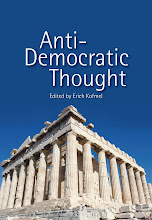
The Anti-Democracy Agenda Symposium 2011 will be the third event we organize to advance the research agenda on anti-democratic thought and practice as well as old and new criticisms of democracy. It will build up on a highly successful workshop on anti-democratic thought SCIS organized at the Annual Conference Workshops in Political Theory in Manchester, England, in September 2007, as well as the Anti-Democracy Agenda Symposium 2010, taking place at the Swiss Federal Institute of Technology (ETH) Zurich in November last year. Both events drew participants from the world over. The Manchester workshop led to the publication of an edited volume on "Anti-Democratic Thought" (Imprint Academic, 2008).
The Anti-Democracy Agenda Symposium 2011 is set to be equally international and interdisciplinary in scope. We invite affiliated academics, independent scholars, and doctoral students and candidates from a wide range of disciplines, such as Philosophy, Political Theory, Political Science, International Relations, Development Studies, Security Studies, Law, Economics, Sociology, Anthropology, Psychology, Literature, History, Classics, Theology, Religious Studies, Education, and so on. Papers may not only cover any and all aspects of criticisms of democracy and anti-democratic thought and practice, from perspectives including anarchism, libertarianism, conservatism, communism, Islamism, the extreme right, and others, but also related concepts such as authoritarianism, dictatorship, military rule, monarchy, chieftaincy, mixed constitution, the backlash against democracy promotion, terrorism, post-democracy, voter apathy, voter ignorance, etc. Have a look at the blog to see what might be of interest and falls within our remit. Papers may be theoretical and/or empirical in nature. Work in progress is welcome too.
This symposium may be the first academic conference to make use of the “Hangouts” video conference facility that is an integral part of Google+. Due to technical restrictions, the number of participants in the Anti-Democracy Agenda Symposium 2011 is limited to 10. All accepted participants will be required to create a profile on Google+ in order to be able to participate in the event. While we encourage the participation of scholars from developing countries, please only apply if you have access to a stable Internet connection. As in our previous physical events, over the course of two days, each presenter will have 60 minutes to present his or her paper and discuss it with all others. Due to the small size of the symposium, all participants are expected to attend both days fully.
As with all SCIS events, no fees will be charged from participants, and no funding is available to cover participants' expenses (if any). We will be glad to issue letters of acceptance on request to assist participants in securing leave from work. Detailed instructions on how to set up a Google+ profile and join the video conference will be provided to confirmed participants.
Please send your proposal to: erichkofmel@gmail.com
Deadline: 15 October 2011
Later submissions may still be accepted, but early submission is strongly advised and proposals may be accepted as they come in.
Cordially,
Erich Kofmel
Managing Director / Research Professor of Political Theory
Sussex Centre for the Individual and Society (SCIS)
https://plus.google.com/109507108125539761871
E-mail: erichkofmel@gmail.com
Postal address:
Sussex Centre for the Individual and Society
1200 Geneva
Switzerland
SCIS is an international association under Swiss law.
Founded 2006 at the University of Sussex.
Showing posts with label backlash. Show all posts
Showing posts with label backlash. Show all posts
16 August 2011

26 September 2010
Article: Asia's Dithering Democracies
On 1 January 2009, "Time" published on its website an article titled "Asia's Dithering Democracies", authored by the magazine's Southeast Asia Bureau Chief, Hannah Beech, who is of Japanese and American parentage.
The full text of the article can be read free of charge here:
www.time.com/time/magazine/article/0,9171,1869271,00.html
Excerpts: "After the shackles of colonialism were overthrown, largely after World War II, the 21st century was supposed to herald the ascent of democracy in Asia. While parts of the region – from Burma and North Korea to Laos, Vietnam and China – are still governed by diktat, the past couple of decades have created a region that to all outward appearances is largely democratic. [...] Yet throughout 2008, many Asians appeared to progressively lose their faith in democratic politics. [...] In many ways, the challenges of Asian democracy are a reflection of its youth. Democracy in the West evolved over centuries – and, even then, its proponents understood its limitations [....] Asia, for the most part, has raced through the democratization process in just a couple of decades. [...] Growing pains may be forgiven in emerging democracies. But if the current political instabilities are allowed to metastasize, Asian nations could tire of the notion of democracy altogether because it's considered too messy, ineffectual or corrupt.
"In South Korea, Mongolia, Taiwan, Thailand and the Philippines, a study by the governance-tracking Asian Barometer Project found that more citizens believed that the nations' recent democratic transitions had brought no improvement to their lives than those who saw positive changes. With time softening the memories of autocratic rule, nostalgia for overthrown dictators is spreading. Some are even calling for a resurgence of so-called 'Asian values,' a mix of paternalistic discipline and market economics that fell into disregard after the 1997 financial meltdown [...]. In [...] many parts of Asia, members of the educated élite bristle at the notion that Western-style democracy is a one-size-fits-all political system. [...]
"Although the Asian Barometer Project found that the majority of Asians say they support most democratic ideals, their commitment to limits on a leader's power is far lower than that of people polled in Europe or even sub-Saharan Africa. [...] This ruler-knows-best attitude can make Asians act more like subjects than citizens. Militaries – the other power pole in much of Asia – can meddle in politics without much public distress from the masses. [...] When Asians finally do react against their governments, it is often in extremis, anger spilling onto the streets in revolutionary-style rallies. [...] For frustrated farmers or construction workers or street vendors, it may be easier to imagine political change through a groundswell of antigovernment rallies rather than through checking one of many underwhelming candidates on a ballot. [...] The backlash against electoral politics by the very people who were recently its proponents may be the most troubling sign of Asian democracy under siege."
It is not mentioned whether the article appeared in print too.
The full text of the article can be read free of charge here:
www.time.com/time/magazine/article/0,9171,1869271,00.html
Excerpts: "After the shackles of colonialism were overthrown, largely after World War II, the 21st century was supposed to herald the ascent of democracy in Asia. While parts of the region – from Burma and North Korea to Laos, Vietnam and China – are still governed by diktat, the past couple of decades have created a region that to all outward appearances is largely democratic. [...] Yet throughout 2008, many Asians appeared to progressively lose their faith in democratic politics. [...] In many ways, the challenges of Asian democracy are a reflection of its youth. Democracy in the West evolved over centuries – and, even then, its proponents understood its limitations [....] Asia, for the most part, has raced through the democratization process in just a couple of decades. [...] Growing pains may be forgiven in emerging democracies. But if the current political instabilities are allowed to metastasize, Asian nations could tire of the notion of democracy altogether because it's considered too messy, ineffectual or corrupt.
"In South Korea, Mongolia, Taiwan, Thailand and the Philippines, a study by the governance-tracking Asian Barometer Project found that more citizens believed that the nations' recent democratic transitions had brought no improvement to their lives than those who saw positive changes. With time softening the memories of autocratic rule, nostalgia for overthrown dictators is spreading. Some are even calling for a resurgence of so-called 'Asian values,' a mix of paternalistic discipline and market economics that fell into disregard after the 1997 financial meltdown [...]. In [...] many parts of Asia, members of the educated élite bristle at the notion that Western-style democracy is a one-size-fits-all political system. [...]
"Although the Asian Barometer Project found that the majority of Asians say they support most democratic ideals, their commitment to limits on a leader's power is far lower than that of people polled in Europe or even sub-Saharan Africa. [...] This ruler-knows-best attitude can make Asians act more like subjects than citizens. Militaries – the other power pole in much of Asia – can meddle in politics without much public distress from the masses. [...] When Asians finally do react against their governments, it is often in extremis, anger spilling onto the streets in revolutionary-style rallies. [...] For frustrated farmers or construction workers or street vendors, it may be easier to imagine political change through a groundswell of antigovernment rallies rather than through checking one of many underwhelming candidates on a ballot. [...] The backlash against electoral politics by the very people who were recently its proponents may be the most troubling sign of Asian democracy under siege."
It is not mentioned whether the article appeared in print too.
15 July 2010
Trend: Democracy in trouble
The "Washington Post" last week published two articles on the backlash against democracy (promotion). First, on 5 July, an opinion piece titled "Around the world, freedom is in peril" by Fred Hiatt, the paper's Editorial Page Editor.
The full text of the article can be read free of charge here:
www.washingtonpost.com/wp-dyn/content/article/2010/07/04/AR2010070403849.html
Excerpts: "As America this weekend celebrates the birth of its liberty, in much of the rest of the world freedom and democracy are in retreat. Over the past decade, authoritarian rulers have refined their techniques to stay in power, learning from each other and thinking two steps ahead of democratic forces. [...] They recognized the threat and mobilized, with old-fashioned methods and new. From China to Egypt to Cuba, political challengers were neutralized, as they always had been, by confiscation of property, imprisonment and torture, with the examples of a few chastening the many. The foolish mistakes of one regime – allowing elections before seizing total control of the election machinery, as in Burma in 1990 – were duly noted and not repeated.
"Dictators have learned from each other to stamp out any buds of independent civil society by means of tax laws and supposedly neutral regulation. With China in the lead, they learned not only to neutralize the World Wide Web but to turn it into an effective weapon for propaganda, tracking and repression of their own citizens, and attacks against democratic rivals. Taking advantage of their control of television, they mobilized ideologies of nationalism and anti-terrorism to undermine the rhetoric of freedom. So at decade's end, the correlation of forces, as the Communists used to say, looks bleak. Three assertive powers – China, Russia and Iran – not only resist democratization but actively seek to disseminate their model of authoritarian rule in their spheres of influence."
On 6 July, the paper published an op-ed titled "Democracy in trouble" by columnist Anne Applebaum.
The full text of the article can be read free of charge here:
www.washingtonpost.com/wp-dyn/content/story/2010/07/05/ST2010070503026.html?sid=ST2010070503026
Excerpt: "[D]emocracy is in trouble. By every measure, the world's autocrats have become more entrenched over the past decade. Countries as disparate as Russia, Venezuela and Iran have become adept at using the rhetoric of 'democracy' – along with faked elections, phony political parties, even state-controlled 'civil society' organizations – to deflect pressure for change. But democracy promotion has also been unfairly discredited by the invasion of Iraq, a decision too often remembered as nothing more than a foolish 'war for democracy' that went predictably wrong. [...] Since becoming president, Barack Obama has shied away from the word democracy in foreign contexts – he prefers 'our common security and prosperity' – as if it might be some dangerous Bushism."
The full text of the article can be read free of charge here:
www.washingtonpost.com/wp-dyn/content/article/2010/07/04/AR2010070403849.html
Excerpts: "As America this weekend celebrates the birth of its liberty, in much of the rest of the world freedom and democracy are in retreat. Over the past decade, authoritarian rulers have refined their techniques to stay in power, learning from each other and thinking two steps ahead of democratic forces. [...] They recognized the threat and mobilized, with old-fashioned methods and new. From China to Egypt to Cuba, political challengers were neutralized, as they always had been, by confiscation of property, imprisonment and torture, with the examples of a few chastening the many. The foolish mistakes of one regime – allowing elections before seizing total control of the election machinery, as in Burma in 1990 – were duly noted and not repeated.
"Dictators have learned from each other to stamp out any buds of independent civil society by means of tax laws and supposedly neutral regulation. With China in the lead, they learned not only to neutralize the World Wide Web but to turn it into an effective weapon for propaganda, tracking and repression of their own citizens, and attacks against democratic rivals. Taking advantage of their control of television, they mobilized ideologies of nationalism and anti-terrorism to undermine the rhetoric of freedom. So at decade's end, the correlation of forces, as the Communists used to say, looks bleak. Three assertive powers – China, Russia and Iran – not only resist democratization but actively seek to disseminate their model of authoritarian rule in their spheres of influence."
On 6 July, the paper published an op-ed titled "Democracy in trouble" by columnist Anne Applebaum.
The full text of the article can be read free of charge here:
www.washingtonpost.com/wp-dyn/content/story/2010/07/05/ST2010070503026.html?sid=ST2010070503026
Excerpt: "[D]emocracy is in trouble. By every measure, the world's autocrats have become more entrenched over the past decade. Countries as disparate as Russia, Venezuela and Iran have become adept at using the rhetoric of 'democracy' – along with faked elections, phony political parties, even state-controlled 'civil society' organizations – to deflect pressure for change. But democracy promotion has also been unfairly discredited by the invasion of Iraq, a decision too often remembered as nothing more than a foolish 'war for democracy' that went predictably wrong. [...] Since becoming president, Barack Obama has shied away from the word democracy in foreign contexts – he prefers 'our common security and prosperity' – as if it might be some dangerous Bushism."
03 July 2010
Trend: Africa's Failing Democracies
The American magazine "Newsweek" yesterday published on its website a short article by Ethiopia-based journalist Jason McLure, titled "Africa's Failing Democracies".
The full text of the article can be read free of charge here:
www.newsweek.com/2010/07/02/africa-s-failing-democracies.html
Excerpts: "When [H]uman [R]ights Watch criticized the results of Ethiopia's May elections, in which the ruling coalition 'won' an improbable 545 out of 547 seats, leaders in Addis Ababa didn't ignore the influential NGO. Instead, they paid tens of thousands of demonstrators to gather in the capital and denounce the report. Ethiopia's political shenanigans are emblematic of a growing trend away from democracy in Africa. The swing includes not only pariah states like Eritrea and Sudan, but also U.S. allies like Rwanda, where President Paul Kagame is up for reelection and seems set to duplicate the improbable 95 percent victory he posted seven years ago. [...] In Gabon and Togo, the deaths of long-serving autocrats have meant elections in which power was smoothly transferred – to their sons, that is. Mauritania, Guinea, Madagascar, and Niger have all suffered coups in the past two years.
"Freedom House, a nonprofit that tracks democratic trends, dropped three African countries from its list of 'electoral democracies' last year, and reported declines in political freedom in 10 others. [...] Why the backsliding? It's partly thanks to the rise of China, which provides cheap loans and investment to resource-rich countries while asking no hard questions about human rights, thus strengthening the hold of authoritarian governments. The West is to blame, too. The Obama administration and its European allies have turned a blind eye to autocratic trends in places like Uganda, Burundi, and Ethiopia because of those countries' role in battling Islamists. [...] 'If this is their representation of democracy and human rights, they shouldn't talk about it anymore,' says Hailu Shawel, an Ethiopian opposition leader. 'They should shut up.'"
I can't figure out whether the article also appeared in print.
The full text of the article can be read free of charge here:
www.newsweek.com/2010/07/02/africa-s-failing-democracies.html
Excerpts: "When [H]uman [R]ights Watch criticized the results of Ethiopia's May elections, in which the ruling coalition 'won' an improbable 545 out of 547 seats, leaders in Addis Ababa didn't ignore the influential NGO. Instead, they paid tens of thousands of demonstrators to gather in the capital and denounce the report. Ethiopia's political shenanigans are emblematic of a growing trend away from democracy in Africa. The swing includes not only pariah states like Eritrea and Sudan, but also U.S. allies like Rwanda, where President Paul Kagame is up for reelection and seems set to duplicate the improbable 95 percent victory he posted seven years ago. [...] In Gabon and Togo, the deaths of long-serving autocrats have meant elections in which power was smoothly transferred – to their sons, that is. Mauritania, Guinea, Madagascar, and Niger have all suffered coups in the past two years.
"Freedom House, a nonprofit that tracks democratic trends, dropped three African countries from its list of 'electoral democracies' last year, and reported declines in political freedom in 10 others. [...] Why the backsliding? It's partly thanks to the rise of China, which provides cheap loans and investment to resource-rich countries while asking no hard questions about human rights, thus strengthening the hold of authoritarian governments. The West is to blame, too. The Obama administration and its European allies have turned a blind eye to autocratic trends in places like Uganda, Burundi, and Ethiopia because of those countries' role in battling Islamists. [...] 'If this is their representation of democracy and human rights, they shouldn't talk about it anymore,' says Hailu Shawel, an Ethiopian opposition leader. 'They should shut up.'"
I can't figure out whether the article also appeared in print.
06 May 2010
CFP: Anti-Democracy Agenda Symposium 2010
Please circulate widely!
CALL FOR PAPERS
Anti-Democracy Agenda Symposium 2010
Organized by: Sussex Centre for the Individual and Society (SCIS)
Location: Gottfried-Semper Villa Garbald, part of the Collegium Helveticum of the Swiss Federal Institute of Technology (ETH) Zurich and the University of Zurich, at Castasegna, in the Swiss Alps
Date: 8-10 November 2010
The "Anti-Democracy Agenda" (www.anti-democracy-agenda.blogspot.com) has been run by the Sussex Centre for the Individual and Society since January 2010. The blog is the premier resource on the net for the study of anti-democratic thought and practice across the boundaries of various traditions and academic disciplines.
The Anti-Democracy Agenda Symposium 2010 will be the first event we organize in conjunction with the blog. It will build up though on a highly successful event on anti-democratic thought SCIS organized earlier, at the Annual Conference Workshops in Political Theory in Manchester, England, in September 2007, drawing participants from the world over. That workshop led to the publication of an edited volume, "Anti-Democratic Thought" (Imprint Academic), in December 2008.
The Anti-Democracy Agenda Symposium 2010 is set to be equally international and interdisciplinary in scope. We invite affiliated academics, independent scholars, and doctoral students and candidates from a wide range of disciplines, such as Philosophy, Political Theory, Political Science, International Relations, Development Studies, Security Studies, Law, Economics, Sociology, Anthropology, Psychology, Literature, History, Classics, Theology, Religious Studies, Education, and so on. Papers may not only cover any and all aspects of criticisms of democracy and anti-democratic thought and practice, from perspectives including anarchism, libertarianism, conservatism, communism, Islamism, the extreme right, and others, but also related concepts such as authoritarianism, dictatorship, military rule, monarchy, chieftaincy, mixed constitution, the backlash against democracy promotion, terrorism, post-democracy, voter apathy, voter ignorance, etc. Have a look at the blog to see what might be of interest and falls within our remit. Papers may be theoretical and/or empirical in nature. Work in progress is welcome too.
We expect that 10-15 participants will be attending the workshop-style Anti-Democracy Agenda Symposium 2010. Over the course of two and a half days, each presenter will have 60 minutes to present his or her paper and discuss it with all others.
As with all SCIS events, no fees will be charged from participants, and no funding is available to cover participants' travel and accommodation expenses. We will be glad to issue letters of invitation on request to assist participants in securing funding from their usual sources. The charges payable directly to the Villa Garbald (approx. $510 half-board/$570 full-board per person) cover accommodation for three nights and food and drink (except alcohol and minibar) throughout your stay. Participants will be arriving on Sunday, taking in the magnificent scenery of the Swiss Alps on a spectacular 5-hour train journey from Zurich airport (via St. Moritz) to a remote Italian-speaking Swiss valley (Val Bregaglia), home to Europe's largest chestnut forest, and leave on Wednesday after lunch, on the same way (cost of a return ticket approx. $115). Alternatively, you can get there in 3-4 hours by train from Milano airport, passing Lake Como. During the symposium there will be ample time to explore the surroundings. Please feel free to contact us with any questions. Detailed travel instructions will be provided to confirmed participants. Don't miss this unique opportunity.
The Italian-style Villa Garbald was built by German star architect Gottfried Semper (of Semper Opera in Dresden and Vienna Burgtheater fame) during his exile in Switzerland. A pro-democracy activist in aristocratic mid-19th century Germany, his experiences with direct-democratic government in Switzerland turned him in later life increasingly against democracy.
Please send your proposal to: e.kofmel@sussexcentre.org
Deadline: 31 July 2010
Later submissions may still be accepted, but early submission is strongly advised and proposals may be accepted as they come in.

Cordially,
Erich Kofmel
Managing Director / Research Professor of Political Theory
Sussex Centre for the Individual and Society (SCIS)
www.sussexcentre.org
E-mail: e.kofmel@sussexcentre.org
Postal address:
Sussex Centre for the Individual and Society
1200 Geneva
Switzerland
SCIS is an international association under Swiss law.
Founded 2006 at the University of Sussex.
CALL FOR PAPERS
Anti-Democracy Agenda Symposium 2010
Organized by: Sussex Centre for the Individual and Society (SCIS)
Location: Gottfried-Semper Villa Garbald, part of the Collegium Helveticum of the Swiss Federal Institute of Technology (ETH) Zurich and the University of Zurich, at Castasegna, in the Swiss Alps
Date: 8-10 November 2010
The "Anti-Democracy Agenda" (www.anti-democracy-agenda.blogspot.com) has been run by the Sussex Centre for the Individual and Society since January 2010. The blog is the premier resource on the net for the study of anti-democratic thought and practice across the boundaries of various traditions and academic disciplines.
The Anti-Democracy Agenda Symposium 2010 will be the first event we organize in conjunction with the blog. It will build up though on a highly successful event on anti-democratic thought SCIS organized earlier, at the Annual Conference Workshops in Political Theory in Manchester, England, in September 2007, drawing participants from the world over. That workshop led to the publication of an edited volume, "Anti-Democratic Thought" (Imprint Academic), in December 2008.
The Anti-Democracy Agenda Symposium 2010 is set to be equally international and interdisciplinary in scope. We invite affiliated academics, independent scholars, and doctoral students and candidates from a wide range of disciplines, such as Philosophy, Political Theory, Political Science, International Relations, Development Studies, Security Studies, Law, Economics, Sociology, Anthropology, Psychology, Literature, History, Classics, Theology, Religious Studies, Education, and so on. Papers may not only cover any and all aspects of criticisms of democracy and anti-democratic thought and practice, from perspectives including anarchism, libertarianism, conservatism, communism, Islamism, the extreme right, and others, but also related concepts such as authoritarianism, dictatorship, military rule, monarchy, chieftaincy, mixed constitution, the backlash against democracy promotion, terrorism, post-democracy, voter apathy, voter ignorance, etc. Have a look at the blog to see what might be of interest and falls within our remit. Papers may be theoretical and/or empirical in nature. Work in progress is welcome too.
We expect that 10-15 participants will be attending the workshop-style Anti-Democracy Agenda Symposium 2010. Over the course of two and a half days, each presenter will have 60 minutes to present his or her paper and discuss it with all others.
As with all SCIS events, no fees will be charged from participants, and no funding is available to cover participants' travel and accommodation expenses. We will be glad to issue letters of invitation on request to assist participants in securing funding from their usual sources. The charges payable directly to the Villa Garbald (approx. $510 half-board/$570 full-board per person) cover accommodation for three nights and food and drink (except alcohol and minibar) throughout your stay. Participants will be arriving on Sunday, taking in the magnificent scenery of the Swiss Alps on a spectacular 5-hour train journey from Zurich airport (via St. Moritz) to a remote Italian-speaking Swiss valley (Val Bregaglia), home to Europe's largest chestnut forest, and leave on Wednesday after lunch, on the same way (cost of a return ticket approx. $115). Alternatively, you can get there in 3-4 hours by train from Milano airport, passing Lake Como. During the symposium there will be ample time to explore the surroundings. Please feel free to contact us with any questions. Detailed travel instructions will be provided to confirmed participants. Don't miss this unique opportunity.
The Italian-style Villa Garbald was built by German star architect Gottfried Semper (of Semper Opera in Dresden and Vienna Burgtheater fame) during his exile in Switzerland. A pro-democracy activist in aristocratic mid-19th century Germany, his experiences with direct-democratic government in Switzerland turned him in later life increasingly against democracy.
Please send your proposal to: e.kofmel@sussexcentre.org
Deadline: 31 July 2010
Later submissions may still be accepted, but early submission is strongly advised and proposals may be accepted as they come in.
Cordially,
Erich Kofmel
Managing Director / Research Professor of Political Theory
Sussex Centre for the Individual and Society (SCIS)
www.sussexcentre.org
E-mail: e.kofmel@sussexcentre.org
Postal address:
Sussex Centre for the Individual and Society
1200 Geneva
Switzerland
SCIS is an international association under Swiss law.
Founded 2006 at the University of Sussex.
20 April 2010
Article: The Backlash Against Democracy Promotion
Thomas Carothers, "The Backlash Against Democracy Promotion" ("Foreign Policy", 85 [2], March/April 2006: pp. 55-68):
www.foreignaffairs.com/articles/61509/thomas-carothers/the-backlash-against-democracy-promotion
Excerpts: "After two decades of the steady expansion of democracy-building programs around the world, a growing number of governments are starting to crack down on such activities within their borders. [...] They have started expelling or harassing Western NGOs and prohibiting local groups from taking foreign funds – or have started punishing them for doing so. This growing backlash has yet to coalesce into a formal or organized movement. But its proponents are clearly learning from and feeding off of one another. [...] Politicians from China to Zimbabwe have publicly [...] condemned the United States' 'democratic offensive' in the former Soviet Union and elsewhere as self-serving, coercive, and immoral.
"The [...] Chinese Communist Party reportedly mapped out a strategy for resisting U.S. and European efforts to promote color revolutions in China and its neighborhood. [...] Zimbabwean President Robert Mugabe has driven out Western NGOs and forced the closure of many local groups that get external support, claiming that they are fronts through which Western 'colonial masters' subvert the government. [...] Further North, [...] Prime Minister Meles Zenawi stated on Ethiopian television that 'there is not going to be a [...] color revolution in Ethiopia after the election.' And in Eritrea, the government enacted a new law [...] forbidding local NGOs from engaging in any work other than relief activities and blocking them from receiving external support. [...] In South America, Venezuelan President Hugo Chávez regularly blasts U.S. democracy promotion as being part of a [...] campaign to oust him. [...]
"Would Washington countenance the presence, during elections, of foreign organizations – especially ones funded by a powerful, possibly hostile government – that underwrite and help carry out voter-education campaigns, the training of and provision of material aid to political parties, parallel vote counts, and citizen-mobilization efforts? [...] No matter how well democracy promoters make their case, [...] many people in countries on the receiving end of such efforts will not be persuaded of the legitimacy of their efforts. Democracy promoters may believe that poor democratic performance reduces a country's right to invoke its sovereignty to block external intervention. That idea may be gaining currency in established democracies. Yet it is unlikely to command wide support in the developing and post-communist worlds, where sovereignty is jealously guarded by governments of all political stripes."
Thomas Carothers is now Vice President for Studies at the Carnegie Endowment for International Peace in Washington, DC.
www.foreignaffairs.com/articles/61509/thomas-carothers/the-backlash-against-democracy-promotion
Excerpts: "After two decades of the steady expansion of democracy-building programs around the world, a growing number of governments are starting to crack down on such activities within their borders. [...] They have started expelling or harassing Western NGOs and prohibiting local groups from taking foreign funds – or have started punishing them for doing so. This growing backlash has yet to coalesce into a formal or organized movement. But its proponents are clearly learning from and feeding off of one another. [...] Politicians from China to Zimbabwe have publicly [...] condemned the United States' 'democratic offensive' in the former Soviet Union and elsewhere as self-serving, coercive, and immoral.
"The [...] Chinese Communist Party reportedly mapped out a strategy for resisting U.S. and European efforts to promote color revolutions in China and its neighborhood. [...] Zimbabwean President Robert Mugabe has driven out Western NGOs and forced the closure of many local groups that get external support, claiming that they are fronts through which Western 'colonial masters' subvert the government. [...] Further North, [...] Prime Minister Meles Zenawi stated on Ethiopian television that 'there is not going to be a [...] color revolution in Ethiopia after the election.' And in Eritrea, the government enacted a new law [...] forbidding local NGOs from engaging in any work other than relief activities and blocking them from receiving external support. [...] In South America, Venezuelan President Hugo Chávez regularly blasts U.S. democracy promotion as being part of a [...] campaign to oust him. [...]
"Would Washington countenance the presence, during elections, of foreign organizations – especially ones funded by a powerful, possibly hostile government – that underwrite and help carry out voter-education campaigns, the training of and provision of material aid to political parties, parallel vote counts, and citizen-mobilization efforts? [...] No matter how well democracy promoters make their case, [...] many people in countries on the receiving end of such efforts will not be persuaded of the legitimacy of their efforts. Democracy promoters may believe that poor democratic performance reduces a country's right to invoke its sovereignty to block external intervention. That idea may be gaining currency in established democracies. Yet it is unlikely to command wide support in the developing and post-communist worlds, where sovereignty is jealously guarded by governments of all political stripes."
Thomas Carothers is now Vice President for Studies at the Carnegie Endowment for International Peace in Washington, DC.
15 April 2010
Article: European Democracy Promotion in Russia Before and After the "Colour" Revolutions
Sinikukka Saari, "European Democracy Promotion in Russia Before and After the 'Colour' Revolutions" ("Democratization", 16 [4], August 2009: pp. 732-55):
www.informaworld.com/smpp/content~db=all~content=a913551843
Abstract: "This article explores international democracy promotion and its impact on Russian policies before and after the colour revolutions in the former Soviet Union. In particular, the article analyses the democracy promotion efforts of major European intergovernmental organizations – the Organization for Security and Cooperation in Europe, the Council of Europe and the European Union – as well as NGOs working in Russia. The article demonstrates that European intergovernmental organizations gave political and economic considerations priority over more consistent and principled policy towards Russia in the 1990s and early 2000s. This instrumentalism partly explains Russia's current aggressive attitude towards international democracy promotion. Informed by the 'colour' revolutions in the former Soviet republics, this negative attitude has turned into a direct, openly articulated and internationally concerted action plan against democracy promotion. This article traces and analyses the shifting dynamics of the Russian challenge to Western democracy promotion. It cautions both against simplistic categorizations of 'democrats' and 'non-democratic forces' by democracy promoters and also against political favouritism linked to them. These categorizations rarely reflect complex reality and they are all too easily manipulated. Overall, the European intergovernmental organizations indirectly legitimized undemocratic practices in Russia in the name of promoting democracy and thus delegitimized their own democracy promotion efforts."
Excerpts: "Despite the typical anti-democracy promotion rhetoric that highlights non-interference and a strict interpretation of state sovereignty, [...] (semi-)authoritarian leaders actively give political and financial support to fellow (semi-)authoritarian states in their neighbourhood. Peter Burnell labelled this phenomenon active anti-assistance and counter-promotion. Its goal is to 'prevent, frustrate, oppose or hollow-out' democratic change. While the forms and methods of the semi-authoritarian challenge have already been studied comprehensively, there has been only little attention to exactly how and why the backlash occurred. [...] Manipulation of political processes means in the Russian context that officially the name of the game is democracy, but in fact the unwritten rules are inherently antidemocratic. The aim of the system is 'to manage, manipulate and contain democracy' with the help of the elite and the experts in political manipulation employed by them.
"Examples of this unhealthy political process are the creation of 'opposition' groups by the ruling elite, buying of parties and politicians, manipulation of the media, and paying for negative, false stories and publishing false opinion polls. [...] Western actors' policy indirectly suggested that shallow rhetoric and the form of institutions are more important to Western actors than how these institutions actually function. [...] [T]he basic features of the undemocratic system in today's Russia already began developing during the Yeltsin era, and since then these features have been institutionalized and streamlined into an effective political system. The crucial feature of this system is that power is legitimized through elections that are 'managed' beforehand in such a manner that true competition is effectively eliminated. This political management is also at the core of Russia's current challenge to international democracy promotion. [...]
"The international dimension of Russia's counter-democracy promotion strategy builds on both normative and institutional challenges. It simultaneously questions European democratic standards and norms as well as European institutions and procedures set up for protecting those standards and monitoring their practical implementation. [...] One of the cornerstones of the anti-democracy promotion campaign has been the accusation that international democracy promoters adhere to 'double standards', especially in the field of election monitoring. [...] Russia has [...] made concrete suggestions on how to reorganize the European election observation framework. The basic idea behind the proposals is that the European standards should reflect the average practices in European states rather than some lofty democratic ideals. [...] By these standards even the Belarusian and Kazakh elections can be claimed to be free and fair and democratic. It is unlikely that such reports would convince Western audiences. However, the target audience is the public in the [...] semi-authoritarian states [...].
"Thus, it seems that the battle over the 'hearts and minds' of citizens has started again in earnest. [...] While during the 1990s Russia hid its undemocratic practices behind democratic and pro-Western slogans, the alternative to Western democratic ideals is nowadays more explicitly articulated and given an ideological foundation. [...] The non-implementation and practical revision of democratic norms were naturally a serious challenge to international democratic norms, but since the official rhetoric remained consistently democratic, this challenge remained an indirect one. [...] [I]t seems that not only have pro-democracy movements learned from past revolutions, but that the anti-democracy side has also learned and has modified its tactics accordingly. The situation now looks gloomy: Russia's challenge has become a direct one, and democracy promotion is aggressively being rooted out."
Sinikukka Saari is a Researcher at the Finnish Institute of International Affairs. She holds a PhD in International Relations from the London School of Economics.
www.informaworld.com/smpp/content~db=all~content=a913551843
Abstract: "This article explores international democracy promotion and its impact on Russian policies before and after the colour revolutions in the former Soviet Union. In particular, the article analyses the democracy promotion efforts of major European intergovernmental organizations – the Organization for Security and Cooperation in Europe, the Council of Europe and the European Union – as well as NGOs working in Russia. The article demonstrates that European intergovernmental organizations gave political and economic considerations priority over more consistent and principled policy towards Russia in the 1990s and early 2000s. This instrumentalism partly explains Russia's current aggressive attitude towards international democracy promotion. Informed by the 'colour' revolutions in the former Soviet republics, this negative attitude has turned into a direct, openly articulated and internationally concerted action plan against democracy promotion. This article traces and analyses the shifting dynamics of the Russian challenge to Western democracy promotion. It cautions both against simplistic categorizations of 'democrats' and 'non-democratic forces' by democracy promoters and also against political favouritism linked to them. These categorizations rarely reflect complex reality and they are all too easily manipulated. Overall, the European intergovernmental organizations indirectly legitimized undemocratic practices in Russia in the name of promoting democracy and thus delegitimized their own democracy promotion efforts."
Excerpts: "Despite the typical anti-democracy promotion rhetoric that highlights non-interference and a strict interpretation of state sovereignty, [...] (semi-)authoritarian leaders actively give political and financial support to fellow (semi-)authoritarian states in their neighbourhood. Peter Burnell labelled this phenomenon active anti-assistance and counter-promotion. Its goal is to 'prevent, frustrate, oppose or hollow-out' democratic change. While the forms and methods of the semi-authoritarian challenge have already been studied comprehensively, there has been only little attention to exactly how and why the backlash occurred. [...] Manipulation of political processes means in the Russian context that officially the name of the game is democracy, but in fact the unwritten rules are inherently antidemocratic. The aim of the system is 'to manage, manipulate and contain democracy' with the help of the elite and the experts in political manipulation employed by them.
"Examples of this unhealthy political process are the creation of 'opposition' groups by the ruling elite, buying of parties and politicians, manipulation of the media, and paying for negative, false stories and publishing false opinion polls. [...] Western actors' policy indirectly suggested that shallow rhetoric and the form of institutions are more important to Western actors than how these institutions actually function. [...] [T]he basic features of the undemocratic system in today's Russia already began developing during the Yeltsin era, and since then these features have been institutionalized and streamlined into an effective political system. The crucial feature of this system is that power is legitimized through elections that are 'managed' beforehand in such a manner that true competition is effectively eliminated. This political management is also at the core of Russia's current challenge to international democracy promotion. [...]
"The international dimension of Russia's counter-democracy promotion strategy builds on both normative and institutional challenges. It simultaneously questions European democratic standards and norms as well as European institutions and procedures set up for protecting those standards and monitoring their practical implementation. [...] One of the cornerstones of the anti-democracy promotion campaign has been the accusation that international democracy promoters adhere to 'double standards', especially in the field of election monitoring. [...] Russia has [...] made concrete suggestions on how to reorganize the European election observation framework. The basic idea behind the proposals is that the European standards should reflect the average practices in European states rather than some lofty democratic ideals. [...] By these standards even the Belarusian and Kazakh elections can be claimed to be free and fair and democratic. It is unlikely that such reports would convince Western audiences. However, the target audience is the public in the [...] semi-authoritarian states [...].
"Thus, it seems that the battle over the 'hearts and minds' of citizens has started again in earnest. [...] While during the 1990s Russia hid its undemocratic practices behind democratic and pro-Western slogans, the alternative to Western democratic ideals is nowadays more explicitly articulated and given an ideological foundation. [...] The non-implementation and practical revision of democratic norms were naturally a serious challenge to international democratic norms, but since the official rhetoric remained consistently democratic, this challenge remained an indirect one. [...] [I]t seems that not only have pro-democracy movements learned from past revolutions, but that the anti-democracy side has also learned and has modified its tactics accordingly. The situation now looks gloomy: Russia's challenge has become a direct one, and democracy promotion is aggressively being rooted out."
Sinikukka Saari is a Researcher at the Finnish Institute of International Affairs. She holds a PhD in International Relations from the London School of Economics.
24 March 2010
Book: Russian Resistance to Democratization in the Former Soviet Union
Thomas Ambrosio, "Authoritarian Backlash: Russian Resistance to Democratization in the Former Soviet Union" (Ashgate, January 2009):
www.ashgatepublishing.com/default.aspx?page=637&calcTitle=1&title_id=8622&edition_id=11221
Publisher's description: "Authoritarian Russia has adopted five strategies to preserve the Kremlin's political power: insulate, bolster, subvert, redefine and coordinate. Thomas Ambrosio examines each of these in turn, all of which seek to counter or undermine regional democratic trends both at home and throughout the former Soviet Union. Policies such as these are of great concern to the growing literature on how autocratic regimes are becoming more active in their resistance to democracy. Through detailed case studies of each strategy, this book makes significant contributions to our understandings of Russian domestic and foreign policies, democratization theory and the policy challenges associated with democracy promotion."
Contents: The authoritarian backlash against democracy; The external promotion of democracy and authoritarianism; Political trends in the former Soviet Union: an overview; Insulate: shielding Russia from external democracy promotion; Redefine: rhetorical defenses against external criticism; Bolster: Russian support for authoritarianism in Belarus; Subvert: undermining democracy in Georgia and Ukraine; Coordinate: working with others to resist democratization; The Russian 2007–2008 election cycle; The future of democracy and the challenge of authoritarianism
Reviews: "[O]ffers a cutting edge account of active international strategies of authoritarian persistence and survival. Studies of international democracy promotion should take note. Future research will profit by building on the book's analysis well beyond its focus on Putin's Russia." (Peter Burnell, University of Warwick)
"[A] compelling framework for how dictators resist internal and external pressure to expand rights and freedoms for their citizens. Authoritarian Backlash contributes to our understanding of Russia as a consolidated dictatorship, rather than democracy, from its chilling portrayal of the 'Putin Youth' to the ominous signs of a budding partnership with other dictatorships around the world." (Joel M. Ostrow, Benedictine University)
The book is fully searchable on Google Book Search:
http://books.google.com/books?id=ACrNelizytEC&printsec=frontcover
Thomas Ambrosio is Associate Professor in Political Science at North Dakota State University.
The recent Briefing Paper 2/2010 of the German Development Institute, "Russia: Supporting Non-Democratic Tendencies in the Post-Soviet Space?", authored by Antje Kästner, appears to be drawing on Ambrosio's book.
The article can be read free of charge here:
www.die-gdi.de/CMS-Homepage/openwebcms3_e.nsf/(ynDK_contentByKey)/ANES-7ZWGYD/$FILE/BP%202.2010.pdf
From the abstract: "Over the last decade, Russia has not only adopted a more authoritarian form of government, but has also become more active in the former USSR. Russia's growing engagement in its 'near abroad' has been paralleled by the rise of illiberal regimes in the region, a development precipitated by active Russian policy action constraining the rise of Western democracy and reinforced by interests shared by the various governments."
Excerpts: "The Orange Revolution in Ukraine was the key event that led Russian authorities to fear the spread of political unrest into Russian territory. In reaction, the Russian government adopted an overtly critical stance towards Western democracy promotion efforts and began to develop its image as an alternative donor in the region. At the same time, Russia stepped up its efforts to cooperate more closely with authoritarian countries [....] Central Asia's natural resources are vital if Russia's authoritarian form of government is to be maintained, while the promotion of controlled instability in the post-Soviet space strengthens Russia's economic and political influence with the aim of ensuring Russian hegemony in the region. [...] Russia is not only supporting incumbent dictators in Azerbaijan, Kazakhstan, Uzbekistan and Turkmenistan, but also reinforcing undemocratic practices in Armenia, Kyrgyzstan and Tajikistan and trying to prevent democratisation in Belarus, Georgia, Moldova and Ukraine. [...] For many leaders in the 'near abroad', Russia has become an attractive alternative to Western donors, not least because the conditions which the Russian government attaches to its commitment pose less of a threat to the incumbent government's position than democratic conditionality."
Antje Kästner is an Associate Fellow at the German Development Institute.
www.ashgatepublishing.com/default.aspx?page=637&calcTitle=1&title_id=8622&edition_id=11221
Publisher's description: "Authoritarian Russia has adopted five strategies to preserve the Kremlin's political power: insulate, bolster, subvert, redefine and coordinate. Thomas Ambrosio examines each of these in turn, all of which seek to counter or undermine regional democratic trends both at home and throughout the former Soviet Union. Policies such as these are of great concern to the growing literature on how autocratic regimes are becoming more active in their resistance to democracy. Through detailed case studies of each strategy, this book makes significant contributions to our understandings of Russian domestic and foreign policies, democratization theory and the policy challenges associated with democracy promotion."
Contents: The authoritarian backlash against democracy; The external promotion of democracy and authoritarianism; Political trends in the former Soviet Union: an overview; Insulate: shielding Russia from external democracy promotion; Redefine: rhetorical defenses against external criticism; Bolster: Russian support for authoritarianism in Belarus; Subvert: undermining democracy in Georgia and Ukraine; Coordinate: working with others to resist democratization; The Russian 2007–2008 election cycle; The future of democracy and the challenge of authoritarianism
Reviews: "[O]ffers a cutting edge account of active international strategies of authoritarian persistence and survival. Studies of international democracy promotion should take note. Future research will profit by building on the book's analysis well beyond its focus on Putin's Russia." (Peter Burnell, University of Warwick)
"[A] compelling framework for how dictators resist internal and external pressure to expand rights and freedoms for their citizens. Authoritarian Backlash contributes to our understanding of Russia as a consolidated dictatorship, rather than democracy, from its chilling portrayal of the 'Putin Youth' to the ominous signs of a budding partnership with other dictatorships around the world." (Joel M. Ostrow, Benedictine University)
The book is fully searchable on Google Book Search:
http://books.google.com/books?id=ACrNelizytEC&printsec=frontcover
Thomas Ambrosio is Associate Professor in Political Science at North Dakota State University.
The recent Briefing Paper 2/2010 of the German Development Institute, "Russia: Supporting Non-Democratic Tendencies in the Post-Soviet Space?", authored by Antje Kästner, appears to be drawing on Ambrosio's book.
The article can be read free of charge here:
www.die-gdi.de/CMS-Homepage/openwebcms3_e.nsf/(ynDK_contentByKey)/ANES-7ZWGYD/$FILE/BP%202.2010.pdf
From the abstract: "Over the last decade, Russia has not only adopted a more authoritarian form of government, but has also become more active in the former USSR. Russia's growing engagement in its 'near abroad' has been paralleled by the rise of illiberal regimes in the region, a development precipitated by active Russian policy action constraining the rise of Western democracy and reinforced by interests shared by the various governments."
Excerpts: "The Orange Revolution in Ukraine was the key event that led Russian authorities to fear the spread of political unrest into Russian territory. In reaction, the Russian government adopted an overtly critical stance towards Western democracy promotion efforts and began to develop its image as an alternative donor in the region. At the same time, Russia stepped up its efforts to cooperate more closely with authoritarian countries [....] Central Asia's natural resources are vital if Russia's authoritarian form of government is to be maintained, while the promotion of controlled instability in the post-Soviet space strengthens Russia's economic and political influence with the aim of ensuring Russian hegemony in the region. [...] Russia is not only supporting incumbent dictators in Azerbaijan, Kazakhstan, Uzbekistan and Turkmenistan, but also reinforcing undemocratic practices in Armenia, Kyrgyzstan and Tajikistan and trying to prevent democratisation in Belarus, Georgia, Moldova and Ukraine. [...] For many leaders in the 'near abroad', Russia has become an attractive alternative to Western donors, not least because the conditions which the Russian government attaches to its commitment pose less of a threat to the incumbent government's position than democratic conditionality."
Antje Kästner is an Associate Fellow at the German Development Institute.
13 March 2010
Article: How Democracy Dies
The US magazine "Newsweek" runs an article in this week's issue titled "How Democracy Dies". Written by Joshua Kurlantzick, the subtitle or lead reads "A global decline in political freedom is partly the fault of the middle class".
The full text of the article (in the browser window alternatively titled "The Global Decline in Democracy") can be read free of charge here:
www.newsweek.com/id/234891
Excerpts: "Many of the same middle-class men and women who once helped push dictators out of power are now seeing just how difficult it can be to establish democracy, and are pining for the days of autocracy. [...] The global economic crisis has also damaged democracy's appeal. To many middle-class men and women in the developing world, the spread of democracy was linked to the spread of capitalism, since many of these countries opened their economies at the same time as they embraced political freedom. As the crisis cuts into people's incomes, many blame democracy, in part, for the economic downturn. [...] The result is that on nearly every continent, democracy is sputtering out. [...]
"[I]n many of the countries where democracy has recently been rolled back, the middle class that once promoted political freedom is now also resorting to extralegal, undemocratic tactics – supposedly to save democracy itself. Middle-class Thai urbanites, for instance, bitterly disappointed by Thaksin's abuses and worried he was empowering the poor at their expense, have rebelled. Rather than challenging Thaksin through the democratic process, such as by bolstering opposition parties or starting their own newspapers, they tore down democracy by shutting down institutions of government and calling for a military coup, even while claiming to support democracy. [...] Many called for a military intervention or some other kind of benign despotism to restore the rule of law and fight corruption, which they claimed had worsened under Thaksin. 'We had to save democracy, even if it meant [ignoring] elections,' said one Thai diplomat sympathetic to the protesters. The Thai elites got what they hoped for: Thaksin is in exile, his opponents are in power, and Thailand's democracy is shattered. [...]
"In Africa, recent coups in Mauritania and Niger were welcomed by the urban middle class, while data from the Asian Barometer surveys, regular polls that examine Asian attitudes toward democracy, show that many respondents have become dissatisfied with their democratic systems. [...] Such is the case in Russia as well, where Putin, even as he wipes out most of the democratic institutions, enjoys staggeringly high poll numbers from the middle class and other segments of the population. [...] Even in China, where it is the poor in rural areas who now take the lead in protests, the urban middle class appears comfortable with the ruling regime. [...]
"The middle class's push back against democracy, by way of coups and other antidemocratic means, has disenfranchised the poor, sparking still more protests. In Thailand, crowds of protesters, most of them poor, have launched their own violent demonstrations that target the middle classes who tried to push Thaksin out of office. Similarly in Bolivia, the middle-class anti-Morales protesters now have been met with angry pro-Morales protesters mostly drawn from the ranks of the poor. In the Philippines, poor men and women furious that their hero Estrada had been forced out by the middle class launched their own counter-protests. Now, with the nation heading to another election, Estrada, out of jail and running again, is picking up support from the poor for his presidential bid."
Joshua Kurlantzick is a journalist and author, a Fellow at the University of Southern California's Center on Public Diplomacy, and a Fellow for Southeast Asia at the Council on Foreign Relations.
The full text of the article (in the browser window alternatively titled "The Global Decline in Democracy") can be read free of charge here:
www.newsweek.com/id/234891
Excerpts: "Many of the same middle-class men and women who once helped push dictators out of power are now seeing just how difficult it can be to establish democracy, and are pining for the days of autocracy. [...] The global economic crisis has also damaged democracy's appeal. To many middle-class men and women in the developing world, the spread of democracy was linked to the spread of capitalism, since many of these countries opened their economies at the same time as they embraced political freedom. As the crisis cuts into people's incomes, many blame democracy, in part, for the economic downturn. [...] The result is that on nearly every continent, democracy is sputtering out. [...]
"[I]n many of the countries where democracy has recently been rolled back, the middle class that once promoted political freedom is now also resorting to extralegal, undemocratic tactics – supposedly to save democracy itself. Middle-class Thai urbanites, for instance, bitterly disappointed by Thaksin's abuses and worried he was empowering the poor at their expense, have rebelled. Rather than challenging Thaksin through the democratic process, such as by bolstering opposition parties or starting their own newspapers, they tore down democracy by shutting down institutions of government and calling for a military coup, even while claiming to support democracy. [...] Many called for a military intervention or some other kind of benign despotism to restore the rule of law and fight corruption, which they claimed had worsened under Thaksin. 'We had to save democracy, even if it meant [ignoring] elections,' said one Thai diplomat sympathetic to the protesters. The Thai elites got what they hoped for: Thaksin is in exile, his opponents are in power, and Thailand's democracy is shattered. [...]
"In Africa, recent coups in Mauritania and Niger were welcomed by the urban middle class, while data from the Asian Barometer surveys, regular polls that examine Asian attitudes toward democracy, show that many respondents have become dissatisfied with their democratic systems. [...] Such is the case in Russia as well, where Putin, even as he wipes out most of the democratic institutions, enjoys staggeringly high poll numbers from the middle class and other segments of the population. [...] Even in China, where it is the poor in rural areas who now take the lead in protests, the urban middle class appears comfortable with the ruling regime. [...]
"The middle class's push back against democracy, by way of coups and other antidemocratic means, has disenfranchised the poor, sparking still more protests. In Thailand, crowds of protesters, most of them poor, have launched their own violent demonstrations that target the middle classes who tried to push Thaksin out of office. Similarly in Bolivia, the middle-class anti-Morales protesters now have been met with angry pro-Morales protesters mostly drawn from the ranks of the poor. In the Philippines, poor men and women furious that their hero Estrada had been forced out by the middle class launched their own counter-protests. Now, with the nation heading to another election, Estrada, out of jail and running again, is picking up support from the poor for his presidential bid."
Joshua Kurlantzick is a journalist and author, a Fellow at the University of Southern California's Center on Public Diplomacy, and a Fellow for Southeast Asia at the Council on Foreign Relations.
18 January 2010
Books: New Challenges to Democratization
The Madrid-based "European think tank for global action" Fundación para las Relaciones Internacionales y el Diálogo Exterior (FRIDE) has been studying the suggested recent "backlash" against democracy. Based on this research, two publications have appeared last year.
First, "New Challenges to Democratization", eds. Peter Burnell and Richard Youngs (Routledge, November 2009):
www.informaworld.com/smpp/title~db=all~content=t916380625
From the publisher's description: "This important text explores the widespread contention that new challenges and obstacles have arisen to democratization, assessing the claim that support for democratization around the world is facing a serious challenge.
"Bringing together leading international scholars of democratization [...], this book examines the issues relating to developments within non-democratic states and issues related to the democratic world and its efforts to support the spread of democracy. Featuring in-depth studies on the limits of US democracy promotion, the Middle East, Russia, China and new democracies, the book sheds light on such questions as: Is the wave of democratization now in retreat or should we be careful not to exaggerate the importance of recent setbacks? Do serious, sustainable alternatives to democracy now exist? Is international democracy promotion finished?"
Contents: 1. New Challenges to Democratization (Peter Burnell, Warwick); 2. State Sovereignty and Democracy: An Awkward Coupling (Laurence Whitehead, Oxford); 3. Ideological Challenges to Democracy: Do they Exist? (Marina Ottaway, Carnegie Endowment for International Peace); 4. The Continuing Backlash against Democracy Promotion (Thomas Carothers, Carnegie Endowment/Johns Hopkins); 5. Democracy Assistance and the Search for Security (Nancy Bermeo, Oxford/Princeton); 6. Public Support versus Dissatisfaction in New Democracies: An Inside Challenge? (Renske Doorenspleet, Warwick); 7. External Sources and Consequences of Russia's 'Sovereign Democracy' (Michael McFaul, Stanford/Hoover Institution, and Regine A. Spector, University of Massachusetts, Amherst); 8. Democratizing One-Party Rule in China (Shaun Breslin, Warwick); 9. Democratization by Whom? Resistance to Democracy Promotion in the Middle East (Bassma Kodmani, Arab Reform Initiative); 10. Energy: A Reinforced Obstacle to Democratization? (Richard Youngs, FRIDE);
11. Addressing Democracy's Challenges (Peter Burnell and Richard Youngs)
The full version of a second publication, "Democracy's Plight in the European Neighbourhood: Struggling Transitions and Proliferating Dynasties", eds. Michael Emerson and Richard Youngs (Centre for European Policy Studies [CEPS], Brussels, and FRIDE, October 2009), can be downloaded free of charge at this link:
www.fride.org/publication/666/democracys-plight-in-the-european-neighbourhood
Description: "In recent years many analysts have focused their attention on an apparent 'backlash' against democracy and democracy promotion. FRIDE and CEPS have previously cooperated on exploring the general nature of this 'backlash'. In this volume we turn to a more specific European neighbourhood focus, and explore the general issues relating to democracy's travails in more detail in the countries to the south and east of the European Union. The underlying question is whether, in an era of democratic pessimism, the European neighbourhood can offer any more optimistic conclusions.
"In this context we asked a group of experts [...] to write short essays covering fifteen different case studies from across the neighbourhood region. They assess a common range of questions: Is democratisation now in retreat, or just stagnating? Do we risk exaggerating the importance of recent setbacks? What is happening to the normative appeal of democracy? How does the financial crisis impact on political trends? How have external democracy promotion efforts evolved and been received? Is international democracy promotion running out of steam? What has been the impact of the slowing of the EU's enlargement process, alongside the limited scope of its neighbourhood policy?
"The book addresses these specific questions in three groups of states. First, those countries in or close to the European Union: Bulgaria, Romania, Serbia and Turkey. Second, states of the former Soviet Union: Georgia, Ukraine, Armenia, Moldova, Russia, Azerbaijan, Kazakhstan and Belarus. Third, three Arab states of the southern Mediterranean: Morocco, Algeria and Egypt."
Excerpt: "There is virtually no well-functioning democracy in the neighbourhood of the European Union, which now finds itself surrounded by states that fall broadly into either one of two categories. In one category there are the states that have seen the post-communist political transition processes go astray and take on various guises of distorted, perverted, or dysfunctional democracy. This group includes the newest member states of the EU. On the other hand there is a set of authoritarian regimes in which the concentration of power has become increasingly consolidated".
Peter Burnell is Professor of Politics at the University of Warwick.
Michael Emerson is an Associate Senior Research Fellow and Program Director for Wider Europe with CEPS.
Richard Youngs is Director General of FRIDE. He also lectures at the University of Warwick.
First, "New Challenges to Democratization", eds. Peter Burnell and Richard Youngs (Routledge, November 2009):
www.informaworld.com/smpp/title~db=all~content=t916380625
From the publisher's description: "This important text explores the widespread contention that new challenges and obstacles have arisen to democratization, assessing the claim that support for democratization around the world is facing a serious challenge.
"Bringing together leading international scholars of democratization [...], this book examines the issues relating to developments within non-democratic states and issues related to the democratic world and its efforts to support the spread of democracy. Featuring in-depth studies on the limits of US democracy promotion, the Middle East, Russia, China and new democracies, the book sheds light on such questions as: Is the wave of democratization now in retreat or should we be careful not to exaggerate the importance of recent setbacks? Do serious, sustainable alternatives to democracy now exist? Is international democracy promotion finished?"
Contents: 1. New Challenges to Democratization (Peter Burnell, Warwick); 2. State Sovereignty and Democracy: An Awkward Coupling (Laurence Whitehead, Oxford); 3. Ideological Challenges to Democracy: Do they Exist? (Marina Ottaway, Carnegie Endowment for International Peace); 4. The Continuing Backlash against Democracy Promotion (Thomas Carothers, Carnegie Endowment/Johns Hopkins); 5. Democracy Assistance and the Search for Security (Nancy Bermeo, Oxford/Princeton); 6. Public Support versus Dissatisfaction in New Democracies: An Inside Challenge? (Renske Doorenspleet, Warwick); 7. External Sources and Consequences of Russia's 'Sovereign Democracy' (Michael McFaul, Stanford/Hoover Institution, and Regine A. Spector, University of Massachusetts, Amherst); 8. Democratizing One-Party Rule in China (Shaun Breslin, Warwick); 9. Democratization by Whom? Resistance to Democracy Promotion in the Middle East (Bassma Kodmani, Arab Reform Initiative); 10. Energy: A Reinforced Obstacle to Democratization? (Richard Youngs, FRIDE);
11. Addressing Democracy's Challenges (Peter Burnell and Richard Youngs)
The full version of a second publication, "Democracy's Plight in the European Neighbourhood: Struggling Transitions and Proliferating Dynasties", eds. Michael Emerson and Richard Youngs (Centre for European Policy Studies [CEPS], Brussels, and FRIDE, October 2009), can be downloaded free of charge at this link:
www.fride.org/publication/666/democracys-plight-in-the-european-neighbourhood
Description: "In recent years many analysts have focused their attention on an apparent 'backlash' against democracy and democracy promotion. FRIDE and CEPS have previously cooperated on exploring the general nature of this 'backlash'. In this volume we turn to a more specific European neighbourhood focus, and explore the general issues relating to democracy's travails in more detail in the countries to the south and east of the European Union. The underlying question is whether, in an era of democratic pessimism, the European neighbourhood can offer any more optimistic conclusions.
"In this context we asked a group of experts [...] to write short essays covering fifteen different case studies from across the neighbourhood region. They assess a common range of questions: Is democratisation now in retreat, or just stagnating? Do we risk exaggerating the importance of recent setbacks? What is happening to the normative appeal of democracy? How does the financial crisis impact on political trends? How have external democracy promotion efforts evolved and been received? Is international democracy promotion running out of steam? What has been the impact of the slowing of the EU's enlargement process, alongside the limited scope of its neighbourhood policy?
"The book addresses these specific questions in three groups of states. First, those countries in or close to the European Union: Bulgaria, Romania, Serbia and Turkey. Second, states of the former Soviet Union: Georgia, Ukraine, Armenia, Moldova, Russia, Azerbaijan, Kazakhstan and Belarus. Third, three Arab states of the southern Mediterranean: Morocco, Algeria and Egypt."
Excerpt: "There is virtually no well-functioning democracy in the neighbourhood of the European Union, which now finds itself surrounded by states that fall broadly into either one of two categories. In one category there are the states that have seen the post-communist political transition processes go astray and take on various guises of distorted, perverted, or dysfunctional democracy. This group includes the newest member states of the EU. On the other hand there is a set of authoritarian regimes in which the concentration of power has become increasingly consolidated".
Peter Burnell is Professor of Politics at the University of Warwick.
Michael Emerson is an Associate Senior Research Fellow and Program Director for Wider Europe with CEPS.
Richard Youngs is Director General of FRIDE. He also lectures at the University of Warwick.
Subscribe to:
Posts (Atom)

 Posts
Posts

