
Slavoj Žižek, "In Defense of Lost Causes" (Verso, 2008):
www.versobooks.com/books/431-in-defense-of-lost-causes
Publisher's description: "In this combative major new work, philosophical sharpshooter Slavoj Zizek looks for the kernel of truth in the totalitarian politics of the past. Examining Heidegger's seduction by fascism and Foucault's flirtation with the Iranian Revolution, he suggests that these were the 'right steps in the wrong direction.' On the revolutionary terror of Robespierre, Mao and the bolsheviks, Zizek argues that while these struggles ended in historic failure and horror, there was a valuable core of idealism lost beneath the bloodshed. A redemptive vision has been obscured by the soft, decentralized politics of the liberal-democratic consensus. Faced with the coming ecological crisis, Zizekk [sic] argues the case for revolutionary terror and the dictatorship of the proletariat. A return to past ideals is needed despite the risks. In the words of Samuel Beckett: 'Try again. Fail again. Fail better.'"
Review: "Zizek [...] addresses the limits of liberal democratic approaches to politics and the possibility of benefit in totalitarian approaches to statehood. [...] Scholars of political theory and modern philosophy will find much here to consider and argue for or against." ("Library Journal")
Slavoj Žižek is a Slovenian philosopher and psychoanalyst, Senior Researcher at the Institute of Sociology, University of Ljubljana, and International Director of the Birkbeck Institute for the Humanities at Birkbeck College, University of London.
Matthew Sharpe's article "'Then We Will Fight Them in the Shadows!': Seven Parataxic Views, On Žižek's Style", which appeared recently in the online publication "International Journal of Žižek Studies" (4 [2], 2010), draws on this book.
The full text of the article can be downloaded free of charge here:
www.zizekstudies.org/index.php/ijzs/article/view/261
Excerpts: "Žižek's commitment to the egalitarian-revolutionary Idea places him on a continuum with the radical democratic political tradition with which his earlier work is usually associated. Democracy, rule of and by the people, implies some minimal commitment to egalitarianism, however conceived. Yet, following Badiou, and associating democracy with contemporary liberal-democracy, Žižek at several points indicates that faith in democracy today is the Enemy to be overcome: 'What, today, prevents the radical questioning of capitalism itself is precisely the belief in the democratic form of the struggle against capitalism.' (Žižek 2008, p. 183) [...] Žižek is unconditionally, or rather profoundly, attracted to [...] the utopian moment of radical negativity, in which the old regime is overthrown and suddenly we confront an indefinite, open future, shorn of any 'big Other' defining what is possible and impossible, permitted and prohibited ('Nothing should be accepted as inviolable in this new re-foundation, neither the need for economic "modernisation" nor the most sacred liberal and democratic fetishes' (Žižek 2008, p. 276)"
Matthew Sharpe and Geoff M. Boucher are the authors of a book on "Žižek and Politics: A Critical Introduction" (Edinburgh University Press, March 2010) that also seeks to highlight "Žižek's shift from his earlier, radical-democratic politics, to his later [that is, current], revolutionary, authoritarian vanguardism":
www.euppublishing.com/book/9780748638048
Publisher's description: "In Zizek and Politics, Geoff Boucher and Matthew Sharpe go beyond standard introductions to spell out a new approach to reading Zizek, one that can be highly critical as well as deeply appreciative. They show that Zizek has a raft of fundamental positions that enable his theoretical positions to be put to work on practical problems. Explaining these positions with clear examples, they outline why Zizek's confrontation with thinkers such as Derrida, Foucault and Deleuze has so radically changed how we think about society. They then go on to track Zizek's own intellectual development during the last twenty years, as he has grappled with theoretical problems and the political climate of the War on Terror. This book is a major addition to the literature on Zizek and a crucial critical introduction to his thought." (bold removed)
This book is fully searchable on Google Book Search (including table of contents):
http://books.google.com/books?id=OHDgjpvREnMC&printsec=frontcover
Matthew Sharpe is a Lecturer in the School of International and Political Studies and Geoff M. Boucher is a Lecturer in the School of Communication and Creative Arts, both at Deakin University, Geelong, Australia.
Showing posts with label fascism. Show all posts
Showing posts with label fascism. Show all posts
25 September 2010

17 September 2010
Article: An alternative to the new wave of ecofascism
Micah White, a US activist and contributing editor at the Canada-based anti-consumerist magazine "Adbusters", is the author of an op-ed article titled "An alternative to the new wave of ecofascism", published on 16 September 2010 on the website of the British "Guardian" newspaper.
The full text of the article can be read free of charge here:
www.guardian.co.uk/commentisfree/cif-green/2010/sep/16/authoritarianism-ecofascism-alternative
Excerpts: "It is time to acknowledge that mainstream environmentalism has failed to prevent climate catastrophe. Its refusal to call for an immediate consumption reduction has backfired and its demise has opened the way for a wave of fascist environmentalists who reject democratic freedom. One well-known example of the authoritarian turn in environmentalism is James Lovelock, the first scientist to discover the presence of ozone-depleting chlorofluorocarbons in the atmosphere. Earlier this year he told the Guardian that democracies are incapable of adequately addressing climate change. [...] His words may be disturbing, but other ecologists have gone much further. Take for example Pentti Linkola, a Finnish fisherman and ecological philosopher. Whereas Lovelock puts his faith in advanced technology, Linkola proposes a turn to fascistic primitivism. Their only point of agreement is on the need to suspend democracy.
"Linkola has built an environmentalist following by calling for an authoritarian, ecological regime that ruthlessly suppresses consumers. Largely unknown outside of Finland until the first English translation of his work was published last year, Linkola represents environmentalism pushed to its totalitarian extreme. [...] His bold political programme includes [...] 're-education' in eco-gulags [...]. In Linkola's dystopian vision, the resources of the state are mobilised to clamp down on individual liberty. But there is no need to suspend democracy if it is returned to the people. Democratic, anti-fascist environmentalism means marshalling the strength of humanity to suppress corporations. Only by silencing the consumerist forces will both climate catastrophe and ecological tyranny be averted."
White calls for "the criminalisation of advertising" and "the possibility of death penalties for corporations". While he claims that this would be done "voluntarily and joyously", it is hard to see just how the measures he proposes are more democratic than those of the ecofascists. He too appears to be seeking to mobilize the resources of the (democratic) state to clamp down on consumerism.
Linkola, the son of a former Rector of the University of Helsinki and grandson of a former Chancellor of that same university, has had a "Fansite" dedicated to him:
www.penttilinkola.com/pentti_linkola/ecofascism/
On that site, he is quoted as saying (presumably originally in Finnish): "Any dictatorship would be better than modern democracy. There cannot be so incompetent dictator, [sic] that he would show more stupidity than a majority of the people. Best dictatorship would be one where lots of heads would roll and government would prevent any economical growth." / "A minority can never have any other effective means to influence the course of matters but through the use of violence." / "We will have to ... learn from the history of revolutionary movements – the [N]ational [S]ocialists, the Finnish Stalinists, from the many stages of the Russian revolution, from the methods of the Red Brigades – and forget our narcissistic selves." / "[D]emocracy and parliamentary system [...] are the most mindless and desperate experiments of the mankind ... [sic]"
The links on the website to other ecofascist resources and groups appear not to be working.
The full text of the article can be read free of charge here:
www.guardian.co.uk/commentisfree/cif-green/2010/sep/16/authoritarianism-ecofascism-alternative
Excerpts: "It is time to acknowledge that mainstream environmentalism has failed to prevent climate catastrophe. Its refusal to call for an immediate consumption reduction has backfired and its demise has opened the way for a wave of fascist environmentalists who reject democratic freedom. One well-known example of the authoritarian turn in environmentalism is James Lovelock, the first scientist to discover the presence of ozone-depleting chlorofluorocarbons in the atmosphere. Earlier this year he told the Guardian that democracies are incapable of adequately addressing climate change. [...] His words may be disturbing, but other ecologists have gone much further. Take for example Pentti Linkola, a Finnish fisherman and ecological philosopher. Whereas Lovelock puts his faith in advanced technology, Linkola proposes a turn to fascistic primitivism. Their only point of agreement is on the need to suspend democracy.
"Linkola has built an environmentalist following by calling for an authoritarian, ecological regime that ruthlessly suppresses consumers. Largely unknown outside of Finland until the first English translation of his work was published last year, Linkola represents environmentalism pushed to its totalitarian extreme. [...] His bold political programme includes [...] 're-education' in eco-gulags [...]. In Linkola's dystopian vision, the resources of the state are mobilised to clamp down on individual liberty. But there is no need to suspend democracy if it is returned to the people. Democratic, anti-fascist environmentalism means marshalling the strength of humanity to suppress corporations. Only by silencing the consumerist forces will both climate catastrophe and ecological tyranny be averted."
White calls for "the criminalisation of advertising" and "the possibility of death penalties for corporations". While he claims that this would be done "voluntarily and joyously", it is hard to see just how the measures he proposes are more democratic than those of the ecofascists. He too appears to be seeking to mobilize the resources of the (democratic) state to clamp down on consumerism.
Linkola, the son of a former Rector of the University of Helsinki and grandson of a former Chancellor of that same university, has had a "Fansite" dedicated to him:
www.penttilinkola.com/pentti_linkola/ecofascism/
On that site, he is quoted as saying (presumably originally in Finnish): "Any dictatorship would be better than modern democracy. There cannot be so incompetent dictator, [sic] that he would show more stupidity than a majority of the people. Best dictatorship would be one where lots of heads would roll and government would prevent any economical growth." / "A minority can never have any other effective means to influence the course of matters but through the use of violence." / "We will have to ... learn from the history of revolutionary movements – the [N]ational [S]ocialists, the Finnish Stalinists, from the many stages of the Russian revolution, from the methods of the Red Brigades – and forget our narcissistic selves." / "[D]emocracy and parliamentary system [...] are the most mindless and desperate experiments of the mankind ... [sic]"
The links on the website to other ecofascist resources and groups appear not to be working.
03 September 2010
Articles: Israel: Fascism is already here
The left-wing political commentator and columnist Yossi Sarid, a member of the Israeli Knesset (parliament) for 32 years and former Minister of Education, Minister of the Environment, and opposition leader, is the author of an article titled "Fascism is already here" that appeared today on the English-language website of the influential Israeli newspaper "Haaretz".
The full text of the article can be read free of charge here:
www.haaretz.com/print-edition/opinion/fascism-is-already-here-1.311858
Excerpts: "Israeli democracy is mainly for decoration, like a tree grown for its beauty, not to bear fruit. Few people actually use it or the rights it affords. Many are merely happy that they can vote in the Knesset elections, and even this number is getting smaller. [...] But here we find a paradox: Those who fight against democracy in order to destroy it, to set up an alternative state in its place, are the very people who know how to exploit it to the full. The settlers know, as do the rabbis, who teach their students how their 'Jewish state' will look. During the past few months it appears as if fascism has already arrived here and is waiting just behind the wall. [...] They use democracy in order to toss it out."
Yossi Sarid, who is the author of six books, currently lectures at the Interdisciplinary Center in Herzliya, Israel.
Already on 23 July 2010, the British newspaper "The Guardian" published in its print edition (p. 28) and on its website an article by contributor Rachel Shabi titled "Israel turns upon its own".
The full text of the article can be read free of charge here:
www.guardian.co.uk/commentisfree/2010/jul/23/israel-turns-upon-its-own
Excerpts: "Israel's liberal left has been warning about this for decades – and now those cautionary words seem like prophesies. Lines of Israeli authors, academics and campaigners have long said that the ugly occupation of the Palestinian people would corrode Israel and derail its democracy. Human rights advocates repeatedly warned that a nation capable of meting out such punishing discrimination to another people would eventually turn on itself. And so it has. The country is in thrall to such anti-democratic sentiment and mob rule racism, manifesting at such breakneck speed that it is hard to keep up. [...] The Association for Civil Rights in Israel (Acri) lists 14 antidemocratic laws currently working their way through parliament, from the demand that Arab citizens pledge allegiance to a 'Jewish democracy' to attempts to gag Israeli rights groups. [...] All this has widespread support".
Rachel Shabi is a freelance journalist born in Israel to Iraqi-Jewish parents, but grown up in the UK. For the past few years, she has been based in Israel.
On the other hand, on 6 August 2010, "Haaretz" published an article online on "The real danger to Israel's civic society", written by Gerald Steinberg and Asher Friedman.
The full text of the article can be read free of charge here:
www.haaretz.com/magazine/week-s-end/the-real-danger-to-israel-s-civic-society-1.306400
Excerpts: "In Russia, Venezuela, Egypt and other repressive societies, the activities of foreign-funded, non-governmental organizations promoting democracy are subject to police harassment and legal restraints. The Israeli environment for NGOs is the polar opposite, with thousands of these organizations, from across the political spectrum, operating freely. Taking advantage of this situation, a number of political-advocacy NGOs are leading campaigns that use the rhetoric of human rights, international law and humanitarian aid to delegitimize Israel and label its leaders as 'war criminals.' This has led to growing criticism of these organizations [...]. In response, these groups have launched a campaign, claiming that the criticism constitutes an assault on democracy. [...] Another element of the 'democracy under attack' argument focuses on Knesset draft bills that would allegedly 'damage in an extremely severe manner the basic principles' of democracy and human rights [...]. This multi-front counter-attack reflects anti-democratic tendencies among these NGOs. [...] Democratic values are threatened most when they are invoked to stifle the very debate that embodies the essence of these values. And this is the real danger to Israeli civic society."
Gerald Steinberg is Professor of Political Science at Bar-Ilan University and President of NGO Monitor. Asher Friedman is a Research Fellow at NGO Monitor.
I can't figure out whether the two "Haaretz" articles appeared in print too, either in the English or Hebrew edition of the paper.
The full text of the article can be read free of charge here:
www.haaretz.com/print-edition/opinion/fascism-is-already-here-1.311858
Excerpts: "Israeli democracy is mainly for decoration, like a tree grown for its beauty, not to bear fruit. Few people actually use it or the rights it affords. Many are merely happy that they can vote in the Knesset elections, and even this number is getting smaller. [...] But here we find a paradox: Those who fight against democracy in order to destroy it, to set up an alternative state in its place, are the very people who know how to exploit it to the full. The settlers know, as do the rabbis, who teach their students how their 'Jewish state' will look. During the past few months it appears as if fascism has already arrived here and is waiting just behind the wall. [...] They use democracy in order to toss it out."
Yossi Sarid, who is the author of six books, currently lectures at the Interdisciplinary Center in Herzliya, Israel.
Already on 23 July 2010, the British newspaper "The Guardian" published in its print edition (p. 28) and on its website an article by contributor Rachel Shabi titled "Israel turns upon its own".
The full text of the article can be read free of charge here:
www.guardian.co.uk/commentisfree/2010/jul/23/israel-turns-upon-its-own
Excerpts: "Israel's liberal left has been warning about this for decades – and now those cautionary words seem like prophesies. Lines of Israeli authors, academics and campaigners have long said that the ugly occupation of the Palestinian people would corrode Israel and derail its democracy. Human rights advocates repeatedly warned that a nation capable of meting out such punishing discrimination to another people would eventually turn on itself. And so it has. The country is in thrall to such anti-democratic sentiment and mob rule racism, manifesting at such breakneck speed that it is hard to keep up. [...] The Association for Civil Rights in Israel (Acri) lists 14 antidemocratic laws currently working their way through parliament, from the demand that Arab citizens pledge allegiance to a 'Jewish democracy' to attempts to gag Israeli rights groups. [...] All this has widespread support".
Rachel Shabi is a freelance journalist born in Israel to Iraqi-Jewish parents, but grown up in the UK. For the past few years, she has been based in Israel.
On the other hand, on 6 August 2010, "Haaretz" published an article online on "The real danger to Israel's civic society", written by Gerald Steinberg and Asher Friedman.
The full text of the article can be read free of charge here:
www.haaretz.com/magazine/week-s-end/the-real-danger-to-israel-s-civic-society-1.306400
Excerpts: "In Russia, Venezuela, Egypt and other repressive societies, the activities of foreign-funded, non-governmental organizations promoting democracy are subject to police harassment and legal restraints. The Israeli environment for NGOs is the polar opposite, with thousands of these organizations, from across the political spectrum, operating freely. Taking advantage of this situation, a number of political-advocacy NGOs are leading campaigns that use the rhetoric of human rights, international law and humanitarian aid to delegitimize Israel and label its leaders as 'war criminals.' This has led to growing criticism of these organizations [...]. In response, these groups have launched a campaign, claiming that the criticism constitutes an assault on democracy. [...] Another element of the 'democracy under attack' argument focuses on Knesset draft bills that would allegedly 'damage in an extremely severe manner the basic principles' of democracy and human rights [...]. This multi-front counter-attack reflects anti-democratic tendencies among these NGOs. [...] Democratic values are threatened most when they are invoked to stifle the very debate that embodies the essence of these values. And this is the real danger to Israeli civic society."
Gerald Steinberg is Professor of Political Science at Bar-Ilan University and President of NGO Monitor. Asher Friedman is a Research Fellow at NGO Monitor.
I can't figure out whether the two "Haaretz" articles appeared in print too, either in the English or Hebrew edition of the paper.
17 May 2010
Book: Ecofascism: Lessons from the German Experience
The short book "Ecofascism: Lessons from the German Experience" by Janet Biehl and Peter Staudenmaier (AK Press, 1995) may be out of print:
www.akpress.org/2096/items/ecofascism
Publisher's description: "The reappearance of fascism in many western countries threatens all the freedoms the left movements have managed to gain over the last half century. Equally disconcerting is the attempt by fascist ideologists and political groups to use ecology in the service of social reaction. This effort is not without long historical roots in Germany, both in its nineteenth-century romanticism and in the Third Reich in the [twentieth] century. In order to preserve the liberatory aspects of ecology, the authors, as social ecologists, explore the German experience of fascism and derive from it historical lessons about the political use of ecology. Including two essay [sic] – 'Fascist Ideology: The Green Wing of the Nazi Party and its Historical Antecedents' and 'Ecology and the Modernization of Fascism in the German Ultra-Right,' Ecofascism examines aspects of German fascism, past and present, in order to draw essential lessons from them for ecology movements both in Germany and elsewhere."
The book is fully searchable on Google Book Search:
http://books.google.com/books?id=GWTY0gLjwbAC&printsec=frontcover
Janet Biehl is the author and editor of numerous books and articles.
German-born Peter Staudenmaier, a left green activist, is now a doctoral candidate in the Department of History at Cornell University.
www.akpress.org/2096/items/ecofascism
Publisher's description: "The reappearance of fascism in many western countries threatens all the freedoms the left movements have managed to gain over the last half century. Equally disconcerting is the attempt by fascist ideologists and political groups to use ecology in the service of social reaction. This effort is not without long historical roots in Germany, both in its nineteenth-century romanticism and in the Third Reich in the [twentieth] century. In order to preserve the liberatory aspects of ecology, the authors, as social ecologists, explore the German experience of fascism and derive from it historical lessons about the political use of ecology. Including two essay [sic] – 'Fascist Ideology: The Green Wing of the Nazi Party and its Historical Antecedents' and 'Ecology and the Modernization of Fascism in the German Ultra-Right,' Ecofascism examines aspects of German fascism, past and present, in order to draw essential lessons from them for ecology movements both in Germany and elsewhere."
The book is fully searchable on Google Book Search:
http://books.google.com/books?id=GWTY0gLjwbAC&printsec=frontcover
Janet Biehl is the author and editor of numerous books and articles.
German-born Peter Staudenmaier, a left green activist, is now a doctoral candidate in the Department of History at Cornell University.
08 May 2010
Book: Karaoke Fascism: Burma and the Politics of Fear
Monique Skidmore, "Karaoke Fascism: Burma and the Politics of Fear" (University of Pennsylvania Press, 2004):
http://www.upenn.edu/pennpress/book/14094.html
Publisher's description: "To come to Burma, one of the few places where despotism still dominates, is to take both a physical and an emotional journey and, like most Burmese, to become caught up in the daily management of fear. Based on Monique Skidmore's experiences living in the capital city of Rangoon, Karaoke Fascism is the first ethnography of fear in Burma and provides a sobering look at the psychological strategies employed by the Burmese people in order to survive under a military dictatorship that seeks to invade and dominate every aspect of life. Skidmore looks at the psychology and politics of fear under the SLORC and SPDC regimes. Encompassing the period of antijunta student street protests, her work describes a project of authoritarian modernity, where Burmese people are conscripted as army porters and must attend mass rallies, chant slogans, construct roads, and engage in other forms of forced labor. In a harrowing portrayal of life deep within an authoritarian state, recovering heroin addicts, psychiatric patients, girl prostitutes, and poor and vulnerable women in forcibly relocated townships speak about fear, hope, and their ongoing resistance to four decades of oppression.
"'Karaoke fascism' is a term the author uses to describe the layers of conformity that Burmese people present to each other and, more important, to the military regime. This complex veneer rests on resistance, collaboration, and complicity, and describes not only the Burmese form of oppression but also the Burmese response to a life of domination. Providing an inside look at the madness and the militarization of the city, Skidmore argues that the weight of fear, the anxiety of constant vulnerability, and the numbing demands of the State upon individuals force Burmese people to cast themselves as automata; they deliberately present lifeless hollow bodies for the State's use, while their minds reach out into the cosmos for an array of alternate realities. Skidmore raises ethical and methodological questions about conducting research on fear when doing so evokes the very emotion in question, in both researcher and informant."
Review: "Skidmore captures perfectly how even the passing visitor to Burma absorbs the atmosphere of fear and internalises the vulnerability and precariousness of a life under a military dictatorship. It is rare for an academic work to be so captivating." ("Australian Journal of Anthropology")
The book if fully searchable on Google Book Search (including table of contents):
http://books.google.com/books?id=nVxwUkwIU8MC&printsec=frontcover
Professor Monique Skidmore is now Dean of the Faculty of Arts and Design at the University of Canberra.
http://www.upenn.edu/pennpress/book/14094.html
Publisher's description: "To come to Burma, one of the few places where despotism still dominates, is to take both a physical and an emotional journey and, like most Burmese, to become caught up in the daily management of fear. Based on Monique Skidmore's experiences living in the capital city of Rangoon, Karaoke Fascism is the first ethnography of fear in Burma and provides a sobering look at the psychological strategies employed by the Burmese people in order to survive under a military dictatorship that seeks to invade and dominate every aspect of life. Skidmore looks at the psychology and politics of fear under the SLORC and SPDC regimes. Encompassing the period of antijunta student street protests, her work describes a project of authoritarian modernity, where Burmese people are conscripted as army porters and must attend mass rallies, chant slogans, construct roads, and engage in other forms of forced labor. In a harrowing portrayal of life deep within an authoritarian state, recovering heroin addicts, psychiatric patients, girl prostitutes, and poor and vulnerable women in forcibly relocated townships speak about fear, hope, and their ongoing resistance to four decades of oppression.
"'Karaoke fascism' is a term the author uses to describe the layers of conformity that Burmese people present to each other and, more important, to the military regime. This complex veneer rests on resistance, collaboration, and complicity, and describes not only the Burmese form of oppression but also the Burmese response to a life of domination. Providing an inside look at the madness and the militarization of the city, Skidmore argues that the weight of fear, the anxiety of constant vulnerability, and the numbing demands of the State upon individuals force Burmese people to cast themselves as automata; they deliberately present lifeless hollow bodies for the State's use, while their minds reach out into the cosmos for an array of alternate realities. Skidmore raises ethical and methodological questions about conducting research on fear when doing so evokes the very emotion in question, in both researcher and informant."
Review: "Skidmore captures perfectly how even the passing visitor to Burma absorbs the atmosphere of fear and internalises the vulnerability and precariousness of a life under a military dictatorship. It is rare for an academic work to be so captivating." ("Australian Journal of Anthropology")
The book if fully searchable on Google Book Search (including table of contents):
http://books.google.com/books?id=nVxwUkwIU8MC&printsec=frontcover
Professor Monique Skidmore is now Dean of the Faculty of Arts and Design at the University of Canberra.
22 March 2010
Book: Where Have All The Fascists Gone?
Tamir Bar-On, "Where Have All The Fascists Gone?" (Ashgate, 2007), with a foreword by Roger Griffin (Professor in Modern History, Oxford Brookes University):
www.ashgatepublishing.com/default.aspx?page=637&calcTitle=1&title_id=8080&edition_id=10650
Publisher's description: "The Intellectual European New Right (ENR), also known as the nouvelle droite, is a cultural school of thought with origins in the revolutionary Right and neo-fascist milieux. Born in France in 1968, it situated itself in a Gramscian mould exclusively on the cultural terrain of political contestation in order to challenge the apparent ideological hegemony of dominant liberal and leftist elites. It also sought to escape the ghetto status of a revolutionary Right milieu wedded to violent extra-parliamentary politics and battered by the legacies of Fascism and Nazism. This study traces the cultural, philosophical, political and historical trajectories of the French nouvelle droite in particular and the ENR in general. It examines the ENR worldview as an ambiguous synthesis of the ideals of the revolutionary Right and New Left. ENR themes related to the loss of cultural identity and immigration have appealed to anti-immigrant political parties throughout Europe. In a post 9/11 climate, as well as an age of rising economic globalization and cultural homogenization, its anti-capitalist ideas embedded within the framework of cultural preservation might make further political inroads into the Europe of the future."
Reviews: "Post-war right-wing extremist movements come in a bewildering variety of shapes and forms, but this book provides a well-written and masterly guide (the first one in the English language) to the evolution of one particularly influential variety known as the European New Right. It deserves to be read by all who care about the future of Europe." (Cyprian Blamires, editor of "World Fascism: A Historical Encyclopedia")
The book is fully searchable on Google Book Search (including table of contents):
http://books.google.com/books?id=OcaHOPaa0iMC&printsec=frontcover
Also of interest may be a recent article by Bar-On, "Understanding Political Conversion and Mimetic Rivalry" ("Totalitarian Movements and Political Religions", 10 [3-4], December 2009: pp. 241-64):
www.informaworld.com/smpp/1868151755-12274951/content~db=all~content=a918688855
From the abstract: "In the late 1980s and early 1990s, the French nouvelle droite under its doyen Alain de Benoist claimed that it had made a political 'conversion' from the revolutionary Right (or conservative revolutionary) milieu to 'democracy' and that it had created a 'post-fascist' political synthesis. The paper under consideration will argue that the nouvelle droite's political 'conversion' process was only exoteric in nature by mimicking the ideas of the New Left and that its esoteric orientation was of 'true believers' who never left a political pantheon of conservative revolutionary ideas with roots largely in the 1920s and 1930s. Using the model of the nouvelle droite, as well as the ideas of René Girard and Emilio Gentile [...], I trace a model of political conversion for the twentieth century and new millennium, with particular emphasis on conversionary prerequisites and processes, as well as the mimetic symbiosis and rivalry between Right and Left."
Excerpts: "It is no accident that the nouvelle droite leader in France, Alain de Benoist, argues [...] that his fundamental quarrel is with egalitarianism, which he argues in a Nietzschean vein produced the mass 'slave' ideologies of the Judeo-Christian tradition and its secular derivatives, namely, liberalism, social democracy, socialism, communism and Marxism. [...] Furthermore, in ideologically diverse journals, de Benoist never tires of pointing out that the shifting sands of the political landscape might dictate if he converts towards the Right or Left. This calculation will presumably be based on whether extreme radicals of the Right or Left can better assist in the destruction of liberal democracy. [...] [H]is conversion to 'democracy' is circumscribed, as it must be direct democracy in the ancient Athenian or Icelandic mould. It [...] bypasses his vehement rejection of liberal and socialist variants of democracy."
Israeli-born Tamir Bar-On is Professor of Humanities and International Relations at the Monterrey Institute of Technology and Higher Education.
www.ashgatepublishing.com/default.aspx?page=637&calcTitle=1&title_id=8080&edition_id=10650
Publisher's description: "The Intellectual European New Right (ENR), also known as the nouvelle droite, is a cultural school of thought with origins in the revolutionary Right and neo-fascist milieux. Born in France in 1968, it situated itself in a Gramscian mould exclusively on the cultural terrain of political contestation in order to challenge the apparent ideological hegemony of dominant liberal and leftist elites. It also sought to escape the ghetto status of a revolutionary Right milieu wedded to violent extra-parliamentary politics and battered by the legacies of Fascism and Nazism. This study traces the cultural, philosophical, political and historical trajectories of the French nouvelle droite in particular and the ENR in general. It examines the ENR worldview as an ambiguous synthesis of the ideals of the revolutionary Right and New Left. ENR themes related to the loss of cultural identity and immigration have appealed to anti-immigrant political parties throughout Europe. In a post 9/11 climate, as well as an age of rising economic globalization and cultural homogenization, its anti-capitalist ideas embedded within the framework of cultural preservation might make further political inroads into the Europe of the future."
Reviews: "Post-war right-wing extremist movements come in a bewildering variety of shapes and forms, but this book provides a well-written and masterly guide (the first one in the English language) to the evolution of one particularly influential variety known as the European New Right. It deserves to be read by all who care about the future of Europe." (Cyprian Blamires, editor of "World Fascism: A Historical Encyclopedia")
The book is fully searchable on Google Book Search (including table of contents):
http://books.google.com/books?id=OcaHOPaa0iMC&printsec=frontcover
Also of interest may be a recent article by Bar-On, "Understanding Political Conversion and Mimetic Rivalry" ("Totalitarian Movements and Political Religions", 10 [3-4], December 2009: pp. 241-64):
www.informaworld.com/smpp/1868151755-12274951/content~db=all~content=a918688855
From the abstract: "In the late 1980s and early 1990s, the French nouvelle droite under its doyen Alain de Benoist claimed that it had made a political 'conversion' from the revolutionary Right (or conservative revolutionary) milieu to 'democracy' and that it had created a 'post-fascist' political synthesis. The paper under consideration will argue that the nouvelle droite's political 'conversion' process was only exoteric in nature by mimicking the ideas of the New Left and that its esoteric orientation was of 'true believers' who never left a political pantheon of conservative revolutionary ideas with roots largely in the 1920s and 1930s. Using the model of the nouvelle droite, as well as the ideas of René Girard and Emilio Gentile [...], I trace a model of political conversion for the twentieth century and new millennium, with particular emphasis on conversionary prerequisites and processes, as well as the mimetic symbiosis and rivalry between Right and Left."
Excerpts: "It is no accident that the nouvelle droite leader in France, Alain de Benoist, argues [...] that his fundamental quarrel is with egalitarianism, which he argues in a Nietzschean vein produced the mass 'slave' ideologies of the Judeo-Christian tradition and its secular derivatives, namely, liberalism, social democracy, socialism, communism and Marxism. [...] Furthermore, in ideologically diverse journals, de Benoist never tires of pointing out that the shifting sands of the political landscape might dictate if he converts towards the Right or Left. This calculation will presumably be based on whether extreme radicals of the Right or Left can better assist in the destruction of liberal democracy. [...] [H]is conversion to 'democracy' is circumscribed, as it must be direct democracy in the ancient Athenian or Icelandic mould. It [...] bypasses his vehement rejection of liberal and socialist variants of democracy."
Israeli-born Tamir Bar-On is Professor of Humanities and International Relations at the Monterrey Institute of Technology and Higher Education.
28 February 2010
Report: Blood & Honour: Britain's Far-Right Militants
The Centre for Social Cohesion (CSC), a right-leaning UK think tank, and Nothing British, an organization that "seeks to promote [liberal democratic] British values and combat political extremism and racism", this week released a report (dated January 2010) under the title "Blood & Honour: Britain's Far-Right Militants", authored by Alexander Meleagrou-Hitchens and Edmund Standing, with a foreword by Denis MacShane, a Labour Party member of parliament and former Minister of State for Europe.
The full text is available free of charge here:
www.socialcohesion.co.uk/files/1266837784_1.pdf
Excerpts: "Blood & Honour (B&H) is an international neo-Nazi network that has evolved from its original incarnation as a neo-Nazi music scene into a far-right franchise. Through music CDs and ideological texts, the B&H network reinforces and disseminates a violent 'white power' supremacist ideology. This ideology derives from Third Reich Nazism and, unlike some other far-right organisations, B&H seeks the creation of a 'Fourth Reich'. While it is not an organisation with official membership, B&H acts as a very effective international network through which to spread violent neo-Nazism [...], a number of recently convicted far-right terrorists were found to be followers of B&H music and literature [...].
"However, unlike Islamist terror, the neo-Nazi equivalent is still in an immature and ineffectual stage in the UK. [...] B&H is ostensibly a 'political' movement; but arguably it has far more in common with other violent ideological forms of extremism than it does with what is generally understood as 'politics', even of a nationalist variety. Certainly, as an explicitly anti-democratic, anti-liberal, fascist organisation, B&H constitutes an atavistic manifestation [...] outside the bounds of normal social and political interaction. The group, therefore, acts as a magnet to those who feel disenfranchised".
Endorsement: "This well-researched and forcefully written exposure of the threat to democracy posed by Blood & Honour is a wake-up call to all those liberals who complacently assume the militant far-right died with the National Front." (Roger Griffin, Oxford Brookes University)
Another CSC publication of possible interest in this context is "The BNP and the Online Fascist Network: an investigation into the online activities of British National Party members and online activists" by Edmund Standing, with an introduction by Alexander Meleagrou-Hitchens (July 2009).
The full text is available free of charge here:
www.douglasmurray.co.uk/TheBNPandtheOnlineFascistNetwork.pdf
The full text is available free of charge here:
www.socialcohesion.co.uk/files/1266837784_1.pdf
Excerpts: "Blood & Honour (B&H) is an international neo-Nazi network that has evolved from its original incarnation as a neo-Nazi music scene into a far-right franchise. Through music CDs and ideological texts, the B&H network reinforces and disseminates a violent 'white power' supremacist ideology. This ideology derives from Third Reich Nazism and, unlike some other far-right organisations, B&H seeks the creation of a 'Fourth Reich'. While it is not an organisation with official membership, B&H acts as a very effective international network through which to spread violent neo-Nazism [...], a number of recently convicted far-right terrorists were found to be followers of B&H music and literature [...].
"However, unlike Islamist terror, the neo-Nazi equivalent is still in an immature and ineffectual stage in the UK. [...] B&H is ostensibly a 'political' movement; but arguably it has far more in common with other violent ideological forms of extremism than it does with what is generally understood as 'politics', even of a nationalist variety. Certainly, as an explicitly anti-democratic, anti-liberal, fascist organisation, B&H constitutes an atavistic manifestation [...] outside the bounds of normal social and political interaction. The group, therefore, acts as a magnet to those who feel disenfranchised".
Endorsement: "This well-researched and forcefully written exposure of the threat to democracy posed by Blood & Honour is a wake-up call to all those liberals who complacently assume the militant far-right died with the National Front." (Roger Griffin, Oxford Brookes University)
Another CSC publication of possible interest in this context is "The BNP and the Online Fascist Network: an investigation into the online activities of British National Party members and online activists" by Edmund Standing, with an introduction by Alexander Meleagrou-Hitchens (July 2009).
The full text is available free of charge here:
www.douglasmurray.co.uk/TheBNPandtheOnlineFascistNetwork.pdf
24 February 2010
Book: A Mass Movement Against Democracy: The Threat of the Sangh Parivar
A short announcement for a book about which I can find almost no information: Shankar Gopalakrishnan, "A Mass Movement Against Democracy: The Threat of the Sangh Parivar" (New Delhi, India: Aakar Books, 2009):
http://aakarbooks.com/bookdetail.php?book_id=304
According to the publisher's website, "Shankar Gopalakrishnan is an activist of the Campaign for Survival and Dignity, a national platform of tribal and forest dweller mass organizations struggling for the rights of forest communities. He has written on forest policy, tribal rights, law development, communalism, Special Economic Zones and neoliberal economic policies. His academic training is in development studies and mathematics".
The book was published in association with the Society for Rural, Urban and Tribal Initiative (SRUTI) in New Delhi, on whose website I found only one reference to it: "Shankar Gopal has finalised the booklet [77 pages] on understanding the functioning of the Sangha parivar and its fascist programs". On the website of a university library in the US which acquired the book, it is described thus: "On the ideology of Rashtriya Swayam Sevak Sangh, sociopolitical organization".
According to a quick online search, Rashtriya Swayam Sevak [or: Swayamsevak] Sangh (RSS) is a Hindu nationalist volunteer organization. Sangh Parivar denotes the family of more than thirty organizations, with millions of members, associated with the RSS, among them national unions of labourers, farmers, fishermen, teachers, students, artists, lawyers, and financial consultants, and the World Hindu Council, but also the BJP, the political party that led the National Democratic Alliance coalition government which ruled India between 1998 and 2004.
http://aakarbooks.com/bookdetail.php?book_id=304
According to the publisher's website, "Shankar Gopalakrishnan is an activist of the Campaign for Survival and Dignity, a national platform of tribal and forest dweller mass organizations struggling for the rights of forest communities. He has written on forest policy, tribal rights, law development, communalism, Special Economic Zones and neoliberal economic policies. His academic training is in development studies and mathematics".
The book was published in association with the Society for Rural, Urban and Tribal Initiative (SRUTI) in New Delhi, on whose website I found only one reference to it: "Shankar Gopal has finalised the booklet [77 pages] on understanding the functioning of the Sangha parivar and its fascist programs". On the website of a university library in the US which acquired the book, it is described thus: "On the ideology of Rashtriya Swayam Sevak Sangh, sociopolitical organization".
According to a quick online search, Rashtriya Swayam Sevak [or: Swayamsevak] Sangh (RSS) is a Hindu nationalist volunteer organization. Sangh Parivar denotes the family of more than thirty organizations, with millions of members, associated with the RSS, among them national unions of labourers, farmers, fishermen, teachers, students, artists, lawyers, and financial consultants, and the World Hindu Council, but also the BJP, the political party that led the National Democratic Alliance coalition government which ruled India between 1998 and 2004.
20 February 2010
Trend: In Italy, Mussolini makes comeback
United Press International yesterday published a special report by Stefan Nicola (UPI Europe Correspondent) headlined "In Italy, Mussolini makes comeback":
www.upi.com/Top_News/Special/2010/02/19/In-Italy-Mussolini-makes-comeback/UPI-78711266608304/
Excerpts: "Italy's Fascist dictator Benito Mussolini is making an unexpected popularity comeback in Italy, a phenomenon nurtured by Prime Minister Silvio Berlusconi over the past 15 years. [...] [T]he Duce, as Mussolini's admirers call him, is becoming increasingly popular [...] even with the younger crowd. In January, the iPhone application iMussolini became the most popular in Italy. The program [...] allowed users to read and listen to speeches of the Fascist leader. Up to 1,000 people downloaded the app each day, before Apple pulled it from its Italian store earlier this month. [...] Streets are being renamed after 'regime heroes,' 'good Fascists' are the stars of movies and politicians from all major parties are belittling the Fascist horrors. In 2008, the mayor of Rome, Gianni Alemanno, a member of the National Alliance, Mussolini's political descendants and key allies of Berlusconi, defended the Fascist dictatorship during a tour of Israel. Last June, Michela Brambilla, the Italian minister of tourism and a possible successor to Berlusconi, did what many interpreted as the Fascist salute [...]. She remains in power, despite the fact that doing the salute is against the law. [...] Berlusconi [...] himself has spoken warmly of the Duce many times".
The UPI report is based on a book by Aram Mattioli (Professor of 19th and 20th Century History at the University of Lucerne, Switzerland) that has just been published in German. It is titled "'Viva Mussolini': Die Aufwertung des Faschismus im Italien Berlusconis" (translated by UPI as "An Appreciation of Fascism in Berlusconi's Italy"; Verlag Ferdinand Schöningh, February 2010):
www.schoeningh.de/katalog/titel/978-3-506-76912-1.html
Says Mattioli (quoted from UPI): "I see a close connection between the revisionist tendencies and the inner state of today's Italy, were political culture has reached a low-point, Italy has entered a state of post-democracy. Democracy is still formally existent but policies are increasingly illiberal."
www.upi.com/Top_News/Special/2010/02/19/In-Italy-Mussolini-makes-comeback/UPI-78711266608304/
Excerpts: "Italy's Fascist dictator Benito Mussolini is making an unexpected popularity comeback in Italy, a phenomenon nurtured by Prime Minister Silvio Berlusconi over the past 15 years. [...] [T]he Duce, as Mussolini's admirers call him, is becoming increasingly popular [...] even with the younger crowd. In January, the iPhone application iMussolini became the most popular in Italy. The program [...] allowed users to read and listen to speeches of the Fascist leader. Up to 1,000 people downloaded the app each day, before Apple pulled it from its Italian store earlier this month. [...] Streets are being renamed after 'regime heroes,' 'good Fascists' are the stars of movies and politicians from all major parties are belittling the Fascist horrors. In 2008, the mayor of Rome, Gianni Alemanno, a member of the National Alliance, Mussolini's political descendants and key allies of Berlusconi, defended the Fascist dictatorship during a tour of Israel. Last June, Michela Brambilla, the Italian minister of tourism and a possible successor to Berlusconi, did what many interpreted as the Fascist salute [...]. She remains in power, despite the fact that doing the salute is against the law. [...] Berlusconi [...] himself has spoken warmly of the Duce many times".
The UPI report is based on a book by Aram Mattioli (Professor of 19th and 20th Century History at the University of Lucerne, Switzerland) that has just been published in German. It is titled "'Viva Mussolini': Die Aufwertung des Faschismus im Italien Berlusconis" (translated by UPI as "An Appreciation of Fascism in Berlusconi's Italy"; Verlag Ferdinand Schöningh, February 2010):
www.schoeningh.de/katalog/titel/978-3-506-76912-1.html
Says Mattioli (quoted from UPI): "I see a close connection between the revisionist tendencies and the inner state of today's Italy, were political culture has reached a low-point, Italy has entered a state of post-democracy. Democracy is still formally existent but policies are increasingly illiberal."
15 February 2010
Article: H.G. Wells's "Liberal Fascism"
Philip Coupland, "H.G. Wells's 'Liberal Fascism'" ("Journal of Contemporary History", 35 [4], October 2000: pp. 541-58):
http://jch.sagepub.com/cgi/content/abstract/35/4/541
Abstract: "During the 1930s H.G. Wells's theory of revolutionary praxis centred around a concept of 'liberal fascism' whereby the Wellsian 'liberal' utopia would be achieved by an authoritarian élite. Taking inspiration from the militarized political movements of the 1930s, this marked a development in the Wellsian theory of revolution from the 'open conspiracy' of the 1920s. Although both communist and fascist movements evinced some of the desired qualities of a Wellsian vanguard, it was fascism rather than communism which came closest to Wells's ideal. However, in practice, despite the failure of approaches to parties of the left and centre as possible agents of revolution, Wells rejected the British Union of Fascists. The disparity between Wells's theory and his actions when faced by the reality of fascism echoes the unresolved tension between ends and means at the heart of the concept of 'liberal fascism'."
Excerpts: "[I]n [the writer, social critic, and utopian] Wells's thinking the forces of destruction and creation, darkness and light, are best understood as a dialectical unity. The same paradigm, I would argue, when applied to Wells's theory of revolutionary praxis in the 1930s, shows how he was not forced to be either a liberal or an authoritarian, but could seek 'liberal' ends by means which were anything but. [...] The relationship between these two sides of Wellsism is well illustrated by the 'Liberal Fascism' which Wells called for in his address to the Young Liberals at their Summer School in Oxford in July 1932.
"'Central' to this reborn 'Liberalism' would be what Wells called a 'competent receiver', by which he meant 'a responsible organisation, able to guide and rule the new scale human community'. The 'competent receiver' was also, Wells carefully explained, 'flatly opposed' to the norms of 'parliamentary democracy', being a 'special class of people' of the type anticipated in 'the Guardian of Plato's Republic'. 'Concrete expressions of this same idea' included 'the Fascisti in Italy', Wells believed. [...] The alternative was for 'civilization' to be left to 'stagger down past redemption to chaotic violence and decadence'. [...]
"[L]iberalism would become an organization to 'replace the dilatory indecisiveness of parliamentary politics' [...,] 'a sort of Liberal Communist Party or a sort of Liberal Fascism'; 'a Liberal Fascisti, for enlightened Nazis ... a greater Communist Party' [...]. The early [Russian communist] party had been acceptable because it replaced the mysticism of 'the version of deified democracy, the Proletariat' with an authoritarian élite. However, against this he saw the 'heavy load of democratic and equalitarian cant' which 'ordained that at the phrase "Class War" every knee should bow'. [...] Wells condemned 'the old sentimental unwashed sweating "democratic" side' of socialism, 'all natural virtue, brotherhood and kisses' [...].
"Wells believed that the early twentieth century had seen the opening of 'the epoch of dictatorships and popular "saviours"'. However, not all forms of authoritarian rule were equal in his opinion. Because Wells firmly and consistently believed that the cult of the leader displaced the force of reason, what was important in the modern form of dictatorship was not the person of the leader but the organization he led. [...] He dismissed the Soviet system as 'a politician's dictatorship, propagandising rather than performing, disappointing her well-wishers abroad'."
Philip Coupland earned a PhD in History from the University of Warwick in 2000. The author of a book and various articles, he does not appear to be currently affiliated to any university.
http://jch.sagepub.com/cgi/content/abstract/35/4/541
Abstract: "During the 1930s H.G. Wells's theory of revolutionary praxis centred around a concept of 'liberal fascism' whereby the Wellsian 'liberal' utopia would be achieved by an authoritarian élite. Taking inspiration from the militarized political movements of the 1930s, this marked a development in the Wellsian theory of revolution from the 'open conspiracy' of the 1920s. Although both communist and fascist movements evinced some of the desired qualities of a Wellsian vanguard, it was fascism rather than communism which came closest to Wells's ideal. However, in practice, despite the failure of approaches to parties of the left and centre as possible agents of revolution, Wells rejected the British Union of Fascists. The disparity between Wells's theory and his actions when faced by the reality of fascism echoes the unresolved tension between ends and means at the heart of the concept of 'liberal fascism'."
Excerpts: "[I]n [the writer, social critic, and utopian] Wells's thinking the forces of destruction and creation, darkness and light, are best understood as a dialectical unity. The same paradigm, I would argue, when applied to Wells's theory of revolutionary praxis in the 1930s, shows how he was not forced to be either a liberal or an authoritarian, but could seek 'liberal' ends by means which were anything but. [...] The relationship between these two sides of Wellsism is well illustrated by the 'Liberal Fascism' which Wells called for in his address to the Young Liberals at their Summer School in Oxford in July 1932.
"'Central' to this reborn 'Liberalism' would be what Wells called a 'competent receiver', by which he meant 'a responsible organisation, able to guide and rule the new scale human community'. The 'competent receiver' was also, Wells carefully explained, 'flatly opposed' to the norms of 'parliamentary democracy', being a 'special class of people' of the type anticipated in 'the Guardian of Plato's Republic'. 'Concrete expressions of this same idea' included 'the Fascisti in Italy', Wells believed. [...] The alternative was for 'civilization' to be left to 'stagger down past redemption to chaotic violence and decadence'. [...]
"[L]iberalism would become an organization to 'replace the dilatory indecisiveness of parliamentary politics' [...,] 'a sort of Liberal Communist Party or a sort of Liberal Fascism'; 'a Liberal Fascisti, for enlightened Nazis ... a greater Communist Party' [...]. The early [Russian communist] party had been acceptable because it replaced the mysticism of 'the version of deified democracy, the Proletariat' with an authoritarian élite. However, against this he saw the 'heavy load of democratic and equalitarian cant' which 'ordained that at the phrase "Class War" every knee should bow'. [...] Wells condemned 'the old sentimental unwashed sweating "democratic" side' of socialism, 'all natural virtue, brotherhood and kisses' [...].
"Wells believed that the early twentieth century had seen the opening of 'the epoch of dictatorships and popular "saviours"'. However, not all forms of authoritarian rule were equal in his opinion. Because Wells firmly and consistently believed that the cult of the leader displaced the force of reason, what was important in the modern form of dictatorship was not the person of the leader but the organization he led. [...] He dismissed the Soviet system as 'a politician's dictatorship, propagandising rather than performing, disappointing her well-wishers abroad'."
Philip Coupland earned a PhD in History from the University of Warwick in 2000. The author of a book and various articles, he does not appear to be currently affiliated to any university.
04 February 2010
Article: Co-opting the Counter Culture: Troy Southgate and the National Revolutionary Faction
Graham D. Macklin, "Co-opting the Counter Culture: Troy Southgate and the National Revolutionary Faction" ("Patterns of Prejudice",
39 [3], September 2005: pp. 301-26):
www.informaworld.com/smpp/content~db=all?content=10.1080/00313220500198292
Abstract: "Formed in 1996 by former National Front activist Troy Southgate, the National Revolutionary Faction (NRF) is a 'national-anarchist' groupuscule. In contrast to the International Third Position, the reactionary Catholic fascist sect from which it emerged, the NRF promotes a radical anti-capitalist and anti-Marxist 'anarchist' agenda of autonomous rural communities within a decentralized, pan-European framework. While the NRF retains an ideological core that is readily identifiable as fascist, that ideology is far from a mimetic atavism. As a result of its increasing radicalization the NRF has attempted to move 'beyond left and right', transcending the traditional limits of national-Bolshevism, to forge a seemingly incongruous synthesis of fascism and anarchism.
"Through its print and online publications, the NRF seeks to utilize its unique ideological position to exploit a burgeoning counter culture of industrial heavy metal music, paganism, esotericism, occultism and Satanism that, it believes, holds the key to the spiritual reinvigoration of western society ready for an essentially Evolian revolt against the culturally and racially enervating forces of American global capitalism. A detailed examination of its history, activism, structure and continued ideological morphology reveals the NRF as an ideological crucible for a growing international network of dissident 'national-revolutionaries' who are currently recalibrating their ideals in order to overcome their acute marginalization."
Excerpts: "This case study of the National Revolutionary Faction (NRF) provides a salutary example of fascism's cogent syncretic core and its ability to produce novel and pragmatic syntheses. [...] Even [Southgate's] assimilation of Noam Chomsky's scathing analysis of social control and hypocrisy at the amoral heart of American-led liberal democracy was refracted through the conspiratorial ideological lens provided by The Protocols of the Elders of Zion. [...] In order to 'change society completely' the NRF purloined anarchist thinkers like Proudhon, Kropotkin and Bakunin, using their revolutionary rhetoric to justify the overthrow of liberal social democracy [... .]
"NRF ideology is totally devoid of anarchism's humanistic social philosophy, which is rejected as 'infected' with feminism, homosexuality and Marxism. In its place Southgate has propagated a 'third position' anarchism based not on 'moral' rights but on Darwinian struggle, which would illuminate the 'natural order' from which every group with 'insurrectionist potential' could unite to destroy 'One World' tyranny with a 'primal bloodlust'. [...] Southgate's view of 'Traditional Anarchy' is suffused with [Julius] Evola's advocacy of 'self-rule by an elite' and the creation of a racial hierarchy conditioned by 'genetics' that, despite its alleged 'anarchism', looks favourably on the heptarchy of Anglo-Saxon England as a model of racial 'kingship'. [...]
"To liberate Europe from the all-encompassing 'blanket cosmopolitanism' of American-led consumerism, not to mention the 'occupying force' of its military presence in Europe, Southgate advocates relinquishing 'the very idea of the West'. [...] The increasing ability of groupuscules like the NRF to absorb and mirror left-wing and environmental causes, effortlessly refracting their concerns about globalization and liberal democracy through their own antisemitic and racist framework, creates a dangerous conflation between ecology and anti-immigration as a way of restoring the 'organic balance' of nature."
In January 2005, Southgate founded the French "Nouvelle Droite"-inspired "New Right" group in the UK which defines itself as "opposed to liberalism, democracy and egalitarianism and fight[ing] to restore the eternal values and principles that have become submerged beneath the corrosive tsunami of the modern world".
This article offers extensive bibliographical references to related literature.
Graham D. Macklin is now a Leverhulme Research Fellow in the Institute of Design, Culture and the Arts at the University of Teesside.
39 [3], September 2005: pp. 301-26):
www.informaworld.com/smpp/content~db=all?content=10.1080/00313220500198292
Abstract: "Formed in 1996 by former National Front activist Troy Southgate, the National Revolutionary Faction (NRF) is a 'national-anarchist' groupuscule. In contrast to the International Third Position, the reactionary Catholic fascist sect from which it emerged, the NRF promotes a radical anti-capitalist and anti-Marxist 'anarchist' agenda of autonomous rural communities within a decentralized, pan-European framework. While the NRF retains an ideological core that is readily identifiable as fascist, that ideology is far from a mimetic atavism. As a result of its increasing radicalization the NRF has attempted to move 'beyond left and right', transcending the traditional limits of national-Bolshevism, to forge a seemingly incongruous synthesis of fascism and anarchism.
"Through its print and online publications, the NRF seeks to utilize its unique ideological position to exploit a burgeoning counter culture of industrial heavy metal music, paganism, esotericism, occultism and Satanism that, it believes, holds the key to the spiritual reinvigoration of western society ready for an essentially Evolian revolt against the culturally and racially enervating forces of American global capitalism. A detailed examination of its history, activism, structure and continued ideological morphology reveals the NRF as an ideological crucible for a growing international network of dissident 'national-revolutionaries' who are currently recalibrating their ideals in order to overcome their acute marginalization."
Excerpts: "This case study of the National Revolutionary Faction (NRF) provides a salutary example of fascism's cogent syncretic core and its ability to produce novel and pragmatic syntheses. [...] Even [Southgate's] assimilation of Noam Chomsky's scathing analysis of social control and hypocrisy at the amoral heart of American-led liberal democracy was refracted through the conspiratorial ideological lens provided by The Protocols of the Elders of Zion. [...] In order to 'change society completely' the NRF purloined anarchist thinkers like Proudhon, Kropotkin and Bakunin, using their revolutionary rhetoric to justify the overthrow of liberal social democracy [... .]
"NRF ideology is totally devoid of anarchism's humanistic social philosophy, which is rejected as 'infected' with feminism, homosexuality and Marxism. In its place Southgate has propagated a 'third position' anarchism based not on 'moral' rights but on Darwinian struggle, which would illuminate the 'natural order' from which every group with 'insurrectionist potential' could unite to destroy 'One World' tyranny with a 'primal bloodlust'. [...] Southgate's view of 'Traditional Anarchy' is suffused with [Julius] Evola's advocacy of 'self-rule by an elite' and the creation of a racial hierarchy conditioned by 'genetics' that, despite its alleged 'anarchism', looks favourably on the heptarchy of Anglo-Saxon England as a model of racial 'kingship'. [...]
"To liberate Europe from the all-encompassing 'blanket cosmopolitanism' of American-led consumerism, not to mention the 'occupying force' of its military presence in Europe, Southgate advocates relinquishing 'the very idea of the West'. [...] The increasing ability of groupuscules like the NRF to absorb and mirror left-wing and environmental causes, effortlessly refracting their concerns about globalization and liberal democracy through their own antisemitic and racist framework, creates a dangerous conflation between ecology and anti-immigration as a way of restoring the 'organic balance' of nature."
In January 2005, Southgate founded the French "Nouvelle Droite"-inspired "New Right" group in the UK which defines itself as "opposed to liberalism, democracy and egalitarianism and fight[ing] to restore the eternal values and principles that have become submerged beneath the corrosive tsunami of the modern world".
This article offers extensive bibliographical references to related literature.
Graham D. Macklin is now a Leverhulme Research Fellow in the Institute of Design, Culture and the Arts at the University of Teesside.
10 January 2010
Book: Democracy in Europe: A History of an Ideology
Democracy an ideology? Yes, if you will believe Luciano Canfora's book "Democracy in Europe: A History of an Ideology" (trans. Simon Jones; Wiley-Blackwell, 2005):
http://eu.wiley.com/WileyCDA/WileyTitle/productCd-1405111313.html
Publisher's description: "This history traces the development of democracy in Europe from its origins in ancient Greece up to the present day. Considers all the major watersheds in the development of democracy in modern Europe. Describes the rediscovery of Ancient Greek political ideals by intellectuals at the end of the eighteenth century. Examines the twenty-year crisis from 1789 to 1815, when the repercussions of revolution in France were felt across the European continent. Explains how events in France led to the explosion of democratic movements between 1830 and 1848. Compares the different manifestations of democracy within Eastern and Western Europe during the latter half of the nineteenth century. Considers fascism and its consequences for democracy in Europe during the twentieth century. Demonstrates how in the recent past democracy itself has become the object of ideological battles."
Review: "Canfora's book provides powerful insights into the idealogical [sic] use of democracy." ("European Review of Labour and Research")
Canfora writes: "[W]hat has prevailed in the end – or rather as things stand now – is 'freedom.' It is defeating democracy. This freedom is not, of course, for all, but for those who are 'strongest' in competition, be they nations, regions, or individuals. [...] [F]reedom is disturbing in that it is either total – in all areas, including personal conduct – or it is not; and every obligation that favors the less 'strong' is precisely a limitation on the freedom of others. In this sense, [Giacomo] Leopardi's view of the unbreakable, inescapable connection between freedom and slavery corresponds to reality. [...] Slavery is, of course, geographically scattered, cleverly dispersed, and concealed in the media. [...]
"[F]reedom has won – in the rich world – with all the terrible consequences this has, and will continue to have, for the rest. Democracy is postponed to some other era, and will be reinvented all over again by other individuals. Perhaps not by Europeans."
Canfora's book is so vehemently anti-democratic, it has been claimed, or at least critical of western democracy and pro-communist/Stalinist, that the intended German publisher refused to print the translation.
The book is fully searchable on Google Book Search (including table of contents):
http://books.google.com/books?id=dodcJC_b1_QC&printsec=frontcover
Luciano Canfora is Professor of Classical Philology at the University of Bari.
http://eu.wiley.com/WileyCDA/WileyTitle/productCd-1405111313.html
Publisher's description: "This history traces the development of democracy in Europe from its origins in ancient Greece up to the present day. Considers all the major watersheds in the development of democracy in modern Europe. Describes the rediscovery of Ancient Greek political ideals by intellectuals at the end of the eighteenth century. Examines the twenty-year crisis from 1789 to 1815, when the repercussions of revolution in France were felt across the European continent. Explains how events in France led to the explosion of democratic movements between 1830 and 1848. Compares the different manifestations of democracy within Eastern and Western Europe during the latter half of the nineteenth century. Considers fascism and its consequences for democracy in Europe during the twentieth century. Demonstrates how in the recent past democracy itself has become the object of ideological battles."
Review: "Canfora's book provides powerful insights into the idealogical [sic] use of democracy." ("European Review of Labour and Research")
Canfora writes: "[W]hat has prevailed in the end – or rather as things stand now – is 'freedom.' It is defeating democracy. This freedom is not, of course, for all, but for those who are 'strongest' in competition, be they nations, regions, or individuals. [...] [F]reedom is disturbing in that it is either total – in all areas, including personal conduct – or it is not; and every obligation that favors the less 'strong' is precisely a limitation on the freedom of others. In this sense, [Giacomo] Leopardi's view of the unbreakable, inescapable connection between freedom and slavery corresponds to reality. [...] Slavery is, of course, geographically scattered, cleverly dispersed, and concealed in the media. [...]
"[F]reedom has won – in the rich world – with all the terrible consequences this has, and will continue to have, for the rest. Democracy is postponed to some other era, and will be reinvented all over again by other individuals. Perhaps not by Europeans."
Canfora's book is so vehemently anti-democratic, it has been claimed, or at least critical of western democracy and pro-communist/Stalinist, that the intended German publisher refused to print the translation.
The book is fully searchable on Google Book Search (including table of contents):
http://books.google.com/books?id=dodcJC_b1_QC&printsec=frontcover
Luciano Canfora is Professor of Classical Philology at the University of Bari.
06 January 2010
Book: The Anti-Enlightenment Tradition
Yale University Press just published "The Anti-Enlightenment Tradition" by Zeev Sternhell (November 2009, trans. David Maisel):
http://yalepress.yale.edu/yupbooks/book.asp?isbn=9780300135541
Publisher's description: "In this masterful work of historical scholarship, Zeev Sternhell, an internationally renowned Israeli political scientist and historian, presents a controversial new view of the fall of democracy and the rise of radical nationalism in the twentieth century. Sternhell locates their origins in the eighteenth century with the advent of the Anti-Enlightenment, far earlier than most historians.
"The thinkers belonging to the Anti-Enlightenment (a movement originally identified by Friederich [sic] Nietzsche) represent a perspective that is antirational and that rejects the principles of natural law and the rights of man. Sternhell asserts that the Anti-Enlightenment was a development separate from the Enlightenment and sees the two traditions as evolving parallel to one another over time. He contends that J.G. Herder and Edmund Burke are among the real founders of the Anti-Enlightenment and shows how that school undermined the very foundations of modern liberalism, finally contributing to the development of fascism that culminated in the European catastrophes of the twentieth century."
Other thinkers discussed here (in an unsympathetic manner) are Thomas Carlyle, Ernest Renan, Hippolyte Taine, Benedetto Croce, Charles Maurras, Oswald Spengler, and Isaiah Berlin. The book includes a chapter on "The Law of Inequality and the War on Democracy".
Reviews: "Zeev Sternhell is one of the most original scholars dealing with the historical roots of fascism and the European Right. This new book is a masterly synthesis which will generate vigorous debate and open new vistas for the understanding of contemporary political thought." (Saul Friedlander, UCLA)
"In his The Anti-Enlightenment Tradition, Professor Sternhell has provided us another work of impeccable scholarship and intellectual stimulation. It is recommended to all who are interested in the fate of our civilization." (A. James Gregor, University of California at Berkeley)
"Everything Zeev Sternhell writes is powerful and challenging, and this book is no exception. At a time when Enlightenment values are again under attack, this history of anti-Enlightenment thought is important and timely." (Robert Tombs, University of Cambridge)
"Even readers who disagree with Sternhell's thesis will have to admire the scope and force of his argument." (Susan Rubin Suleiman, Harvard)
Zeev Sternhell is Leon Blum Professor of Political Science at the Hebrew University of Jerusalem and recipient of the 2008 Israel Prize in Political Science.
http://yalepress.yale.edu/yupbooks/book.asp?isbn=9780300135541
Publisher's description: "In this masterful work of historical scholarship, Zeev Sternhell, an internationally renowned Israeli political scientist and historian, presents a controversial new view of the fall of democracy and the rise of radical nationalism in the twentieth century. Sternhell locates their origins in the eighteenth century with the advent of the Anti-Enlightenment, far earlier than most historians.
"The thinkers belonging to the Anti-Enlightenment (a movement originally identified by Friederich [sic] Nietzsche) represent a perspective that is antirational and that rejects the principles of natural law and the rights of man. Sternhell asserts that the Anti-Enlightenment was a development separate from the Enlightenment and sees the two traditions as evolving parallel to one another over time. He contends that J.G. Herder and Edmund Burke are among the real founders of the Anti-Enlightenment and shows how that school undermined the very foundations of modern liberalism, finally contributing to the development of fascism that culminated in the European catastrophes of the twentieth century."
Other thinkers discussed here (in an unsympathetic manner) are Thomas Carlyle, Ernest Renan, Hippolyte Taine, Benedetto Croce, Charles Maurras, Oswald Spengler, and Isaiah Berlin. The book includes a chapter on "The Law of Inequality and the War on Democracy".
Reviews: "Zeev Sternhell is one of the most original scholars dealing with the historical roots of fascism and the European Right. This new book is a masterly synthesis which will generate vigorous debate and open new vistas for the understanding of contemporary political thought." (Saul Friedlander, UCLA)
"In his The Anti-Enlightenment Tradition, Professor Sternhell has provided us another work of impeccable scholarship and intellectual stimulation. It is recommended to all who are interested in the fate of our civilization." (A. James Gregor, University of California at Berkeley)
"Everything Zeev Sternhell writes is powerful and challenging, and this book is no exception. At a time when Enlightenment values are again under attack, this history of anti-Enlightenment thought is important and timely." (Robert Tombs, University of Cambridge)
"Even readers who disagree with Sternhell's thesis will have to admire the scope and force of his argument." (Susan Rubin Suleiman, Harvard)
Zeev Sternhell is Leon Blum Professor of Political Science at the Hebrew University of Jerusalem and recipient of the 2008 Israel Prize in Political Science.
Book: The Seduction of Unreason: The Intellectual Romance with Fascism from Nietzsche to Postmodernism
In 2004, Princeton University Press published Richard Wolin's "The Seduction of Unreason: The Intellectual Romance with Fascism from Nietzsche to Postmodernism":
http://press.princeton.edu/titles/7705.html
From the publisher's description: "In this intellectual genealogy of the postmodern spirit, Richard Wolin shows that postmodernism's infatuation with fascism has been widespread and not incidental. He calls into question postmodernism's claim to have inherited the mantle of the left – and suggests that postmodern thought has long been smitten with the opposite end of the political spectrum.
"In probing chapters on C.G. Jung, Hans-Georg Gadamer, Georges Bataille, and Maurice Blanchot, Wolin discovers an unsettling commonality: during the 1930s, these thinkers leaned to the right and were tainted by a proverbial 'fascination with fascism.' Frustrated by democracy's shortcomings, they were seduced by fascism's grandiose promises of political regeneration. The dictatorships in Italy and Germany promised redemption from the uncertainties of political liberalism. [...]
"Postmodernism's origins among the profascist literati of the 1930s reveal a dark political patrimony. The unspoken affinities between Counter-Enlightenment and postmodernism constitute the guiding thread of Wolin's suggestive narrative. In their mutual hostility toward reason and democracy, postmodernists and the advocates of Counter-Enlightenment betray a telltale strategic alliance – they cohabit the fraught terrain where far left and far right intersect."
Reviews: "The Seduction of Unreason is a wide-ranging yet subtle consideration of the intellectual's abiding fascination with absolutism, and as such it is a perceptive, compelling and invaluable document." (John Banville, "The Irish Times")
The book is fully searchable on Google Book Search (including table of contents):
http://books.google.com/books?id=4H4BeyiYBuEC&printsec=frontcover
Richard Wolin is Distinguished Professor of History at CUNY.
http://press.princeton.edu/titles/7705.html
From the publisher's description: "In this intellectual genealogy of the postmodern spirit, Richard Wolin shows that postmodernism's infatuation with fascism has been widespread and not incidental. He calls into question postmodernism's claim to have inherited the mantle of the left – and suggests that postmodern thought has long been smitten with the opposite end of the political spectrum.
"In probing chapters on C.G. Jung, Hans-Georg Gadamer, Georges Bataille, and Maurice Blanchot, Wolin discovers an unsettling commonality: during the 1930s, these thinkers leaned to the right and were tainted by a proverbial 'fascination with fascism.' Frustrated by democracy's shortcomings, they were seduced by fascism's grandiose promises of political regeneration. The dictatorships in Italy and Germany promised redemption from the uncertainties of political liberalism. [...]
"Postmodernism's origins among the profascist literati of the 1930s reveal a dark political patrimony. The unspoken affinities between Counter-Enlightenment and postmodernism constitute the guiding thread of Wolin's suggestive narrative. In their mutual hostility toward reason and democracy, postmodernists and the advocates of Counter-Enlightenment betray a telltale strategic alliance – they cohabit the fraught terrain where far left and far right intersect."
Reviews: "The Seduction of Unreason is a wide-ranging yet subtle consideration of the intellectual's abiding fascination with absolutism, and as such it is a perceptive, compelling and invaluable document." (John Banville, "The Irish Times")
The book is fully searchable on Google Book Search (including table of contents):
http://books.google.com/books?id=4H4BeyiYBuEC&printsec=frontcover
Richard Wolin is Distinguished Professor of History at CUNY.
Subscribe to:
Posts (Atom)
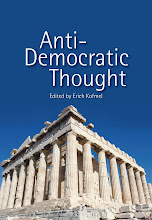

 Posts
Posts

