
Please circulate widely!
CALL FOR PAPERS
Anti-Democracy Agenda Symposium 2011
Organized by: Sussex Centre for the Individual and Society (SCIS)
Mode: Online by Google+ video conference
Date: 15-16 November 2011
The "Anti-Democracy Agenda" is the premier resource on the net for the study of anti-democratic thought and practice across the boundaries of various traditions and academic disciplines. First introduced by the Sussex Centre for the Individual and Society (SCIS) as a blog in January 2010, it has since been reconstituted as a circle (with associated public posts, much like a blog) on the new social network Google+. An archive of the blog is to be found here: http://anti-democracy-agenda.blogspot.com
For the new circle, see here:
https://plus.google.com/109507108125539761871/posts
The Anti-Democracy Agenda Symposium 2011 will be the third event we organize to advance the research agenda on anti-democratic thought and practice as well as old and new criticisms of democracy. It will build up on a highly successful workshop on anti-democratic thought SCIS organized at the Annual Conference Workshops in Political Theory in Manchester, England, in September 2007, as well as the Anti-Democracy Agenda Symposium 2010, taking place at the Swiss Federal Institute of Technology (ETH) Zurich in November last year. Both events drew participants from the world over. The Manchester workshop led to the publication of an edited volume on "Anti-Democratic Thought" (Imprint Academic, 2008).
The Anti-Democracy Agenda Symposium 2011 is set to be equally international and interdisciplinary in scope. We invite affiliated academics, independent scholars, and doctoral students and candidates from a wide range of disciplines, such as Philosophy, Political Theory, Political Science, International Relations, Development Studies, Security Studies, Law, Economics, Sociology, Anthropology, Psychology, Literature, History, Classics, Theology, Religious Studies, Education, and so on. Papers may not only cover any and all aspects of criticisms of democracy and anti-democratic thought and practice, from perspectives including anarchism, libertarianism, conservatism, communism, Islamism, the extreme right, and others, but also related concepts such as authoritarianism, dictatorship, military rule, monarchy, chieftaincy, mixed constitution, the backlash against democracy promotion, terrorism, post-democracy, voter apathy, voter ignorance, etc. Have a look at the blog to see what might be of interest and falls within our remit. Papers may be theoretical and/or empirical in nature. Work in progress is welcome too.
This symposium may be the first academic conference to make use of the “Hangouts” video conference facility that is an integral part of Google+. Due to technical restrictions, the number of participants in the Anti-Democracy Agenda Symposium 2011 is limited to 10. All accepted participants will be required to create a profile on Google+ in order to be able to participate in the event. While we encourage the participation of scholars from developing countries, please only apply if you have access to a stable Internet connection. As in our previous physical events, over the course of two days, each presenter will have 60 minutes to present his or her paper and discuss it with all others. Due to the small size of the symposium, all participants are expected to attend both days fully.
As with all SCIS events, no fees will be charged from participants, and no funding is available to cover participants' expenses (if any). We will be glad to issue letters of acceptance on request to assist participants in securing leave from work. Detailed instructions on how to set up a Google+ profile and join the video conference will be provided to confirmed participants.
Please send your proposal to: erichkofmel@gmail.com
Deadline: 15 October 2011
Later submissions may still be accepted, but early submission is strongly advised and proposals may be accepted as they come in.
Cordially,
Erich Kofmel
Managing Director / Research Professor of Political Theory
Sussex Centre for the Individual and Society (SCIS)
https://plus.google.com/109507108125539761871
E-mail: erichkofmel@gmail.com
Postal address:
Sussex Centre for the Individual and Society
1200 Geneva
Switzerland
SCIS is an international association under Swiss law.
Founded 2006 at the University of Sussex.
Showing posts with label philosophy. Show all posts
Showing posts with label philosophy. Show all posts
16 August 2011

30 December 2010
CFP: Freedom and Power
"Theoria: A Journal of Social and Political Theory", based out of the Faculty of Humanities, Development and Social Sciences at the University of KwaZulu-Natal, South Africa, is planning an issue on "Freedom and Power".
Call for papers
Description: "Ever since Livy proclaimed that 'freedom is to be in one's own power', if not from a long time before, the relationship between freedom and power has been an enduring concern of political theorists. It has withstood even Berlin's sharp distinctions between seemingly irreconcilable kinds of freedom and the subsequent diversion via debates about 'negative['], 'positive' and 'republican' freedom. With greater historical purview it is possible to see that the fault line between various competing conceptions of freedom is clearest with regard to how social and political theorists conceive of the relationship between freedom and power. While some thinkers have opposed freedom and power, arguing that liberty can only be truly attained free from power and domination (republicans) or in the absence of external impediments imposed by other human beings (liberals), others have identified a close and intriguing link between them, especially in the sphere of politics. A motley crew of radicals, Marxists and conservatives occupy the latter camp, including Livy, Machiavelli, Montaigne, Marx, Nietzsche and Foucault. Moreover, those in the former camp tend to think of freedom in formal and abstract terms, while proponents of the latter eschew this now normal tendency in political philosophy and instead think of freedom in fully substantive, concrete and even materialist terms. (Hobbes is an unusual and unique figure as his account of freedom inspires members of both parties in this debate.)
"Several important questions arise concerning freedom and power: What is freedom?; What is the relationship between freedom and power?; How, if at all, are freedom and domination related?; Is there a categorical or insurmountable conflict between freedom and discipline?; Does freedom depend upon being free from interference or being able to achieve certain desired or desirable goals or ends?; Are these two conditions – freedom from interference and the ability or power to achieve certain ends – related in some sense?; Can we measure freedom, and, if so, how?; What forms or degrees of freedom are possible in modern representative democracies?; How does representation affect freedom?; Is our freedom dependent on the power of our representatives?; How does the degradation of the planetary environment affect our views on freedom?; Given the dire need for self-control and self-discipline, especially regarding levels of consumption in the developed North, is the concept of freedom even still relevant?; Does the concept of freedom need to be reconfigured to accommodate constraint, austerity and self-control? If so, how?; What do the experiences of relatively recently liberated states teach us about freedom?; What is the relationship between freedom and power in the 'Global South'?; How, if at all, does poverty affect freedom?
"The editors of Theoria ask contributors to think about these questions in and of themselves and in the light of the various arguments from any of the proponents of the various conceptions of freedom. These can be written about in term of furthering our understanding of the nature of personal and political freedom within modern representative democracies or in order to develop novel arguments that propose conceptions of freedom for different possible future political organizations and forms of power. While abstract theoretical insights and arguments are welcome, we urge contributors to try and think about freedom and power within and between particular political contexts, especially within the 'Global South', where often freedom is a nascent and precarious achievement, and sometimes only for the lucky few, and between the 'Global South' and the 'Global North', either in relational or comparative terms. Given the changing power relations that exist within and between existing states, there is also much room for utopian thought regarding new forms of freedom in as yet un-experienced contexts of political power and moral conflict."
Submission must be sent in MS Word format to the Managing Editor, Sherran Clarence (University of the Western Cape): sherranclarence@gmail.com
Deadline: 31 August 2011
Call for papers
Description: "Ever since Livy proclaimed that 'freedom is to be in one's own power', if not from a long time before, the relationship between freedom and power has been an enduring concern of political theorists. It has withstood even Berlin's sharp distinctions between seemingly irreconcilable kinds of freedom and the subsequent diversion via debates about 'negative['], 'positive' and 'republican' freedom. With greater historical purview it is possible to see that the fault line between various competing conceptions of freedom is clearest with regard to how social and political theorists conceive of the relationship between freedom and power. While some thinkers have opposed freedom and power, arguing that liberty can only be truly attained free from power and domination (republicans) or in the absence of external impediments imposed by other human beings (liberals), others have identified a close and intriguing link between them, especially in the sphere of politics. A motley crew of radicals, Marxists and conservatives occupy the latter camp, including Livy, Machiavelli, Montaigne, Marx, Nietzsche and Foucault. Moreover, those in the former camp tend to think of freedom in formal and abstract terms, while proponents of the latter eschew this now normal tendency in political philosophy and instead think of freedom in fully substantive, concrete and even materialist terms. (Hobbes is an unusual and unique figure as his account of freedom inspires members of both parties in this debate.)
"Several important questions arise concerning freedom and power: What is freedom?; What is the relationship between freedom and power?; How, if at all, are freedom and domination related?; Is there a categorical or insurmountable conflict between freedom and discipline?; Does freedom depend upon being free from interference or being able to achieve certain desired or desirable goals or ends?; Are these two conditions – freedom from interference and the ability or power to achieve certain ends – related in some sense?; Can we measure freedom, and, if so, how?; What forms or degrees of freedom are possible in modern representative democracies?; How does representation affect freedom?; Is our freedom dependent on the power of our representatives?; How does the degradation of the planetary environment affect our views on freedom?; Given the dire need for self-control and self-discipline, especially regarding levels of consumption in the developed North, is the concept of freedom even still relevant?; Does the concept of freedom need to be reconfigured to accommodate constraint, austerity and self-control? If so, how?; What do the experiences of relatively recently liberated states teach us about freedom?; What is the relationship between freedom and power in the 'Global South'?; How, if at all, does poverty affect freedom?
"The editors of Theoria ask contributors to think about these questions in and of themselves and in the light of the various arguments from any of the proponents of the various conceptions of freedom. These can be written about in term of furthering our understanding of the nature of personal and political freedom within modern representative democracies or in order to develop novel arguments that propose conceptions of freedom for different possible future political organizations and forms of power. While abstract theoretical insights and arguments are welcome, we urge contributors to try and think about freedom and power within and between particular political contexts, especially within the 'Global South', where often freedom is a nascent and precarious achievement, and sometimes only for the lucky few, and between the 'Global South' and the 'Global North', either in relational or comparative terms. Given the changing power relations that exist within and between existing states, there is also much room for utopian thought regarding new forms of freedom in as yet un-experienced contexts of political power and moral conflict."
Submission must be sent in MS Word format to the Managing Editor, Sherran Clarence (University of the Western Cape): sherranclarence@gmail.com
Deadline: 31 August 2011
15 November 2010
Article: Postdemocracy, organizational transformation and the (im)possibility of politics
Timon Beyes and Christina Volkmann, "The fantasy of the organizational One: Postdemocracy, organizational transformation and the (im)possibility of politics" ("Journal of Organizational Change Management", 23 [6], 2010: pp. 651-68):
www.emeraldinsight.com/journals.htm?articleid=1891962
Abstract: "Purpose – The purpose of this paper is to reflect upon the politics of and in organizational transformations in the wake of the fall of the Berlin wall and Germany's reunification. Design/methodology/approach – The paper juxtaposes a political-philosophical perspective informed by Rancière – what we call a dramaturgy of politics – with the findings of an ethnographic study conducted in the Berlin State Library in 2002/2003. Findings – The paper outlines a reading of the event of November 9, 1989[,] and its aftermath as a dissensual event of politics proper, i.e. the emergence of a new political subjectivity, followed by a consensual process of social organization. In the state library, both the consensual 'fantasy of the organizational One' as well [sic] its disruption are causing struggles over what is visible and sayable. A dramaturgy of politics thus encourages us to add our voices to the specific time-spaces in which an excess of words, signs and forms alters the configuration of what is visible and expressible. Research limitations/implications – The usual disclaimers about the limits of ethnographic research apply. The paper calls for further inquiries into the dramaturgy of organizational politics. It also reflects upon the 'Western gaze' and the problematic of 'speaking for' the presumably dominated. Originality/value – It is hoped that the paper contributes to the understanding of the politics of organization (theory) by outlining an alternative conceptual approach and confronting it with ethnographic findings."
I had no access to the full text of the article.
Timon Beyes is Senior Lecturer in Non-Profit Management at the University of St Gallen, Switzerland.
Christina Volkmann is Lecturer in Management at the University of Essex.
www.emeraldinsight.com/journals.htm?articleid=1891962
Abstract: "Purpose – The purpose of this paper is to reflect upon the politics of and in organizational transformations in the wake of the fall of the Berlin wall and Germany's reunification. Design/methodology/approach – The paper juxtaposes a political-philosophical perspective informed by Rancière – what we call a dramaturgy of politics – with the findings of an ethnographic study conducted in the Berlin State Library in 2002/2003. Findings – The paper outlines a reading of the event of November 9, 1989[,] and its aftermath as a dissensual event of politics proper, i.e. the emergence of a new political subjectivity, followed by a consensual process of social organization. In the state library, both the consensual 'fantasy of the organizational One' as well [sic] its disruption are causing struggles over what is visible and sayable. A dramaturgy of politics thus encourages us to add our voices to the specific time-spaces in which an excess of words, signs and forms alters the configuration of what is visible and expressible. Research limitations/implications – The usual disclaimers about the limits of ethnographic research apply. The paper calls for further inquiries into the dramaturgy of organizational politics. It also reflects upon the 'Western gaze' and the problematic of 'speaking for' the presumably dominated. Originality/value – It is hoped that the paper contributes to the understanding of the politics of organization (theory) by outlining an alternative conceptual approach and confronting it with ethnographic findings."
I had no access to the full text of the article.
Timon Beyes is Senior Lecturer in Non-Profit Management at the University of St Gallen, Switzerland.
Christina Volkmann is Lecturer in Management at the University of Essex.
13 November 2010
Report on the Anti-Democracy Agenda Symposium 2010: Setting the example for the debate of the future
The first event held by the Geneva-based Sussex Centre for the Individual and Society (SCIS) in conjunction with its "Anti-Democracy Agenda" blog, the Anti-Democracy Agenda Symposium 2010, took place to great acclaim on 8 and 9 November 2010 at the Swiss Federal Institute of Technology (ETH) Zurich.
Keynotes to the symposium were contributed by Professor Doh Chull Shin, a native of Korea, director of the Korea Democracy Barometer, and core partner in the Asian Barometer Survey (an ongoing research project monitoring democratization in Asian countries), who is based in the Department of Political Science at the University of Missouri, a leading public research university in the United States, and Professor Kuldip Singh, Head of the Department of Political Science at Guru Nanak Dev University in Amritsar, India.
The Anti-Democracy Agenda Symposium 2010 attracted twelve papers submitted by participants from institutions such as the National University of Singapore, the University of the Philippines, the Technical University of Lisbon (Portugal), Ankara University (Turkey), the University of the Punjab, Quaid-i-Azam University (both Pakistan), the University of Central Oklahoma (USA), and the Islamic Azad University (Iran). Other countries and territories of origin or residence represented include Palestine, Hong Kong, New Zealand, the UK, Switzerland, Nigeria, Korea, and India.
Participants – from doctoral candidates to full professors – came from the disciplines of Political Science, Philosophy, Political Theory, Islamic Studies, Defence and Strategic Studies, Law, and Media Studies, giving theoretical as well as empirical presentations under the titles "Is Confucianism Anti-democratic?", "Islamic Philosophy and Criticizing Democracy", "Against Liberal Democracy", "Anti-Democracy Is Created By Means of Media", "Twenty-First Century Anti-Democracy: Theory and Practice in the World", "A Critique of Western Discourses of Sovereignty and Democracy from Chinese Lenses", "Reflecting on Anti-Democracy Forces in Arab Politics", "'Democracy' in Kazakhstan: Political System Managed from Above", "Pakistan’s Road to Democracy: Islam, Military and Silent Majority", "Democracy: A Form of Government or an Instinct?", "The Role of Ethics in Shaping Democracy: An Examination of Unethical Actions among House of Assembly Members in Nigeria", and "Pekan Anti Otoritarian: Some Observations on Anarchist Gathering at Indonesia".
After a workshop on "Anti-Democratic Thought" in Manchester in 2007, this was the second symposium on anti-democracy organized by the Sussex Centre for the Individual and Society and, once more, it opened up new frontiers for the study of anti-democratic thought and practice. Bringing together scholars from both sides of the debate, advocates of democracy as well as critics and opponents, it set the example for the proper academic conduct of a discussion that does not take place anywhere else, yet. Focusing on twenty-first century anti-democracy, rather than historical expressions and criticisms, it shone the way toward the most important debate of the near future. Asia will play as central a role in that debate as participants from Asia did in our symposium.
The Anti-Democracy Agenda blog and the Sussex Centre for the Individual and Society will continue to be at the forefront of these developments.

Keynotes to the symposium were contributed by Professor Doh Chull Shin, a native of Korea, director of the Korea Democracy Barometer, and core partner in the Asian Barometer Survey (an ongoing research project monitoring democratization in Asian countries), who is based in the Department of Political Science at the University of Missouri, a leading public research university in the United States, and Professor Kuldip Singh, Head of the Department of Political Science at Guru Nanak Dev University in Amritsar, India.
The Anti-Democracy Agenda Symposium 2010 attracted twelve papers submitted by participants from institutions such as the National University of Singapore, the University of the Philippines, the Technical University of Lisbon (Portugal), Ankara University (Turkey), the University of the Punjab, Quaid-i-Azam University (both Pakistan), the University of Central Oklahoma (USA), and the Islamic Azad University (Iran). Other countries and territories of origin or residence represented include Palestine, Hong Kong, New Zealand, the UK, Switzerland, Nigeria, Korea, and India.
Participants – from doctoral candidates to full professors – came from the disciplines of Political Science, Philosophy, Political Theory, Islamic Studies, Defence and Strategic Studies, Law, and Media Studies, giving theoretical as well as empirical presentations under the titles "Is Confucianism Anti-democratic?", "Islamic Philosophy and Criticizing Democracy", "Against Liberal Democracy", "Anti-Democracy Is Created By Means of Media", "Twenty-First Century Anti-Democracy: Theory and Practice in the World", "A Critique of Western Discourses of Sovereignty and Democracy from Chinese Lenses", "Reflecting on Anti-Democracy Forces in Arab Politics", "'Democracy' in Kazakhstan: Political System Managed from Above", "Pakistan’s Road to Democracy: Islam, Military and Silent Majority", "Democracy: A Form of Government or an Instinct?", "The Role of Ethics in Shaping Democracy: An Examination of Unethical Actions among House of Assembly Members in Nigeria", and "Pekan Anti Otoritarian: Some Observations on Anarchist Gathering at Indonesia".
After a workshop on "Anti-Democratic Thought" in Manchester in 2007, this was the second symposium on anti-democracy organized by the Sussex Centre for the Individual and Society and, once more, it opened up new frontiers for the study of anti-democratic thought and practice. Bringing together scholars from both sides of the debate, advocates of democracy as well as critics and opponents, it set the example for the proper academic conduct of a discussion that does not take place anywhere else, yet. Focusing on twenty-first century anti-democracy, rather than historical expressions and criticisms, it shone the way toward the most important debate of the near future. Asia will play as central a role in that debate as participants from Asia did in our symposium.
The Anti-Democracy Agenda blog and the Sussex Centre for the Individual and Society will continue to be at the forefront of these developments.

25 September 2010
Book: In Defense of Lost Causes
Slavoj Žižek, "In Defense of Lost Causes" (Verso, 2008):
www.versobooks.com/books/431-in-defense-of-lost-causes
Publisher's description: "In this combative major new work, philosophical sharpshooter Slavoj Zizek looks for the kernel of truth in the totalitarian politics of the past. Examining Heidegger's seduction by fascism and Foucault's flirtation with the Iranian Revolution, he suggests that these were the 'right steps in the wrong direction.' On the revolutionary terror of Robespierre, Mao and the bolsheviks, Zizek argues that while these struggles ended in historic failure and horror, there was a valuable core of idealism lost beneath the bloodshed. A redemptive vision has been obscured by the soft, decentralized politics of the liberal-democratic consensus. Faced with the coming ecological crisis, Zizekk [sic] argues the case for revolutionary terror and the dictatorship of the proletariat. A return to past ideals is needed despite the risks. In the words of Samuel Beckett: 'Try again. Fail again. Fail better.'"
Review: "Zizek [...] addresses the limits of liberal democratic approaches to politics and the possibility of benefit in totalitarian approaches to statehood. [...] Scholars of political theory and modern philosophy will find much here to consider and argue for or against." ("Library Journal")
Slavoj Žižek is a Slovenian philosopher and psychoanalyst, Senior Researcher at the Institute of Sociology, University of Ljubljana, and International Director of the Birkbeck Institute for the Humanities at Birkbeck College, University of London.
Matthew Sharpe's article "'Then We Will Fight Them in the Shadows!': Seven Parataxic Views, On Žižek's Style", which appeared recently in the online publication "International Journal of Žižek Studies" (4 [2], 2010), draws on this book.
The full text of the article can be downloaded free of charge here:
www.zizekstudies.org/index.php/ijzs/article/view/261
Excerpts: "Žižek's commitment to the egalitarian-revolutionary Idea places him on a continuum with the radical democratic political tradition with which his earlier work is usually associated. Democracy, rule of and by the people, implies some minimal commitment to egalitarianism, however conceived. Yet, following Badiou, and associating democracy with contemporary liberal-democracy, Žižek at several points indicates that faith in democracy today is the Enemy to be overcome: 'What, today, prevents the radical questioning of capitalism itself is precisely the belief in the democratic form of the struggle against capitalism.' (Žižek 2008, p. 183) [...] Žižek is unconditionally, or rather profoundly, attracted to [...] the utopian moment of radical negativity, in which the old regime is overthrown and suddenly we confront an indefinite, open future, shorn of any 'big Other' defining what is possible and impossible, permitted and prohibited ('Nothing should be accepted as inviolable in this new re-foundation, neither the need for economic "modernisation" nor the most sacred liberal and democratic fetishes' (Žižek 2008, p. 276)"
Matthew Sharpe and Geoff M. Boucher are the authors of a book on "Žižek and Politics: A Critical Introduction" (Edinburgh University Press, March 2010) that also seeks to highlight "Žižek's shift from his earlier, radical-democratic politics, to his later [that is, current], revolutionary, authoritarian vanguardism":
www.euppublishing.com/book/9780748638048
Publisher's description: "In Zizek and Politics, Geoff Boucher and Matthew Sharpe go beyond standard introductions to spell out a new approach to reading Zizek, one that can be highly critical as well as deeply appreciative. They show that Zizek has a raft of fundamental positions that enable his theoretical positions to be put to work on practical problems. Explaining these positions with clear examples, they outline why Zizek's confrontation with thinkers such as Derrida, Foucault and Deleuze has so radically changed how we think about society. They then go on to track Zizek's own intellectual development during the last twenty years, as he has grappled with theoretical problems and the political climate of the War on Terror. This book is a major addition to the literature on Zizek and a crucial critical introduction to his thought." (bold removed)
This book is fully searchable on Google Book Search (including table of contents):
http://books.google.com/books?id=OHDgjpvREnMC&printsec=frontcover
Matthew Sharpe is a Lecturer in the School of International and Political Studies and Geoff M. Boucher is a Lecturer in the School of Communication and Creative Arts, both at Deakin University, Geelong, Australia.
www.versobooks.com/books/431-in-defense-of-lost-causes
Publisher's description: "In this combative major new work, philosophical sharpshooter Slavoj Zizek looks for the kernel of truth in the totalitarian politics of the past. Examining Heidegger's seduction by fascism and Foucault's flirtation with the Iranian Revolution, he suggests that these were the 'right steps in the wrong direction.' On the revolutionary terror of Robespierre, Mao and the bolsheviks, Zizek argues that while these struggles ended in historic failure and horror, there was a valuable core of idealism lost beneath the bloodshed. A redemptive vision has been obscured by the soft, decentralized politics of the liberal-democratic consensus. Faced with the coming ecological crisis, Zizekk [sic] argues the case for revolutionary terror and the dictatorship of the proletariat. A return to past ideals is needed despite the risks. In the words of Samuel Beckett: 'Try again. Fail again. Fail better.'"
Review: "Zizek [...] addresses the limits of liberal democratic approaches to politics and the possibility of benefit in totalitarian approaches to statehood. [...] Scholars of political theory and modern philosophy will find much here to consider and argue for or against." ("Library Journal")
Slavoj Žižek is a Slovenian philosopher and psychoanalyst, Senior Researcher at the Institute of Sociology, University of Ljubljana, and International Director of the Birkbeck Institute for the Humanities at Birkbeck College, University of London.
Matthew Sharpe's article "'Then We Will Fight Them in the Shadows!': Seven Parataxic Views, On Žižek's Style", which appeared recently in the online publication "International Journal of Žižek Studies" (4 [2], 2010), draws on this book.
The full text of the article can be downloaded free of charge here:
www.zizekstudies.org/index.php/ijzs/article/view/261
Excerpts: "Žižek's commitment to the egalitarian-revolutionary Idea places him on a continuum with the radical democratic political tradition with which his earlier work is usually associated. Democracy, rule of and by the people, implies some minimal commitment to egalitarianism, however conceived. Yet, following Badiou, and associating democracy with contemporary liberal-democracy, Žižek at several points indicates that faith in democracy today is the Enemy to be overcome: 'What, today, prevents the radical questioning of capitalism itself is precisely the belief in the democratic form of the struggle against capitalism.' (Žižek 2008, p. 183) [...] Žižek is unconditionally, or rather profoundly, attracted to [...] the utopian moment of radical negativity, in which the old regime is overthrown and suddenly we confront an indefinite, open future, shorn of any 'big Other' defining what is possible and impossible, permitted and prohibited ('Nothing should be accepted as inviolable in this new re-foundation, neither the need for economic "modernisation" nor the most sacred liberal and democratic fetishes' (Žižek 2008, p. 276)"
Matthew Sharpe and Geoff M. Boucher are the authors of a book on "Žižek and Politics: A Critical Introduction" (Edinburgh University Press, March 2010) that also seeks to highlight "Žižek's shift from his earlier, radical-democratic politics, to his later [that is, current], revolutionary, authoritarian vanguardism":
www.euppublishing.com/book/9780748638048
Publisher's description: "In Zizek and Politics, Geoff Boucher and Matthew Sharpe go beyond standard introductions to spell out a new approach to reading Zizek, one that can be highly critical as well as deeply appreciative. They show that Zizek has a raft of fundamental positions that enable his theoretical positions to be put to work on practical problems. Explaining these positions with clear examples, they outline why Zizek's confrontation with thinkers such as Derrida, Foucault and Deleuze has so radically changed how we think about society. They then go on to track Zizek's own intellectual development during the last twenty years, as he has grappled with theoretical problems and the political climate of the War on Terror. This book is a major addition to the literature on Zizek and a crucial critical introduction to his thought." (bold removed)
This book is fully searchable on Google Book Search (including table of contents):
http://books.google.com/books?id=OHDgjpvREnMC&printsec=frontcover
Matthew Sharpe is a Lecturer in the School of International and Political Studies and Geoff M. Boucher is a Lecturer in the School of Communication and Creative Arts, both at Deakin University, Geelong, Australia.
24 September 2010
Book: Why we don't love democracy (in French)
Myriam Revault d'Allonnes is the author of "Pourquoi nous n'aimons pas la démocratie" (Why we don't love democracy; my translation), a book published in February 2010 by Seuil:
www.seuil.com/fiche-ouvrage.php?EAN=9782020986687
Publisher's description: "We remember Churchill's saying: 'Democracy is the worst form of government except all those other forms that have been tried from time to time'. Obviously, we do not 'love' democracy. And yet we are all democrats ... This strange process of disenchantment is as virulent as it is old: already in ancient Athens, there was no shortage of critics of democracy. Myriam Revault d'Allonnes interrogates not only the criticisms or sarcasms levelled at democracy, but also the nature of the democratic experience, with its uncertainty, conflicts, incompleteness, inextricably linked to what opposes and threatens it. How should democratic man, confronted with this always problematic existence, not fall prey to dissatisfaction and permanent disappointment? Nevertheless, if we do not 'love' democracy, can we not desire to? Because it is the democratic experience that makes us ethical and political subjects, citizens who do not just want to be governed, 'not like that, not for this, not by them'." (my rough translation)
Myriam Revault d'Allonnes is Professor of Philosophy at the École Pratique des Hautes Etudes (EPHE), Paris.
www.seuil.com/fiche-ouvrage.php?EAN=9782020986687
Publisher's description: "We remember Churchill's saying: 'Democracy is the worst form of government except all those other forms that have been tried from time to time'. Obviously, we do not 'love' democracy. And yet we are all democrats ... This strange process of disenchantment is as virulent as it is old: already in ancient Athens, there was no shortage of critics of democracy. Myriam Revault d'Allonnes interrogates not only the criticisms or sarcasms levelled at democracy, but also the nature of the democratic experience, with its uncertainty, conflicts, incompleteness, inextricably linked to what opposes and threatens it. How should democratic man, confronted with this always problematic existence, not fall prey to dissatisfaction and permanent disappointment? Nevertheless, if we do not 'love' democracy, can we not desire to? Because it is the democratic experience that makes us ethical and political subjects, citizens who do not just want to be governed, 'not like that, not for this, not by them'." (my rough translation)
Myriam Revault d'Allonnes is Professor of Philosophy at the École Pratique des Hautes Etudes (EPHE), Paris.
21 September 2010
Article: Manifesto of Affirmationism
The leftist French philosopher Alain Badiou's "Manifesto of Affirmationism" (trans. Barbara P. Fulks) was published in the New York-based biannual journal of critical theory, art, and fiction "Lacanian Ink" (24/25, spring 2005: no page numbers given).
The full text of the article can be read free of charge here:
www.lacan.com/frameXXIV5.htm
Excerpts: "We cannot understand what is gripping us and causing us to despair if we do not return again and again to the fact that our world is not at all a democracy, but rather an imperial conservatism under the guise of democratic phraseology. What to say of today's world? A solitary power whose army is terrorizing the entire planet dictates its law of the circulation of capital and images and proclaims everywhere, with the most extreme violence, the Duties and Rights of everyone. [...] Under the imposed name of 'terrorism,' those most violently opposed to this hegemony of the brutal West, for which 'democracy' is spiritual ornament, are in reality part of it [...]: the fury of inspired barbarism against sated imperialism. [...] Romantic formalism has always been an artistic orientation of ensconced and terminal dominations. And it is thus in our time: that of a unique and multiform doctrine (economic liberalism and political electoralism), integrating for the first time the quasi-totality of human species in the distribution and constraint of its fortune.
"Yes, our time is that of the unique doctrine and of the consensus which is created around it under the strange name of 'democracy.' Any unique doctrine of this type is desperate, nihilist, because it only proposes to the human multiplicity the absurd perpetuation of its obscene order. And the artistic subjectivity that it leads to is that of this nihilism and of this obscenity. [...] The only maxim of contemporary art is to not be 'Western.' Which means also that it should not be democratic, if democratic means: conforming to the Western idea of political liberty. [...] Yes, the only problem is to know if the artistic imperative can be detached from the Western imperative, which is that of marketing and communication. Western democracy, in effect, is marketing and communication. Thus true art is that which interrupts marketing, that which communicates nothing. Immobile and incommunicable, this is the art we need, the only one that addresses everyone, not circulating according to any pre-established network and not communicating with anyone in particular. Art should augment in everyone the non-democratic strength of one's liberty. [...]
"A non-Western art is necessarily an abstract art, in the following sense: it abstracts from all particularity and formalizes this gesture of abstraction. In order to combat expressivity, to combat Romantic formalism, there is only the dynamic of abstraction. [...] The abstraction in art which is and which is to come does not consider any particular public [...]: it does what it says, without needing acceptance from anyone. We affirm that all sociological and institutional speculations about the audience for the arts must be abandoned. Sociology, and criticism itself, is only and always the auxiliary of Western democracy. [...] Convinced of controlling the entire extent of the visible and of the audible through commercial laws of marketing and the democratic laws of communication, contemporary power no longer needs censorship. It says: 'Everything is possible.' Which also might mean that nothing is. Abandoning itself to this authorization to jouir [enjoy, delight in] is the ruin of all art, as well as all thought. We should be our own pitiless censors. [...] It is better to do nothing than to work officially in the visibility of what the West declares to exist."
Alain Badiou was formerly chair of Philosophy at the École Normale Supérieure (ENS) in Paris.
The full text of the article can be read free of charge here:
www.lacan.com/frameXXIV5.htm
Excerpts: "We cannot understand what is gripping us and causing us to despair if we do not return again and again to the fact that our world is not at all a democracy, but rather an imperial conservatism under the guise of democratic phraseology. What to say of today's world? A solitary power whose army is terrorizing the entire planet dictates its law of the circulation of capital and images and proclaims everywhere, with the most extreme violence, the Duties and Rights of everyone. [...] Under the imposed name of 'terrorism,' those most violently opposed to this hegemony of the brutal West, for which 'democracy' is spiritual ornament, are in reality part of it [...]: the fury of inspired barbarism against sated imperialism. [...] Romantic formalism has always been an artistic orientation of ensconced and terminal dominations. And it is thus in our time: that of a unique and multiform doctrine (economic liberalism and political electoralism), integrating for the first time the quasi-totality of human species in the distribution and constraint of its fortune.
"Yes, our time is that of the unique doctrine and of the consensus which is created around it under the strange name of 'democracy.' Any unique doctrine of this type is desperate, nihilist, because it only proposes to the human multiplicity the absurd perpetuation of its obscene order. And the artistic subjectivity that it leads to is that of this nihilism and of this obscenity. [...] The only maxim of contemporary art is to not be 'Western.' Which means also that it should not be democratic, if democratic means: conforming to the Western idea of political liberty. [...] Yes, the only problem is to know if the artistic imperative can be detached from the Western imperative, which is that of marketing and communication. Western democracy, in effect, is marketing and communication. Thus true art is that which interrupts marketing, that which communicates nothing. Immobile and incommunicable, this is the art we need, the only one that addresses everyone, not circulating according to any pre-established network and not communicating with anyone in particular. Art should augment in everyone the non-democratic strength of one's liberty. [...]
"A non-Western art is necessarily an abstract art, in the following sense: it abstracts from all particularity and formalizes this gesture of abstraction. In order to combat expressivity, to combat Romantic formalism, there is only the dynamic of abstraction. [...] The abstraction in art which is and which is to come does not consider any particular public [...]: it does what it says, without needing acceptance from anyone. We affirm that all sociological and institutional speculations about the audience for the arts must be abandoned. Sociology, and criticism itself, is only and always the auxiliary of Western democracy. [...] Convinced of controlling the entire extent of the visible and of the audible through commercial laws of marketing and the democratic laws of communication, contemporary power no longer needs censorship. It says: 'Everything is possible.' Which also might mean that nothing is. Abandoning itself to this authorization to jouir [enjoy, delight in] is the ruin of all art, as well as all thought. We should be our own pitiless censors. [...] It is better to do nothing than to work officially in the visibility of what the West declares to exist."
Alain Badiou was formerly chair of Philosophy at the École Normale Supérieure (ENS) in Paris.
17 September 2010
Article: An alternative to the new wave of ecofascism
Micah White, a US activist and contributing editor at the Canada-based anti-consumerist magazine "Adbusters", is the author of an op-ed article titled "An alternative to the new wave of ecofascism", published on 16 September 2010 on the website of the British "Guardian" newspaper.
The full text of the article can be read free of charge here:
www.guardian.co.uk/commentisfree/cif-green/2010/sep/16/authoritarianism-ecofascism-alternative
Excerpts: "It is time to acknowledge that mainstream environmentalism has failed to prevent climate catastrophe. Its refusal to call for an immediate consumption reduction has backfired and its demise has opened the way for a wave of fascist environmentalists who reject democratic freedom. One well-known example of the authoritarian turn in environmentalism is James Lovelock, the first scientist to discover the presence of ozone-depleting chlorofluorocarbons in the atmosphere. Earlier this year he told the Guardian that democracies are incapable of adequately addressing climate change. [...] His words may be disturbing, but other ecologists have gone much further. Take for example Pentti Linkola, a Finnish fisherman and ecological philosopher. Whereas Lovelock puts his faith in advanced technology, Linkola proposes a turn to fascistic primitivism. Their only point of agreement is on the need to suspend democracy.
"Linkola has built an environmentalist following by calling for an authoritarian, ecological regime that ruthlessly suppresses consumers. Largely unknown outside of Finland until the first English translation of his work was published last year, Linkola represents environmentalism pushed to its totalitarian extreme. [...] His bold political programme includes [...] 're-education' in eco-gulags [...]. In Linkola's dystopian vision, the resources of the state are mobilised to clamp down on individual liberty. But there is no need to suspend democracy if it is returned to the people. Democratic, anti-fascist environmentalism means marshalling the strength of humanity to suppress corporations. Only by silencing the consumerist forces will both climate catastrophe and ecological tyranny be averted."
White calls for "the criminalisation of advertising" and "the possibility of death penalties for corporations". While he claims that this would be done "voluntarily and joyously", it is hard to see just how the measures he proposes are more democratic than those of the ecofascists. He too appears to be seeking to mobilize the resources of the (democratic) state to clamp down on consumerism.
Linkola, the son of a former Rector of the University of Helsinki and grandson of a former Chancellor of that same university, has had a "Fansite" dedicated to him:
www.penttilinkola.com/pentti_linkola/ecofascism/
On that site, he is quoted as saying (presumably originally in Finnish): "Any dictatorship would be better than modern democracy. There cannot be so incompetent dictator, [sic] that he would show more stupidity than a majority of the people. Best dictatorship would be one where lots of heads would roll and government would prevent any economical growth." / "A minority can never have any other effective means to influence the course of matters but through the use of violence." / "We will have to ... learn from the history of revolutionary movements – the [N]ational [S]ocialists, the Finnish Stalinists, from the many stages of the Russian revolution, from the methods of the Red Brigades – and forget our narcissistic selves." / "[D]emocracy and parliamentary system [...] are the most mindless and desperate experiments of the mankind ... [sic]"
The links on the website to other ecofascist resources and groups appear not to be working.
The full text of the article can be read free of charge here:
www.guardian.co.uk/commentisfree/cif-green/2010/sep/16/authoritarianism-ecofascism-alternative
Excerpts: "It is time to acknowledge that mainstream environmentalism has failed to prevent climate catastrophe. Its refusal to call for an immediate consumption reduction has backfired and its demise has opened the way for a wave of fascist environmentalists who reject democratic freedom. One well-known example of the authoritarian turn in environmentalism is James Lovelock, the first scientist to discover the presence of ozone-depleting chlorofluorocarbons in the atmosphere. Earlier this year he told the Guardian that democracies are incapable of adequately addressing climate change. [...] His words may be disturbing, but other ecologists have gone much further. Take for example Pentti Linkola, a Finnish fisherman and ecological philosopher. Whereas Lovelock puts his faith in advanced technology, Linkola proposes a turn to fascistic primitivism. Their only point of agreement is on the need to suspend democracy.
"Linkola has built an environmentalist following by calling for an authoritarian, ecological regime that ruthlessly suppresses consumers. Largely unknown outside of Finland until the first English translation of his work was published last year, Linkola represents environmentalism pushed to its totalitarian extreme. [...] His bold political programme includes [...] 're-education' in eco-gulags [...]. In Linkola's dystopian vision, the resources of the state are mobilised to clamp down on individual liberty. But there is no need to suspend democracy if it is returned to the people. Democratic, anti-fascist environmentalism means marshalling the strength of humanity to suppress corporations. Only by silencing the consumerist forces will both climate catastrophe and ecological tyranny be averted."
White calls for "the criminalisation of advertising" and "the possibility of death penalties for corporations". While he claims that this would be done "voluntarily and joyously", it is hard to see just how the measures he proposes are more democratic than those of the ecofascists. He too appears to be seeking to mobilize the resources of the (democratic) state to clamp down on consumerism.
Linkola, the son of a former Rector of the University of Helsinki and grandson of a former Chancellor of that same university, has had a "Fansite" dedicated to him:
www.penttilinkola.com/pentti_linkola/ecofascism/
On that site, he is quoted as saying (presumably originally in Finnish): "Any dictatorship would be better than modern democracy. There cannot be so incompetent dictator, [sic] that he would show more stupidity than a majority of the people. Best dictatorship would be one where lots of heads would roll and government would prevent any economical growth." / "A minority can never have any other effective means to influence the course of matters but through the use of violence." / "We will have to ... learn from the history of revolutionary movements – the [N]ational [S]ocialists, the Finnish Stalinists, from the many stages of the Russian revolution, from the methods of the Red Brigades – and forget our narcissistic selves." / "[D]emocracy and parliamentary system [...] are the most mindless and desperate experiments of the mankind ... [sic]"
The links on the website to other ecofascist resources and groups appear not to be working.
09 July 2010
Article: DIY Science, Democracy, and Dogma
Patrick Lin's article "DIY Science, Democracy, and Dogma" was published on 6 July on the website of the "technoprogressive" US-based Institute for Ethics and Emerging Technologies (IEET).
The full text of the article can be read free of charge here:
www.ieet.org/index.php/IEET/more/lin20100706/
Excerpts: "Ordinary citizens today have access to much greater destructive power than ever before, and this may force the evolution of democracy, which has turned somewhat into dogma. [...] [D]emocracy and its attendant values of education, information freedom, and progress are what enable DIY [Do-It-Yourself] science. In this way, democracy has become a threat to itself. To explain, let me rewind to about one month ago. I was a speaker at the Humanity+ Summit at Harvard [...]. The conference theme was 'Rise of the Citizen-Scientist.' I've always had mixed feelings about this issue: [...] is DIY science wise in this day and age? [...] Today, the individual wields much power, enough to change government itself as well as to open an unprecedented world of hurt on fellow citizens, whether with malicious computer hacking or fertilizer-based bombs or anthrax-laced letters or any number of other ways. At the same time, we accept that democracy is a risky venture [...]. The average citizen, with a shrinking attention span, continues to cast the most important votes with incomplete or just plain misinformed knowledge. This risk – of irresponsible power among the masses – is the double edged blade of democracy.
"But today, it is still a traitorous offense in many circles to question the limits of freedom and individual rights [...]. Democracy has become dogma, a mantra of sorts – and God help you if you criticize those values. (You fascist! Terrorist!) [...] But, granting that democracy is better than all other forms of government today (Plato and Marx would still disagree), is it the best form of government possible? Can we do better? Are we allowed to ask these questions? Let me put it this way: If individuals had the power to destroy cities and societies – and we may have that soon, if we don't already – would a democracy even work? [...] Information wants to be free, and it may take new regulation – or a non-democratic regime – to rein them in [...]. A bioattack spawned from a DIY lab, as one scenario, could cause such murder and panic that it destabilizes society, imploding democratic controls from within. We should know by now that no organization is too big to fail. [...] I worry that the furious pace of technology and information is on a collision course with democracy and freedom. It is an act of faith to believe that democracy will always work, no matter the scale of the society or the state of science – no one really knows."
Patrick Lin is Assistant Professor of Philosophy at California Polytechnic State University, San Luis Obispo.
The full text of the article can be read free of charge here:
www.ieet.org/index.php/IEET/more/lin20100706/
Excerpts: "Ordinary citizens today have access to much greater destructive power than ever before, and this may force the evolution of democracy, which has turned somewhat into dogma. [...] [D]emocracy and its attendant values of education, information freedom, and progress are what enable DIY [Do-It-Yourself] science. In this way, democracy has become a threat to itself. To explain, let me rewind to about one month ago. I was a speaker at the Humanity+ Summit at Harvard [...]. The conference theme was 'Rise of the Citizen-Scientist.' I've always had mixed feelings about this issue: [...] is DIY science wise in this day and age? [...] Today, the individual wields much power, enough to change government itself as well as to open an unprecedented world of hurt on fellow citizens, whether with malicious computer hacking or fertilizer-based bombs or anthrax-laced letters or any number of other ways. At the same time, we accept that democracy is a risky venture [...]. The average citizen, with a shrinking attention span, continues to cast the most important votes with incomplete or just plain misinformed knowledge. This risk – of irresponsible power among the masses – is the double edged blade of democracy.
"But today, it is still a traitorous offense in many circles to question the limits of freedom and individual rights [...]. Democracy has become dogma, a mantra of sorts – and God help you if you criticize those values. (You fascist! Terrorist!) [...] But, granting that democracy is better than all other forms of government today (Plato and Marx would still disagree), is it the best form of government possible? Can we do better? Are we allowed to ask these questions? Let me put it this way: If individuals had the power to destroy cities and societies – and we may have that soon, if we don't already – would a democracy even work? [...] Information wants to be free, and it may take new regulation – or a non-democratic regime – to rein them in [...]. A bioattack spawned from a DIY lab, as one scenario, could cause such murder and panic that it destabilizes society, imploding democratic controls from within. We should know by now that no organization is too big to fail. [...] I worry that the furious pace of technology and information is on a collision course with democracy and freedom. It is an act of faith to believe that democracy will always work, no matter the scale of the society or the state of science – no one really knows."
Patrick Lin is Assistant Professor of Philosophy at California Polytechnic State University, San Luis Obispo.
04 July 2010
Journal "Theory & Event" special issue questioning democracy
The journal "Theory & Event" just published a special issue carrying a symposium of papers, first presented at a roundtable at last year's annual meeting of the American Political Science Association (APSA), under the heading "We Are All Democrats Now" (13 [2], 2010):
http://muse.jhu.edu/journals/theory_and_event/toc/tae.13.2.html
The journal's editors, Jodi Dean (Hobart and William Smith Colleges) and Davide Panagia (Trent University), write in their introduction to this issue: "Wendy Brown guest edits our symposium, 'We are All Democrats Now.' From ancient Greece to contemporary Israel, from a deep aspiration worth saving to a barrier demanding its own overcoming, democracy appears in these discussions not only as being in question but also as a concept in need of being questioned."
The following articles are included:
Wendy Brown (Berkeley), "Editor's Introduction We are all democrats now ..." (page numbers not given).
Excerpt: "Democracy today experiences historically unparalleled global popularity, including among political theorists. Yet, in practice, democracy has never been more conceptually footloose, substantively thin or semiotically manipulated for undemocratic domestic and foreign exploits. What accounts for this schism? And what are the specific difficulties for democracy in a world contoured by civilizational conflict, eroding nation-state sovereignty, settler colonialism by 'democracies,' unprecedentedly large mergers of state and capital, ascending neoliberal rationality, and invasions and occupations conducted in the name of democratization? [...] [G]iven the disrepair and misuse into which it has fallen, ought democracy to be abandoned for other visions and practices of popular justice and shared power? The contributors to this symposium [...] approach democracy cautiously, curiously, even skeptically, [...] and query the cultural, social, economic, political and even intellectual conditions that would nurture or erode it."
Wendy Brown (Berkeley), "We Are All Democrats Now ..." (page numbers not given).
Excerpt: "Perhaps democracy's current popularity depends on the openness and even vacuity of its meaning and practice – an empty signifier to which any and all can attach their dreams and hopes. Or perhaps capitalism, modern democracy's non-identical birth twin and always the more robust and wily of the two, has finally reduced democracy to a 'brand,' that late modern twist on commodity fetishism which wholly severs a product's saleable image from its content. Or perhaps, in the joke on Whiggish history wherein the twenty-first century features godheads warring with an intensity presumed vanquished by modernity, democracy has emerged as a new world religion – not a specific form of political power and culture but an alter before which the West and its admirers worship and the divine purpose through which Western imperial crusades are shaped and legitimated. Democracy is not only exalted across the globe today but across the political spectrum. Along with post-Cold War regime changers, former Soviet subjects still reveling in entrepreneurial bliss, apostles of neoliberalism, and never-say-die liberals, we of the EuroAtlantic Left are also mesmerized [...]."
John R. Wallach (Hunter College/CUNY), "None of Us is a Democrat Now" (page numbers not given).
Excerpt: "The title of the panel, 'We are all democrats now ...,' is self-subverting: it notes a common political belief, and it subjects it to questioning. 'People may say it's so, but that can't be the case: so what’s going on?' It's both curious and provocative. It is curious, because one of the sources of the panel is Sheldon Wolin's most recent book, [...] in which he argues that democracy has been hollowed out by the forces of capitalism, bureaucracy, and state-power to become a one-dimensional political form that is connivingly, ultimately, anti-democratic. Wolin would say that there are strikingly few democrats now. [...] Dutifully provoked, I have chosen to signal my remarks by negating the panel's title, affirming that 'none of us is a democrat now.'"
Neve Gordon (Ben-Gurion University of the Negev), "Democracy and Colonialism" (page numbers not given).
Excerpt: "I contend that colonialism has served as a crucial component in the historical processes through which modern democracies were created and sustained. Focusing on the production of 'the people' – namely, those who are acknowledged as citizens and consequently have been granted the right to participate in political decisions – I maintain that colonialism has been deployed by democracy as a force that unifies, limits, and stabilizes the people within the metropole by employing violent forms of exclusion."
Antonio Y. Vázquez-Arroyo (University of Minnesota), "Democracy Today: Four Maxims" (page numbers not given).
Excerpt: "Worldwide, the summer of 2009 was a throwback. The world witnessed Manuel Zelaya getting ousted in Honduras – in what seemed an anachronism in the post-cold war era – by a coup d'état, with a mild reproach by the United States. [...] Coeval with this, an election, the minimal marker of democracy, was blatantly stolen in Iran, with Ayatollahs in tow, to the temporary outrage of the west; of course, the same west that scolded the Afghan elites was silent about the fact that [...] US drones killed 60 people in Pakistan, including women and children. [...] And this is without dwelling on the collusion of western democracies with on-going anti-democratic practices that their very ordinariness and dreariness render invisible, such as the apartheid occupation in Israel that effectively keeps the Palestinian population at the threshold of a humanitarian catastrophe [...]."
Anne Norton (University of Pennsylvania), "Democracy and the Divine" (page numbers not given).
Excerpt: "There are few democrats now, fewer still, I suspect, in the academy. Philosophers we might have trusted have fled from the defense of democracy. Derrida's late work exiled democracy to an uncertain, always deferred future. Democracy could be found only in the company of the rioting shebab of the banlieux, who were, those rogues, that canaille, too 'close to democracy.' Their society was suspect. Democracy had to be saved from these, the poor and disenfranchised, who were closest to it. Derrida's project should be familiar to us, since it has been seen often enough. His advice followed the example set by the Turkish, Argentine Chilean and Pakistani militaries: to save democracy from itself by taking up arms against the democrats. Derrida was hardly alone in this. The democratic politics of Muslims in Europe and the Middle East have been opposed by philosophers from Rawls to Zizek; few questions have so united this intellectually diverse assembly."
I wasn't able to access the full text of any of the longer articles. The full text of Brown's short introduction can be read free of charge.
http://muse.jhu.edu/journals/theory_and_event/toc/tae.13.2.html
The journal's editors, Jodi Dean (Hobart and William Smith Colleges) and Davide Panagia (Trent University), write in their introduction to this issue: "Wendy Brown guest edits our symposium, 'We are All Democrats Now.' From ancient Greece to contemporary Israel, from a deep aspiration worth saving to a barrier demanding its own overcoming, democracy appears in these discussions not only as being in question but also as a concept in need of being questioned."
The following articles are included:
Wendy Brown (Berkeley), "Editor's Introduction We are all democrats now ..." (page numbers not given).
Excerpt: "Democracy today experiences historically unparalleled global popularity, including among political theorists. Yet, in practice, democracy has never been more conceptually footloose, substantively thin or semiotically manipulated for undemocratic domestic and foreign exploits. What accounts for this schism? And what are the specific difficulties for democracy in a world contoured by civilizational conflict, eroding nation-state sovereignty, settler colonialism by 'democracies,' unprecedentedly large mergers of state and capital, ascending neoliberal rationality, and invasions and occupations conducted in the name of democratization? [...] [G]iven the disrepair and misuse into which it has fallen, ought democracy to be abandoned for other visions and practices of popular justice and shared power? The contributors to this symposium [...] approach democracy cautiously, curiously, even skeptically, [...] and query the cultural, social, economic, political and even intellectual conditions that would nurture or erode it."
Wendy Brown (Berkeley), "We Are All Democrats Now ..." (page numbers not given).
Excerpt: "Perhaps democracy's current popularity depends on the openness and even vacuity of its meaning and practice – an empty signifier to which any and all can attach their dreams and hopes. Or perhaps capitalism, modern democracy's non-identical birth twin and always the more robust and wily of the two, has finally reduced democracy to a 'brand,' that late modern twist on commodity fetishism which wholly severs a product's saleable image from its content. Or perhaps, in the joke on Whiggish history wherein the twenty-first century features godheads warring with an intensity presumed vanquished by modernity, democracy has emerged as a new world religion – not a specific form of political power and culture but an alter before which the West and its admirers worship and the divine purpose through which Western imperial crusades are shaped and legitimated. Democracy is not only exalted across the globe today but across the political spectrum. Along with post-Cold War regime changers, former Soviet subjects still reveling in entrepreneurial bliss, apostles of neoliberalism, and never-say-die liberals, we of the EuroAtlantic Left are also mesmerized [...]."
John R. Wallach (Hunter College/CUNY), "None of Us is a Democrat Now" (page numbers not given).
Excerpt: "The title of the panel, 'We are all democrats now ...,' is self-subverting: it notes a common political belief, and it subjects it to questioning. 'People may say it's so, but that can't be the case: so what’s going on?' It's both curious and provocative. It is curious, because one of the sources of the panel is Sheldon Wolin's most recent book, [...] in which he argues that democracy has been hollowed out by the forces of capitalism, bureaucracy, and state-power to become a one-dimensional political form that is connivingly, ultimately, anti-democratic. Wolin would say that there are strikingly few democrats now. [...] Dutifully provoked, I have chosen to signal my remarks by negating the panel's title, affirming that 'none of us is a democrat now.'"
Neve Gordon (Ben-Gurion University of the Negev), "Democracy and Colonialism" (page numbers not given).
Excerpt: "I contend that colonialism has served as a crucial component in the historical processes through which modern democracies were created and sustained. Focusing on the production of 'the people' – namely, those who are acknowledged as citizens and consequently have been granted the right to participate in political decisions – I maintain that colonialism has been deployed by democracy as a force that unifies, limits, and stabilizes the people within the metropole by employing violent forms of exclusion."
Antonio Y. Vázquez-Arroyo (University of Minnesota), "Democracy Today: Four Maxims" (page numbers not given).
Excerpt: "Worldwide, the summer of 2009 was a throwback. The world witnessed Manuel Zelaya getting ousted in Honduras – in what seemed an anachronism in the post-cold war era – by a coup d'état, with a mild reproach by the United States. [...] Coeval with this, an election, the minimal marker of democracy, was blatantly stolen in Iran, with Ayatollahs in tow, to the temporary outrage of the west; of course, the same west that scolded the Afghan elites was silent about the fact that [...] US drones killed 60 people in Pakistan, including women and children. [...] And this is without dwelling on the collusion of western democracies with on-going anti-democratic practices that their very ordinariness and dreariness render invisible, such as the apartheid occupation in Israel that effectively keeps the Palestinian population at the threshold of a humanitarian catastrophe [...]."
Anne Norton (University of Pennsylvania), "Democracy and the Divine" (page numbers not given).
Excerpt: "There are few democrats now, fewer still, I suspect, in the academy. Philosophers we might have trusted have fled from the defense of democracy. Derrida's late work exiled democracy to an uncertain, always deferred future. Democracy could be found only in the company of the rioting shebab of the banlieux, who were, those rogues, that canaille, too 'close to democracy.' Their society was suspect. Democracy had to be saved from these, the poor and disenfranchised, who were closest to it. Derrida's project should be familiar to us, since it has been seen often enough. His advice followed the example set by the Turkish, Argentine Chilean and Pakistani militaries: to save democracy from itself by taking up arms against the democrats. Derrida was hardly alone in this. The democratic politics of Muslims in Europe and the Middle East have been opposed by philosophers from Rawls to Zizek; few questions have so united this intellectually diverse assembly."
I wasn't able to access the full text of any of the longer articles. The full text of Brown's short introduction can be read free of charge.
21 May 2010
Book: Telecracy Against Democracy (in French)
"Cultural Politics: An International Journal", in its latest issue, publishes the English translation of a text by Bernard Stiegler under the title "Telecracy Against Democracy" (6 [2], July 2010: pp. 171-80):
www.ingentaconnect.com/content/berg/cpij/2010/00000006/00000002/art00003
Abstract: "The text we publish here is the first chapter of Bernard Stiegler's La Télécratie contre la Démocratie. The broad argument of Stiegler's book (and of this introductory chapter) is that what he terms 'telecracy' is ruining democracy by short-circuiting the normal mechanisms of politics and destroying the foundations of citizenship, as understood since the Greeks. As a result, television and the wider 'televisual' program industries have become the central political issue within our societies."
The book was published in French by Flammarion in 2006:
http://editions.flammarion.com/albums_detail.cfm?id=33599
I can't access the full text of either the article or the book.
Bernard Stiegler, a philosopher who spent five years in prison for armed robbery, is Director of the Department of Cultural Development at the Centre Pompidou in Paris and Professorial Fellow in the Centre for Cultural Studies at Goldsmiths, University of London.
www.ingentaconnect.com/content/berg/cpij/2010/00000006/00000002/art00003
Abstract: "The text we publish here is the first chapter of Bernard Stiegler's La Télécratie contre la Démocratie. The broad argument of Stiegler's book (and of this introductory chapter) is that what he terms 'telecracy' is ruining democracy by short-circuiting the normal mechanisms of politics and destroying the foundations of citizenship, as understood since the Greeks. As a result, television and the wider 'televisual' program industries have become the central political issue within our societies."
The book was published in French by Flammarion in 2006:
http://editions.flammarion.com/albums_detail.cfm?id=33599
I can't access the full text of either the article or the book.
Bernard Stiegler, a philosopher who spent five years in prison for armed robbery, is Director of the Department of Cultural Development at the Centre Pompidou in Paris and Professorial Fellow in the Centre for Cultural Studies at Goldsmiths, University of London.
15 May 2010
Article: Is a Halakhic State Possible? The Paradox of Jewish Theocracy
Aviezer Ravitzky, "Is a Halakhic State Possible? The Paradox of Jewish Theocracy" ("Israel Affairs", 11 [1], January 2005: pp. 137-64):
www.informaworld.com/smpp/content~content=a714003326&db=all
Abstract: "Is a consistent Jewish religious position requires [sic] either fashioning the State of Israel into a halakhic theocracy or negating it completely? If Torah observers gained control over Israeli society, would their faith require them (or permit them) to impose the Torah's laws on one and all, even against the will of the community and its elected representatives? Would there be no escape from having the rule of Torah undercut that of the State? In this article we propose a negative answer to these questions. We argue that the vision of a halakhic theocracy is vulnerable to challenges on two main levels – on the basis of the age-old inner logic of the Jewish tradition and on account of the actual condition of the contemporary Jews. However, criticism of the 'halakhic state' does not imply endorsement of the opposing slogan, 'separating of religion and Jewish state'. The latter gives rise to its own set of serious difficulties, from the perspective of the religion of Israel and of the State of Israel alike. Both positions may be refutable equally. Yet, there is a wide range of useful political and cultural options available between these two poles."
Excerpt: "The Jewish religion is a religion of legal, societal and national dimensions. It is a religion of law (halakhah), in that it concentrates on its adherents' way of life and takes a greater interest in their tangible actions than in their declarations of faith. It is a social religion, in that it deals with communal values and seeks to shape the public domain, sometimes even before getting involved with the private. And it is a national religion, in that most of its commandments and directives pertain to a particular people, the congregation of Israel, and only a few are directed toward humanity per se. Taken together, these three elements afford the Jewish religious tradition a definite political character. Naturally, such a religio-political tradition can never be indifferent with respect to a state that it regards as the state of the Jewish people. It will strive mightily to influence that state's laws and values and to impose its imprint on its culture and symbols."
The article has been reprinted in "Israeli Democracy at the Crossroads", ed. Raphael Cohen-Almagor (Routledge, July 2005: pp. 137-64). The contents of the book appear to be (almost) identical to those of the earlier journal.
The article (as published in the book) can be partially read here:
http://books.google.com/books?id=EUomQ3KB3p0C&pg=PT137&dq
Aviezer Ravitzky is Saul Rosenblum Professor of Jewish Philosophy at the Hebrew University of Jerusalem and recipient of the 2001 Israel Prize in Jewish Thought.
www.informaworld.com/smpp/content~content=a714003326&db=all
Abstract: "Is a consistent Jewish religious position requires [sic] either fashioning the State of Israel into a halakhic theocracy or negating it completely? If Torah observers gained control over Israeli society, would their faith require them (or permit them) to impose the Torah's laws on one and all, even against the will of the community and its elected representatives? Would there be no escape from having the rule of Torah undercut that of the State? In this article we propose a negative answer to these questions. We argue that the vision of a halakhic theocracy is vulnerable to challenges on two main levels – on the basis of the age-old inner logic of the Jewish tradition and on account of the actual condition of the contemporary Jews. However, criticism of the 'halakhic state' does not imply endorsement of the opposing slogan, 'separating of religion and Jewish state'. The latter gives rise to its own set of serious difficulties, from the perspective of the religion of Israel and of the State of Israel alike. Both positions may be refutable equally. Yet, there is a wide range of useful political and cultural options available between these two poles."
Excerpt: "The Jewish religion is a religion of legal, societal and national dimensions. It is a religion of law (halakhah), in that it concentrates on its adherents' way of life and takes a greater interest in their tangible actions than in their declarations of faith. It is a social religion, in that it deals with communal values and seeks to shape the public domain, sometimes even before getting involved with the private. And it is a national religion, in that most of its commandments and directives pertain to a particular people, the congregation of Israel, and only a few are directed toward humanity per se. Taken together, these three elements afford the Jewish religious tradition a definite political character. Naturally, such a religio-political tradition can never be indifferent with respect to a state that it regards as the state of the Jewish people. It will strive mightily to influence that state's laws and values and to impose its imprint on its culture and symbols."
The article has been reprinted in "Israeli Democracy at the Crossroads", ed. Raphael Cohen-Almagor (Routledge, July 2005: pp. 137-64). The contents of the book appear to be (almost) identical to those of the earlier journal.
The article (as published in the book) can be partially read here:
http://books.google.com/books?id=EUomQ3KB3p0C&pg=PT137&dq
Aviezer Ravitzky is Saul Rosenblum Professor of Jewish Philosophy at the Hebrew University of Jerusalem and recipient of the 2001 Israel Prize in Jewish Thought.
06 May 2010
CFP: Anti-Democracy Agenda Symposium 2010
Please circulate widely!
CALL FOR PAPERS
Anti-Democracy Agenda Symposium 2010
Organized by: Sussex Centre for the Individual and Society (SCIS)
Location: Gottfried-Semper Villa Garbald, part of the Collegium Helveticum of the Swiss Federal Institute of Technology (ETH) Zurich and the University of Zurich, at Castasegna, in the Swiss Alps
Date: 8-10 November 2010
The "Anti-Democracy Agenda" (www.anti-democracy-agenda.blogspot.com) has been run by the Sussex Centre for the Individual and Society since January 2010. The blog is the premier resource on the net for the study of anti-democratic thought and practice across the boundaries of various traditions and academic disciplines.
The Anti-Democracy Agenda Symposium 2010 will be the first event we organize in conjunction with the blog. It will build up though on a highly successful event on anti-democratic thought SCIS organized earlier, at the Annual Conference Workshops in Political Theory in Manchester, England, in September 2007, drawing participants from the world over. That workshop led to the publication of an edited volume, "Anti-Democratic Thought" (Imprint Academic), in December 2008.
The Anti-Democracy Agenda Symposium 2010 is set to be equally international and interdisciplinary in scope. We invite affiliated academics, independent scholars, and doctoral students and candidates from a wide range of disciplines, such as Philosophy, Political Theory, Political Science, International Relations, Development Studies, Security Studies, Law, Economics, Sociology, Anthropology, Psychology, Literature, History, Classics, Theology, Religious Studies, Education, and so on. Papers may not only cover any and all aspects of criticisms of democracy and anti-democratic thought and practice, from perspectives including anarchism, libertarianism, conservatism, communism, Islamism, the extreme right, and others, but also related concepts such as authoritarianism, dictatorship, military rule, monarchy, chieftaincy, mixed constitution, the backlash against democracy promotion, terrorism, post-democracy, voter apathy, voter ignorance, etc. Have a look at the blog to see what might be of interest and falls within our remit. Papers may be theoretical and/or empirical in nature. Work in progress is welcome too.
We expect that 10-15 participants will be attending the workshop-style Anti-Democracy Agenda Symposium 2010. Over the course of two and a half days, each presenter will have 60 minutes to present his or her paper and discuss it with all others.
As with all SCIS events, no fees will be charged from participants, and no funding is available to cover participants' travel and accommodation expenses. We will be glad to issue letters of invitation on request to assist participants in securing funding from their usual sources. The charges payable directly to the Villa Garbald (approx. $510 half-board/$570 full-board per person) cover accommodation for three nights and food and drink (except alcohol and minibar) throughout your stay. Participants will be arriving on Sunday, taking in the magnificent scenery of the Swiss Alps on a spectacular 5-hour train journey from Zurich airport (via St. Moritz) to a remote Italian-speaking Swiss valley (Val Bregaglia), home to Europe's largest chestnut forest, and leave on Wednesday after lunch, on the same way (cost of a return ticket approx. $115). Alternatively, you can get there in 3-4 hours by train from Milano airport, passing Lake Como. During the symposium there will be ample time to explore the surroundings. Please feel free to contact us with any questions. Detailed travel instructions will be provided to confirmed participants. Don't miss this unique opportunity.
The Italian-style Villa Garbald was built by German star architect Gottfried Semper (of Semper Opera in Dresden and Vienna Burgtheater fame) during his exile in Switzerland. A pro-democracy activist in aristocratic mid-19th century Germany, his experiences with direct-democratic government in Switzerland turned him in later life increasingly against democracy.
Please send your proposal to: e.kofmel@sussexcentre.org
Deadline: 31 July 2010
Later submissions may still be accepted, but early submission is strongly advised and proposals may be accepted as they come in.

Cordially,
Erich Kofmel
Managing Director / Research Professor of Political Theory
Sussex Centre for the Individual and Society (SCIS)
www.sussexcentre.org
E-mail: e.kofmel@sussexcentre.org
Postal address:
Sussex Centre for the Individual and Society
1200 Geneva
Switzerland
SCIS is an international association under Swiss law.
Founded 2006 at the University of Sussex.
CALL FOR PAPERS
Anti-Democracy Agenda Symposium 2010
Organized by: Sussex Centre for the Individual and Society (SCIS)
Location: Gottfried-Semper Villa Garbald, part of the Collegium Helveticum of the Swiss Federal Institute of Technology (ETH) Zurich and the University of Zurich, at Castasegna, in the Swiss Alps
Date: 8-10 November 2010
The "Anti-Democracy Agenda" (www.anti-democracy-agenda.blogspot.com) has been run by the Sussex Centre for the Individual and Society since January 2010. The blog is the premier resource on the net for the study of anti-democratic thought and practice across the boundaries of various traditions and academic disciplines.
The Anti-Democracy Agenda Symposium 2010 will be the first event we organize in conjunction with the blog. It will build up though on a highly successful event on anti-democratic thought SCIS organized earlier, at the Annual Conference Workshops in Political Theory in Manchester, England, in September 2007, drawing participants from the world over. That workshop led to the publication of an edited volume, "Anti-Democratic Thought" (Imprint Academic), in December 2008.
The Anti-Democracy Agenda Symposium 2010 is set to be equally international and interdisciplinary in scope. We invite affiliated academics, independent scholars, and doctoral students and candidates from a wide range of disciplines, such as Philosophy, Political Theory, Political Science, International Relations, Development Studies, Security Studies, Law, Economics, Sociology, Anthropology, Psychology, Literature, History, Classics, Theology, Religious Studies, Education, and so on. Papers may not only cover any and all aspects of criticisms of democracy and anti-democratic thought and practice, from perspectives including anarchism, libertarianism, conservatism, communism, Islamism, the extreme right, and others, but also related concepts such as authoritarianism, dictatorship, military rule, monarchy, chieftaincy, mixed constitution, the backlash against democracy promotion, terrorism, post-democracy, voter apathy, voter ignorance, etc. Have a look at the blog to see what might be of interest and falls within our remit. Papers may be theoretical and/or empirical in nature. Work in progress is welcome too.
We expect that 10-15 participants will be attending the workshop-style Anti-Democracy Agenda Symposium 2010. Over the course of two and a half days, each presenter will have 60 minutes to present his or her paper and discuss it with all others.
As with all SCIS events, no fees will be charged from participants, and no funding is available to cover participants' travel and accommodation expenses. We will be glad to issue letters of invitation on request to assist participants in securing funding from their usual sources. The charges payable directly to the Villa Garbald (approx. $510 half-board/$570 full-board per person) cover accommodation for three nights and food and drink (except alcohol and minibar) throughout your stay. Participants will be arriving on Sunday, taking in the magnificent scenery of the Swiss Alps on a spectacular 5-hour train journey from Zurich airport (via St. Moritz) to a remote Italian-speaking Swiss valley (Val Bregaglia), home to Europe's largest chestnut forest, and leave on Wednesday after lunch, on the same way (cost of a return ticket approx. $115). Alternatively, you can get there in 3-4 hours by train from Milano airport, passing Lake Como. During the symposium there will be ample time to explore the surroundings. Please feel free to contact us with any questions. Detailed travel instructions will be provided to confirmed participants. Don't miss this unique opportunity.
The Italian-style Villa Garbald was built by German star architect Gottfried Semper (of Semper Opera in Dresden and Vienna Burgtheater fame) during his exile in Switzerland. A pro-democracy activist in aristocratic mid-19th century Germany, his experiences with direct-democratic government in Switzerland turned him in later life increasingly against democracy.
Please send your proposal to: e.kofmel@sussexcentre.org
Deadline: 31 July 2010
Later submissions may still be accepted, but early submission is strongly advised and proposals may be accepted as they come in.
Cordially,
Erich Kofmel
Managing Director / Research Professor of Political Theory
Sussex Centre for the Individual and Society (SCIS)
www.sussexcentre.org
E-mail: e.kofmel@sussexcentre.org
Postal address:
Sussex Centre for the Individual and Society
1200 Geneva
Switzerland
SCIS is an international association under Swiss law.
Founded 2006 at the University of Sussex.
16 April 2010
CFP: Deconstructing Democracy
Call for papers: Deconstructing Democracy
The November 2011 issue of the journal "Derrida Today" will be a special issue on "Deconstructing Democracy". Jacques Derrida's evocation of a "democracy-to-come" is most famously associated with global politics immediately after the fall of the Berlin Wall and the announcement of a new world order. Over subsequent years, the term recurred in Derrida's discussions of religion, sovereignty, justice, human rights, and the war on terror. How adaptable was this deconstructive construction of democracy, and how well has it survived into the era after both established communism and evangelical neo-conservatism, the era of stalemate in Iraq and Afghanistan, of the global financial crisis and climate change?
Far from being a mere restatement or celebration of Derrida's own discussions of democracy, this issue will hope to encourage a critical re-appraisal of the relationship between deconstruction and the democratic: What are the horizons of the deconstruction of democracy with, beyond or against Derrida; with, beyond or against democracy? Does "democracy-to-come" have an enduring legacy? What does deconstruction have to offer democratic thinking now? Does deconstruction help us re-think the strengths and limitations of democracy both as it is currently practiced and as an idea? Whatever happened to the "New International"? Is deconstruction democratic?
Possible contributors should send a 250-word proposal to Nick Mansfield and Nicole Anderson (both Macquarie University): dteditors@gmail.com
Deadline: 30 June 2010
Complete papers will be due by 31 December 2010.
Additional information about the journal is to be found here:
www.euppublishing.com/journal/drt
The November 2011 issue of the journal "Derrida Today" will be a special issue on "Deconstructing Democracy". Jacques Derrida's evocation of a "democracy-to-come" is most famously associated with global politics immediately after the fall of the Berlin Wall and the announcement of a new world order. Over subsequent years, the term recurred in Derrida's discussions of religion, sovereignty, justice, human rights, and the war on terror. How adaptable was this deconstructive construction of democracy, and how well has it survived into the era after both established communism and evangelical neo-conservatism, the era of stalemate in Iraq and Afghanistan, of the global financial crisis and climate change?
Far from being a mere restatement or celebration of Derrida's own discussions of democracy, this issue will hope to encourage a critical re-appraisal of the relationship between deconstruction and the democratic: What are the horizons of the deconstruction of democracy with, beyond or against Derrida; with, beyond or against democracy? Does "democracy-to-come" have an enduring legacy? What does deconstruction have to offer democratic thinking now? Does deconstruction help us re-think the strengths and limitations of democracy both as it is currently practiced and as an idea? Whatever happened to the "New International"? Is deconstruction democratic?
Possible contributors should send a 250-word proposal to Nick Mansfield and Nicole Anderson (both Macquarie University): dteditors@gmail.com
Deadline: 30 June 2010
Complete papers will be due by 31 December 2010.
Additional information about the journal is to be found here:
www.euppublishing.com/journal/drt
07 April 2010
Article: Plato's Criticisms of Democracy in the Republic
Gerasimos Santas, "Plato's Criticisms of Democracy in the Republic" ("Social Philosophy and Policy", 24 [2], July 2007: pp. 70-89):
http://journals.cambridge.org/action/displayAbstract?fromPage=online&aid=1031868
Abstract: "Plato's antidemocratic theory of social justice is instructive once we distinguish between the abstract parts of his theory and the empirical or other assumptions he uses in applying that theory. His application may have contained empirical mistakes, and it may have been burdened too much with a prolific metaphysics and a demanding epistemology. An attempt is made to look at his theory of social justice in imaginary isolation from empirical mistakes and from his metaphysics and epistemology. It is then argued that some of Plato's proposals and criticisms of democracy are well worth our attention, especially in the case of governing. His attempt to separate ruling and wealth and to establish economic floors and ceilings for his ideal city seems especially instructive in view of problems in these areas that modern democracies have experienced. Isolating his theory of social justice from his epistemology and metaphysics may be more problematic. Still, Plato's insistence that superior wisdom is the central virtue of rulers is instructive, and in this respect some modern defenders of democratic justice, such as J.S. Mill and John Rawls, have leaned some in Plato's direction. Finally, Plato's criticism of democratic free choice of occupation is less persuasive."
Once again, I had no access to the full text of this article.
Gerasimos X. Santas is Professor Emeritus of Philosophy at the University of California, Irvine.
http://journals.cambridge.org/action/displayAbstract?fromPage=online&aid=1031868
Abstract: "Plato's antidemocratic theory of social justice is instructive once we distinguish between the abstract parts of his theory and the empirical or other assumptions he uses in applying that theory. His application may have contained empirical mistakes, and it may have been burdened too much with a prolific metaphysics and a demanding epistemology. An attempt is made to look at his theory of social justice in imaginary isolation from empirical mistakes and from his metaphysics and epistemology. It is then argued that some of Plato's proposals and criticisms of democracy are well worth our attention, especially in the case of governing. His attempt to separate ruling and wealth and to establish economic floors and ceilings for his ideal city seems especially instructive in view of problems in these areas that modern democracies have experienced. Isolating his theory of social justice from his epistemology and metaphysics may be more problematic. Still, Plato's insistence that superior wisdom is the central virtue of rulers is instructive, and in this respect some modern defenders of democratic justice, such as J.S. Mill and John Rawls, have leaned some in Plato's direction. Finally, Plato's criticism of democratic free choice of occupation is less persuasive."
Once again, I had no access to the full text of this article.
Gerasimos X. Santas is Professor Emeritus of Philosophy at the University of California, Irvine.
05 April 2010
Article: Nietzsche's Anti-democratic Liberalism
Béla Egyed's article "Nietzsche's Anti-democratic Liberalism" was published in Slovakia's "Kritika & Kontext: Journal of Critical Thinking" (35, 2007 [2]: pp. 100-13).
The full text of the article can be read free of charge here:
www.kritika.sk/pdf/2_2007/7.pdf
Excerpts: "The title of this paper reflects my view that, 'liberalism' and 'democracy' denote related but separable concepts. [...] Nietzsche was a sworn enemy of populism and egalitarianism, [...] a liberal but not a democrat. [...] In what sense is his liberalism 'anti-democratic'? My short answer to this question is that Nietzsche was, indeed, an 'aristocratic radical' [...], and his general criticism of 'the democratic idea' was motivated mostly by his mistrust of the 'new idols', political imposters seeking to take the place left vacant by the death of God. [...] What he is opposed to is the democratic ideology which he attacks relentlessly for its promoting mediocrity and the basest of human instincts. [...]
"It is a mistake to construe Nietzsche's elitism of the spirit as an advocacy of a rigid political hierarchy. His 'higher type' does not denote a political category: it refers to those who possess the aristocratic instincts as a countervailing force against the instinctive hatred of any form of distinction on the part of the 'democratic herd'. [...] These higher types need to understand, but keep their distance from, the herd and its values. [...] Nietzsche has, in fact, two politics: the one is a perfunctory endorsement of existing institutions he considers essential, inevitable and contemptible, the other is a proto-politics of para-personal drives and intensities, practiced by genealogists and critics of existing values and institutions. [...] Let me give the last word to Nietzsche: 'Liberal institutions immediately cease to be liberal as soon as they are attained: subsequently there is nothing more harmful to freedom than liberal institutions [...]'."
Hungarian-born Béla Egyed is Adjunct Research Professor in the Department of Philosophy at Carleton University and Adjunct Professor in the Department of Philosophy at Concordia University, Canada.
The full text of the article can be read free of charge here:
www.kritika.sk/pdf/2_2007/7.pdf
Excerpts: "The title of this paper reflects my view that, 'liberalism' and 'democracy' denote related but separable concepts. [...] Nietzsche was a sworn enemy of populism and egalitarianism, [...] a liberal but not a democrat. [...] In what sense is his liberalism 'anti-democratic'? My short answer to this question is that Nietzsche was, indeed, an 'aristocratic radical' [...], and his general criticism of 'the democratic idea' was motivated mostly by his mistrust of the 'new idols', political imposters seeking to take the place left vacant by the death of God. [...] What he is opposed to is the democratic ideology which he attacks relentlessly for its promoting mediocrity and the basest of human instincts. [...]
"It is a mistake to construe Nietzsche's elitism of the spirit as an advocacy of a rigid political hierarchy. His 'higher type' does not denote a political category: it refers to those who possess the aristocratic instincts as a countervailing force against the instinctive hatred of any form of distinction on the part of the 'democratic herd'. [...] These higher types need to understand, but keep their distance from, the herd and its values. [...] Nietzsche has, in fact, two politics: the one is a perfunctory endorsement of existing institutions he considers essential, inevitable and contemptible, the other is a proto-politics of para-personal drives and intensities, practiced by genealogists and critics of existing values and institutions. [...] Let me give the last word to Nietzsche: 'Liberal institutions immediately cease to be liberal as soon as they are attained: subsequently there is nothing more harmful to freedom than liberal institutions [...]'."
Hungarian-born Béla Egyed is Adjunct Research Professor in the Department of Philosophy at Carleton University and Adjunct Professor in the Department of Philosophy at Concordia University, Canada.
04 April 2010
Article: The Non- and Anti-Democratic in Post-Modernity
Masahiro Hamashita, "The Non- and Anti-Democratic in Post-Modernity" ("Diogenes", 55 [4], November 2008: pp. 27-31):
http://dio.sagepub.com/cgi/content/abstract/55/4/27
Abstract: "Is, or has, democracy a universal value? This is the main question raised by this paper, which distinguishes between two aspects of democracy: political institution in opposition to despotism, and political belief against any kind of slavery and subordination. The role played by intellectuals in the development of contemporary democracy, and the relation of democracy to mass culture and the influence of mass media on a true democratic attitude, are studied within the frame of an overall 'mass aesthetization' which characterizes contemporary societies."
An article I could, unfortunately, not access.
Masahiro Hamashita is Professor of Aesthetics in the Department of Intercultural Studies at Kobe College, Nishinomiya City, Japan.
http://dio.sagepub.com/cgi/content/abstract/55/4/27
Abstract: "Is, or has, democracy a universal value? This is the main question raised by this paper, which distinguishes between two aspects of democracy: political institution in opposition to despotism, and political belief against any kind of slavery and subordination. The role played by intellectuals in the development of contemporary democracy, and the relation of democracy to mass culture and the influence of mass media on a true democratic attitude, are studied within the frame of an overall 'mass aesthetization' which characterizes contemporary societies."
An article I could, unfortunately, not access.
Masahiro Hamashita is Professor of Aesthetics in the Department of Intercultural Studies at Kobe College, Nishinomiya City, Japan.
22 February 2010
Article: Bioethics and Deliberative Democracy: Five Warnings from Hobbes
Griffin Trotter, "Bioethics and Deliberative Democracy: Five Warnings from Hobbes" ("Journal of Medicine and Philosophy", 31 [3], June 2006: pp. 235-50).
Abstract: "Thomas Hobbes is one of the most ardent and thoroughgoing opponents of participatory democracy among Western political philosophers. Though Hobbes's alternative to participatory democracy – assent by subjects to rule by an absolute sovereign – no longer constitutes a viable political alternative for Westerners, his critique of participatory democracy is a potentially valuable source of insight about its liabilities. This essay elaborates five theses from Hobbes that stand as cogent warnings to those who embrace participatory democracy, especially those (such as most bioethicists) advocating for deliberative democracy based on a rational consensus model. In light of these warnings, the author suggests an alternative, modus vivendi approach to deliberative democracy that would radically alter the current practice of bioethics."
The full text of the article can be read free of charge here:
http://pdfserve.informaworld.com/761063__748843840.pdf
Excerpts: "Unlike Hobbes, I have no particular disdain for democracy. My intention here is to improve our conception of it. To that end, I will employ Hobbesian notions as leading ideas. [...] Hobbes is uniquely prominent among Enlightenment philosophers for his critical stance toward democracy [...]. He believes, first of all, that participatory democracy is difficult to carry off on a grand scale, and always devolves into rule by an aristocracy of vain-glorious public personalities [...], the most adroit manipulators of public sentiment will hold power and use this power in the way power is typically used – to serve their individual ends (whether these ends be egoistic, as Hobbes frequently presumes, or of the nature of imposing a comprehensive moral vision upon dissenting subjects). [...]
"Hobbes [...] worries about the politicization of ordinary human activities. The purpose of the state, on his view, is to carve out a secure area where such activities can be conducted without hostile interference. [...] [P]ublic advocacy [...] is profitless, not merely because it cannot succeed in producing a robust moral consensus, but more importantly because liberty and individual felicity would be enhanced by allowing opposing individuals and groups to establish their own practices, free from government interference and from each other [....] Democratic processes strongly tend to enhance both government's power (ability to enforce obedience) and its dominion (scope of things enforced). Because the citizens of a democracy participate in its rule, they tend to confuse dominion with liberty [...].
"In participatory democracy, many are involved, each with their own particular interests, desires, and objectives to which political power is an available means. [...] Each of these mini-demagogues is potentially capable of converting his/her personal concerns into political issues. Cooperation with disinterested demagogues is negotiated via a quid pro quo (well illustrated in the United States by our congressional earmarks) – begetting layer upon layer of political accretions. As we have witnessed in recent years, the metastasis of public projects eventually produces an unwieldy workload that overwhelms elected officials. Rather than viewing this predicament as a signal to scale down government, these officials create committees, commissions, and agencies – filled with political allies and authorized to create or enact more rules and prohibitions. [...]
"Insofar as citizens conflate their political dominion with their liberty or their felicity, they will tend to conjure grand visions of what they can achieve with like-minded political allies (against the will of dissenters). The typical result, on Hobbes's account, is a suffocating profusion of collective thinking. [...] Hobbes spends quite a bit of time delineating the ways in which public discourse amplifies realistic personal fears into irrational public hysteria. [...] The credo seems to be that it is better to do something coercively in large aggregates than to do it by consent in small groups. [...]
"[P]olitical processes aimed at moral consensus exacerbate each of the aforementioned dangers of participatory democracy. Founded, as it is, on the false claim that extensive moral consensus is possible, the quest for consensus requires multiple layers of deception. Citizens must be deceived into believing that the opinions of statesmen or moral experts are morally authoritative for the whole group (Hobbes's sovereign would never pose such a ludicrous claim). They must be deceived into believing that their well-being is enhanced by acquiescing to the purported moral consensus. And they must be deceived into believing that this acquiescence is in important respects autonomous and voluntary (despite the obvious fact that it is coerced). [...]
"Hobbes's critique of democracy-by-rational-consensus, and its bioethical counterpart, opens the door to a much longer and more difficult discussion. [...] Real political discourse is fractious; it involves the whole gamut of moral, immoral, and amoral human motives; and it succeeds primarily by producing cooperative activity, not moral consensus. Hobbes prefers monarchy over participatory democracy primarily because he thinks it is less apt to produce tyrannical accretions of government power and dominion, leaving citizens and diverse moral communities at relative liberty to chart their own moral destinies."
I read this as a libertarian take on democracy.
Griffin Trotter, who received both an MD and a PhD in Philosophy, is Associate Professor in the Department of Health Care at Saint Louis University.
Abstract: "Thomas Hobbes is one of the most ardent and thoroughgoing opponents of participatory democracy among Western political philosophers. Though Hobbes's alternative to participatory democracy – assent by subjects to rule by an absolute sovereign – no longer constitutes a viable political alternative for Westerners, his critique of participatory democracy is a potentially valuable source of insight about its liabilities. This essay elaborates five theses from Hobbes that stand as cogent warnings to those who embrace participatory democracy, especially those (such as most bioethicists) advocating for deliberative democracy based on a rational consensus model. In light of these warnings, the author suggests an alternative, modus vivendi approach to deliberative democracy that would radically alter the current practice of bioethics."
The full text of the article can be read free of charge here:
http://pdfserve.informaworld.com/761063__748843840.pdf
Excerpts: "Unlike Hobbes, I have no particular disdain for democracy. My intention here is to improve our conception of it. To that end, I will employ Hobbesian notions as leading ideas. [...] Hobbes is uniquely prominent among Enlightenment philosophers for his critical stance toward democracy [...]. He believes, first of all, that participatory democracy is difficult to carry off on a grand scale, and always devolves into rule by an aristocracy of vain-glorious public personalities [...], the most adroit manipulators of public sentiment will hold power and use this power in the way power is typically used – to serve their individual ends (whether these ends be egoistic, as Hobbes frequently presumes, or of the nature of imposing a comprehensive moral vision upon dissenting subjects). [...]
"Hobbes [...] worries about the politicization of ordinary human activities. The purpose of the state, on his view, is to carve out a secure area where such activities can be conducted without hostile interference. [...] [P]ublic advocacy [...] is profitless, not merely because it cannot succeed in producing a robust moral consensus, but more importantly because liberty and individual felicity would be enhanced by allowing opposing individuals and groups to establish their own practices, free from government interference and from each other [....] Democratic processes strongly tend to enhance both government's power (ability to enforce obedience) and its dominion (scope of things enforced). Because the citizens of a democracy participate in its rule, they tend to confuse dominion with liberty [...].
"In participatory democracy, many are involved, each with their own particular interests, desires, and objectives to which political power is an available means. [...] Each of these mini-demagogues is potentially capable of converting his/her personal concerns into political issues. Cooperation with disinterested demagogues is negotiated via a quid pro quo (well illustrated in the United States by our congressional earmarks) – begetting layer upon layer of political accretions. As we have witnessed in recent years, the metastasis of public projects eventually produces an unwieldy workload that overwhelms elected officials. Rather than viewing this predicament as a signal to scale down government, these officials create committees, commissions, and agencies – filled with political allies and authorized to create or enact more rules and prohibitions. [...]
"Insofar as citizens conflate their political dominion with their liberty or their felicity, they will tend to conjure grand visions of what they can achieve with like-minded political allies (against the will of dissenters). The typical result, on Hobbes's account, is a suffocating profusion of collective thinking. [...] Hobbes spends quite a bit of time delineating the ways in which public discourse amplifies realistic personal fears into irrational public hysteria. [...] The credo seems to be that it is better to do something coercively in large aggregates than to do it by consent in small groups. [...]
"[P]olitical processes aimed at moral consensus exacerbate each of the aforementioned dangers of participatory democracy. Founded, as it is, on the false claim that extensive moral consensus is possible, the quest for consensus requires multiple layers of deception. Citizens must be deceived into believing that the opinions of statesmen or moral experts are morally authoritative for the whole group (Hobbes's sovereign would never pose such a ludicrous claim). They must be deceived into believing that their well-being is enhanced by acquiescing to the purported moral consensus. And they must be deceived into believing that this acquiescence is in important respects autonomous and voluntary (despite the obvious fact that it is coerced). [...]
"Hobbes's critique of democracy-by-rational-consensus, and its bioethical counterpart, opens the door to a much longer and more difficult discussion. [...] Real political discourse is fractious; it involves the whole gamut of moral, immoral, and amoral human motives; and it succeeds primarily by producing cooperative activity, not moral consensus. Hobbes prefers monarchy over participatory democracy primarily because he thinks it is less apt to produce tyrannical accretions of government power and dominion, leaving citizens and diverse moral communities at relative liberty to chart their own moral destinies."
I read this as a libertarian take on democracy.
Griffin Trotter, who received both an MD and a PhD in Philosophy, is Associate Professor in the Department of Health Care at Saint Louis University.
17 February 2010
Book chapter: Žižek against democracy
Jodi Dean's book "Žižek's Politics” (Routledge, August 2006) includes a chapter on "Democratic Fundamentalism" (pp. 95-133):
www.routledge.com/books/Zizeks-Politics-isbn9780415951753
That chapter seems to be largely identical to an article titled "Zizek against Democracy" Dean published in the journal "Law, Culture, and the Humanities" a year earlier (1 [2], June 2005: pp. 154-77):
http://lch.sagepub.com/cgi/content/abstract/1/2/154
From the abstract: "This article takes up [the Slovenian philosopher and psychoanalyst] Slavoj Zizek's critical interrogation of democracy, defending Zizek's position as an alternative left politics, indeed, as that position most attuned to the loss of the political today. Whereas liberal and pragmatic approaches to politics and political theory accept the diminishment of political aspirations as realistic accommodation to the complexities of late capitalist societies as well as preferable to the dangers of totalitarianism accompanying Marxist and revolutionary theories, Zizek's psychoanalytic philosophy confronts directly the trap involved in acquiescence to a diminished political field, that is to say, to a political field constituted through the exclusion of the economy: within the ideological matrix of liberal democracy, any move against nationalism, fundamentalism, or ethnic violence ends up reinforcing Capital and guaranteeing democracy's failure. Arguing that formal democracy is irrevocably and necessarily 'stained' by a particular content that conditions and limits its universalizability, he challenges his readers to relinquish our attachment to democracy. I argue that critical Left theory should take up this challenge."
Some excerpts (from the book): "[D]emocracy is the form our attachment to Capital takes; it is the way we organize our enjoyment. He writes, 'what prevents the radical question of "capitalism" itself is precisely belief in the democratic form of the struggle against capitalism.' Faithful to democracy, we eschew the demanding task of politicizing the economy and envisioning a different political order. Some theorists think Žižek's position here is mere posturing. [...] [Ernesto] Laclau implies that Žižek's antidemocratic stance is something new. Attention to Žižek's writing shows, to the contrary, that a skepticism toward democracy has long been a crucial component of his project. [...]
"In a number of his early books published in English, Žižek voices a sense of betrayal at the bait and switch occurring in Eastern Europe when they 'went for' democracy and got capitalism and nationalism instead [...], what Žižek calls a 'scoundrel time' when capitalism appears as democracy and democracy as and through capitalism. [...] In subsequent work, Žižek names the limit to current thinking 'democratic fundamentalism'. [...] [D]emocracy binds our thinking – anything that is not democratic is necessarily horrible, totalitarian, and unacceptable to any rational person. [...] Are we destined to fetishize democracy [...]?"
The book is fully searchable on Google Book Search (including full table of contents):
http://books.google.com/books?id=NXfzZ9omaQwC&printsec=frontcover
While I haven't been able to access the 2005 journal article, yet another version of this text is available from Dean's blog (I don't know/didn't check, however, to what extent the text may or may not be identical with that published in either the journal or the book):
http://jdeanicite.typepad.com/i_cite/files/zizek_against_democracy_new_version.doc
I couldn't shake the feeling that Dean is a whole lot more anti-democratic than Žižek, and Žižek's writings merely serve her as a prop to expound her own ideas. But, then, that's how Žižek works too.
Jodi Dean is Professor of Political Science at Hobart and William Smith Colleges and Erasmus Professor of the Humanities in the Faculty of Philosophy at Erasmus University Rotterdam.
www.routledge.com/books/Zizeks-Politics-isbn9780415951753
That chapter seems to be largely identical to an article titled "Zizek against Democracy" Dean published in the journal "Law, Culture, and the Humanities" a year earlier (1 [2], June 2005: pp. 154-77):
http://lch.sagepub.com/cgi/content/abstract/1/2/154
From the abstract: "This article takes up [the Slovenian philosopher and psychoanalyst] Slavoj Zizek's critical interrogation of democracy, defending Zizek's position as an alternative left politics, indeed, as that position most attuned to the loss of the political today. Whereas liberal and pragmatic approaches to politics and political theory accept the diminishment of political aspirations as realistic accommodation to the complexities of late capitalist societies as well as preferable to the dangers of totalitarianism accompanying Marxist and revolutionary theories, Zizek's psychoanalytic philosophy confronts directly the trap involved in acquiescence to a diminished political field, that is to say, to a political field constituted through the exclusion of the economy: within the ideological matrix of liberal democracy, any move against nationalism, fundamentalism, or ethnic violence ends up reinforcing Capital and guaranteeing democracy's failure. Arguing that formal democracy is irrevocably and necessarily 'stained' by a particular content that conditions and limits its universalizability, he challenges his readers to relinquish our attachment to democracy. I argue that critical Left theory should take up this challenge."
Some excerpts (from the book): "[D]emocracy is the form our attachment to Capital takes; it is the way we organize our enjoyment. He writes, 'what prevents the radical question of "capitalism" itself is precisely belief in the democratic form of the struggle against capitalism.' Faithful to democracy, we eschew the demanding task of politicizing the economy and envisioning a different political order. Some theorists think Žižek's position here is mere posturing. [...] [Ernesto] Laclau implies that Žižek's antidemocratic stance is something new. Attention to Žižek's writing shows, to the contrary, that a skepticism toward democracy has long been a crucial component of his project. [...]
"In a number of his early books published in English, Žižek voices a sense of betrayal at the bait and switch occurring in Eastern Europe when they 'went for' democracy and got capitalism and nationalism instead [...], what Žižek calls a 'scoundrel time' when capitalism appears as democracy and democracy as and through capitalism. [...] In subsequent work, Žižek names the limit to current thinking 'democratic fundamentalism'. [...] [D]emocracy binds our thinking – anything that is not democratic is necessarily horrible, totalitarian, and unacceptable to any rational person. [...] Are we destined to fetishize democracy [...]?"
The book is fully searchable on Google Book Search (including full table of contents):
http://books.google.com/books?id=NXfzZ9omaQwC&printsec=frontcover
While I haven't been able to access the 2005 journal article, yet another version of this text is available from Dean's blog (I don't know/didn't check, however, to what extent the text may or may not be identical with that published in either the journal or the book):
http://jdeanicite.typepad.com/i_cite/files/zizek_against_democracy_new_version.doc
I couldn't shake the feeling that Dean is a whole lot more anti-democratic than Žižek, and Žižek's writings merely serve her as a prop to expound her own ideas. But, then, that's how Žižek works too.
Jodi Dean is Professor of Political Science at Hobart and William Smith Colleges and Erasmus Professor of the Humanities in the Faculty of Philosophy at Erasmus University Rotterdam.
13 February 2010
Articles: "Sceptical Democracy" and sceptical authoritarianism
Vittorio Bufacchi, "Sceptical Democracy" ("Politics", 21 [1], February 2001: pp. 23-30):
http://www3.interscience.wiley.com/journal/119018484/abstract
Abstract: "Two extreme philosophical positions pose a constant threat to democracy. Those who believe in the certainty of their beliefs (totalitarianism) and those who deny the existence of any truth (nihilism and post-modernity) uphold these anti-democratic positions. Squeezed between these two polarities we find liberal democracy. One of the distinctive properties of liberal democracy is its endorsement of a political definition of scepticism. The aim of this article is to explore the relationship between liberal democracy and scepticism."
Excerpt: "It is regrettable that for many sympathisers of liberal democracy, scepticism is a dirty word. The aim of this article is to suggest that the rehabilitation of scepticism is long overdue. If democracy is going to defend itself from anti-democratic threats, it is imperative for democratic theory to embrace a political definition of scepticism. [...] On one side, anti-democratic thought is entertained by those who attack the spiritual decay of democracy for its inability to ground society on infallible foundations. At the other extreme, democracy is dismissed for being at best a culturally relative notion, and at worst an instrument of Western cultural imperialism. [...] Nihilism, cynicism and relativism are as cancerous to democracy as the arrogance or nostalgia for certainty."
Bufacchi's article spurred a number of responses, among them Thom Brooks' "A Defence of Sceptical Authoritarianism" ("Politics", 22 [3], September 2002: pp. 152-62):
http://www3.interscience.wiley.com/journal/118915467/abstract
Abstract: "Vittorio Bufacchi argued in this journal that democracy was under threat from two extreme philosophical positions: totalitarianism and nihilism. Sandwiched between these polarities is liberal democracy. Bufacchi believes that one of liberal democracy's distinctive properties is an endorsement of scepticism, which he then attempts to illuminate. In contrast, this article will argue that an authoritarian government bound by a constitution permitting civil liberties might also adopt political scepticism. This removes the aforementioned distinctiveness of liberal democracy in this regard and, in addition, leads us toward a rethinking of the possibility of a more plausible consideration of democracy."
I haven't been able to access the full text of the latter article.
In 2008, Thom Brooks also contributed a chapter asking "Is Plato's Political Philosophy Anti-Democratic?" to my edited volume "Anti-Democratic Thought", published by Imprint Academic. The full text can be read here:
http://books.google.com/books?printsec=frontcover&id=KkMdJtaaeOYC#PPA17,M1
Vittorio Bufacchi is a Lecturer in the Department of Philosophy at University College Cork.
Thom Brooks is now Reader in Political and Legal Philosophy at the University of Newcastle.
http://www3.interscience.wiley.com/journal/119018484/abstract
Abstract: "Two extreme philosophical positions pose a constant threat to democracy. Those who believe in the certainty of their beliefs (totalitarianism) and those who deny the existence of any truth (nihilism and post-modernity) uphold these anti-democratic positions. Squeezed between these two polarities we find liberal democracy. One of the distinctive properties of liberal democracy is its endorsement of a political definition of scepticism. The aim of this article is to explore the relationship between liberal democracy and scepticism."
Excerpt: "It is regrettable that for many sympathisers of liberal democracy, scepticism is a dirty word. The aim of this article is to suggest that the rehabilitation of scepticism is long overdue. If democracy is going to defend itself from anti-democratic threats, it is imperative for democratic theory to embrace a political definition of scepticism. [...] On one side, anti-democratic thought is entertained by those who attack the spiritual decay of democracy for its inability to ground society on infallible foundations. At the other extreme, democracy is dismissed for being at best a culturally relative notion, and at worst an instrument of Western cultural imperialism. [...] Nihilism, cynicism and relativism are as cancerous to democracy as the arrogance or nostalgia for certainty."
Bufacchi's article spurred a number of responses, among them Thom Brooks' "A Defence of Sceptical Authoritarianism" ("Politics", 22 [3], September 2002: pp. 152-62):
http://www3.interscience.wiley.com/journal/118915467/abstract
Abstract: "Vittorio Bufacchi argued in this journal that democracy was under threat from two extreme philosophical positions: totalitarianism and nihilism. Sandwiched between these polarities is liberal democracy. Bufacchi believes that one of liberal democracy's distinctive properties is an endorsement of scepticism, which he then attempts to illuminate. In contrast, this article will argue that an authoritarian government bound by a constitution permitting civil liberties might also adopt political scepticism. This removes the aforementioned distinctiveness of liberal democracy in this regard and, in addition, leads us toward a rethinking of the possibility of a more plausible consideration of democracy."
I haven't been able to access the full text of the latter article.
In 2008, Thom Brooks also contributed a chapter asking "Is Plato's Political Philosophy Anti-Democratic?" to my edited volume "Anti-Democratic Thought", published by Imprint Academic. The full text can be read here:
http://books.google.com/books?printsec=frontcover&id=KkMdJtaaeOYC#PPA17,M1
Vittorio Bufacchi is a Lecturer in the Department of Philosophy at University College Cork.
Thom Brooks is now Reader in Political and Legal Philosophy at the University of Newcastle.
Subscribe to:
Posts (Atom)
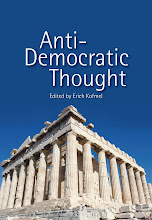

 Posts
Posts

