Please circulate widely!
CALL FOR PAPERS
Anti-Democracy Agenda Symposium 2011
Organized by: Sussex Centre for the Individual and Society (SCIS)
Mode: Online by Google+ video conference
Date: 15-16 November 2011
The "Anti-Democracy Agenda" is the premier resource on the net for the study of anti-democratic thought and practice across the boundaries of various traditions and academic disciplines. First introduced by the Sussex Centre for the Individual and Society (SCIS) as a blog in January 2010, it has since been reconstituted as a circle (with associated public posts, much like a blog) on the new social network Google+. An archive of the blog is to be found here: http://anti-democracy-agenda.blogspot.com
For the new circle, see here:
https://plus.google.com/109507108125539761871/posts
The Anti-Democracy Agenda Symposium 2011 will be the third event we organize to advance the research agenda on anti-democratic thought and practice as well as old and new criticisms of democracy. It will build up on a highly successful workshop on anti-democratic thought SCIS organized at the Annual Conference Workshops in Political Theory in Manchester, England, in September 2007, as well as the Anti-Democracy Agenda Symposium 2010, taking place at the Swiss Federal Institute of Technology (ETH) Zurich in November last year. Both events drew participants from the world over. The Manchester workshop led to the publication of an edited volume on "Anti-Democratic Thought" (Imprint Academic, 2008).
The Anti-Democracy Agenda Symposium 2011 is set to be equally international and interdisciplinary in scope. We invite affiliated academics, independent scholars, and doctoral students and candidates from a wide range of disciplines, such as Philosophy, Political Theory, Political Science, International Relations, Development Studies, Security Studies, Law, Economics, Sociology, Anthropology, Psychology, Literature, History, Classics, Theology, Religious Studies, Education, and so on. Papers may not only cover any and all aspects of criticisms of democracy and anti-democratic thought and practice, from perspectives including anarchism, libertarianism, conservatism, communism, Islamism, the extreme right, and others, but also related concepts such as authoritarianism, dictatorship, military rule, monarchy, chieftaincy, mixed constitution, the backlash against democracy promotion, terrorism, post-democracy, voter apathy, voter ignorance, etc. Have a look at the blog to see what might be of interest and falls within our remit. Papers may be theoretical and/or empirical in nature. Work in progress is welcome too.
This symposium may be the first academic conference to make use of the “Hangouts” video conference facility that is an integral part of Google+. Due to technical restrictions, the number of participants in the Anti-Democracy Agenda Symposium 2011 is limited to 10. All accepted participants will be required to create a profile on Google+ in order to be able to participate in the event. While we encourage the participation of scholars from developing countries, please only apply if you have access to a stable Internet connection. As in our previous physical events, over the course of two days, each presenter will have 60 minutes to present his or her paper and discuss it with all others. Due to the small size of the symposium, all participants are expected to attend both days fully.
As with all SCIS events, no fees will be charged from participants, and no funding is available to cover participants' expenses (if any). We will be glad to issue letters of acceptance on request to assist participants in securing leave from work. Detailed instructions on how to set up a Google+ profile and join the video conference will be provided to confirmed participants.
Please send your proposal to: erichkofmel@gmail.com
Deadline: 15 October 2011
Later submissions may still be accepted, but early submission is strongly advised and proposals may be accepted as they come in.
Cordially,
Erich Kofmel
Managing Director / Research Professor of Political Theory
Sussex Centre for the Individual and Society (SCIS)
https://plus.google.com/109507108125539761871
E-mail: erichkofmel@gmail.com
Postal address:
Sussex Centre for the Individual and Society
1200 Geneva
Switzerland
SCIS is an international association under Swiss law.
Founded 2006 at the University of Sussex.
Showing posts with label economics. Show all posts
Showing posts with label economics. Show all posts
16 August 2011

03 October 2010
Article: Why western-style democracy is not suitable for Africa
George Ayittey is the author of a commentary article titled "Why western-style democracy is not suitable for Africa", published on 20 August 2010 on the CNN news website.
The full text of the article can be read free of charge here:
http://edition.cnn.com/2010/OPINION/08/20/ayittey.democracy.africa/index.html
Excerpts: "Western-style multi-party democracy is possible but not suitable for Africa. [...] The alternative is to take decisions by consensus. [...] In the early 1990s, following the collapse of the former Soviet Union, the winds of change swept across Africa, toppling long-standing autocrats. In our haste to democratize – and also as a condition for Western aid – we copied and adopted the Western form of democracy and neglected to build upon our own democratic tradition. The Western model allowed an elected leader to use power and the state machinery to advance the economic interests of his ethnic group and exclude all others [...]. Virtually all of Africa's civil wars were started by politically marginalized or excluded groups. At Africa's traditional village level, a chief is chosen by the Queen Mother of the royal family to rule for life. His appointment must be ratified by the Council of Elders, which consists of heads of extended families in the village. In governance, the chief must consult with the Council on all important matters. [...] If the chief and the Council cannot reach unanimous decision on an important issue, a village meeting is called and the issue put before the people, who will debate it until they reach a consensus. [...]
"If the chief is 'bad' he can be recalled by the Queen Mother, removed by the Council of Elders, or abandoned by the people, who will vote with their feet to settle somewhere else. [...] Africans could have built upon this system. In the West, the basic economic and social unit is the individual; in Africa, it is the extended family or the collective. The American says, 'I am because I am.' The African says, 'I am because we are.' The 'we' denotes the community. So let each group choose their leaders and place them in a National Assembly. Next, let each province or state choose their leaders and place them in a National Council. Choose the president from this National Council and avoid the huge expenditures on election campaigning that comes with Western-style democracy. Those resources can be better put to development in poor African countries. Next, let the president and National Council take their decisions by consensus. If there is a deadlock, refer the issue to the National Assembly. This type of democracy is in consonance with our own African heritage."
Ghanaian-born George Ayittey is a Distinguished Economist in Residence at American University, Washington, DC, a Research Fellow at the libertarian Independent Institute, and an Associate Scholar at the Foreign Policy Research Institute (FPRI). In 2008, the magazines "Prospect" (UK) and "Foreign Policy" (US) listed him as one of the "Top 100 Public Intellectuals".
The full text of the article can be read free of charge here:
http://edition.cnn.com/2010/OPINION/08/20/ayittey.democracy.africa/index.html
Excerpts: "Western-style multi-party democracy is possible but not suitable for Africa. [...] The alternative is to take decisions by consensus. [...] In the early 1990s, following the collapse of the former Soviet Union, the winds of change swept across Africa, toppling long-standing autocrats. In our haste to democratize – and also as a condition for Western aid – we copied and adopted the Western form of democracy and neglected to build upon our own democratic tradition. The Western model allowed an elected leader to use power and the state machinery to advance the economic interests of his ethnic group and exclude all others [...]. Virtually all of Africa's civil wars were started by politically marginalized or excluded groups. At Africa's traditional village level, a chief is chosen by the Queen Mother of the royal family to rule for life. His appointment must be ratified by the Council of Elders, which consists of heads of extended families in the village. In governance, the chief must consult with the Council on all important matters. [...] If the chief and the Council cannot reach unanimous decision on an important issue, a village meeting is called and the issue put before the people, who will debate it until they reach a consensus. [...]
"If the chief is 'bad' he can be recalled by the Queen Mother, removed by the Council of Elders, or abandoned by the people, who will vote with their feet to settle somewhere else. [...] Africans could have built upon this system. In the West, the basic economic and social unit is the individual; in Africa, it is the extended family or the collective. The American says, 'I am because I am.' The African says, 'I am because we are.' The 'we' denotes the community. So let each group choose their leaders and place them in a National Assembly. Next, let each province or state choose their leaders and place them in a National Council. Choose the president from this National Council and avoid the huge expenditures on election campaigning that comes with Western-style democracy. Those resources can be better put to development in poor African countries. Next, let the president and National Council take their decisions by consensus. If there is a deadlock, refer the issue to the National Assembly. This type of democracy is in consonance with our own African heritage."
Ghanaian-born George Ayittey is a Distinguished Economist in Residence at American University, Washington, DC, a Research Fellow at the libertarian Independent Institute, and an Associate Scholar at the Foreign Policy Research Institute (FPRI). In 2008, the magazines "Prospect" (UK) and "Foreign Policy" (US) listed him as one of the "Top 100 Public Intellectuals".
28 September 2010
Article: What is Europeism?
Václav Klaus, the liberal-conservative President of the Czech Republic, is the author of an article titled "What is Europeism?" that forms part of a booklet, "What is Europeism, or What Should Not Be The Future For Europe" (by Václav Klaus, Jiří Weigl, Petr Mach Marek Loužek, and Jiří Brodský), published in 2006 by the pro-market public policy think tank Center for Economics and Politics (CEP) in Prague (pp. 7-20).
The booklet is available free of charge here:
www.cepin.cz/docs/dokumenty/europeism.pdf
Excerpts: "Europeism is a doctrine which hardly anyone advocates explicitly and, due to this, it is insufficiently specified or systematically formulated (de facto only some of its critics talk about it seriously). It is not possible to refer to any books and articles, from which it could be 'read'. [...] Europeists are [...] characterized by their clear stances in disputes about parliamentary democracy or civil society and in disputes about democracy or post-democracy. They do not prefer standard democratic processes. [...] It is also entirely obvious on which side the Europeists stand in the disputes about the importance of various post-democratic 'isms', such as multiculturalism, feminism, ecologism, homosexualism, NGOism, etc. [...] Europeists want, in their decision-making at the supranational level, to get rid of politics (because they dream about creating an apolitical society) and to introduce the system of decision-making which would be easy and uncontrollable. That is why they advocate post-democracy and graciously smile at the obsolete and old-fashioned advocates of the good old democracy and the good old 'political' politics. [...]
"The effort to emancipate politics and politicians from democratic 'accountability' is one of the primary objectives of the Europeists. They are not alone in this, but I am certain that never in history had the people with this type of thinking reached such success as through the creation of the EU. [...] These are the interests to get rid of the state as an unsubstitutable guarantor of democracy, as a basic political unit of a democratic system (in contrast to Reichs, empires, unions, leagues of countries), as the only meaningfully organizable arena of political life, as the biggest possible, but at the same time also the smallest reasonable, base of political representation and representativeness. Europeism is an attempt to create the Huxleyian brave new world in which there will be 'rosy hours', but not freedom and democracy. [...] They trust the chosen ones (not the elected ones), they trust themselves or those who are chosen by them. [...] They want to mastermind, plan, regulate, administer the others, because some (they themselves) do know and others do not. Even though we thought that after the collapse of communism all this was a matter of the past, it is not so. It is around us again." (bold removed)
The booklet is available free of charge here:
www.cepin.cz/docs/dokumenty/europeism.pdf
Excerpts: "Europeism is a doctrine which hardly anyone advocates explicitly and, due to this, it is insufficiently specified or systematically formulated (de facto only some of its critics talk about it seriously). It is not possible to refer to any books and articles, from which it could be 'read'. [...] Europeists are [...] characterized by their clear stances in disputes about parliamentary democracy or civil society and in disputes about democracy or post-democracy. They do not prefer standard democratic processes. [...] It is also entirely obvious on which side the Europeists stand in the disputes about the importance of various post-democratic 'isms', such as multiculturalism, feminism, ecologism, homosexualism, NGOism, etc. [...] Europeists want, in their decision-making at the supranational level, to get rid of politics (because they dream about creating an apolitical society) and to introduce the system of decision-making which would be easy and uncontrollable. That is why they advocate post-democracy and graciously smile at the obsolete and old-fashioned advocates of the good old democracy and the good old 'political' politics. [...]
"The effort to emancipate politics and politicians from democratic 'accountability' is one of the primary objectives of the Europeists. They are not alone in this, but I am certain that never in history had the people with this type of thinking reached such success as through the creation of the EU. [...] These are the interests to get rid of the state as an unsubstitutable guarantor of democracy, as a basic political unit of a democratic system (in contrast to Reichs, empires, unions, leagues of countries), as the only meaningfully organizable arena of political life, as the biggest possible, but at the same time also the smallest reasonable, base of political representation and representativeness. Europeism is an attempt to create the Huxleyian brave new world in which there will be 'rosy hours', but not freedom and democracy. [...] They trust the chosen ones (not the elected ones), they trust themselves or those who are chosen by them. [...] They want to mastermind, plan, regulate, administer the others, because some (they themselves) do know and others do not. Even though we thought that after the collapse of communism all this was a matter of the past, it is not so. It is around us again." (bold removed)
19 September 2010
Article: Why Democracies Collapse: The Reasons for Democratic Failure and Success
Abraham Diskin, Hanna Diskin, and Reuven Y. Hazan, "Why Democracies Collapse: The Reasons for Democratic Failure and Success" ("International Political Science Review", 26 [3], July 2005: pp. 291-309):
http://ips.sagepub.com/content/26/3/291
Abstract: "Most studies of democratic stability are based within either the socioeconomic or the politico-institutional tradition, but usually not on both. This article combines the two approaches. In all, 11 variables associated with democratic stability are divided into four groups (institutional, societal, mediating, and extraneous) and examined in 30 cases of democratic collapse and 32 cases of stable democracies. Five variables prove to be the most influential on the fate of democracies. When a country scores negatively on four of these five variables it is almost doomed to collapse. Some of the variables prove to be correlated in an opposite way to that which has been suggested in the literature."
Unfortunately, I could not access the full text of the article.
Abraham Diskin is Professor and Reuven Y. Hazan is Associate Professor, both in the Department of Political Science at the Hebrew University of Jerusalem. Hanna Diskin, the Director General of Maggie Publishers, Jerusalem, also lectures in that department.
http://ips.sagepub.com/content/26/3/291
Abstract: "Most studies of democratic stability are based within either the socioeconomic or the politico-institutional tradition, but usually not on both. This article combines the two approaches. In all, 11 variables associated with democratic stability are divided into four groups (institutional, societal, mediating, and extraneous) and examined in 30 cases of democratic collapse and 32 cases of stable democracies. Five variables prove to be the most influential on the fate of democracies. When a country scores negatively on four of these five variables it is almost doomed to collapse. Some of the variables prove to be correlated in an opposite way to that which has been suggested in the literature."
Unfortunately, I could not access the full text of the article.
Abraham Diskin is Professor and Reuven Y. Hazan is Associate Professor, both in the Department of Political Science at the Hebrew University of Jerusalem. Hanna Diskin, the Director General of Maggie Publishers, Jerusalem, also lectures in that department.
05 September 2010
Article: "Peak oil" may threaten survival of democracy, says German military
On 1 September 2010, the major German weekly news magazine "Der Spiegel" published on its English website an article by business editor Stefan Schultz titled "Military Study Warns of a Potentially Drastic Oil Crisis".
The full text of the article can be read free of charge here:
www.spiegel.de/international/germany/0,1518,715138,00.html
Excerpts: "A study by a German military think tank has analyzed how 'peak oil' might change the global economy. The internal draft document – leaked on the Internet – shows for the first time how carefully the German government has considered a potential energy crisis. The term 'peak oil' is used by energy experts to refer to a point in time when global oil reserves pass their zenith and production gradually begins to decline. This would result in a permanent supply crisis [...]. The issue is so politically explosive that it's remarkable when an institution like the Bundeswehr, the German military, uses the term 'peak oil' at all. [...] The study is a product of the Future Analysis department of the Bundeswehr Transformation Center, a think tank tasked with fixing a direction for the German military. The team of authors [...] warns of shifts in the global balance of power, of the formation of new relationships based on interdependency, of a decline in importance of the western industrial nations, of the 'total collapse of the markets' and of serious political and economic crises.
"The study [...] was not meant for publication. The document is said to be in draft stage and to consist solely of scientific opinion, which has not yet been edited by the Defense Ministry and other government bodies. [...] According to the German report, there is 'some probability that peak oil will occur around the year 2010 and that the impact on security is expected to be felt 15 to 30 years later.' The Bundeswehr prediction is consistent with those of well-known scientists who assume global oil production has either already passed its peak or will do so this year. [...] 'In the medium term the global economic system and every market-oriented national economy would collapse.' [...] The Bundeswehr study also raises fears for the survival of democracy itself. Parts of the population could perceive the upheaval triggered by peak oil 'as a general systemic crisis.' This would create 'room for ideological and extremist alternatives to existing forms of government.' Fragmentation of the affected population is likely and could 'in extreme cases lead to open conflict.'" (bold removed)
The full text of the article can be read free of charge here:
www.spiegel.de/international/germany/0,1518,715138,00.html
Excerpts: "A study by a German military think tank has analyzed how 'peak oil' might change the global economy. The internal draft document – leaked on the Internet – shows for the first time how carefully the German government has considered a potential energy crisis. The term 'peak oil' is used by energy experts to refer to a point in time when global oil reserves pass their zenith and production gradually begins to decline. This would result in a permanent supply crisis [...]. The issue is so politically explosive that it's remarkable when an institution like the Bundeswehr, the German military, uses the term 'peak oil' at all. [...] The study is a product of the Future Analysis department of the Bundeswehr Transformation Center, a think tank tasked with fixing a direction for the German military. The team of authors [...] warns of shifts in the global balance of power, of the formation of new relationships based on interdependency, of a decline in importance of the western industrial nations, of the 'total collapse of the markets' and of serious political and economic crises.
"The study [...] was not meant for publication. The document is said to be in draft stage and to consist solely of scientific opinion, which has not yet been edited by the Defense Ministry and other government bodies. [...] According to the German report, there is 'some probability that peak oil will occur around the year 2010 and that the impact on security is expected to be felt 15 to 30 years later.' The Bundeswehr prediction is consistent with those of well-known scientists who assume global oil production has either already passed its peak or will do so this year. [...] 'In the medium term the global economic system and every market-oriented national economy would collapse.' [...] The Bundeswehr study also raises fears for the survival of democracy itself. Parts of the population could perceive the upheaval triggered by peak oil 'as a general systemic crisis.' This would create 'room for ideological and extremist alternatives to existing forms of government.' Fragmentation of the affected population is likely and could 'in extreme cases lead to open conflict.'" (bold removed)
06 July 2010
Article: Democracy Undermined: Constitutional Subterfuge in Latin America
Forrest D. Colburn and Alberto Trejos are the authors of the article "Democracy Undermined: Constitutional Subterfuge in Latin America", published in the latest issue of the quarterly US magazine "Dissent" (57 [3], summer 2010: pp. 11-5):
http://muse.jhu.edu/journals/dissent/summary/v057/57.3.colburn.html
Abstract: "Although democracy is being questioned and even battered throughout Latin America, what is happening in Venezuela, Ecuador, and Bolivia is qualitatively different. It is more than a 'ratcheting up' of the assault on democracy; it is a deliberate, well-designed project to deconstruct democracy and substitute something else in its place, poorly defined as that may be. What is new here – and completely unanticipated by the legions of academics who wrote in the 1980s and 1990s about the 'transition' to democracy – is the use of democracy to dismantle democracy. These projects pose a political and moral dilemma: how do you oppose political change that has been approved by a majority, sanctified by elections? Especially in poor countries with marked income and wealth disparities, which frequently overlap with race, how do you in good faith oppose the political projects of those who not only speak in the name of the oppressed, but who have the electoral support of the oppressed?"
Excerpt: "Early in the morning of June 28, 2009, the president of Honduras, Manuel 'Mel' Zelaya, was rousted out of his bed by soldiers and sent out of the country in his pajamas. It was an old-fashioned coup d'état, evoking, seemingly, a bygone era. The coup d'état seemed out of place because democracy has taken hold everywhere in Latin America except Cuba. In principle, now, elections are the only sanctioned route to the presidency; and, in principle again, presidents leave office after completing their term – only then, but definitely then. What was novel, in fact, about the ouster of Zelaya was the fear that prompted it – what can be called 'constitutional subterfuge.' The military in Honduras acted in a clumsy way to avert a very real threat to democracy – Zelaya's move to call an unprecedented special election to remove a term limit on the presidency – in that country and elsewhere in the region."
Unfortunately, I can't access the full text of this article.
Forrest D. Colburn is a Professor in the Department of Latin American and Puerto Rican Studies at Lehman College, City University of New York.
Alberto Trejos is Professor of Economics at INCAE Business School, Costa Rica, where he previously served as Minister of Foreign Trade.
http://muse.jhu.edu/journals/dissent/summary/v057/57.3.colburn.html
Abstract: "Although democracy is being questioned and even battered throughout Latin America, what is happening in Venezuela, Ecuador, and Bolivia is qualitatively different. It is more than a 'ratcheting up' of the assault on democracy; it is a deliberate, well-designed project to deconstruct democracy and substitute something else in its place, poorly defined as that may be. What is new here – and completely unanticipated by the legions of academics who wrote in the 1980s and 1990s about the 'transition' to democracy – is the use of democracy to dismantle democracy. These projects pose a political and moral dilemma: how do you oppose political change that has been approved by a majority, sanctified by elections? Especially in poor countries with marked income and wealth disparities, which frequently overlap with race, how do you in good faith oppose the political projects of those who not only speak in the name of the oppressed, but who have the electoral support of the oppressed?"
Excerpt: "Early in the morning of June 28, 2009, the president of Honduras, Manuel 'Mel' Zelaya, was rousted out of his bed by soldiers and sent out of the country in his pajamas. It was an old-fashioned coup d'état, evoking, seemingly, a bygone era. The coup d'état seemed out of place because democracy has taken hold everywhere in Latin America except Cuba. In principle, now, elections are the only sanctioned route to the presidency; and, in principle again, presidents leave office after completing their term – only then, but definitely then. What was novel, in fact, about the ouster of Zelaya was the fear that prompted it – what can be called 'constitutional subterfuge.' The military in Honduras acted in a clumsy way to avert a very real threat to democracy – Zelaya's move to call an unprecedented special election to remove a term limit on the presidency – in that country and elsewhere in the region."
Unfortunately, I can't access the full text of this article.
Forrest D. Colburn is a Professor in the Department of Latin American and Puerto Rican Studies at Lehman College, City University of New York.
Alberto Trejos is Professor of Economics at INCAE Business School, Costa Rica, where he previously served as Minister of Foreign Trade.
04 June 2010
Article: Unemployment Linked to Dislike of Democracy
On 2 June, the science news site LiveScience.com published an article titled "Unemployment Linked to Dislike of Democracy" by staff writer Zoë Macintosh.
The article can be read free of charge here:
www.livescience.com/culture/jobless-opinion-democracy-system.html
Excerpts: "Individuals out of a job are more likely to harbor negative opinions about democracy and desire a rogue [sic] leader than their employed counterparts, a new study suggests. Using data from more than 130,000 people from 69 countries, scientists found that having or not having a job is enough to make otherwise similar individuals feel differently about the effectiveness of democratic political systems. [...] The results only showed correlations between these variables, but not cause-and-effect relationships. Joblessness was not linked to one's disapproval of how the country was run or the specific leadership in charge, only to discontent with democracy as a whole. [...] Across the board, those with greater wealth or education held significantly less negative opinions about democracy. [...] The results held even when scientists controlled for reverse causality (with political view causing joblessness) posed by 'political misfits' whose opinions about democracy go against the mainstream."
The article is based on a working paper by Duha Tore Altindag and Naci H. Mocan, published in May 2010 by the American research organization National Bureau of Economic Research (NBER).
Unfortunately, the full text of the working paper is not available without paying:
www.nber.org/papers/w15994
Turkish-born Duha Tore Altindag is a PhD candidate in Economics and Turkish-born Naci H. Mocan is Ourso Distinguished Professor of Economics, both at Louisiana State University.
The article can be read free of charge here:
www.livescience.com/culture/jobless-opinion-democracy-system.html
Excerpts: "Individuals out of a job are more likely to harbor negative opinions about democracy and desire a rogue [sic] leader than their employed counterparts, a new study suggests. Using data from more than 130,000 people from 69 countries, scientists found that having or not having a job is enough to make otherwise similar individuals feel differently about the effectiveness of democratic political systems. [...] The results only showed correlations between these variables, but not cause-and-effect relationships. Joblessness was not linked to one's disapproval of how the country was run or the specific leadership in charge, only to discontent with democracy as a whole. [...] Across the board, those with greater wealth or education held significantly less negative opinions about democracy. [...] The results held even when scientists controlled for reverse causality (with political view causing joblessness) posed by 'political misfits' whose opinions about democracy go against the mainstream."
The article is based on a working paper by Duha Tore Altindag and Naci H. Mocan, published in May 2010 by the American research organization National Bureau of Economic Research (NBER).
Unfortunately, the full text of the working paper is not available without paying:
www.nber.org/papers/w15994
Turkish-born Duha Tore Altindag is a PhD candidate in Economics and Turkish-born Naci H. Mocan is Ourso Distinguished Professor of Economics, both at Louisiana State University.
11 May 2010
Article: The Mechanics of Regime Instability in Latin America
Adam Przeworski, "The Mechanics of Regime Instability in Latin America" ("Journal of Politics in Latin America", 1 [1], 2009: pp. 5-36).
The full text of the article can be read free of charge here:
http://hup.sub.uni-hamburg.de/giga/jpla/article/viewFile/20/20
Abstract: "The paper is narrowly addressed to a single puzzle: How did it happen that countries that attempted to install democracy earlier enjoyed it less frequently? Regime dynamics are driven by two mechanisms: (1) Democracies become more durable as per capita income increases, and (2) Past experiences with democracy destabilize both democracies and autocracies. As a result, countries that experiment with democracy at lower income levels experience more regime instability. Moreover, until they reach some income threshold, at any time such countries are less likely to be democratic than countries that first enter democracy when they have higher incomes. Hence, paradoxically, the resistance of European monarchies against democracy resulted in democracies that were more stable than those following post-independence attempts in Latin America."
Excerpts: "Now, the claim that Latin American countries tried democracy earlier and, most importantly, at lower levels of economic development than Europe and North America is not original, even if it often evokes surprise among ethnocentric North American and Europeans. [...] To some extent, this timing is due to the fact that several parts of Latin America participated in the 1809 election to the Cortes of Cádiz, thus launching the idea of representative institutions at the time when many European countries were involved in the Napoleonic wars and elections were still rare. But a more general reason was that Latin American wars of independence were at the same time directed against monarchical rule, while most European countries experienced a gradual devolution of power from monarchs to parliaments. [...]
"Latin Americans had to constitute their institutions anew. And they were traversing a terra incognita. Monarchies, republics with predominantly hereditary collective governing bodies, and one republic with an elected legislature and an indirectly elected president were the choices known when first Haiti in 1804 and then Venezuela in 1811 proclaimed independence. In several new countries the first form of the government was a collective body that exercised both the legislative and the executive function. Triumvirates governed Argentina from 1811 to 1814 and Venezuela in 1811-12. [...] In the end institutions based on the United States pattern prevailed – in time all Latin American political systems would have elected legislatures while placing executive function in the hands of presidents – but this alternative became complicated from the onset by Bolívar's itch to keep the position for life. [...]
"The most creative was Dr. José Gaspár Rodriguez de Francia who, having become one of two consuls who were to alternate every four months in 1813, then a dictator appointed for three years, in 1816 proclaimed himself El Dictador Perpetuo of Paraguay and ruled it until 1840 as El Supremo. While this story may sound anecdotal, Francia's innovation was both radical and durable, deserving to be placed on par with Lenin's invention of the one-party state. It was radical since the only model of dictatorship known at the time was the Roman one, and in this model dictatorship was a power that was delegated, exceptional, and limited in duration. 'Perpetual Dictator' was an oxymoron. Moreover, the last attempt to make dictatorship permanent, almost twenty centuries earlier, did not bode well for Dr. Francia's fate. Yet this invention turned out to be durable: Francia set the precedent for such illustrious gentlemen as Mussolini, Hitler, Franco, Kim Il-sung, al-Gaddafi, or Castro. [...]
"Now, how is it possible that Latin American countries attempted to institute democracies at lower income levels but ended up with fewer of them at all levels? [...] [A]t a low income [...] level, the probability of democracy falling is quite high. Suppose this democracy falls. The probability that the subsequent autocracy survives is then lower, so that the probability that this country will try democracy again is higher, but the probability that the second democracy survives is also lower. This sequence can be repeated several times, so that if per capita income were constant, both regimes would become increasingly unstable. But income matters: if the economy grows in the meantime, the probability that a democracy dies declines in spite of the past regime instability. And at one time, income passes a threshold above which democracy is impregnable [...].
"Note that the reasons autocratic spells become shorter and democratic spells longer at higher incomes are different. Autocratic spells are shorter almost exclusively because countries that have higher incomes have accumulated more visits to democracy, and such visits destabilize the subsequent autocracies. Democratic spells are longer, however, only because democracy lasts longer at higher income levels. Although past visits to democracy do destabilize subsequent democratic regimes, this effect is small, while the effect of income is powerful."
Polish-born Adam Przeworski is Carroll and Milton Petrie Professor of Politics and (by courtesy) of Economics at New York University.
The full text of the article can be read free of charge here:
http://hup.sub.uni-hamburg.de/giga/jpla/article/viewFile/20/20
Abstract: "The paper is narrowly addressed to a single puzzle: How did it happen that countries that attempted to install democracy earlier enjoyed it less frequently? Regime dynamics are driven by two mechanisms: (1) Democracies become more durable as per capita income increases, and (2) Past experiences with democracy destabilize both democracies and autocracies. As a result, countries that experiment with democracy at lower income levels experience more regime instability. Moreover, until they reach some income threshold, at any time such countries are less likely to be democratic than countries that first enter democracy when they have higher incomes. Hence, paradoxically, the resistance of European monarchies against democracy resulted in democracies that were more stable than those following post-independence attempts in Latin America."
Excerpts: "Now, the claim that Latin American countries tried democracy earlier and, most importantly, at lower levels of economic development than Europe and North America is not original, even if it often evokes surprise among ethnocentric North American and Europeans. [...] To some extent, this timing is due to the fact that several parts of Latin America participated in the 1809 election to the Cortes of Cádiz, thus launching the idea of representative institutions at the time when many European countries were involved in the Napoleonic wars and elections were still rare. But a more general reason was that Latin American wars of independence were at the same time directed against monarchical rule, while most European countries experienced a gradual devolution of power from monarchs to parliaments. [...]
"Latin Americans had to constitute their institutions anew. And they were traversing a terra incognita. Monarchies, republics with predominantly hereditary collective governing bodies, and one republic with an elected legislature and an indirectly elected president were the choices known when first Haiti in 1804 and then Venezuela in 1811 proclaimed independence. In several new countries the first form of the government was a collective body that exercised both the legislative and the executive function. Triumvirates governed Argentina from 1811 to 1814 and Venezuela in 1811-12. [...] In the end institutions based on the United States pattern prevailed – in time all Latin American political systems would have elected legislatures while placing executive function in the hands of presidents – but this alternative became complicated from the onset by Bolívar's itch to keep the position for life. [...]
"The most creative was Dr. José Gaspár Rodriguez de Francia who, having become one of two consuls who were to alternate every four months in 1813, then a dictator appointed for three years, in 1816 proclaimed himself El Dictador Perpetuo of Paraguay and ruled it until 1840 as El Supremo. While this story may sound anecdotal, Francia's innovation was both radical and durable, deserving to be placed on par with Lenin's invention of the one-party state. It was radical since the only model of dictatorship known at the time was the Roman one, and in this model dictatorship was a power that was delegated, exceptional, and limited in duration. 'Perpetual Dictator' was an oxymoron. Moreover, the last attempt to make dictatorship permanent, almost twenty centuries earlier, did not bode well for Dr. Francia's fate. Yet this invention turned out to be durable: Francia set the precedent for such illustrious gentlemen as Mussolini, Hitler, Franco, Kim Il-sung, al-Gaddafi, or Castro. [...]
"Now, how is it possible that Latin American countries attempted to institute democracies at lower income levels but ended up with fewer of them at all levels? [...] [A]t a low income [...] level, the probability of democracy falling is quite high. Suppose this democracy falls. The probability that the subsequent autocracy survives is then lower, so that the probability that this country will try democracy again is higher, but the probability that the second democracy survives is also lower. This sequence can be repeated several times, so that if per capita income were constant, both regimes would become increasingly unstable. But income matters: if the economy grows in the meantime, the probability that a democracy dies declines in spite of the past regime instability. And at one time, income passes a threshold above which democracy is impregnable [...].
"Note that the reasons autocratic spells become shorter and democratic spells longer at higher incomes are different. Autocratic spells are shorter almost exclusively because countries that have higher incomes have accumulated more visits to democracy, and such visits destabilize the subsequent autocracies. Democratic spells are longer, however, only because democracy lasts longer at higher income levels. Although past visits to democracy do destabilize subsequent democratic regimes, this effect is small, while the effect of income is powerful."
Polish-born Adam Przeworski is Carroll and Milton Petrie Professor of Politics and (by courtesy) of Economics at New York University.
06 May 2010
CFP: Anti-Democracy Agenda Symposium 2010
Please circulate widely!
CALL FOR PAPERS
Anti-Democracy Agenda Symposium 2010
Organized by: Sussex Centre for the Individual and Society (SCIS)
Location: Gottfried-Semper Villa Garbald, part of the Collegium Helveticum of the Swiss Federal Institute of Technology (ETH) Zurich and the University of Zurich, at Castasegna, in the Swiss Alps
Date: 8-10 November 2010
The "Anti-Democracy Agenda" (www.anti-democracy-agenda.blogspot.com) has been run by the Sussex Centre for the Individual and Society since January 2010. The blog is the premier resource on the net for the study of anti-democratic thought and practice across the boundaries of various traditions and academic disciplines.
The Anti-Democracy Agenda Symposium 2010 will be the first event we organize in conjunction with the blog. It will build up though on a highly successful event on anti-democratic thought SCIS organized earlier, at the Annual Conference Workshops in Political Theory in Manchester, England, in September 2007, drawing participants from the world over. That workshop led to the publication of an edited volume, "Anti-Democratic Thought" (Imprint Academic), in December 2008.
The Anti-Democracy Agenda Symposium 2010 is set to be equally international and interdisciplinary in scope. We invite affiliated academics, independent scholars, and doctoral students and candidates from a wide range of disciplines, such as Philosophy, Political Theory, Political Science, International Relations, Development Studies, Security Studies, Law, Economics, Sociology, Anthropology, Psychology, Literature, History, Classics, Theology, Religious Studies, Education, and so on. Papers may not only cover any and all aspects of criticisms of democracy and anti-democratic thought and practice, from perspectives including anarchism, libertarianism, conservatism, communism, Islamism, the extreme right, and others, but also related concepts such as authoritarianism, dictatorship, military rule, monarchy, chieftaincy, mixed constitution, the backlash against democracy promotion, terrorism, post-democracy, voter apathy, voter ignorance, etc. Have a look at the blog to see what might be of interest and falls within our remit. Papers may be theoretical and/or empirical in nature. Work in progress is welcome too.
We expect that 10-15 participants will be attending the workshop-style Anti-Democracy Agenda Symposium 2010. Over the course of two and a half days, each presenter will have 60 minutes to present his or her paper and discuss it with all others.
As with all SCIS events, no fees will be charged from participants, and no funding is available to cover participants' travel and accommodation expenses. We will be glad to issue letters of invitation on request to assist participants in securing funding from their usual sources. The charges payable directly to the Villa Garbald (approx. $510 half-board/$570 full-board per person) cover accommodation for three nights and food and drink (except alcohol and minibar) throughout your stay. Participants will be arriving on Sunday, taking in the magnificent scenery of the Swiss Alps on a spectacular 5-hour train journey from Zurich airport (via St. Moritz) to a remote Italian-speaking Swiss valley (Val Bregaglia), home to Europe's largest chestnut forest, and leave on Wednesday after lunch, on the same way (cost of a return ticket approx. $115). Alternatively, you can get there in 3-4 hours by train from Milano airport, passing Lake Como. During the symposium there will be ample time to explore the surroundings. Please feel free to contact us with any questions. Detailed travel instructions will be provided to confirmed participants. Don't miss this unique opportunity.
The Italian-style Villa Garbald was built by German star architect Gottfried Semper (of Semper Opera in Dresden and Vienna Burgtheater fame) during his exile in Switzerland. A pro-democracy activist in aristocratic mid-19th century Germany, his experiences with direct-democratic government in Switzerland turned him in later life increasingly against democracy.
Please send your proposal to: e.kofmel@sussexcentre.org
Deadline: 31 July 2010
Later submissions may still be accepted, but early submission is strongly advised and proposals may be accepted as they come in.

Cordially,
Erich Kofmel
Managing Director / Research Professor of Political Theory
Sussex Centre for the Individual and Society (SCIS)
www.sussexcentre.org
E-mail: e.kofmel@sussexcentre.org
Postal address:
Sussex Centre for the Individual and Society
1200 Geneva
Switzerland
SCIS is an international association under Swiss law.
Founded 2006 at the University of Sussex.
CALL FOR PAPERS
Anti-Democracy Agenda Symposium 2010
Organized by: Sussex Centre for the Individual and Society (SCIS)
Location: Gottfried-Semper Villa Garbald, part of the Collegium Helveticum of the Swiss Federal Institute of Technology (ETH) Zurich and the University of Zurich, at Castasegna, in the Swiss Alps
Date: 8-10 November 2010
The "Anti-Democracy Agenda" (www.anti-democracy-agenda.blogspot.com) has been run by the Sussex Centre for the Individual and Society since January 2010. The blog is the premier resource on the net for the study of anti-democratic thought and practice across the boundaries of various traditions and academic disciplines.
The Anti-Democracy Agenda Symposium 2010 will be the first event we organize in conjunction with the blog. It will build up though on a highly successful event on anti-democratic thought SCIS organized earlier, at the Annual Conference Workshops in Political Theory in Manchester, England, in September 2007, drawing participants from the world over. That workshop led to the publication of an edited volume, "Anti-Democratic Thought" (Imprint Academic), in December 2008.
The Anti-Democracy Agenda Symposium 2010 is set to be equally international and interdisciplinary in scope. We invite affiliated academics, independent scholars, and doctoral students and candidates from a wide range of disciplines, such as Philosophy, Political Theory, Political Science, International Relations, Development Studies, Security Studies, Law, Economics, Sociology, Anthropology, Psychology, Literature, History, Classics, Theology, Religious Studies, Education, and so on. Papers may not only cover any and all aspects of criticisms of democracy and anti-democratic thought and practice, from perspectives including anarchism, libertarianism, conservatism, communism, Islamism, the extreme right, and others, but also related concepts such as authoritarianism, dictatorship, military rule, monarchy, chieftaincy, mixed constitution, the backlash against democracy promotion, terrorism, post-democracy, voter apathy, voter ignorance, etc. Have a look at the blog to see what might be of interest and falls within our remit. Papers may be theoretical and/or empirical in nature. Work in progress is welcome too.
We expect that 10-15 participants will be attending the workshop-style Anti-Democracy Agenda Symposium 2010. Over the course of two and a half days, each presenter will have 60 minutes to present his or her paper and discuss it with all others.
As with all SCIS events, no fees will be charged from participants, and no funding is available to cover participants' travel and accommodation expenses. We will be glad to issue letters of invitation on request to assist participants in securing funding from their usual sources. The charges payable directly to the Villa Garbald (approx. $510 half-board/$570 full-board per person) cover accommodation for three nights and food and drink (except alcohol and minibar) throughout your stay. Participants will be arriving on Sunday, taking in the magnificent scenery of the Swiss Alps on a spectacular 5-hour train journey from Zurich airport (via St. Moritz) to a remote Italian-speaking Swiss valley (Val Bregaglia), home to Europe's largest chestnut forest, and leave on Wednesday after lunch, on the same way (cost of a return ticket approx. $115). Alternatively, you can get there in 3-4 hours by train from Milano airport, passing Lake Como. During the symposium there will be ample time to explore the surroundings. Please feel free to contact us with any questions. Detailed travel instructions will be provided to confirmed participants. Don't miss this unique opportunity.
The Italian-style Villa Garbald was built by German star architect Gottfried Semper (of Semper Opera in Dresden and Vienna Burgtheater fame) during his exile in Switzerland. A pro-democracy activist in aristocratic mid-19th century Germany, his experiences with direct-democratic government in Switzerland turned him in later life increasingly against democracy.
Please send your proposal to: e.kofmel@sussexcentre.org
Deadline: 31 July 2010
Later submissions may still be accepted, but early submission is strongly advised and proposals may be accepted as they come in.
Cordially,
Erich Kofmel
Managing Director / Research Professor of Political Theory
Sussex Centre for the Individual and Society (SCIS)
www.sussexcentre.org
E-mail: e.kofmel@sussexcentre.org
Postal address:
Sussex Centre for the Individual and Society
1200 Geneva
Switzerland
SCIS is an international association under Swiss law.
Founded 2006 at the University of Sussex.
18 April 2010
CONF: Non-Democratic Regimes
Conference on "Non-Democratic Regimes" of the Georg Walter Leitner Program in International and Comparative Political Economy at Yale University, New Haven, Connecticut, USA, 11-12 June 2010
www.yale.edu/leitner/NonDemocratic_Regimes.html
Description: "This conference brings together researchers studying the politics of non-democratic regimes, including democratization, repression, growth, and civil and international conflict. More specifically, how do economic conditions affect popular support for a dictator and the transition to democracy? When do citizens protest against a dictatorship and when does a dictatorship respond with repression? When does a dictatorship allow for limited forms of political representation? What explains the post-tenure fate of dictators and how does it affect their propensity to democratize? Is the International Court of Justice a spoiler or promoter of democracy? What explains the variety of non-democratic institutions and how do such institutions affect economic growth? How does the targeting of groups or a populist rhetoric allow the leaders of weak democracies to avoid accountability? Which non-democratic institutions are more likely to generate international wars? Why do the leaders of non-democracies get involved in such long civil wars in the post-World War II period? Presenters use a variety of methodology to tackle such a wide array of questions, including formal and quantitative methods."
Presenters include Charles Boix (Princeton), Joseph Wright (Pennsylvania State University), Beatriz Magaloni (Stanford), Jason Brownlee (University of Texas at Austin), Peter Lorentzen (Berkeley), Alexandre Debs (Yale), Monika Nalepa (University of Notre Dame), Milan Svolik (University of Illinois at Urbana-Champaign), Philip Keefer (World Bank), Alastair Smith (New York University), Konstantin Sonin (New Economic School, Moscow), Jessica Weeks (Cornell), and Andrea Vindigni (Princeton).
No registration information is provided on the website. To see whether it is possible to participate, please contact the conference organizer, Alexandre Debs (Yale): alexandre.debs@yale.edu
www.yale.edu/leitner/NonDemocratic_Regimes.html
Description: "This conference brings together researchers studying the politics of non-democratic regimes, including democratization, repression, growth, and civil and international conflict. More specifically, how do economic conditions affect popular support for a dictator and the transition to democracy? When do citizens protest against a dictatorship and when does a dictatorship respond with repression? When does a dictatorship allow for limited forms of political representation? What explains the post-tenure fate of dictators and how does it affect their propensity to democratize? Is the International Court of Justice a spoiler or promoter of democracy? What explains the variety of non-democratic institutions and how do such institutions affect economic growth? How does the targeting of groups or a populist rhetoric allow the leaders of weak democracies to avoid accountability? Which non-democratic institutions are more likely to generate international wars? Why do the leaders of non-democracies get involved in such long civil wars in the post-World War II period? Presenters use a variety of methodology to tackle such a wide array of questions, including formal and quantitative methods."
Presenters include Charles Boix (Princeton), Joseph Wright (Pennsylvania State University), Beatriz Magaloni (Stanford), Jason Brownlee (University of Texas at Austin), Peter Lorentzen (Berkeley), Alexandre Debs (Yale), Monika Nalepa (University of Notre Dame), Milan Svolik (University of Illinois at Urbana-Champaign), Philip Keefer (World Bank), Alastair Smith (New York University), Konstantin Sonin (New Economic School, Moscow), Jessica Weeks (Cornell), and Andrea Vindigni (Princeton).
No registration information is provided on the website. To see whether it is possible to participate, please contact the conference organizer, Alexandre Debs (Yale): alexandre.debs@yale.edu
09 April 2010
Article: Why Non-Democratic Leaders Have More Children
Dustin Beckett and Gregory D. Hess, "All in the Family: Why Non-Democratic Leaders Have More Children" ("Economics of Governance", 9 [1], January 2008: pp. 65-85):
www.springerlink.com/content/m6k1464v4vm24k67/
Abstract: "Economists have come to learn that politics matters. But survival matters the most to those involved in politics. We provide a theory whereby non-benevolent, non-democratic leaders increase their expected family size to raise the likelihood that a child will be a match at continuing the regime's survival. As a consequence, having a larger family size raises the non-democratic leader's expected rents that they can exploit from the citizenry. In contrast, democratic leaders have a lower desire to appropriate rents from the citizenry, and therefore have a diminished desire to have additional children for these purposes. We construct a data set of the number of children of country leaders as of August 31, 2005. We find that in a sample of 221 country leaders, fully non-democratic leaders have approximately 1.5-2.5 more actual children as compared to if they are fully democratic. This empirical relationship is established controlling for a full array of country specific as well as individual specific variables. Our finding also continues to hold when using alternative measures of family size."
Excerpt: "While the question of 'who governs?' goes to the heart of the difference between democratic and non-democratic rule, 'who governs next?' is no less a distinguishing query. Often, transitions of power in mature democracies take place at regular intervals, where timing and tenure limits are determined in the law. For non-democratic countries, however, transitions are more problematic and irregular, as there are fewer formal mechanisms for a smooth succession of power."
Sounds intriguing, but the article seems deeply flawed. It is badly written and obviously not edited, i.e.: "For non-democratic leaders, [...] performance indicators are not the main criteria for determining the survival duration of non-democratic leaders."; "a new leader decides how much to seek rent from the citizenry".
Also, this is the first study I came across that is based on (two versions of) "Who's Who" and – get this – "[t]he final source for the data is the online encyclopedia [...] Wikipedia". Are they serious?
Finally, what about leaders, democratic or not, of countries that have, during the leader's lifetime, alternated between democracy and non-democracy or experienced increasing or decreasing levels of democracy? The children of a non-democratic leader may have been born when the country was still a democracy. And even non-democratic rule lasts on average only twenty-one years, it is claimed. But (less than) 21-year olds don't usually become heads of government. Even in non-democratic countries (with the possible exception of monarchies), sons or daughters that young are unlikely to succeed a parent. Most leaders will have started a family well before becoming leaders – and most likely before they ever knew that they were going to become leaders. (Only 15% of the leaders studied were "in line" to succeed to their position.) All this may suggest other reasons for family size than the merely economic ones proposed by the authors of this study.
Dustin H. Beckett is a doctoral candidate in Social Science at the California Institute of Technology.
Gregory D. Hess is James G. Boswell Professor of Economics at Claremont McKenna College.
www.springerlink.com/content/m6k1464v4vm24k67/
Abstract: "Economists have come to learn that politics matters. But survival matters the most to those involved in politics. We provide a theory whereby non-benevolent, non-democratic leaders increase their expected family size to raise the likelihood that a child will be a match at continuing the regime's survival. As a consequence, having a larger family size raises the non-democratic leader's expected rents that they can exploit from the citizenry. In contrast, democratic leaders have a lower desire to appropriate rents from the citizenry, and therefore have a diminished desire to have additional children for these purposes. We construct a data set of the number of children of country leaders as of August 31, 2005. We find that in a sample of 221 country leaders, fully non-democratic leaders have approximately 1.5-2.5 more actual children as compared to if they are fully democratic. This empirical relationship is established controlling for a full array of country specific as well as individual specific variables. Our finding also continues to hold when using alternative measures of family size."
Excerpt: "While the question of 'who governs?' goes to the heart of the difference between democratic and non-democratic rule, 'who governs next?' is no less a distinguishing query. Often, transitions of power in mature democracies take place at regular intervals, where timing and tenure limits are determined in the law. For non-democratic countries, however, transitions are more problematic and irregular, as there are fewer formal mechanisms for a smooth succession of power."
Sounds intriguing, but the article seems deeply flawed. It is badly written and obviously not edited, i.e.: "For non-democratic leaders, [...] performance indicators are not the main criteria for determining the survival duration of non-democratic leaders."; "a new leader decides how much to seek rent from the citizenry".
Also, this is the first study I came across that is based on (two versions of) "Who's Who" and – get this – "[t]he final source for the data is the online encyclopedia [...] Wikipedia". Are they serious?
Finally, what about leaders, democratic or not, of countries that have, during the leader's lifetime, alternated between democracy and non-democracy or experienced increasing or decreasing levels of democracy? The children of a non-democratic leader may have been born when the country was still a democracy. And even non-democratic rule lasts on average only twenty-one years, it is claimed. But (less than) 21-year olds don't usually become heads of government. Even in non-democratic countries (with the possible exception of monarchies), sons or daughters that young are unlikely to succeed a parent. Most leaders will have started a family well before becoming leaders – and most likely before they ever knew that they were going to become leaders. (Only 15% of the leaders studied were "in line" to succeed to their position.) All this may suggest other reasons for family size than the merely economic ones proposed by the authors of this study.
Dustin H. Beckett is a doctoral candidate in Social Science at the California Institute of Technology.
Gregory D. Hess is James G. Boswell Professor of Economics at Claremont McKenna College.
Book: After democracy (in French)
Of possible interest to those able to read books in French: "Après la démocratie" (After democracy) by Emmanuel Todd (Gallimard, October 2008):
www.gallimard.fr/catalog/Html/clip/A78683/A78683.swf
Review: "Emmanuel Todd, the French historian, made a name for himself by predicting the collapse of the Soviet Union. [...] In his latest book, [...] he conjures up the alarming possibility of a post-democratic Europe reverting to ethnic scapegoating and dictatorship. Mr Todd's thesis will strike many readers as nonsense. In particular, his conclusion that only overt protectionism can preserve Europe's social fabric has already been attacked for being dangerously counter-productive. After all, was it not the reversion to protectionism after the crash of 1929 that tipped the world into the Great Depression and fuelled the rise of Hitler? Yet some of Mr Todd's arguments are as insightful as they are polemical, and reflect the evolution of Europe's political debate. His warnings of a democratic meltdown in France, and perhaps more generally in the developed world, certainly deserve to be read, challenged and debated." (John Thornhill, "Financial Times")
From the publisher's description (my rough translation): "Beneath a variety of symptoms, we encounter a veritable crisis of democracy. In order to understand it, we must identify the contributing factors, both present and historical, including the emptiness of religion, educational stagnation, the new social stratification, the destructive impact of free trade, the impoverishment of the middle class, confusion of the elite. [...] We have to ask ourselves if politicians, unable to manipulate our 'opinion democracy' any longer, will not simply seek to curtail the universal franchise."
Emmanuel Todd is a Research Engineer at France's National Institute of Demographic Studies (INED). A political scientist by training, he holds a PhD in History from the University of Cambridge.
www.gallimard.fr/catalog/Html/clip/A78683/A78683.swf
Review: "Emmanuel Todd, the French historian, made a name for himself by predicting the collapse of the Soviet Union. [...] In his latest book, [...] he conjures up the alarming possibility of a post-democratic Europe reverting to ethnic scapegoating and dictatorship. Mr Todd's thesis will strike many readers as nonsense. In particular, his conclusion that only overt protectionism can preserve Europe's social fabric has already been attacked for being dangerously counter-productive. After all, was it not the reversion to protectionism after the crash of 1929 that tipped the world into the Great Depression and fuelled the rise of Hitler? Yet some of Mr Todd's arguments are as insightful as they are polemical, and reflect the evolution of Europe's political debate. His warnings of a democratic meltdown in France, and perhaps more generally in the developed world, certainly deserve to be read, challenged and debated." (John Thornhill, "Financial Times")
From the publisher's description (my rough translation): "Beneath a variety of symptoms, we encounter a veritable crisis of democracy. In order to understand it, we must identify the contributing factors, both present and historical, including the emptiness of religion, educational stagnation, the new social stratification, the destructive impact of free trade, the impoverishment of the middle class, confusion of the elite. [...] We have to ask ourselves if politicians, unable to manipulate our 'opinion democracy' any longer, will not simply seek to curtail the universal franchise."
Emmanuel Todd is a Research Engineer at France's National Institute of Demographic Studies (INED). A political scientist by training, he holds a PhD in History from the University of Cambridge.
31 March 2010
Book: Property, Freedom, and Society: Essays in Honor of Hans-Hermann Hoppe
In July 2009, the libertarian Ludwig von Mises Institute published the book "Property, Freedom, and Society: Essays in Honor of Hans-Hermann Hoppe" (Professor Emeritus of Economics at the University of Nevada, Las Vegas, and a Distinguished Fellow with the Mises Institute), edited by Jörg Guido Hülsmann (University of Angers, France/Mises Institute) and Stephan Kinsella (Mises Institute).
The full text of the book can be read free of charge here:
http://mises.org/books/property_freedom_society_kinsella.pdf
Part Four of this contributed volume is titled "Democracy Reconsidered" and comprises of four short articles. Among them:
Doug French (Mises Institute), "The Trouble with Democracy: Maslow Meets Hoppe" (pp. 237-42).
Excerpts: "[T]o be elected and stay elected in American politics to any full-time position requires the suspension of any ethics or good sense a person may possess. [...] Democracy makes it possible for the demagogue to inflame the childish imagination of the masses, 'by virtue of his talent for nonsense.' [...] Because democracy is open to any and all who can get themselves elected, either through connections, personality, or personal wealth, it is a social system where leadership positions become a hotbed for sociopaths. [...]
[T]hose stuck on the need for esteem are drawn to it like flies to dung. [...] So while the electorate recognizes that they are electing, at best incompetents, and at worst crooks, the constant, naïve, pro-democracy mantra is that 'we just need to elect the right people.' But, the 'right people' aren't (and won't be) running for office."
Robert Higgs (Independent Institute), "Democracy and Faits Accomplis" (pp. 249-62).
Excerpts: "No institution of modern life commands as much veneration as democracy. It comes closer than anything else to being the supreme object of adoration in a global religion. Anyone who denies its righteousness and desirability soon finds himself a pariah. [...] Many people are atheists, but few are anti-democrats. [...] Although democracy made giant ideological strides in the nineteenth century, a few writers had the courage to condemn it even well into the twentieth century. [...] [O]ffice-seekers typically either speak in vague, emotion-laden generalities or simply lie about their intentions. After taking office, they may act in complete disregard of their campaign promises, trusting that when they run for reelection, they will be able to concoct a plausible excuse for their infidelity and betrayal of trust. Thus, the voters remain permanently immersed in a fog of disinformation, emotional manipulation, and bald-faced mendacity. No matter what a candidate promises, the voters have no means of holding him to those promises or of punishing his misbehavior until it may be too late to matter. [...] Contemplating this situation, one readily recalls Goethe's dictum that 'none are more hopelessly enslaved than those who falsely believe they are free.'"
Some other articles from the book also discuss Hoppe's anti-democratic convictions.
The full text of the book can be read free of charge here:
http://mises.org/books/property_freedom_society_kinsella.pdf
Part Four of this contributed volume is titled "Democracy Reconsidered" and comprises of four short articles. Among them:
Doug French (Mises Institute), "The Trouble with Democracy: Maslow Meets Hoppe" (pp. 237-42).
Excerpts: "[T]o be elected and stay elected in American politics to any full-time position requires the suspension of any ethics or good sense a person may possess. [...] Democracy makes it possible for the demagogue to inflame the childish imagination of the masses, 'by virtue of his talent for nonsense.' [...] Because democracy is open to any and all who can get themselves elected, either through connections, personality, or personal wealth, it is a social system where leadership positions become a hotbed for sociopaths. [...]
[T]hose stuck on the need for esteem are drawn to it like flies to dung. [...] So while the electorate recognizes that they are electing, at best incompetents, and at worst crooks, the constant, naïve, pro-democracy mantra is that 'we just need to elect the right people.' But, the 'right people' aren't (and won't be) running for office."
Robert Higgs (Independent Institute), "Democracy and Faits Accomplis" (pp. 249-62).
Excerpts: "No institution of modern life commands as much veneration as democracy. It comes closer than anything else to being the supreme object of adoration in a global religion. Anyone who denies its righteousness and desirability soon finds himself a pariah. [...] Many people are atheists, but few are anti-democrats. [...] Although democracy made giant ideological strides in the nineteenth century, a few writers had the courage to condemn it even well into the twentieth century. [...] [O]ffice-seekers typically either speak in vague, emotion-laden generalities or simply lie about their intentions. After taking office, they may act in complete disregard of their campaign promises, trusting that when they run for reelection, they will be able to concoct a plausible excuse for their infidelity and betrayal of trust. Thus, the voters remain permanently immersed in a fog of disinformation, emotional manipulation, and bald-faced mendacity. No matter what a candidate promises, the voters have no means of holding him to those promises or of punishing his misbehavior until it may be too late to matter. [...] Contemplating this situation, one readily recalls Goethe's dictum that 'none are more hopelessly enslaved than those who falsely believe they are free.'"
Some other articles from the book also discuss Hoppe's anti-democratic convictions.
18 March 2010
Article: What's So Good About Democracy?
The article "What's So Good About Democracy?" by Norman Barry was published in "The Freeman: Ideas on Liberty" (53 [5], May 2003: pp. 44-8), the near-monthly magazine of the Foundation for Economic Education (FEE).
The article can be read free of charge here:
www.thefreemanonline.org/featured/whats-so-good-about-democracy/
Excerpts: "Some words convey descriptive information about the world – like those used in the weather forecast – while others are designed not to tell us anything factually important but to act on our emotions and garner our support, such as advertising slogans and political words. This is true of democracy: If anybody confesses to being anti-democratic he is likely to be called a fascist. In its emotive sense, all sorts of good things, such as liberty, rights, majority rule, and the public interest, are bundled up and marketed under the label 'democracy.' [...] A modern critique of democracy must proceed from [...] nineteenth-century skeptical insights – but with one crucially important qualification: the threat to civilization has not actually come from the unfettered mob but from the uncontrollable influence of pressure groups ([James] Madison's 'factions') on the social and economic process. They are much more dangerous than majoritarianism precisely because they can claim the imprimatur of liberal democracy for their anti-individualistic and anti-market effects. [...]
"It was the Italian theorists of elitism who first produced a powerful, theoretical critique of democracy, and some of their strictures are relevant to modern considerations. [...] Although [Joseph] Schumpeter had the key to a wholesale critique of democracy, he still supported it. Democracy could work, he thought, if a society were reasonably homogeneous, had a reliable bureaucracy [...], and not too many affairs were subject to political, as opposed to private economic, decision-making. He thought that the level of rationality fell as soon as people left the marketplace and played politics, either as voters or activists. This seems to be true. Just watch the supreme rationality of the housewife quickly responding to price changes at Wal-Mart, compared to her ignorance of the policy proposals of political parties at an election. [...] The problem is that it is not in her interest to be well-informed about politics. It is simply in no one's rational self-interest to be informed about what is in the 'public interest.' Least of all is it in anyone's interest to sacrifice his well-being for the 'common good.' Democratic theorists have never solved the problem of why rational people vote at all, given the nugatory effect a single vote can have on the result of an election. [...]
"A coherent critique of democracy requires things of which Schumpeter never dreamt: first, a logical explanation of why the public good cannot often be transmitted through the voting mechanism (not merely the casual observation that it rarely happens) and, second, a theory of why, in practice, democratic politics degenerates into a squabble over benefits among rival interest groups. [...] In fact, a democracy would work better if the people voted directly on separate issues rather than having their representatives vote on bundles produced by the parties. Contra conventional conservatism, direct democracy is actually better than representative government. [...] Because of its emotive appeal, selling an anti-democratic idea is politically difficult. Various alternatives have been suggested, but most are infeasible whatever their internal logic. As suggested above, an effective approach, paradoxically, might be to demand more democracy, with choices put to the people rather than to their elected representatives. [...] All of this is rather tame for an anti-democrat. Even the Swiss [model's] constraints are not insurmountable; they have failed to resist some advances of centralized government. But they do constitute a model from which further dents in the edifice of conventional majority rule and almost unlimited sovereignty might be made."
Personal experience from Switzerland tells me that there is no significant difference in outcomes between representative democracy and direct democracy.
The late Norman Barry (1944-2008) was a libertarian Professor of Social and Political Theory at the University of Buckingham.
The article can be read free of charge here:
www.thefreemanonline.org/featured/whats-so-good-about-democracy/
Excerpts: "Some words convey descriptive information about the world – like those used in the weather forecast – while others are designed not to tell us anything factually important but to act on our emotions and garner our support, such as advertising slogans and political words. This is true of democracy: If anybody confesses to being anti-democratic he is likely to be called a fascist. In its emotive sense, all sorts of good things, such as liberty, rights, majority rule, and the public interest, are bundled up and marketed under the label 'democracy.' [...] A modern critique of democracy must proceed from [...] nineteenth-century skeptical insights – but with one crucially important qualification: the threat to civilization has not actually come from the unfettered mob but from the uncontrollable influence of pressure groups ([James] Madison's 'factions') on the social and economic process. They are much more dangerous than majoritarianism precisely because they can claim the imprimatur of liberal democracy for their anti-individualistic and anti-market effects. [...]
"It was the Italian theorists of elitism who first produced a powerful, theoretical critique of democracy, and some of their strictures are relevant to modern considerations. [...] Although [Joseph] Schumpeter had the key to a wholesale critique of democracy, he still supported it. Democracy could work, he thought, if a society were reasonably homogeneous, had a reliable bureaucracy [...], and not too many affairs were subject to political, as opposed to private economic, decision-making. He thought that the level of rationality fell as soon as people left the marketplace and played politics, either as voters or activists. This seems to be true. Just watch the supreme rationality of the housewife quickly responding to price changes at Wal-Mart, compared to her ignorance of the policy proposals of political parties at an election. [...] The problem is that it is not in her interest to be well-informed about politics. It is simply in no one's rational self-interest to be informed about what is in the 'public interest.' Least of all is it in anyone's interest to sacrifice his well-being for the 'common good.' Democratic theorists have never solved the problem of why rational people vote at all, given the nugatory effect a single vote can have on the result of an election. [...]
"A coherent critique of democracy requires things of which Schumpeter never dreamt: first, a logical explanation of why the public good cannot often be transmitted through the voting mechanism (not merely the casual observation that it rarely happens) and, second, a theory of why, in practice, democratic politics degenerates into a squabble over benefits among rival interest groups. [...] In fact, a democracy would work better if the people voted directly on separate issues rather than having their representatives vote on bundles produced by the parties. Contra conventional conservatism, direct democracy is actually better than representative government. [...] Because of its emotive appeal, selling an anti-democratic idea is politically difficult. Various alternatives have been suggested, but most are infeasible whatever their internal logic. As suggested above, an effective approach, paradoxically, might be to demand more democracy, with choices put to the people rather than to their elected representatives. [...] All of this is rather tame for an anti-democrat. Even the Swiss [model's] constraints are not insurmountable; they have failed to resist some advances of centralized government. But they do constitute a model from which further dents in the edifice of conventional majority rule and almost unlimited sovereignty might be made."
Personal experience from Switzerland tells me that there is no significant difference in outcomes between representative democracy and direct democracy.
The late Norman Barry (1944-2008) was a libertarian Professor of Social and Political Theory at the University of Buckingham.
14 March 2010
Book: The Crisis of Capitalist Democracy
Just published: Richard A. Posner, "The Crisis of Capitalist Democracy" (Harvard University Press, March 2010):
www.hup.harvard.edu/catalog/POSECC.html
Publisher's description: "Following up on his timely and well-received book, A Failure of Capitalism, Richard Posner steps back to take a longer view of the continuing crisis of democratic capitalism as the American and world economies crawl gradually back from the depths to which they had fallen in the autumn of 2008 and the winter of 2009. By means of a lucid narrative of the crisis and a series of analytical chapters pinpointing critical issues of economic collapse and gradual recovery, Posner helps non-technical readers understand business-cycle and financial economics, and financial and governmental institutions, practices, and transactions, while maintaining a neutrality impossible for persons professionally committed to one theory or another. He calls for fresh thinking about the business cycle that would build on the original ideas of Keynes.
"Central to these ideas is that of uncertainty as opposed to risk. Risk can be quantified and measured. Uncertainty cannot, and in this lies the inherent instability of a capitalist economy. As we emerge from the financial earthquake, a deficit aftershock rumbles. It is in reference to that potential aftershock, as well as to the government's stumbling efforts at financial regulatory reform, that Posner raises the question of the adequacy of our democratic institutions to the economic challenges heightened by the greatest economic crisis since the Great Depression. The crisis and the government's energetic response to it have enormously increased the national debt at the same time that structural defects in the American political system may make it impossible to pay down the debt by any means other than inflation or devaluation."
Review: "Posner [...] has enormous credibility when he casts a skeptical eye on Wall Street. As an influential free-market thinker, he helped shape the antiregulatory ideology that inspired so much public policy since 1980 [...]. In his final pages, though, the author can't muster much confidence that America will overcome its splintered politics, the 'quasi bribery' of campaign money, or the bipartisan myth that we can thrive indefinitely on low taxes and profligate public spending." (Paul Barrett, "BusinessWeek")
According to the book's index, "democracy" is discussed only on four (of 400) pages. Interesting, too, that the title speaks of "capitalist democracy", while the blurb has "democratic capitalism".
Richard A. Posner is Circuit Judge at the United States Court of Appeals for the Seventh Circuit and Senior Lecturer in Law at the University of Chicago.
www.hup.harvard.edu/catalog/POSECC.html
Publisher's description: "Following up on his timely and well-received book, A Failure of Capitalism, Richard Posner steps back to take a longer view of the continuing crisis of democratic capitalism as the American and world economies crawl gradually back from the depths to which they had fallen in the autumn of 2008 and the winter of 2009. By means of a lucid narrative of the crisis and a series of analytical chapters pinpointing critical issues of economic collapse and gradual recovery, Posner helps non-technical readers understand business-cycle and financial economics, and financial and governmental institutions, practices, and transactions, while maintaining a neutrality impossible for persons professionally committed to one theory or another. He calls for fresh thinking about the business cycle that would build on the original ideas of Keynes.
"Central to these ideas is that of uncertainty as opposed to risk. Risk can be quantified and measured. Uncertainty cannot, and in this lies the inherent instability of a capitalist economy. As we emerge from the financial earthquake, a deficit aftershock rumbles. It is in reference to that potential aftershock, as well as to the government's stumbling efforts at financial regulatory reform, that Posner raises the question of the adequacy of our democratic institutions to the economic challenges heightened by the greatest economic crisis since the Great Depression. The crisis and the government's energetic response to it have enormously increased the national debt at the same time that structural defects in the American political system may make it impossible to pay down the debt by any means other than inflation or devaluation."
Review: "Posner [...] has enormous credibility when he casts a skeptical eye on Wall Street. As an influential free-market thinker, he helped shape the antiregulatory ideology that inspired so much public policy since 1980 [...]. In his final pages, though, the author can't muster much confidence that America will overcome its splintered politics, the 'quasi bribery' of campaign money, or the bipartisan myth that we can thrive indefinitely on low taxes and profligate public spending." (Paul Barrett, "BusinessWeek")
According to the book's index, "democracy" is discussed only on four (of 400) pages. Interesting, too, that the title speaks of "capitalist democracy", while the blurb has "democratic capitalism".
Richard A. Posner is Circuit Judge at the United States Court of Appeals for the Seventh Circuit and Senior Lecturer in Law at the University of Chicago.
08 March 2010
Article: The Democratic Domino Theory: An Empirical Investigation
Peter T. Leeson and Andrea M. Dean, "The Democratic Domino Theory: An Empirical Investigation" ("American Journal of Political Science", 53 [3], July 2009: pp. 533-51).
Abstract: "According to the democratic domino theory, increases or decreases in democracy in one country spread and 'infect' neighboring countries, increasing or decreasing their democracy in turn. Using spatial econometrics and panel data that cover over 130 countries between 1850 and 2000, this article empirically investigates the democratic domino theory. We find that democratic dominoes do in fact fall as the theory contends. However, these dominoes fall significantly 'lighter' than the importance of this model suggests. Countries 'catch' only about 11% of the increases or decreases in their average geographic neighbors' increases or decreases in democracy. This finding has potentially important foreign policy implications. The 'lightness' with which democratic dominoes fall suggests that even if foreign military intervention aimed at promoting democracy in undemocratic countries succeeds in democratizing these nations, intervention is likely to have only a small effect on democracy in their broader regions." (originally all in italics)
The full text of the article is available free of charge here:
http://peterleeson.homestead.com/Democratic_Domino_Theory.pdf
Some excerpts: "Most recently, a democratic domino idea has been used to justify American intervention in Iraq and the Middle East [...]. Despite this idea's importance guiding global foreign affairs, relatively little research has investigated whether in fact changes in democracy spread between geographic neighbors as this theory hypothesizes. Indeed, surprisingly few papers directly address the domino theory as a general proposition at all. [...] Our results point to several conclusions. First, foreign policy should not pretend that democratic increases in one country will lead, in the words of President Bush, to a 'democratic revolution' in the larger region it is situated in. [...] Although there are a handful of intervention successes that succeeded in promoting democracy [...] most U.S. attempts at imposing liberal democracy abroad have failed."
Peter T. Leeson is BB&T Professor for the Study of Capitalism in the Department of Economics at George Mason University.
Andrea M. Dean is a Ken and Randy Kendrick Fellow in the Department of Economics at West Virginia University.
Abstract: "According to the democratic domino theory, increases or decreases in democracy in one country spread and 'infect' neighboring countries, increasing or decreasing their democracy in turn. Using spatial econometrics and panel data that cover over 130 countries between 1850 and 2000, this article empirically investigates the democratic domino theory. We find that democratic dominoes do in fact fall as the theory contends. However, these dominoes fall significantly 'lighter' than the importance of this model suggests. Countries 'catch' only about 11% of the increases or decreases in their average geographic neighbors' increases or decreases in democracy. This finding has potentially important foreign policy implications. The 'lightness' with which democratic dominoes fall suggests that even if foreign military intervention aimed at promoting democracy in undemocratic countries succeeds in democratizing these nations, intervention is likely to have only a small effect on democracy in their broader regions." (originally all in italics)
The full text of the article is available free of charge here:
http://peterleeson.homestead.com/Democratic_Domino_Theory.pdf
Some excerpts: "Most recently, a democratic domino idea has been used to justify American intervention in Iraq and the Middle East [...]. Despite this idea's importance guiding global foreign affairs, relatively little research has investigated whether in fact changes in democracy spread between geographic neighbors as this theory hypothesizes. Indeed, surprisingly few papers directly address the domino theory as a general proposition at all. [...] Our results point to several conclusions. First, foreign policy should not pretend that democratic increases in one country will lead, in the words of President Bush, to a 'democratic revolution' in the larger region it is situated in. [...] Although there are a handful of intervention successes that succeeded in promoting democracy [...] most U.S. attempts at imposing liberal democracy abroad have failed."
Peter T. Leeson is BB&T Professor for the Study of Capitalism in the Department of Economics at George Mason University.
Andrea M. Dean is a Ken and Randy Kendrick Fellow in the Department of Economics at West Virginia University.
04 March 2010
Book: Dead Aid: Why Aid Is Not Working and How There Is a Better Way for Africa
Dambisa Moyo, "Dead Aid: Why Aid Is Not Working and How There Is a Better Way for Africa", with a foreword by Harvard professor Niall Ferguson (Allan Lane/Farrar, Straus and Giroux, 2009):
http://us.macmillan.com/Book.aspx?isbn=9780374139568
From the publisher's description: "In the past fifty years, more than $1 trillion in development-related aid has been transferred from rich countries to Africa. Has this assistance improved the lives of Africans? No. In fact, across the continent, the recipients of this aid are not better off as a result of it, but worse – much worse. In Dead Aid, Dambisa Moyo [...] illuminates the way in which overreliance on aid has trapped developing nations in a vicious circle of aid dependency, corruption, market distortion, and further poverty [...]. Dead Aid is an unsettling yet optimistic work, a powerful challenge to the assumptions and arguments that support a profoundly misguided development policy in Africa. And it is a clarion call to a new, more hopeful vision of how to address the desperate poverty that plagues millions."
Excerpts: "Alongside [the aid requirement of good] governance emerged the West's growing obsession with democracy for the developing world. The installation of democracy was the donor's final refuge; the last-ditch attempt to show that aid interventions could work, would work, if only the political conditions were right. [...] For the West, the process of open and fair elections had taken centuries to evolve, but the hope was that (coupled with aid) shoe-horning democracy into underdeveloped nations would guarantee that African countries would see a sudden change in their economic and political fortunes. Yet [...] any improvements in Africa's economic profile have been largely achieved in spite of (nominal) democracy, not because of it. [...]
"In a perfect world, what poor countries at the lowest rungs of economic development need is not a multi-party democracy, but in fact a decisive benevolent dictator to push through the reforms required to get the economy moving [...]. One only has to look to the history of Asian economies (China, Indonesia, Korea, Malaysia, Singapore, Taiwan and Thailand) to see how this is borne out. And even beyond Asia, Pinochet's Chile and Fujimori's Peru are examples of economic success in lands bereft of democracy. [...] What is clear is that democracy is not the prerequisite for economic growth that aid proponents maintain. On the contrary, it is economic growth that is a prerequisite for democracy; and the one thing economic growth does not need is aid. [...]
"[L]ike it or not, the Chinese are coming. And it is in Africa that their campaign for global dominance will be solidified. [...] Whether or not Chinese domination is in the interest of the average African today is irrelevant. [...] [I]n the immediate term a woman in rural Dongo cares less about the risk to her democratic freedom in forty years' time than about putting food on her table tonight. [...] The secret of China's success is that its foray into Africa is all business."
Zambian-born Dambisa Moyo, a former consultant for the World Bank and Head of Economic Research and Strategy for Sub-Saharan Africa at Goldman Sachs, holds a PhD in Economics from Oxford.
http://us.macmillan.com/Book.aspx?isbn=9780374139568
From the publisher's description: "In the past fifty years, more than $1 trillion in development-related aid has been transferred from rich countries to Africa. Has this assistance improved the lives of Africans? No. In fact, across the continent, the recipients of this aid are not better off as a result of it, but worse – much worse. In Dead Aid, Dambisa Moyo [...] illuminates the way in which overreliance on aid has trapped developing nations in a vicious circle of aid dependency, corruption, market distortion, and further poverty [...]. Dead Aid is an unsettling yet optimistic work, a powerful challenge to the assumptions and arguments that support a profoundly misguided development policy in Africa. And it is a clarion call to a new, more hopeful vision of how to address the desperate poverty that plagues millions."
Excerpts: "Alongside [the aid requirement of good] governance emerged the West's growing obsession with democracy for the developing world. The installation of democracy was the donor's final refuge; the last-ditch attempt to show that aid interventions could work, would work, if only the political conditions were right. [...] For the West, the process of open and fair elections had taken centuries to evolve, but the hope was that (coupled with aid) shoe-horning democracy into underdeveloped nations would guarantee that African countries would see a sudden change in their economic and political fortunes. Yet [...] any improvements in Africa's economic profile have been largely achieved in spite of (nominal) democracy, not because of it. [...]
"In a perfect world, what poor countries at the lowest rungs of economic development need is not a multi-party democracy, but in fact a decisive benevolent dictator to push through the reforms required to get the economy moving [...]. One only has to look to the history of Asian economies (China, Indonesia, Korea, Malaysia, Singapore, Taiwan and Thailand) to see how this is borne out. And even beyond Asia, Pinochet's Chile and Fujimori's Peru are examples of economic success in lands bereft of democracy. [...] What is clear is that democracy is not the prerequisite for economic growth that aid proponents maintain. On the contrary, it is economic growth that is a prerequisite for democracy; and the one thing economic growth does not need is aid. [...]
"[L]ike it or not, the Chinese are coming. And it is in Africa that their campaign for global dominance will be solidified. [...] Whether or not Chinese domination is in the interest of the average African today is irrelevant. [...] [I]n the immediate term a woman in rural Dongo cares less about the risk to her democratic freedom in forty years' time than about putting food on her table tonight. [...] The secret of China's success is that its foray into Africa is all business."
Zambian-born Dambisa Moyo, a former consultant for the World Bank and Head of Economic Research and Strategy for Sub-Saharan Africa at Goldman Sachs, holds a PhD in Economics from Oxford.
21 February 2010
Journal special issue on political ignorance in democracy
In autumn 1998, "Critical Review: A Journal of Politics and Society" carried a symposium on "Public Ignorance and Democracy" (12 [4]). In winter 2006, it carried another one on "Democratic Competence", also with some articles of possible interest (18 [1-3]). On occasion of the last but one annual meeting of the American Political Science Association (APSA) in Boston, then, the Critical Review Foundation convened a "Conference on Political Ignorance and Dogmatism" titled "Homo Politicus: Ignorant, Dogmatic, Irrational?" on 31 August 2008. The conference comprised five hour-long roundtables, the transcripts of which were published again in a special issue of "Critical Review" (20 [4], December 2008):
www.informaworld.com/smpp/title~db=all~content=g908384773
Contents:
Jeffrey Friedman (University of Texas, Austin/Editor, "Critical Review"), "Preface" (p. 415), "Introductory Remarks" (pp. 417-21), and "Closing Remarks" (pp. 527-33).
Scott Althaus (University of Illinois, Urbana-Champaign; moderator), Bryan Caplan (George Mason University), Jeffrey Friedman, Ilya Somin (University of Pennsylvania), and Nassim Nicholas Taleb (New York University; discussant), "Roundtable 1: Public Ignorance: Rational, Irrational, or Inevitable?" (pp. 423-44).
Excerpts: "[Friedman:] [A]mazingly little – as far as I know – survey research has been done asking people why they do or don't vote. Do people not vote because they realize that their vote doesn't really count, given the large size of the electorate? [...] [I]t's hard to [...] explain the political ignorance of voters, who by virtue of voting seem to think that their vote does count. [...] The fact that they vote [...] suggests that many hundreds of millions of voters around the world don't know the odds against their vote making any difference, and probably have never even thought about that. [...] [Somin:] [A] recent survey shows that over 70 percent of the public can name all three of the Three Stooges. [...] On the other hand, only about 40 percent can name the three branches of the federal government. [...] Similarly, most people cannot name more than one of the rights that are in the Bill of Rights, but most people can name multiple characters on 'The Simpsons.' [...] [Y]ou probably spend much more time deciding what car you're going to buy or what television you're going to buy than deciding who you're going to vote for for president. It's not because the presidency is less important than these other things, it's because you know that your choice is individually decisive on the car or the house but is not going to be decisive on the presidency."
Scott Althaus (discussant), John Bullock (Yale), Jeffrey Friedman (moderator), Arthur Lupia (University of Michigan), and Paul Quirk (University of British Columbia), "Roundtable 2: Ignorance and Error" (pp. 445-61).
Excerpts: "[Lupia:] How should we measure voter competence? To measure competence, it has to be competence with respect to something, such as a task. [...] For now, we can think of the task to be voting. [...] What I want to point out to you first, is that if you take a chimpanzee and you give it a fair coin and you make its vote based on the outcome of that coin toss, the chimp gets the answer right half the time. [...] So the question you might want to ask yourself is, 'Is the voter in a binary-choice situation dumber than a chimp with a coin?' [...] [Quirk:] Why should we say, or why do I say in the things that I write, that the public is prone to error or maybe that it lacks competence in public-policy judgments? [...] There is no SAT on public policy where people need to score a 600 in order to get into the voting booth. [...] One could imagine, and attribute to a scholar like me, such views as that we ought to find ways to limit voting participation, or that we should delegate absolutely as much policy making as we can to expert commissions, or that possibly we should limit the frequency of elections, or endorse vast increases in the amount of secrecy that the government uses: these are some of the recommendations you could make on the grounds that the public was not competent about judging policies. [...] I think it's reasonable to oppose the expansion of direct democracy – that is, to oppose more use of referendums or teledemocracy and so forth. [...] [Althaus:] [L]ook at what those so-called 'classical democratic theorists' had to say, none of them presumed that democracy required an informed citizenry. Quite the contrary, they were writing before universal education. Most people were ignorant, according to conventional standards; they could not read. The problem of democracy was how to design a system that worked despite the fact that most people who would have had the power under universal suffrage to choose the government might lack the competence to carry out this task."
Samuel DeCanio (Georgetown University), Jeffrey Friedman (moderator), David R. Mayhew (Yale; discussant), Michael H. Murakami (Yale), and Nick Weller (University of Southern California), "Roundtable 3: Political Ignorance, Empirical Realities" (pp. 463-80).
Excerpts: "[DeCanio:] [M]ost voters [...] cannot name their elected officials, much less describe what these individuals are doing once they're in power. [...] [Murakami:] [R]ecent papers highlight the public's inability to distinguish between the outcomes of policy and the outcomes of random chance. [...] I'm actually arguing against a popular political environment, including journalism, where it's assumed that citizens should be making these kind of very sophisticated, knowledgeable decisions, which is unrealistic. [...] I think that there is a bridge that needs to be built [...] to overcome the misinterpretation of people who are highly critical of the competence of citizens as attacking democracy."
Scott Althaus (moderator), David Barash (University of Washington), Jeffrey Friedman (discussant), George E. Marcus (Williams College), and Charles S. Taber (State University of New York, Stony Brook), "Roundtable 4: Political Dogmatism" (pp. 481-98).
Jeffrey Friedman (moderator/discussant), Tom Hoffman (Spring Hill College), Russell Muirhead (University of Texas, Austin), Mark Pennington (Queen Mary, University of London), and Ilya Somin, "Roundtable 5: Normative Implications" (pp. 499-525).
Excerpts: "[Muirhead:] 'How should democracy take stock of the fact of voter ignorance?' [...] We inhabit, as you know, a commercial republic, not the Greek polis, and the commercial republic asks for much less of citizens than did the participatory democracy of ancient Athens. It asks that citizens work regularly and vote only very occasionally. [...] So the problem of citizen ignorance is less acute for commercial republics than it would be for a participatory republic or a participatory democracy. It's less acute for us than it would be if we filled our Supreme Court by lottery or if we filled the Senate by lottery. It's less acute for a representative democracy, where citizens are basically engaged in commerce, than it would be for others. [...] [Pennington:] I think the major normative implication to arise from this work on public ignorance is the notion that we should actually limit the scope of democratic collective-choice mechanisms."
While probably none of the speakers in this conference would call themselves anti-democratic, it has been suggested by others (such as Bruce Gilley) that in fact they are.
www.informaworld.com/smpp/title~db=all~content=g908384773
Contents:
Jeffrey Friedman (University of Texas, Austin/Editor, "Critical Review"), "Preface" (p. 415), "Introductory Remarks" (pp. 417-21), and "Closing Remarks" (pp. 527-33).
Scott Althaus (University of Illinois, Urbana-Champaign; moderator), Bryan Caplan (George Mason University), Jeffrey Friedman, Ilya Somin (University of Pennsylvania), and Nassim Nicholas Taleb (New York University; discussant), "Roundtable 1: Public Ignorance: Rational, Irrational, or Inevitable?" (pp. 423-44).
Excerpts: "[Friedman:] [A]mazingly little – as far as I know – survey research has been done asking people why they do or don't vote. Do people not vote because they realize that their vote doesn't really count, given the large size of the electorate? [...] [I]t's hard to [...] explain the political ignorance of voters, who by virtue of voting seem to think that their vote does count. [...] The fact that they vote [...] suggests that many hundreds of millions of voters around the world don't know the odds against their vote making any difference, and probably have never even thought about that. [...] [Somin:] [A] recent survey shows that over 70 percent of the public can name all three of the Three Stooges. [...] On the other hand, only about 40 percent can name the three branches of the federal government. [...] Similarly, most people cannot name more than one of the rights that are in the Bill of Rights, but most people can name multiple characters on 'The Simpsons.' [...] [Y]ou probably spend much more time deciding what car you're going to buy or what television you're going to buy than deciding who you're going to vote for for president. It's not because the presidency is less important than these other things, it's because you know that your choice is individually decisive on the car or the house but is not going to be decisive on the presidency."
Scott Althaus (discussant), John Bullock (Yale), Jeffrey Friedman (moderator), Arthur Lupia (University of Michigan), and Paul Quirk (University of British Columbia), "Roundtable 2: Ignorance and Error" (pp. 445-61).
Excerpts: "[Lupia:] How should we measure voter competence? To measure competence, it has to be competence with respect to something, such as a task. [...] For now, we can think of the task to be voting. [...] What I want to point out to you first, is that if you take a chimpanzee and you give it a fair coin and you make its vote based on the outcome of that coin toss, the chimp gets the answer right half the time. [...] So the question you might want to ask yourself is, 'Is the voter in a binary-choice situation dumber than a chimp with a coin?' [...] [Quirk:] Why should we say, or why do I say in the things that I write, that the public is prone to error or maybe that it lacks competence in public-policy judgments? [...] There is no SAT on public policy where people need to score a 600 in order to get into the voting booth. [...] One could imagine, and attribute to a scholar like me, such views as that we ought to find ways to limit voting participation, or that we should delegate absolutely as much policy making as we can to expert commissions, or that possibly we should limit the frequency of elections, or endorse vast increases in the amount of secrecy that the government uses: these are some of the recommendations you could make on the grounds that the public was not competent about judging policies. [...] I think it's reasonable to oppose the expansion of direct democracy – that is, to oppose more use of referendums or teledemocracy and so forth. [...] [Althaus:] [L]ook at what those so-called 'classical democratic theorists' had to say, none of them presumed that democracy required an informed citizenry. Quite the contrary, they were writing before universal education. Most people were ignorant, according to conventional standards; they could not read. The problem of democracy was how to design a system that worked despite the fact that most people who would have had the power under universal suffrage to choose the government might lack the competence to carry out this task."
Samuel DeCanio (Georgetown University), Jeffrey Friedman (moderator), David R. Mayhew (Yale; discussant), Michael H. Murakami (Yale), and Nick Weller (University of Southern California), "Roundtable 3: Political Ignorance, Empirical Realities" (pp. 463-80).
Excerpts: "[DeCanio:] [M]ost voters [...] cannot name their elected officials, much less describe what these individuals are doing once they're in power. [...] [Murakami:] [R]ecent papers highlight the public's inability to distinguish between the outcomes of policy and the outcomes of random chance. [...] I'm actually arguing against a popular political environment, including journalism, where it's assumed that citizens should be making these kind of very sophisticated, knowledgeable decisions, which is unrealistic. [...] I think that there is a bridge that needs to be built [...] to overcome the misinterpretation of people who are highly critical of the competence of citizens as attacking democracy."
Scott Althaus (moderator), David Barash (University of Washington), Jeffrey Friedman (discussant), George E. Marcus (Williams College), and Charles S. Taber (State University of New York, Stony Brook), "Roundtable 4: Political Dogmatism" (pp. 481-98).
Jeffrey Friedman (moderator/discussant), Tom Hoffman (Spring Hill College), Russell Muirhead (University of Texas, Austin), Mark Pennington (Queen Mary, University of London), and Ilya Somin, "Roundtable 5: Normative Implications" (pp. 499-525).
Excerpts: "[Muirhead:] 'How should democracy take stock of the fact of voter ignorance?' [...] We inhabit, as you know, a commercial republic, not the Greek polis, and the commercial republic asks for much less of citizens than did the participatory democracy of ancient Athens. It asks that citizens work regularly and vote only very occasionally. [...] So the problem of citizen ignorance is less acute for commercial republics than it would be for a participatory republic or a participatory democracy. It's less acute for us than it would be if we filled our Supreme Court by lottery or if we filled the Senate by lottery. It's less acute for a representative democracy, where citizens are basically engaged in commerce, than it would be for others. [...] [Pennington:] I think the major normative implication to arise from this work on public ignorance is the notion that we should actually limit the scope of democratic collective-choice mechanisms."
While probably none of the speakers in this conference would call themselves anti-democratic, it has been suggested by others (such as Bruce Gilley) that in fact they are.
05 February 2010
Article: When will a Dictator be Good?
Ling Shen, "When will a Dictator be Good?" ("Economic Theory",
31 [2], May 2007: pp. 343-66).
Abstract: "Dictatorship is the predominant political system in many developing countries. However, different dictators act quite differently: a good dictator implements growth-enhancing economic policies, e.g., investment in public education and infrastructure, whereas a bad dictator taxes her citizens for her own consumption [EK: How many female dictators have there been in history?]. The present paper provides a theoretical model by deriving underlying determinants of dictatorial behavior. We assume that the engine of economic growth is private investment. It can increase the productivity of individuals who invest, as well as the aggregate technological level. A good dictator encourages this investment in order to tax more. However, the cost of this encouragement is that the ensuing higher growth rate will induce earlier democratization. In this paper we will illustrate the risk of choosing a growth-enhancing policy, while leading to additional tax revenues in the short-run will also increase the likelihood of a revolution resulting in the eventual overthrow of the dictator. Furthermore, we will find that the higher the return from private investments the less likely the dictator will be a good one. Contrary to McGuire and Olson [...] we find that a long life-time does not always induce positive incentives among dictators."
The article can be read free of charge here:
http://iclass.shufe.edu.cn/teacherweb/users/shenling/2006%20et.pdf
Excerpt: "Most academic studies of political economy [...] focus on the democratic political system, [...] few studies shed light on dictatorship, although most people on earth live in such regimes. A puzzling phenomenon in dictatorial economies is that they can achieve dramatically different economic growth rates."
Ling Shen's most recent publication (co-authored with Marc Schiffbauer) is titled "Democracy vs. Dictatorship: Comparing the Evolution of Economic Growth under Two Political Regimes" ("Economics of Transition", 18 [1], January 2010: pp. 59-90):
www.ingentaconnect.com/content/bpl/ecot/2010/00000018/00000001/art00003
From the abstract: "A democratic society is often regarded as a prerequisite for economic growth and development. Yet, most empirical studies are not capable of identifying a positive link between GDP growth and democracy indexes. In addition, it is a stylized empirical fact that: (i) most developing countries are dictatorships; and (ii) many poor dictatorships have experienced high growth performances and emerged from poverty such as South Korea, China and Egypt. Against this background, it is of interest to analyse in which ways the growth performance between autocratic and democratic economies may differ, in particular among low-income countries. [...] In this framework, we demonstrate that poor but large and stable dictatorships exhibit a higher equilibrium growth rate than comparable (equally poor) democracies."
I wasn't able to access the full text of the published version of this article. As of today, only a draft seems to be available on Shen's university website.
Ling Shen is now an Assistant Professor in the School of Economics at the Shanghai University of Finance and Economics.
31 [2], May 2007: pp. 343-66).
Abstract: "Dictatorship is the predominant political system in many developing countries. However, different dictators act quite differently: a good dictator implements growth-enhancing economic policies, e.g., investment in public education and infrastructure, whereas a bad dictator taxes her citizens for her own consumption [EK: How many female dictators have there been in history?]. The present paper provides a theoretical model by deriving underlying determinants of dictatorial behavior. We assume that the engine of economic growth is private investment. It can increase the productivity of individuals who invest, as well as the aggregate technological level. A good dictator encourages this investment in order to tax more. However, the cost of this encouragement is that the ensuing higher growth rate will induce earlier democratization. In this paper we will illustrate the risk of choosing a growth-enhancing policy, while leading to additional tax revenues in the short-run will also increase the likelihood of a revolution resulting in the eventual overthrow of the dictator. Furthermore, we will find that the higher the return from private investments the less likely the dictator will be a good one. Contrary to McGuire and Olson [...] we find that a long life-time does not always induce positive incentives among dictators."
The article can be read free of charge here:
http://iclass.shufe.edu.cn/teacherweb/users/shenling/2006%20et.pdf
Excerpt: "Most academic studies of political economy [...] focus on the democratic political system, [...] few studies shed light on dictatorship, although most people on earth live in such regimes. A puzzling phenomenon in dictatorial economies is that they can achieve dramatically different economic growth rates."
Ling Shen's most recent publication (co-authored with Marc Schiffbauer) is titled "Democracy vs. Dictatorship: Comparing the Evolution of Economic Growth under Two Political Regimes" ("Economics of Transition", 18 [1], January 2010: pp. 59-90):
www.ingentaconnect.com/content/bpl/ecot/2010/00000018/00000001/art00003
From the abstract: "A democratic society is often regarded as a prerequisite for economic growth and development. Yet, most empirical studies are not capable of identifying a positive link between GDP growth and democracy indexes. In addition, it is a stylized empirical fact that: (i) most developing countries are dictatorships; and (ii) many poor dictatorships have experienced high growth performances and emerged from poverty such as South Korea, China and Egypt. Against this background, it is of interest to analyse in which ways the growth performance between autocratic and democratic economies may differ, in particular among low-income countries. [...] In this framework, we demonstrate that poor but large and stable dictatorships exhibit a higher equilibrium growth rate than comparable (equally poor) democracies."
I wasn't able to access the full text of the published version of this article. As of today, only a draft seems to be available on Shen's university website.
Ling Shen is now an Assistant Professor in the School of Economics at the Shanghai University of Finance and Economics.
08 January 2010
Article: The Economic Critique of Democracy in Australia
Gregory Melleuish just had an article published on "Bruce Smith, Edward Shann, W.K. Hancock: The Economic Critique of Democracy in Australia", to be found in the latest issue of the "Australian Journal of Political Science" (44 [4], December 2009: pp. 579-95).
Abstract: "This paper argues that there were a number of writers in Australia from the late 1880s to the early 1930s who developed what is best described as an economic critique of the workings of democracy. The three writers considered by this paper, Bruce Smith, Edward Shann and W.K. Hancock, all developed critiques of Australian democracy along similar lines. The central feature of their argument was that Australian majoritarian democracy was making poor policy decisions because it attempted to override the laws of economics in the name of the popular will and ethics. They seemed to have believed that this problem would only be resolved once Australia possessed a mature and economically literate population."
Melleuish writes: "In a sense the works of these three men can be seen as constituting a free trade counterpoise to the more protectionist and statist conception of democracy that emerged out of late-nineteenth and early-twentieth century Victoria [...]. Democracy [...] pits the commonsense of the populace against the expert knowledge of economists and political scientists. [...]
"[E]conomic laws are largely counter-intuitive and therefore can only be understood after a considerable amount of study and reflection. Simple, commonsense moral reflection on economic matters translates into bad policy and poor legislation, the sort of legislation to which they believe democratic legislatures are prone because they lack adequate knowledge and understanding. [...]
"Majoritarian democracy is unable to stop this practice because to become a representative one has to be elected and to be elected means pandering to the electorate."
Gregory Melleuish is an Associate Professor in the School of History and Politics at the University of Wollongong.
Abstract: "This paper argues that there were a number of writers in Australia from the late 1880s to the early 1930s who developed what is best described as an economic critique of the workings of democracy. The three writers considered by this paper, Bruce Smith, Edward Shann and W.K. Hancock, all developed critiques of Australian democracy along similar lines. The central feature of their argument was that Australian majoritarian democracy was making poor policy decisions because it attempted to override the laws of economics in the name of the popular will and ethics. They seemed to have believed that this problem would only be resolved once Australia possessed a mature and economically literate population."
Melleuish writes: "In a sense the works of these three men can be seen as constituting a free trade counterpoise to the more protectionist and statist conception of democracy that emerged out of late-nineteenth and early-twentieth century Victoria [...]. Democracy [...] pits the commonsense of the populace against the expert knowledge of economists and political scientists. [...]
"[E]conomic laws are largely counter-intuitive and therefore can only be understood after a considerable amount of study and reflection. Simple, commonsense moral reflection on economic matters translates into bad policy and poor legislation, the sort of legislation to which they believe democratic legislatures are prone because they lack adequate knowledge and understanding. [...]
"Majoritarian democracy is unable to stop this practice because to become a representative one has to be elected and to be elected means pandering to the electorate."
Gregory Melleuish is an Associate Professor in the School of History and Politics at the University of Wollongong.
Subscribe to:
Comments (Atom)
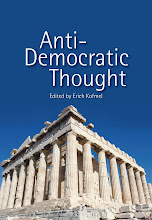

 Posts
Posts

