
In a blog article by the conservative eurosceptic UK Member of the European Parliament (MEP) and lead writer of the "Daily Telegraph", Daniel Hannan, published on 1 October 2010 on the website of the newspaper, the President of the European Commission, José Manuel Barroso, is cited as being critical of democracy ("The EU is an antidote to democratic governments, argues President Barroso", so the title of the article). Unfortunately, the quote and sentiments attributed to Barroso are not referenced by the author.
The full text of the article can be read free of charge here:
http://blogs.telegraph.co.uk/news/danielhannan/100056661/the-eu-is-an-antidote-to-democratic-governments-argues-president-barroso/
Excerpts: "Barroso [...] has offered one of the few utterly honest arguments for European integration. The reason we need the EU, he suggests, is precisely because it's not democratic. Left to themselves, elected governments might do all sorts of things simply to humour their voters: 'Governments are not always right. If governments were always right we would not have the situation that we have today. Decisions taken by the most democratic institutions in the world are very often wrong.' This was, in large measure, the original rationale for European unification. The founding fathers had come through the Second World War with – perhaps understandably – a jaded view of democracy. They fretted that, left to themselves, electorates might fall for demagogues. So they deliberately designed a system in which supreme power was wielded by appointed Commissioners who didn't need to worry about public opinion. It would be going too far to describe the Euro-patriarchs as anti-democratic: Robert Schuman had a sincere commitment to the ballot box, even if Jean Monnet hadn't. But it is fair to say that they believed that the democratic process sometimes needed to be guided, tempered, constrained.
"There are still plenty of people who think this way. Whenever I make the case for referendums, someone in the audience objects that the issues are too difficult for the man in the street, that the experts should be allowed to get on, that we are quietly relieved when politicians do what they think is best for us. [...] Most Barrosistas want a kind of moderated democracy, where voters are ultimately in charge, but where experts also have their place. Yet this has been the argument of every tyrant in history: Bonaparte, Mussolini, Salazar, Lenin. It is, mutatis mutandis, the justification of the ayatollahs in Teheran, who allow elections, but empower an unelected commission to step in when people get the result wrong. It is the argument you hear in private from Chinese Communists: yes, people should be free to elect candidates for certain offices, but a country like this would fall apart without the expertise concentrated in our party. [...] Voters, being human, can make mistakes. But it doesn't follow that a class of experts would have made a better decision." (italics removed)
Showing posts with label experts. Show all posts
Showing posts with label experts. Show all posts
04 October 2010

22 February 2010
Article: Bioethics and Deliberative Democracy: Five Warnings from Hobbes
Griffin Trotter, "Bioethics and Deliberative Democracy: Five Warnings from Hobbes" ("Journal of Medicine and Philosophy", 31 [3], June 2006: pp. 235-50).
Abstract: "Thomas Hobbes is one of the most ardent and thoroughgoing opponents of participatory democracy among Western political philosophers. Though Hobbes's alternative to participatory democracy – assent by subjects to rule by an absolute sovereign – no longer constitutes a viable political alternative for Westerners, his critique of participatory democracy is a potentially valuable source of insight about its liabilities. This essay elaborates five theses from Hobbes that stand as cogent warnings to those who embrace participatory democracy, especially those (such as most bioethicists) advocating for deliberative democracy based on a rational consensus model. In light of these warnings, the author suggests an alternative, modus vivendi approach to deliberative democracy that would radically alter the current practice of bioethics."
The full text of the article can be read free of charge here:
http://pdfserve.informaworld.com/761063__748843840.pdf
Excerpts: "Unlike Hobbes, I have no particular disdain for democracy. My intention here is to improve our conception of it. To that end, I will employ Hobbesian notions as leading ideas. [...] Hobbes is uniquely prominent among Enlightenment philosophers for his critical stance toward democracy [...]. He believes, first of all, that participatory democracy is difficult to carry off on a grand scale, and always devolves into rule by an aristocracy of vain-glorious public personalities [...], the most adroit manipulators of public sentiment will hold power and use this power in the way power is typically used – to serve their individual ends (whether these ends be egoistic, as Hobbes frequently presumes, or of the nature of imposing a comprehensive moral vision upon dissenting subjects). [...]
"Hobbes [...] worries about the politicization of ordinary human activities. The purpose of the state, on his view, is to carve out a secure area where such activities can be conducted without hostile interference. [...] [P]ublic advocacy [...] is profitless, not merely because it cannot succeed in producing a robust moral consensus, but more importantly because liberty and individual felicity would be enhanced by allowing opposing individuals and groups to establish their own practices, free from government interference and from each other [....] Democratic processes strongly tend to enhance both government's power (ability to enforce obedience) and its dominion (scope of things enforced). Because the citizens of a democracy participate in its rule, they tend to confuse dominion with liberty [...].
"In participatory democracy, many are involved, each with their own particular interests, desires, and objectives to which political power is an available means. [...] Each of these mini-demagogues is potentially capable of converting his/her personal concerns into political issues. Cooperation with disinterested demagogues is negotiated via a quid pro quo (well illustrated in the United States by our congressional earmarks) – begetting layer upon layer of political accretions. As we have witnessed in recent years, the metastasis of public projects eventually produces an unwieldy workload that overwhelms elected officials. Rather than viewing this predicament as a signal to scale down government, these officials create committees, commissions, and agencies – filled with political allies and authorized to create or enact more rules and prohibitions. [...]
"Insofar as citizens conflate their political dominion with their liberty or their felicity, they will tend to conjure grand visions of what they can achieve with like-minded political allies (against the will of dissenters). The typical result, on Hobbes's account, is a suffocating profusion of collective thinking. [...] Hobbes spends quite a bit of time delineating the ways in which public discourse amplifies realistic personal fears into irrational public hysteria. [...] The credo seems to be that it is better to do something coercively in large aggregates than to do it by consent in small groups. [...]
"[P]olitical processes aimed at moral consensus exacerbate each of the aforementioned dangers of participatory democracy. Founded, as it is, on the false claim that extensive moral consensus is possible, the quest for consensus requires multiple layers of deception. Citizens must be deceived into believing that the opinions of statesmen or moral experts are morally authoritative for the whole group (Hobbes's sovereign would never pose such a ludicrous claim). They must be deceived into believing that their well-being is enhanced by acquiescing to the purported moral consensus. And they must be deceived into believing that this acquiescence is in important respects autonomous and voluntary (despite the obvious fact that it is coerced). [...]
"Hobbes's critique of democracy-by-rational-consensus, and its bioethical counterpart, opens the door to a much longer and more difficult discussion. [...] Real political discourse is fractious; it involves the whole gamut of moral, immoral, and amoral human motives; and it succeeds primarily by producing cooperative activity, not moral consensus. Hobbes prefers monarchy over participatory democracy primarily because he thinks it is less apt to produce tyrannical accretions of government power and dominion, leaving citizens and diverse moral communities at relative liberty to chart their own moral destinies."
I read this as a libertarian take on democracy.
Griffin Trotter, who received both an MD and a PhD in Philosophy, is Associate Professor in the Department of Health Care at Saint Louis University.
28 January 2010
Articles: Wolff's (Plato's) argument that democracy is irrational
The Royal Institute of Philosophy's journal "Think" has published a string of three articles of possible interest (hard to say as I can't get access to them without paying $45/£30 each – for 4, 6, and 7 pages, respectively, that is!).
Most recently, they published "Reply to Wolff, Plato, Smith, Churchill and Aristotle on Democracy" by Timothy Childers (8 [22], June 2009: pp. 93-9):
http://journals.cambridge.org/action/displayAbstract?fromPage=online&aid=5101968
Abstract: "Fraser Smith (THINK 16) argues that Plato's argument against democracy as reconstructed by Jonathon [sic] Wolff is flawed because in a 'modern' democracy the people do not rule, but instead elect officials subject to a system of checks and balances. Smith's conception of democracy is much like Churchill's (and Popper's). I will argue that Smith's reply does not address Wolff and Plato's argument. I will then point out that Aristotle replied to Plato's argument in an appealing – and strikingly modern – fashion. Aristotle, I conclude, did justify to at least some degree democracy, and hence did address Plato's argument."
Timothy Childers is a member of the Institute of Logic of the Academy of Sciences of the Czech Republic, Prague.
The article by Fraser W. Smith that Childers refers to is "A Short Reply to Wolff's (Plato's) Argument that Democracy is Irrational" (6 [16], December 2008: pp. 49-52):
http://journals.cambridge.org/action/displayAbstract?fromPage=online&aid=3224368
Abstract: "Wolff suggests by way of the following argument (adapted by Wolff from Plato's Republic) that democracy appears to be irrational. Here is the argument given: 1) Ruling is a skill. 2) It is rational to leave the exercise of skills to experts [sic] 3) In a democracy the people rule. 4) The people are not experts. Therefore: 5) Democracy is irrational."
Fraser W. Smith's affiliation is not mentioned by the journal.
The original article by Jonathan Wolff is titled "Are We Good Enough for Democracy?" (1 [2], September 2002: pp. 29-34):
http://journals.cambridge.org/action/displayAbstract?fromPage=online&aid=3194964
Abstract: "Is democracy a good thing? Most of us think so. And yet, as Jonathan Wolff here explains, Plato thought democracy was a very bad idea. If you favour democracy (and I'm guessing you do), then your challenge is to explain what, if anything, is wrong with Plato's argument. So can you?"
The arguments in that article were taken from Wolff's book "Introduction to Political Philosophy" (Oxford University Press, 1996), chapter 3 "Who Should Rule?", section "Plato against democracy"
(pp. 66-77 in the revised edition of 2006):
http://ukcatalogue.oup.com/product/9780199296095.do
Excerpts (2006 edition): "On the latter understanding, then, democracy is mob rule: the rule of the rabble, the vulgar, the unwashed, the unfit. But this insult to democracy is a mere preliminary to Plato's main anti-democratic arguments. His basic weapon is the so-called 'craft analogy'. The point is very simple. If you were ill, and wanted advice on your health, you would go to an expert – the doctor. [...] The last thing you would do is to assemble a crowd, and ask them to vote on the correct remedy. The health of the state is a matter of no less importance than the health of any given individual. [...]
"If the people are allowed to decide they will be swayed by those who speak loudest and with most conviction [...]. Meanwhile, those who are truly skilled [...] will be ignored. [...] Ruling, like medicine, navigation, or even farming, is a skill. [...] Just as medicine should be left to the experts, and a medical training only given to those most suited, so should ruling, and a training to rule. [...] Plato's argument against democracy seems devastating. If ruling is a skill, and a skill that can only be attained by the few, then democracy seems plainly absurd or irrational. [...]
"[Plato's experts, the philosopher-kings,] agree to rule, not for the intrinsic or external rewards of the role, but because they would otherwise find themselves ruled by others. Rather than allow other people – worse still, all other people – to rule, they grudgingly accept this necessary duty."
Jonathan Wolff is Professor of Philosophy at University College London.
02 January 2010
Books: Climate scientists against democracy
One of the arguably most progressive movements of our times – environmentalists fighting global warming and climate change – shows signs of turning anti-democratic in the wake of the perceived failure of the climate summit in Copenhagen.
Before Copenhagen, hardly anyone took notice of anti-democratic thought arising out of environmental science, one of the most fashionable fields of research at this time. Let me highlight some of the recent developments.
Two years ago, Australians David Shearman and Joseph Wayne Smith published a book called "The Climate Change Challenge and the Failure of Democracy" (Praeger, 2007):
www.praeger.com/catalog/C34504.aspx
From the publisher's description: "Climate change threatens the future of civilization, but humanity is impotent in effecting solutions. Even in those nations with a commitment to reduce greenhouse emissions, they continue to rise. This failure mirrors those in many other spheres that deplete the fish of the sea, erode fertile land, destroy native forests, pollute rivers and streams, and utilize the world's natural resources beyond their replacement rate.
"In this provocative book, Shearman and Smith present evidence that the fundamental problem causing environmental destruction – and climate change in particular – is the operation of liberal democracy. Its flaws and contradictions bestow upon government – and its institutions, laws, and the markets and corporations that provide its sustenance – an inability to make decisions that could provide a sustainable society.
"Having argued that democracy has failed humanity, the authors go even further and demonstrate that this failure can easily lead to authoritarianism without our even noticing. Even more provocatively, they assert that there is merit in preparing for this eventuality if we want to survive climate change. They are not suggesting that existing authoritarian regimes are more successful in mitigating greenhouse emissions, for to be successful economically they have adopted the market system with alacrity. Nevertheless, the authors conclude that an authoritarian form of government is necessary, but this will be governance by experts and not by those who seek power.
"There are in existence highly successful authoritarian structures – for example, in medicine and in corporate empires – that are capable of implementing urgent decisions impossible under liberal democracy. Society is verging on a philosophical choice between liberty or life."
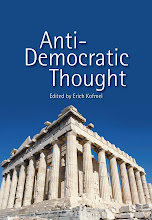
It is certainly noteworthy that both authors did not work at universities at the time this book was published – and haven't done so since. After holding faculty positions at Edinburgh and Yale, Shearman now works as a practicing physician. Smith is described as a lawyer, philosopher, and book author. Predictably, just like my own book, "Anti-Democratic Thought" (Imprint Academic, 2008), they received largely negative and even hostile reader reviews, simply for opposing democracy – along the lines of "Superficial Diatribe" and "Genocide, anyone? Sure would cut the ol' carbon footprint if you could just feed all those consumers and wrong-thinkers into the shredders ..."
Few academics showed themselves supportive: "For those wanting to think outside the square on climate change issues, this book is indispensable" (Bob Birrell, Monash); "This is an argument-moving book, a fresh and audacious contribution to the climate change debate" (Otis L. Graham, University of California, Santa Barbara); "If political thinking at its best makes the pressing questions of the day an occasion to revisit cherished fundamentals, then this book qualifies" (Gordon Graham, Princeton Theological Seminary – a fellow Imprint Academic author and critic of democracy).
The book is fully searchable on Google Book Search (including table of contents):
http://books.google.com/books?id=divhhP_kmMUC&printsec=frontcover
However, since then a number of climate scientists have adopted positions akin to those advanced by Shearman and Smith. James Hansen, for example, a renowned climate modeller with NASA (and billed as "[t]he scientist who convinced the world to take notice [...] of global warming"), is quoted in the "Guardian" as saying "that corporate lobbying has undermined democratic attempts to curb carbon pollution. 'The democratic process doesn't quite seem to be working,'" for "money is talking louder than the votes". "In Hansen's view, dealing with climate change allows no room for the compromises that rule the world of elected politics."
90-year-old British scientist James Lovelock (also a former NASA consultant and named one of the world's top-100 global public intellectuals by "Prospect" magazine in 2005), in "The Vanishing Face of Gaia: A Final Warning" (Allen Lane, 2009), may be appalling his readers, according to "Publishers Weekly", with "his contention that democracy may need to be abandoned to appropriately confront the challenge [of climate change]":
www.penguin.co.uk/nf/Book/BookDisplay/0,,9781846141850,00.html?/The_Vanishing_Face_of_Gaia_James_Lovelock
Hansen and Lovelock, too, have gained the freedom to say what they really think about democracy (and its dangers) by not standing in the (sole) employ of a university. While Hansen only holds an adjunct professorship at Columbia, Lovelock, though having been an honorary visiting fellow at an Oxford college since 1994, works independently out of his private laboratory.
Much more in this vein can be found in the fora and on message boards of the environmental science community.
It remains to be seen whether such sentiments uttered more frequently by climate scientists will be able to turn public opinion against democracy, and if the protesters that got themselves beat up and arrested on the streets of Copenhagen will turn away from the anti-authoritarian and decentralized grassroots democracy that is still the preferred mode of operation of most anti- and alter-globalization and environmental activism.
Also, Shearman and Smith are correct to stress that the environmental record of today's authoritarian regimes is by no means better than that of democratic governments. From what we heard last week, it appears that China with her obstruction policy is largely responsible for the apparent failure of the Copenhagen summit – for which the western democracies took the blame. China is not interested in curtailing her economic and industrial growth and the burgeoning capitalism (which, in time, will lead to democratic reforms).
Rule by experts, as proposed by climate scientists, is not a new idea either, though. It is as old as Plato's philosopher kings, H.G. Wells' liberal fascism, communist planning, and the EU bureaucracy. Let's just say, it hasn't worked.
We need new alternatives.
Subscribe to:
Posts (Atom)

 Posts

