Please circulate widely!
CALL FOR PAPERS
Anti-Democracy Agenda Symposium 2011
Organized by: Sussex Centre for the Individual and Society (SCIS)
Mode: Online by Google+ video conference
Date: 15-16 November 2011
The "Anti-Democracy Agenda" is the premier resource on the net for the study of anti-democratic thought and practice across the boundaries of various traditions and academic disciplines. First introduced by the Sussex Centre for the Individual and Society (SCIS) as a blog in January 2010, it has since been reconstituted as a circle (with associated public posts, much like a blog) on the new social network Google+. An archive of the blog is to be found here: http://anti-democracy-agenda.blogspot.com
For the new circle, see here:
https://plus.google.com/109507108125539761871/posts
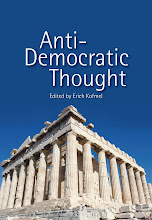
The Anti-Democracy Agenda Symposium 2011 will be the third event we organize to advance the research agenda on anti-democratic thought and practice as well as old and new criticisms of democracy. It will build up on a highly successful workshop on anti-democratic thought SCIS organized at the Annual Conference Workshops in Political Theory in Manchester, England, in September 2007, as well as the Anti-Democracy Agenda Symposium 2010, taking place at the Swiss Federal Institute of Technology (ETH) Zurich in November last year. Both events drew participants from the world over. The Manchester workshop led to the publication of an edited volume on "Anti-Democratic Thought" (Imprint Academic, 2008).
The Anti-Democracy Agenda Symposium 2011 is set to be equally international and interdisciplinary in scope. We invite affiliated academics, independent scholars, and doctoral students and candidates from a wide range of disciplines, such as Philosophy, Political Theory, Political Science, International Relations, Development Studies, Security Studies, Law, Economics, Sociology, Anthropology, Psychology, Literature, History, Classics, Theology, Religious Studies, Education, and so on. Papers may not only cover any and all aspects of criticisms of democracy and anti-democratic thought and practice, from perspectives including anarchism, libertarianism, conservatism, communism, Islamism, the extreme right, and others, but also related concepts such as authoritarianism, dictatorship, military rule, monarchy, chieftaincy, mixed constitution, the backlash against democracy promotion, terrorism, post-democracy, voter apathy, voter ignorance, etc. Have a look at the blog to see what might be of interest and falls within our remit. Papers may be theoretical and/or empirical in nature. Work in progress is welcome too.
This symposium may be the first academic conference to make use of the “Hangouts” video conference facility that is an integral part of Google+. Due to technical restrictions, the number of participants in the Anti-Democracy Agenda Symposium 2011 is limited to 10. All accepted participants will be required to create a profile on Google+ in order to be able to participate in the event. While we encourage the participation of scholars from developing countries, please only apply if you have access to a stable Internet connection. As in our previous physical events, over the course of two days, each presenter will have 60 minutes to present his or her paper and discuss it with all others. Due to the small size of the symposium, all participants are expected to attend both days fully.
As with all SCIS events, no fees will be charged from participants, and no funding is available to cover participants' expenses (if any). We will be glad to issue letters of acceptance on request to assist participants in securing leave from work. Detailed instructions on how to set up a Google+ profile and join the video conference will be provided to confirmed participants.
Please send your proposal to: erichkofmel@gmail.com
Deadline: 15 October 2011
Later submissions may still be accepted, but early submission is strongly advised and proposals may be accepted as they come in.
Cordially,
Erich Kofmel
Managing Director / Research Professor of Political Theory
Sussex Centre for the Individual and Society (SCIS)
https://plus.google.com/109507108125539761871
E-mail: erichkofmel@gmail.com
Postal address:
Sussex Centre for the Individual and Society
1200 Geneva
Switzerland
SCIS is an international association under Swiss law.
Founded 2006 at the University of Sussex.
Showing posts with label call for papers. Show all posts
Showing posts with label call for papers. Show all posts
16 August 2011

17 February 2011
CFP: Democracy and its Critics: Ancient and Modern
One-day conference "Democracy and its Critics: Ancient and Modern" of the Political Thought Specialist Group of the Political Studies Association (PSA), Oxford, UK (precise venue to be confirmed), October 2011 (possible date: 22 October)
Call for papers
Description: "Most of the countries of the world are now democracies in that they have representative governmental institutions controlled by freely elected officials which operate under the rule of law and guarantee a wide array of individual rights, including equality and non-discrimination, personal liberty, freedom of expression, association and conscience, fair trials and a variety of social benefits. If a country's democratic system works tolerably well, the large majority of its citizens would not want to live under a very different political system, such as an absolute monarchy, communism, fascism, one-party dictatorship or anarchism, and this provides some indication of the relationship between citizenry and democracy. Nevertheless, in the past century or so democracies have had their critics and in some cases powerful enemies who have argued that democracy does not provide society the security, economic development, welfare and the other goods it 'really' needs.
"Some critics, for example, argue that modern liberal democracy is not a 'real' democracy as power is actually exercised not by the people, but by an oligarchy or a bureaucratic elite, and they compare this system unfavourably with the direct democracy of Athens and other Greek city-states in the 5th and 4th centuries BC where the body of citizens actually participated, on an equal footing, in making decisions on public issues. However, ancient democracy also had its critics, including great thinkers like Plato and Aristotle. Similar republican forms of government in ancient Rome also had their critics and enemies. The aim of the conference is to bring together and encourage discussion among scholars who are interested in the main features of ancient and modern forms of democracy, and seek to assess the purposes and methods of their governments by reference to the wishes and needs of the people."
Papers are invited that deal with any of the above issues. Please send an abstract to both Evangelia Sembou (Study group convenor): evangelia.sembou@hotmail.com
and Zenon Stavrinides (University of Leeds): z.stavrinides@leeds.ac.uk
Deadline: 30 April 2011
An early expression of interest would be appreciated, as it would help determine numbers.
Call for papers
Description: "Most of the countries of the world are now democracies in that they have representative governmental institutions controlled by freely elected officials which operate under the rule of law and guarantee a wide array of individual rights, including equality and non-discrimination, personal liberty, freedom of expression, association and conscience, fair trials and a variety of social benefits. If a country's democratic system works tolerably well, the large majority of its citizens would not want to live under a very different political system, such as an absolute monarchy, communism, fascism, one-party dictatorship or anarchism, and this provides some indication of the relationship between citizenry and democracy. Nevertheless, in the past century or so democracies have had their critics and in some cases powerful enemies who have argued that democracy does not provide society the security, economic development, welfare and the other goods it 'really' needs.
"Some critics, for example, argue that modern liberal democracy is not a 'real' democracy as power is actually exercised not by the people, but by an oligarchy or a bureaucratic elite, and they compare this system unfavourably with the direct democracy of Athens and other Greek city-states in the 5th and 4th centuries BC where the body of citizens actually participated, on an equal footing, in making decisions on public issues. However, ancient democracy also had its critics, including great thinkers like Plato and Aristotle. Similar republican forms of government in ancient Rome also had their critics and enemies. The aim of the conference is to bring together and encourage discussion among scholars who are interested in the main features of ancient and modern forms of democracy, and seek to assess the purposes and methods of their governments by reference to the wishes and needs of the people."
Papers are invited that deal with any of the above issues. Please send an abstract to both Evangelia Sembou (Study group convenor): evangelia.sembou@hotmail.com
and Zenon Stavrinides (University of Leeds): z.stavrinides@leeds.ac.uk
Deadline: 30 April 2011
An early expression of interest would be appreciated, as it would help determine numbers.
30 December 2010
CFP: Freedom and Power
"Theoria: A Journal of Social and Political Theory", based out of the Faculty of Humanities, Development and Social Sciences at the University of KwaZulu-Natal, South Africa, is planning an issue on "Freedom and Power".
Call for papers
Description: "Ever since Livy proclaimed that 'freedom is to be in one's own power', if not from a long time before, the relationship between freedom and power has been an enduring concern of political theorists. It has withstood even Berlin's sharp distinctions between seemingly irreconcilable kinds of freedom and the subsequent diversion via debates about 'negative['], 'positive' and 'republican' freedom. With greater historical purview it is possible to see that the fault line between various competing conceptions of freedom is clearest with regard to how social and political theorists conceive of the relationship between freedom and power. While some thinkers have opposed freedom and power, arguing that liberty can only be truly attained free from power and domination (republicans) or in the absence of external impediments imposed by other human beings (liberals), others have identified a close and intriguing link between them, especially in the sphere of politics. A motley crew of radicals, Marxists and conservatives occupy the latter camp, including Livy, Machiavelli, Montaigne, Marx, Nietzsche and Foucault. Moreover, those in the former camp tend to think of freedom in formal and abstract terms, while proponents of the latter eschew this now normal tendency in political philosophy and instead think of freedom in fully substantive, concrete and even materialist terms. (Hobbes is an unusual and unique figure as his account of freedom inspires members of both parties in this debate.)
"Several important questions arise concerning freedom and power: What is freedom?; What is the relationship between freedom and power?; How, if at all, are freedom and domination related?; Is there a categorical or insurmountable conflict between freedom and discipline?; Does freedom depend upon being free from interference or being able to achieve certain desired or desirable goals or ends?; Are these two conditions – freedom from interference and the ability or power to achieve certain ends – related in some sense?; Can we measure freedom, and, if so, how?; What forms or degrees of freedom are possible in modern representative democracies?; How does representation affect freedom?; Is our freedom dependent on the power of our representatives?; How does the degradation of the planetary environment affect our views on freedom?; Given the dire need for self-control and self-discipline, especially regarding levels of consumption in the developed North, is the concept of freedom even still relevant?; Does the concept of freedom need to be reconfigured to accommodate constraint, austerity and self-control? If so, how?; What do the experiences of relatively recently liberated states teach us about freedom?; What is the relationship between freedom and power in the 'Global South'?; How, if at all, does poverty affect freedom?
"The editors of Theoria ask contributors to think about these questions in and of themselves and in the light of the various arguments from any of the proponents of the various conceptions of freedom. These can be written about in term of furthering our understanding of the nature of personal and political freedom within modern representative democracies or in order to develop novel arguments that propose conceptions of freedom for different possible future political organizations and forms of power. While abstract theoretical insights and arguments are welcome, we urge contributors to try and think about freedom and power within and between particular political contexts, especially within the 'Global South', where often freedom is a nascent and precarious achievement, and sometimes only for the lucky few, and between the 'Global South' and the 'Global North', either in relational or comparative terms. Given the changing power relations that exist within and between existing states, there is also much room for utopian thought regarding new forms of freedom in as yet un-experienced contexts of political power and moral conflict."
Submission must be sent in MS Word format to the Managing Editor, Sherran Clarence (University of the Western Cape): sherranclarence@gmail.com
Deadline: 31 August 2011
Call for papers
Description: "Ever since Livy proclaimed that 'freedom is to be in one's own power', if not from a long time before, the relationship between freedom and power has been an enduring concern of political theorists. It has withstood even Berlin's sharp distinctions between seemingly irreconcilable kinds of freedom and the subsequent diversion via debates about 'negative['], 'positive' and 'republican' freedom. With greater historical purview it is possible to see that the fault line between various competing conceptions of freedom is clearest with regard to how social and political theorists conceive of the relationship between freedom and power. While some thinkers have opposed freedom and power, arguing that liberty can only be truly attained free from power and domination (republicans) or in the absence of external impediments imposed by other human beings (liberals), others have identified a close and intriguing link between them, especially in the sphere of politics. A motley crew of radicals, Marxists and conservatives occupy the latter camp, including Livy, Machiavelli, Montaigne, Marx, Nietzsche and Foucault. Moreover, those in the former camp tend to think of freedom in formal and abstract terms, while proponents of the latter eschew this now normal tendency in political philosophy and instead think of freedom in fully substantive, concrete and even materialist terms. (Hobbes is an unusual and unique figure as his account of freedom inspires members of both parties in this debate.)
"Several important questions arise concerning freedom and power: What is freedom?; What is the relationship between freedom and power?; How, if at all, are freedom and domination related?; Is there a categorical or insurmountable conflict between freedom and discipline?; Does freedom depend upon being free from interference or being able to achieve certain desired or desirable goals or ends?; Are these two conditions – freedom from interference and the ability or power to achieve certain ends – related in some sense?; Can we measure freedom, and, if so, how?; What forms or degrees of freedom are possible in modern representative democracies?; How does representation affect freedom?; Is our freedom dependent on the power of our representatives?; How does the degradation of the planetary environment affect our views on freedom?; Given the dire need for self-control and self-discipline, especially regarding levels of consumption in the developed North, is the concept of freedom even still relevant?; Does the concept of freedom need to be reconfigured to accommodate constraint, austerity and self-control? If so, how?; What do the experiences of relatively recently liberated states teach us about freedom?; What is the relationship between freedom and power in the 'Global South'?; How, if at all, does poverty affect freedom?
"The editors of Theoria ask contributors to think about these questions in and of themselves and in the light of the various arguments from any of the proponents of the various conceptions of freedom. These can be written about in term of furthering our understanding of the nature of personal and political freedom within modern representative democracies or in order to develop novel arguments that propose conceptions of freedom for different possible future political organizations and forms of power. While abstract theoretical insights and arguments are welcome, we urge contributors to try and think about freedom and power within and between particular political contexts, especially within the 'Global South', where often freedom is a nascent and precarious achievement, and sometimes only for the lucky few, and between the 'Global South' and the 'Global North', either in relational or comparative terms. Given the changing power relations that exist within and between existing states, there is also much room for utopian thought regarding new forms of freedom in as yet un-experienced contexts of political power and moral conflict."
Submission must be sent in MS Word format to the Managing Editor, Sherran Clarence (University of the Western Cape): sherranclarence@gmail.com
Deadline: 31 August 2011
29 June 2010
CFP: Breakdowns of Democracy Revisited
12th Mediterranean Research Meeting of the Robert Schuman Centre for Advanced Studies, European University Institute (EUI), Florence and Montecatini Terme, Italy, 6-9 April 2011
Call for papers for Workshop 7: "Breakdowns of Democracy Revisited: Transitions from Liberal-Democratic to Authoritarian Regimes around the Mediterranean Littoral"
www.eui.eu/DepartmentsAndCentres/RobertSchumanCentre/Research/InternationalTransnationalRelations/MediterraneanProgramme/MRM/MRM2011/Index.aspx
From the workshop description: "Studies of democratization have matured greatly over the last two decades [...]. Nevertheless, early expectations that new democracies would survive and flourish have run up against significant cases in which political reform has quickly stalled out or regressed to liberalized authoritarian rule. This development has opened the door to systematic investigations of the circumstances under which initial liberalization programs have failed to gain momentum, most notably in Tunisia and Jordan. Such studies raise the crucial question of whether democratization can be assumed to move in only one direction. History suggests that liberal democracies on occasion collapse and get replaced by highly illiberal regimes. Classic cases of democratic breakdown include Italy in the early 1920s and Germany a decade later.
"Less fully investigated are parallel instances of democratic collapse in Spain, Greece and Turkey. Completely ignored are countries whose brief liberal-democratic eras have been overlooked by political scientists and historians. A number of important examples of the transition away from liberal democracy can be found in the MENA [Middle East and North Africa region]. Among these stand Egypt, Syria, Iraq and perhaps even Libya, not to mention the aborted transition to illiberal governance in Lebanon of the late 1950s. Focused comparisons between well-studied episodes of the breakdown of liberal political orders along the northern shores of the Mediterranean and largely overlooked instances to the south and east are certain to enhance our understanding of the causal factors and processes that lead democracies to be supplanted by authoritarian regimes.
"Scholarship on the topic has lain virtually dormant since the late 1970s. [...] This workshop proposes not only to bring a wide range of additional, long-overlooked cases into the literature on democratic collapse but also to begin the crucial task of formulating well-structured comparisons across different empirical examples. Contributions which focus on countries that have so far been ignored in the academic literature, particularly ones situated in the MENA region, will be expected to make reference to analyses of better-studied examples. Given the peculiarities of the German model, the organizers anticipate that the experience of Italy during the first two decades of the twentieth century is likely to prove particularly thought-provoking, and would therefore welcome proposals from specialists in Italian history and politics. Contributions intended primarily to advance the theory of liberal-democratic breakdown are certainly encouraged, but will be expected to rest on a firm empirical foundation.
"Liberal experiments in the MENA during the 1920s and 1930s are routinely dismissed as too imperfect to be included in discussions of the structure, workings and transformation of democratic governance. The workshop organizers firmly reject such dismissiveness toward the variety of party-based, electoral systems that one finds throughout the Arab world in the decades before the wave of military-led revolutions washed across the region. Instead, they hope that detailed explorations of the liberal-democratic moment in the MENA, unbiased by what E.P. Thompson might call 'the enormous condescension of posterity,' will offer new insight into the dynamics of politics in this part of the world, while at the same time reinvigoring conceptual debates about the dynamics of democratization on the basis of evidence drawn from all shores of the Mediterranean."
Please find detailed instructions on how to submit a paper proposal for this workshop on the conference website (see particularly full call for papers and online form). The procedures and requirements are uncommonly stringent.
Deadline: 15 July 2010
Only for workshop-related questions, contact directly the workshop directors, Fred Lawson (Mills College, California): lawson@mills.edu
and Abdelwahab Shaker (Bibliotheca Alexandrina, Egypt): abdelwahab.shaker@bibalex.org
Call for papers for Workshop 7: "Breakdowns of Democracy Revisited: Transitions from Liberal-Democratic to Authoritarian Regimes around the Mediterranean Littoral"
www.eui.eu/DepartmentsAndCentres/RobertSchumanCentre/Research/InternationalTransnationalRelations/MediterraneanProgramme/MRM/MRM2011/Index.aspx
From the workshop description: "Studies of democratization have matured greatly over the last two decades [...]. Nevertheless, early expectations that new democracies would survive and flourish have run up against significant cases in which political reform has quickly stalled out or regressed to liberalized authoritarian rule. This development has opened the door to systematic investigations of the circumstances under which initial liberalization programs have failed to gain momentum, most notably in Tunisia and Jordan. Such studies raise the crucial question of whether democratization can be assumed to move in only one direction. History suggests that liberal democracies on occasion collapse and get replaced by highly illiberal regimes. Classic cases of democratic breakdown include Italy in the early 1920s and Germany a decade later.
"Less fully investigated are parallel instances of democratic collapse in Spain, Greece and Turkey. Completely ignored are countries whose brief liberal-democratic eras have been overlooked by political scientists and historians. A number of important examples of the transition away from liberal democracy can be found in the MENA [Middle East and North Africa region]. Among these stand Egypt, Syria, Iraq and perhaps even Libya, not to mention the aborted transition to illiberal governance in Lebanon of the late 1950s. Focused comparisons between well-studied episodes of the breakdown of liberal political orders along the northern shores of the Mediterranean and largely overlooked instances to the south and east are certain to enhance our understanding of the causal factors and processes that lead democracies to be supplanted by authoritarian regimes.
"Scholarship on the topic has lain virtually dormant since the late 1970s. [...] This workshop proposes not only to bring a wide range of additional, long-overlooked cases into the literature on democratic collapse but also to begin the crucial task of formulating well-structured comparisons across different empirical examples. Contributions which focus on countries that have so far been ignored in the academic literature, particularly ones situated in the MENA region, will be expected to make reference to analyses of better-studied examples. Given the peculiarities of the German model, the organizers anticipate that the experience of Italy during the first two decades of the twentieth century is likely to prove particularly thought-provoking, and would therefore welcome proposals from specialists in Italian history and politics. Contributions intended primarily to advance the theory of liberal-democratic breakdown are certainly encouraged, but will be expected to rest on a firm empirical foundation.
"Liberal experiments in the MENA during the 1920s and 1930s are routinely dismissed as too imperfect to be included in discussions of the structure, workings and transformation of democratic governance. The workshop organizers firmly reject such dismissiveness toward the variety of party-based, electoral systems that one finds throughout the Arab world in the decades before the wave of military-led revolutions washed across the region. Instead, they hope that detailed explorations of the liberal-democratic moment in the MENA, unbiased by what E.P. Thompson might call 'the enormous condescension of posterity,' will offer new insight into the dynamics of politics in this part of the world, while at the same time reinvigoring conceptual debates about the dynamics of democratization on the basis of evidence drawn from all shores of the Mediterranean."
Please find detailed instructions on how to submit a paper proposal for this workshop on the conference website (see particularly full call for papers and online form). The procedures and requirements are uncommonly stringent.
Deadline: 15 July 2010
Only for workshop-related questions, contact directly the workshop directors, Fred Lawson (Mills College, California): lawson@mills.edu
and Abdelwahab Shaker (Bibliotheca Alexandrina, Egypt): abdelwahab.shaker@bibalex.org
03 June 2010
CFP: Democracy, History, Universality: Beyond the Decline of the West
Sixth General Conference of the European Consortium for Political Research (ECPR), University of Iceland, Reykjavik, 25-27 August 2011
Call for panels and papers for a section on "Democracy, History, Universality: Beyond the Decline of the West"
www.ecprnet.eu/conferences/general_conference/Reykjavik/section_details.asp?sectionID=84
Description: "The global debate about the universal significance of democracy represents one of the defining features of our time. Democracy is accepted by nearly everyone as the only legitimate form of government. At the same time, the appeal of the democratic values is weakened both by an ever greater degree of alienation between the population and the democratic institutions in the quintessentially democratic societies of Europe and North America and by the fact that in the more peripheral countries the pro-democracy rhetoric is often cynically used to justify some of the most undemocratic decisions and practices.
"Another crucial dimension of the debate is the increasing recognition that liberal democracy is indeed rooted in the historical experience and cultural particularity of the West. This tension between universalism and particularism has several dimensions. In Europe, it is reflected in the clash between universalist ambitions associated with the European democratic model and the rise of xenophobic politics that strive to redefine Europe in cultural or religious terms. At the same time, accepting the fact that democracy is historically conditioned immediately opens it up to the relativist challenge.
"The western community is often accused of monopolising the power to define what democracy means in political practice, which arguably exposes the Eurocentric nature of democracy promotion undertaken by democratic governments. Political leaders of many nations that explicitly define themselves as non-western now offer their respective political regimes as possible alternative models of democratic development. These claims have to be taken seriously despite their underlying instrumental motives, because what makes them possible in the first place are genuine grassroots concerns about western unilateralism, shared by many people all over the world.
"The panels within this section will be focused around the tension between the supposedly universal value of democracy and its embeddedness in a particular historical experience. The following questions will be discussed, among others: Can we think of truly universal democracy, or must the universal, as some theorists argue, be cleared of any positive predicates? What is happening to the idea of the West as a model democratic community? Does the universal appeal of the European idea give way to xenophobic particularism? What are the consequences of the internal tensions within the West and external challenges to its alleged domination? Can the criticism of democracy as 'too western' pave the way towards truly generic emancipation of humankind?"
Instructions on how to submit proposals for panels and papers are to be found here:
www.ecprnet.eu/conferences/general_conference/Reykjavik/documents/Panel_Chair_Guidelines_and_Deadlines.pdf
Currently, only proposals for panels will be accepted. Proposals for papers can be submitted from 1 November 2010, when a list of the panels accepted for this section will be published on the ECPR website. All proposals are to be submitted online.
Deadline for panel proposals: 1 September 2010
Deadline for paper proposals: 1 February 2011
For further information, please contact the section convenors:
Viatcheslav Morozov (University of Tartu): viacheslav.morozov@ut.ee
Christopher S. Browning (University of Warwick): c.s.browning@warwick.ac.uk
Pertti Joenniemi (Danish Institute for International Studies): pjo@diis.dk
Please note that conference participants may only appear in the academic programme once in any one capacity. That is, they may only chair one section, they may only chair one panel, they may only present one paper, they may only act once as a discussant.
Call for panels and papers for a section on "Democracy, History, Universality: Beyond the Decline of the West"
www.ecprnet.eu/conferences/general_conference/Reykjavik/section_details.asp?sectionID=84
Description: "The global debate about the universal significance of democracy represents one of the defining features of our time. Democracy is accepted by nearly everyone as the only legitimate form of government. At the same time, the appeal of the democratic values is weakened both by an ever greater degree of alienation between the population and the democratic institutions in the quintessentially democratic societies of Europe and North America and by the fact that in the more peripheral countries the pro-democracy rhetoric is often cynically used to justify some of the most undemocratic decisions and practices.
"Another crucial dimension of the debate is the increasing recognition that liberal democracy is indeed rooted in the historical experience and cultural particularity of the West. This tension between universalism and particularism has several dimensions. In Europe, it is reflected in the clash between universalist ambitions associated with the European democratic model and the rise of xenophobic politics that strive to redefine Europe in cultural or religious terms. At the same time, accepting the fact that democracy is historically conditioned immediately opens it up to the relativist challenge.
"The western community is often accused of monopolising the power to define what democracy means in political practice, which arguably exposes the Eurocentric nature of democracy promotion undertaken by democratic governments. Political leaders of many nations that explicitly define themselves as non-western now offer their respective political regimes as possible alternative models of democratic development. These claims have to be taken seriously despite their underlying instrumental motives, because what makes them possible in the first place are genuine grassroots concerns about western unilateralism, shared by many people all over the world.
"The panels within this section will be focused around the tension between the supposedly universal value of democracy and its embeddedness in a particular historical experience. The following questions will be discussed, among others: Can we think of truly universal democracy, or must the universal, as some theorists argue, be cleared of any positive predicates? What is happening to the idea of the West as a model democratic community? Does the universal appeal of the European idea give way to xenophobic particularism? What are the consequences of the internal tensions within the West and external challenges to its alleged domination? Can the criticism of democracy as 'too western' pave the way towards truly generic emancipation of humankind?"
Instructions on how to submit proposals for panels and papers are to be found here:
www.ecprnet.eu/conferences/general_conference/Reykjavik/documents/Panel_Chair_Guidelines_and_Deadlines.pdf
Currently, only proposals for panels will be accepted. Proposals for papers can be submitted from 1 November 2010, when a list of the panels accepted for this section will be published on the ECPR website. All proposals are to be submitted online.
Deadline for panel proposals: 1 September 2010
Deadline for paper proposals: 1 February 2011
For further information, please contact the section convenors:
Viatcheslav Morozov (University of Tartu): viacheslav.morozov@ut.ee
Christopher S. Browning (University of Warwick): c.s.browning@warwick.ac.uk
Pertti Joenniemi (Danish Institute for International Studies): pjo@diis.dk
Please note that conference participants may only appear in the academic programme once in any one capacity. That is, they may only chair one section, they may only chair one panel, they may only present one paper, they may only act once as a discussant.
06 May 2010
CFP: Anti-Democracy Agenda Symposium 2010
Please circulate widely!
CALL FOR PAPERS
Anti-Democracy Agenda Symposium 2010
Organized by: Sussex Centre for the Individual and Society (SCIS)
Location: Gottfried-Semper Villa Garbald, part of the Collegium Helveticum of the Swiss Federal Institute of Technology (ETH) Zurich and the University of Zurich, at Castasegna, in the Swiss Alps
Date: 8-10 November 2010
The "Anti-Democracy Agenda" (www.anti-democracy-agenda.blogspot.com) has been run by the Sussex Centre for the Individual and Society since January 2010. The blog is the premier resource on the net for the study of anti-democratic thought and practice across the boundaries of various traditions and academic disciplines.
The Anti-Democracy Agenda Symposium 2010 will be the first event we organize in conjunction with the blog. It will build up though on a highly successful event on anti-democratic thought SCIS organized earlier, at the Annual Conference Workshops in Political Theory in Manchester, England, in September 2007, drawing participants from the world over. That workshop led to the publication of an edited volume, "Anti-Democratic Thought" (Imprint Academic), in December 2008.
The Anti-Democracy Agenda Symposium 2010 is set to be equally international and interdisciplinary in scope. We invite affiliated academics, independent scholars, and doctoral students and candidates from a wide range of disciplines, such as Philosophy, Political Theory, Political Science, International Relations, Development Studies, Security Studies, Law, Economics, Sociology, Anthropology, Psychology, Literature, History, Classics, Theology, Religious Studies, Education, and so on. Papers may not only cover any and all aspects of criticisms of democracy and anti-democratic thought and practice, from perspectives including anarchism, libertarianism, conservatism, communism, Islamism, the extreme right, and others, but also related concepts such as authoritarianism, dictatorship, military rule, monarchy, chieftaincy, mixed constitution, the backlash against democracy promotion, terrorism, post-democracy, voter apathy, voter ignorance, etc. Have a look at the blog to see what might be of interest and falls within our remit. Papers may be theoretical and/or empirical in nature. Work in progress is welcome too.
We expect that 10-15 participants will be attending the workshop-style Anti-Democracy Agenda Symposium 2010. Over the course of two and a half days, each presenter will have 60 minutes to present his or her paper and discuss it with all others.
As with all SCIS events, no fees will be charged from participants, and no funding is available to cover participants' travel and accommodation expenses. We will be glad to issue letters of invitation on request to assist participants in securing funding from their usual sources. The charges payable directly to the Villa Garbald (approx. $510 half-board/$570 full-board per person) cover accommodation for three nights and food and drink (except alcohol and minibar) throughout your stay. Participants will be arriving on Sunday, taking in the magnificent scenery of the Swiss Alps on a spectacular 5-hour train journey from Zurich airport (via St. Moritz) to a remote Italian-speaking Swiss valley (Val Bregaglia), home to Europe's largest chestnut forest, and leave on Wednesday after lunch, on the same way (cost of a return ticket approx. $115). Alternatively, you can get there in 3-4 hours by train from Milano airport, passing Lake Como. During the symposium there will be ample time to explore the surroundings. Please feel free to contact us with any questions. Detailed travel instructions will be provided to confirmed participants. Don't miss this unique opportunity.
The Italian-style Villa Garbald was built by German star architect Gottfried Semper (of Semper Opera in Dresden and Vienna Burgtheater fame) during his exile in Switzerland. A pro-democracy activist in aristocratic mid-19th century Germany, his experiences with direct-democratic government in Switzerland turned him in later life increasingly against democracy.
Please send your proposal to: e.kofmel@sussexcentre.org
Deadline: 31 July 2010
Later submissions may still be accepted, but early submission is strongly advised and proposals may be accepted as they come in.

Cordially,
Erich Kofmel
Managing Director / Research Professor of Political Theory
Sussex Centre for the Individual and Society (SCIS)
www.sussexcentre.org
E-mail: e.kofmel@sussexcentre.org
Postal address:
Sussex Centre for the Individual and Society
1200 Geneva
Switzerland
SCIS is an international association under Swiss law.
Founded 2006 at the University of Sussex.
CALL FOR PAPERS
Anti-Democracy Agenda Symposium 2010
Organized by: Sussex Centre for the Individual and Society (SCIS)
Location: Gottfried-Semper Villa Garbald, part of the Collegium Helveticum of the Swiss Federal Institute of Technology (ETH) Zurich and the University of Zurich, at Castasegna, in the Swiss Alps
Date: 8-10 November 2010
The "Anti-Democracy Agenda" (www.anti-democracy-agenda.blogspot.com) has been run by the Sussex Centre for the Individual and Society since January 2010. The blog is the premier resource on the net for the study of anti-democratic thought and practice across the boundaries of various traditions and academic disciplines.
The Anti-Democracy Agenda Symposium 2010 will be the first event we organize in conjunction with the blog. It will build up though on a highly successful event on anti-democratic thought SCIS organized earlier, at the Annual Conference Workshops in Political Theory in Manchester, England, in September 2007, drawing participants from the world over. That workshop led to the publication of an edited volume, "Anti-Democratic Thought" (Imprint Academic), in December 2008.
The Anti-Democracy Agenda Symposium 2010 is set to be equally international and interdisciplinary in scope. We invite affiliated academics, independent scholars, and doctoral students and candidates from a wide range of disciplines, such as Philosophy, Political Theory, Political Science, International Relations, Development Studies, Security Studies, Law, Economics, Sociology, Anthropology, Psychology, Literature, History, Classics, Theology, Religious Studies, Education, and so on. Papers may not only cover any and all aspects of criticisms of democracy and anti-democratic thought and practice, from perspectives including anarchism, libertarianism, conservatism, communism, Islamism, the extreme right, and others, but also related concepts such as authoritarianism, dictatorship, military rule, monarchy, chieftaincy, mixed constitution, the backlash against democracy promotion, terrorism, post-democracy, voter apathy, voter ignorance, etc. Have a look at the blog to see what might be of interest and falls within our remit. Papers may be theoretical and/or empirical in nature. Work in progress is welcome too.
We expect that 10-15 participants will be attending the workshop-style Anti-Democracy Agenda Symposium 2010. Over the course of two and a half days, each presenter will have 60 minutes to present his or her paper and discuss it with all others.
As with all SCIS events, no fees will be charged from participants, and no funding is available to cover participants' travel and accommodation expenses. We will be glad to issue letters of invitation on request to assist participants in securing funding from their usual sources. The charges payable directly to the Villa Garbald (approx. $510 half-board/$570 full-board per person) cover accommodation for three nights and food and drink (except alcohol and minibar) throughout your stay. Participants will be arriving on Sunday, taking in the magnificent scenery of the Swiss Alps on a spectacular 5-hour train journey from Zurich airport (via St. Moritz) to a remote Italian-speaking Swiss valley (Val Bregaglia), home to Europe's largest chestnut forest, and leave on Wednesday after lunch, on the same way (cost of a return ticket approx. $115). Alternatively, you can get there in 3-4 hours by train from Milano airport, passing Lake Como. During the symposium there will be ample time to explore the surroundings. Please feel free to contact us with any questions. Detailed travel instructions will be provided to confirmed participants. Don't miss this unique opportunity.
The Italian-style Villa Garbald was built by German star architect Gottfried Semper (of Semper Opera in Dresden and Vienna Burgtheater fame) during his exile in Switzerland. A pro-democracy activist in aristocratic mid-19th century Germany, his experiences with direct-democratic government in Switzerland turned him in later life increasingly against democracy.
Please send your proposal to: e.kofmel@sussexcentre.org
Deadline: 31 July 2010
Later submissions may still be accepted, but early submission is strongly advised and proposals may be accepted as they come in.
Cordially,
Erich Kofmel
Managing Director / Research Professor of Political Theory
Sussex Centre for the Individual and Society (SCIS)
www.sussexcentre.org
E-mail: e.kofmel@sussexcentre.org
Postal address:
Sussex Centre for the Individual and Society
1200 Geneva
Switzerland
SCIS is an international association under Swiss law.
Founded 2006 at the University of Sussex.
16 April 2010
CFP: Deconstructing Democracy
Call for papers: Deconstructing Democracy
The November 2011 issue of the journal "Derrida Today" will be a special issue on "Deconstructing Democracy". Jacques Derrida's evocation of a "democracy-to-come" is most famously associated with global politics immediately after the fall of the Berlin Wall and the announcement of a new world order. Over subsequent years, the term recurred in Derrida's discussions of religion, sovereignty, justice, human rights, and the war on terror. How adaptable was this deconstructive construction of democracy, and how well has it survived into the era after both established communism and evangelical neo-conservatism, the era of stalemate in Iraq and Afghanistan, of the global financial crisis and climate change?
Far from being a mere restatement or celebration of Derrida's own discussions of democracy, this issue will hope to encourage a critical re-appraisal of the relationship between deconstruction and the democratic: What are the horizons of the deconstruction of democracy with, beyond or against Derrida; with, beyond or against democracy? Does "democracy-to-come" have an enduring legacy? What does deconstruction have to offer democratic thinking now? Does deconstruction help us re-think the strengths and limitations of democracy both as it is currently practiced and as an idea? Whatever happened to the "New International"? Is deconstruction democratic?
Possible contributors should send a 250-word proposal to Nick Mansfield and Nicole Anderson (both Macquarie University): dteditors@gmail.com
Deadline: 30 June 2010
Complete papers will be due by 31 December 2010.
Additional information about the journal is to be found here:
www.euppublishing.com/journal/drt
The November 2011 issue of the journal "Derrida Today" will be a special issue on "Deconstructing Democracy". Jacques Derrida's evocation of a "democracy-to-come" is most famously associated with global politics immediately after the fall of the Berlin Wall and the announcement of a new world order. Over subsequent years, the term recurred in Derrida's discussions of religion, sovereignty, justice, human rights, and the war on terror. How adaptable was this deconstructive construction of democracy, and how well has it survived into the era after both established communism and evangelical neo-conservatism, the era of stalemate in Iraq and Afghanistan, of the global financial crisis and climate change?
Far from being a mere restatement or celebration of Derrida's own discussions of democracy, this issue will hope to encourage a critical re-appraisal of the relationship between deconstruction and the democratic: What are the horizons of the deconstruction of democracy with, beyond or against Derrida; with, beyond or against democracy? Does "democracy-to-come" have an enduring legacy? What does deconstruction have to offer democratic thinking now? Does deconstruction help us re-think the strengths and limitations of democracy both as it is currently practiced and as an idea? Whatever happened to the "New International"? Is deconstruction democratic?
Possible contributors should send a 250-word proposal to Nick Mansfield and Nicole Anderson (both Macquarie University): dteditors@gmail.com
Deadline: 30 June 2010
Complete papers will be due by 31 December 2010.
Additional information about the journal is to be found here:
www.euppublishing.com/journal/drt
Subscribe to:
Posts (Atom)

 Posts
Posts

