
While recent events in North Africa could lead one to believe otherwise, the "Freedom in the World 2011" survey, released on 13 January 2011 by Freedom House, an organization that advocates democracy around the world, finds that last year, like the years before, the number of electoral democracies declined further.
According to the press release, "[t]his represents the longest continuous period of decline in the nearly 40-year history of the survey. [...] A total of 25 countries showed significant declines in 2010, more than double the 11 countries exhibiting noteworthy gains [...], and the number of electoral democracies dropped to 115, far below the 2005 figure of 123. [...] Three countries – the Philippines, Tanzania, and Tonga – achieved electoral democracy status after conducting elections that were regarded as improvements over earlier polls. Declines in Burundi, Guinea-Bissau, Haiti, and Sri Lanka triggered their removal from the list of electoral democracies."
In an overview essay, "Freedom in the World 2011: The Authoritarian Challenge to Democracy", the author, Arch Puddington, Director of Research at Freedom House, writes: "[T]he world's most powerful authoritarians have acted with aggression and self-assurance, and democratic leaders have responded with equivocation or silence. [...] Among lesser powers, those with energy riches or geostrategic significance demonstrated that acts of antidemocratic contempt will draw no serious rebuke from the democratic world. [...] [I]f the world's democracies fail to unite and speak out in defense of their own values, despots will continue to gain from divide-and-conquer strategies, as Russia's leaders are now doing in their approach to Europe and the United States. [...] The past decade began at a high point for freedom and concluded with freedom under duress."
Details are to be found here:
www.freedomhouse.org/images/File/fiw/FIW_Overview_2011.pdf
Showing posts with label trend. Show all posts
Showing posts with label trend. Show all posts
31 January 2011

29 October 2010
Article: Germans are increasingly anti-democratic
On 27 October 2010, the Czech English-language weekly newspaper "The Prague Post" published on its website an op-ed article by Nora Langenbacher titled "Germans are increasingly anti-democratic".
The full text of the article can be read free of charge here:
www.praguepost.com/opinion/6181-germans-are-increasingly-anti-democratic.html
Excerpts: "[T]he German nonprofit institution Friedrich Ebert Foundation places great emphasis on combating anti-democratic, racist and xenophobic tendencies. [...] Of central concern to the foundation is the existence of anti-democratic and racist attitudes among the general public. [...] A recently published study [in German] conducted by us, an organization committed to social democracy, once again highlights [...] that right-wing extremist thought is not merely a problem of 'the margins of society.' Instead, the scientists found widespread acceptance of chauvinistic, social Darwinist, xenophobic and anti-Semitic statements as well as shocking agreement with the idea of dictatorship generally as well as with aspects of the German National Socialism in particular. For example, more than one out of 10 interviewees in the study wished for 'a "Führer" to rule Germany with strong leadership,' and almost every 10th person said, 'For Germany's national interest, a dictatorship might be a better form of government.' [...] This widespread general resignation regarding democracy as it exists and the feeling of having no political influence whatsoever combined with the rise in right-wing attitudes reveals a dramatic challenge for German politics and society."
It is not mentioned whether the article appeared in print too.
Nora Langenbacher, a political scientist, coordinates the "Combating Right-Wing Extremism" project of the Friedrich Ebert Foundation (FES).
05 October 2010
Trend: Africa healthier, wealthier and undemocratic
Clare Byrne, writing for the South African Press Association (SAPA) and the Deutsche Presse-Agentur (dpa), is credited with an article, "Africa healthier, wealthier and undemocratic", published on 4 October 2010 on the South African "NewsTime" website.
The full text of the article can be read free of charge here:
www.newstime.co.za/SouthAfrica/Africa_healthier_wealthier_and_undemocratic/12230/
Excerpts: "Africans are becoming healthier and getting more opportunities to generate wealth. But five decades after most Africans first got a vote, democracy on the continent is ailing, an index of African governance showed Monday. The 2010 Ibrahim Index of African [G]overnance found that access to economic opportunities had improved in 41 out of 53 African countries between 2004/2005 and 2008/2009. In human development terms, Africa had also made strides, with 44 countries showing improvements, particularly in health and social welfare. Yet, despite the economic and social progress, 35 countries had suffered declines in safety and the rule of law, the index showed. There was also bad news in the area of human rights and citizen participation in the political progress, which had worsened in about two-thirds of African countries.
"The index – the first of its kind in Africa – was launched in 2007 by Mo Ibrahim, the multimillionaire Sudanese founder of Celtel, one of Africa's largest mobile phone networks. [...] Eritrea, Guinea, Madagascar, Mauritania and Somalia had fallen the furthest. All five were beset by armed conflicts or coups during the review period. Elsewhere, the lack of citizen oversight also meant most governments were not being held to account, the index showed. 'We see the challenge of consolidating democracy and extending it,' [Mo Ibrahim Foundation board member Mamphele] Ramphele, a former managing director of the World Bank said. 'Many citizens on our continent are not active,' she said. At the same time as he launched the index, Mo Ibrahim, a vocal campaigner against corruption, also launched a prize for excellence in African leadership worth over 5 million dollars. The prize has not been awarded in the past two years, after no suitable candidates were found."
The full results of the 2010 Ibrahim Index of African Governance are to be found here:
www.moibrahimfoundation.org/en/section/the-ibrahim-index
26 September 2010
Article: Asia's Dithering Democracies
On 1 January 2009, "Time" published on its website an article titled "Asia's Dithering Democracies", authored by the magazine's Southeast Asia Bureau Chief, Hannah Beech, who is of Japanese and American parentage.
The full text of the article can be read free of charge here:
www.time.com/time/magazine/article/0,9171,1869271,00.html
Excerpts: "After the shackles of colonialism were overthrown, largely after World War II, the 21st century was supposed to herald the ascent of democracy in Asia. While parts of the region – from Burma and North Korea to Laos, Vietnam and China – are still governed by diktat, the past couple of decades have created a region that to all outward appearances is largely democratic. [...] Yet throughout 2008, many Asians appeared to progressively lose their faith in democratic politics. [...] In many ways, the challenges of Asian democracy are a reflection of its youth. Democracy in the West evolved over centuries – and, even then, its proponents understood its limitations [....] Asia, for the most part, has raced through the democratization process in just a couple of decades. [...] Growing pains may be forgiven in emerging democracies. But if the current political instabilities are allowed to metastasize, Asian nations could tire of the notion of democracy altogether because it's considered too messy, ineffectual or corrupt.
"In South Korea, Mongolia, Taiwan, Thailand and the Philippines, a study by the governance-tracking Asian Barometer Project found that more citizens believed that the nations' recent democratic transitions had brought no improvement to their lives than those who saw positive changes. With time softening the memories of autocratic rule, nostalgia for overthrown dictators is spreading. Some are even calling for a resurgence of so-called 'Asian values,' a mix of paternalistic discipline and market economics that fell into disregard after the 1997 financial meltdown [...]. In [...] many parts of Asia, members of the educated élite bristle at the notion that Western-style democracy is a one-size-fits-all political system. [...]
"Although the Asian Barometer Project found that the majority of Asians say they support most democratic ideals, their commitment to limits on a leader's power is far lower than that of people polled in Europe or even sub-Saharan Africa. [...] This ruler-knows-best attitude can make Asians act more like subjects than citizens. Militaries – the other power pole in much of Asia – can meddle in politics without much public distress from the masses. [...] When Asians finally do react against their governments, it is often in extremis, anger spilling onto the streets in revolutionary-style rallies. [...] For frustrated farmers or construction workers or street vendors, it may be easier to imagine political change through a groundswell of antigovernment rallies rather than through checking one of many underwhelming candidates on a ballot. [...] The backlash against electoral politics by the very people who were recently its proponents may be the most troubling sign of Asian democracy under siege."
It is not mentioned whether the article appeared in print too.
25 September 2010
Article: Engaging Muslim Communities
Zeyno Baran's article "Engaging Muslim Communities" – an excerpt from a 2009 testimony before the United States Senate Committee on Homeland Security and Governmental Affairs – was published in "Defining Ideas" (no. 1/March 2010), a quarterly journal of the Stanford-based conservative public policy think tank Hoover Institution.
The full text of the article can be read free of charge here:
www.hoover.org/publications/defining-ideas/article/5380
Excerpts: "I have written extensively about the difference between Islam (the religion) and Islamism (the political ideology) and how we need to expose the extremists' cynical exploitation of the religion as a means of convincing the moderate majority of their fellow Muslims that the current conflict is religious in nature – and that the only solution is for Muslims to come together as part of a single nation (umma) following its own legal system (sharia) in pursuit of a new and antidemocratic world order. Why is Islamism a threat to democracy? Because, according to its interpretations, sharia regulates every aspect of an individual's life; moreover, because it is considered God's law, no compromises are possible. The holistic nature of Islamist ideology makes it fundamentally incompatible with the self-criticism and exercise of free will necessary for human beings to form truly liberal and democratic societies. [...]
"The Islamist movement is much stronger today than it was in 2001. And it will continue to get stronger over the next decade until we realize we are faced with a long-term social transformation project designed to make Muslims an angry and fearful people who can then be easily controlled. [...] Throughout the world, liberal democracy is once again being challenged as a political system and, more fundamentally, as an ideology and as a set of beliefs. Whether we like it or not, we are engaged in an ideological struggle – and the United States is losing ground. [...] Faced with authoritarian threats in both religious and secular forms, the United States should not be questioning whether to promote democracy but how to promote it. [...] If not, the United States and its allies will continue to grow weaker as their opponents strengthen.
"In general, the United States looks for short-term successes when a generational commitment is needed (as originally stated by the Bush administration). But because the United States had to demonstrate success quickly, it went for the 'low-hanging fruit' – at points even sounding as doctrinaire about democracy promotion as those who oppose democracy. [...] Since September 11, anti-American movements, groups, and leaders – from Russia to Venezuela – have come together in a shared hostility to the Western liberal system. [...] I believe having President Obama in office will grant the United States only short-term relief. Islamists are working on new narratives and searching for new grievances; their need to undermine the United States and its democratic vision is incredibly strong. [...] Clearly, the United States cannot do this cheaply, especially given how much everyone else is spending on antidemocratic agendas."
Turkish-born Zeyno Baran is a Senior Fellow at the Hudson Institute, a conservative think tank based in Washington, DC.
20 September 2010
Article: Democracy Still Matters
Roger Cohen, a London-based "International Herald Tribune" columnist, in an op-ed piece the "New York Times" today published on its website, eloquently paints a picture of the global "anti-democratic tide" that seems at once gradual and unavoidable. The title of the article, "Democracy Still Matters", subsequently cannot but ring untrue.
The full text of the article can be read free of charge here:
www.nytimes.com/2010/09/21/opinion/21iht-edcohen.html
Excerpts: "One mystery of the first decade of the 21st century is the decline of democracy. It's not that nations with democratic systems have dwindled in number but that democracy has lost its luster. It's an idea without a glow. [...] Those who saw something of the blood expended through the 20th century to secure liberal societies must inevitably find democracy's diminished appeal puzzling. But there are reasons. The lingering wars waged partly in democracy's name in Iraq and Afghanistan hurt its reputation [...]. Given the bloody mayhem, it was easy to portray 'democracy' as a fig leaf for the West's bellicose designs and casual hypocrisies. While the democratic West fought, a nondemocratic China grew. It emerged onto the world stage prizing stability, avoiding military adventure and delivering 10 percent annual growth of which Western democracies could only dream. China's 'surge' was domestic. It was unencumbered by the paralyzing debate of democratic process.
"When the West's financial system imploded in 2008, the Chinese response was vigorous. A 'Beijing consensus' gained traction. The borderline between democracy and authoritarianism grew more opaque. The dichotomy between freedom and tyranny suddenly seemed oh-so 20th century. The new authoritarianism of China or Russia was harder to define and therefore harder to confront. 'Regimes like the one in Russia are stabilized by the fact that they have no ideology,' said Ivan Krastev, a fellow at the Institute for Human Sciences in Vienna. 'There is really no ideological means to attack them.' They also derive resilience from the fact that their borders are open. 'The middle class is not interested in changing the system because if they don't like it they can fly to London,' Krastev noted. Having grown up in Communist Bulgaria, he believes democracy was oversold in the 1990's. All good things, at the Cold War's end, were shoveled into the democratic basket: prosperity, growth, peace. When democracy stopped delivering in these areas, it suffered. [...]
"Meanwhile technology kicked in with what the author Jonathan Franzen has called its 'trillion little bits of distracting noise.' People, synched with themselves, retreated into private networks and away from the public space – the commons – where democratic politics had been played out. Democracies seemed blocked, as in Belgium, or corrupted, as in Israel, or parodies, as in Italy, or paralyzed, as in the Netherlands. [...] Obama soon found himself caught in the gridlock of the very partisan shrieking he had vowed to overcome. [...] So what? So what if money trumped democracy and stability trumped open societies for hundreds of millions of people? So what if the rule of law or individual freedom was compromised, the press muzzled, and media-controlling presidents thought they could use 'democracy' to rule for life with occasional four-year breaks. So what if people no longer thought their vote would change anything because politics was for sale? Perhaps liberal democracy, along with its Western cradle, had passed its zenith."
As of now, the article seems not to have appeared in print in the "New York Times", though it may be included in a print edition of the "Times"-owned "International Herald Tribune".
15 July 2010
Trend: Democracy in trouble
The "Washington Post" last week published two articles on the backlash against democracy (promotion). First, on 5 July, an opinion piece titled "Around the world, freedom is in peril" by Fred Hiatt, the paper's Editorial Page Editor.
The full text of the article can be read free of charge here:
www.washingtonpost.com/wp-dyn/content/article/2010/07/04/AR2010070403849.html
Excerpts: "As America this weekend celebrates the birth of its liberty, in much of the rest of the world freedom and democracy are in retreat. Over the past decade, authoritarian rulers have refined their techniques to stay in power, learning from each other and thinking two steps ahead of democratic forces. [...] They recognized the threat and mobilized, with old-fashioned methods and new. From China to Egypt to Cuba, political challengers were neutralized, as they always had been, by confiscation of property, imprisonment and torture, with the examples of a few chastening the many. The foolish mistakes of one regime – allowing elections before seizing total control of the election machinery, as in Burma in 1990 – were duly noted and not repeated.
"Dictators have learned from each other to stamp out any buds of independent civil society by means of tax laws and supposedly neutral regulation. With China in the lead, they learned not only to neutralize the World Wide Web but to turn it into an effective weapon for propaganda, tracking and repression of their own citizens, and attacks against democratic rivals. Taking advantage of their control of television, they mobilized ideologies of nationalism and anti-terrorism to undermine the rhetoric of freedom. So at decade's end, the correlation of forces, as the Communists used to say, looks bleak. Three assertive powers – China, Russia and Iran – not only resist democratization but actively seek to disseminate their model of authoritarian rule in their spheres of influence."
On 6 July, the paper published an op-ed titled "Democracy in trouble" by columnist Anne Applebaum.
The full text of the article can be read free of charge here:
www.washingtonpost.com/wp-dyn/content/story/2010/07/05/ST2010070503026.html?sid=ST2010070503026
Excerpt: "[D]emocracy is in trouble. By every measure, the world's autocrats have become more entrenched over the past decade. Countries as disparate as Russia, Venezuela and Iran have become adept at using the rhetoric of 'democracy' – along with faked elections, phony political parties, even state-controlled 'civil society' organizations – to deflect pressure for change. But democracy promotion has also been unfairly discredited by the invasion of Iraq, a decision too often remembered as nothing more than a foolish 'war for democracy' that went predictably wrong. [...] Since becoming president, Barack Obama has shied away from the word democracy in foreign contexts – he prefers 'our common security and prosperity' – as if it might be some dangerous Bushism."
The full text of the article can be read free of charge here:
www.washingtonpost.com/wp-dyn/content/article/2010/07/04/AR2010070403849.html
Excerpts: "As America this weekend celebrates the birth of its liberty, in much of the rest of the world freedom and democracy are in retreat. Over the past decade, authoritarian rulers have refined their techniques to stay in power, learning from each other and thinking two steps ahead of democratic forces. [...] They recognized the threat and mobilized, with old-fashioned methods and new. From China to Egypt to Cuba, political challengers were neutralized, as they always had been, by confiscation of property, imprisonment and torture, with the examples of a few chastening the many. The foolish mistakes of one regime – allowing elections before seizing total control of the election machinery, as in Burma in 1990 – were duly noted and not repeated.
"Dictators have learned from each other to stamp out any buds of independent civil society by means of tax laws and supposedly neutral regulation. With China in the lead, they learned not only to neutralize the World Wide Web but to turn it into an effective weapon for propaganda, tracking and repression of their own citizens, and attacks against democratic rivals. Taking advantage of their control of television, they mobilized ideologies of nationalism and anti-terrorism to undermine the rhetoric of freedom. So at decade's end, the correlation of forces, as the Communists used to say, looks bleak. Three assertive powers – China, Russia and Iran – not only resist democratization but actively seek to disseminate their model of authoritarian rule in their spheres of influence."
On 6 July, the paper published an op-ed titled "Democracy in trouble" by columnist Anne Applebaum.
The full text of the article can be read free of charge here:
www.washingtonpost.com/wp-dyn/content/story/2010/07/05/ST2010070503026.html?sid=ST2010070503026
Excerpt: "[D]emocracy is in trouble. By every measure, the world's autocrats have become more entrenched over the past decade. Countries as disparate as Russia, Venezuela and Iran have become adept at using the rhetoric of 'democracy' – along with faked elections, phony political parties, even state-controlled 'civil society' organizations – to deflect pressure for change. But democracy promotion has also been unfairly discredited by the invasion of Iraq, a decision too often remembered as nothing more than a foolish 'war for democracy' that went predictably wrong. [...] Since becoming president, Barack Obama has shied away from the word democracy in foreign contexts – he prefers 'our common security and prosperity' – as if it might be some dangerous Bushism."
03 July 2010
Trend: Africa's Failing Democracies
The American magazine "Newsweek" yesterday published on its website a short article by Ethiopia-based journalist Jason McLure, titled "Africa's Failing Democracies".
The full text of the article can be read free of charge here:
www.newsweek.com/2010/07/02/africa-s-failing-democracies.html
Excerpts: "When [H]uman [R]ights Watch criticized the results of Ethiopia's May elections, in which the ruling coalition 'won' an improbable 545 out of 547 seats, leaders in Addis Ababa didn't ignore the influential NGO. Instead, they paid tens of thousands of demonstrators to gather in the capital and denounce the report. Ethiopia's political shenanigans are emblematic of a growing trend away from democracy in Africa. The swing includes not only pariah states like Eritrea and Sudan, but also U.S. allies like Rwanda, where President Paul Kagame is up for reelection and seems set to duplicate the improbable 95 percent victory he posted seven years ago. [...] In Gabon and Togo, the deaths of long-serving autocrats have meant elections in which power was smoothly transferred – to their sons, that is. Mauritania, Guinea, Madagascar, and Niger have all suffered coups in the past two years.
"Freedom House, a nonprofit that tracks democratic trends, dropped three African countries from its list of 'electoral democracies' last year, and reported declines in political freedom in 10 others. [...] Why the backsliding? It's partly thanks to the rise of China, which provides cheap loans and investment to resource-rich countries while asking no hard questions about human rights, thus strengthening the hold of authoritarian governments. The West is to blame, too. The Obama administration and its European allies have turned a blind eye to autocratic trends in places like Uganda, Burundi, and Ethiopia because of those countries' role in battling Islamists. [...] 'If this is their representation of democracy and human rights, they shouldn't talk about it anymore,' says Hailu Shawel, an Ethiopian opposition leader. 'They should shut up.'"
I can't figure out whether the article also appeared in print.
30 June 2010
Trend: Democracy declines in former Soviet Union and new EU states
Freedom House, a US organization advocating democracy around the world, and Freedom House Europe, its regional hub based in Hungary, yesterday released their "Nations in Transit 2010" report:
www.freedomhouse.eu/index.php?option=com_content&view=article&id=321
From the press release: "In a sign of broad, cross-regional pressures on democratic development, countries throughout the former Soviet Union and Central and Eastern Europe suffered declines in their democratic institutions [...]. The democracy scores for 14 of the 29 countries examined in Nations in Transit worsened in 2009 compared with the previous year. In the former Soviet Union, six countries saw an erosion in their overall score. Six new European Union member states also experienced declines, with two countries in the Balkans accounting for the remainder. By contrast, only five countries covered by the survey registered improvements. The findings in this year's edition cap a decade in which all of the countries in the former Soviet Union save one suffered declines in democratic accountability. Russia experienced the single largest overall deterioration during this 10-year period. [...]
"At the close of the decade, and 20 years after the end of the Cold War, nearly 80 percent of residents of the former Soviet Union – some 221 million people – still live under entrenched authoritarian regimes [...]. Amid pressures that included economic recession and rising nationalism, a number of new EU member states suffered declines. Slovakia experienced the sharpest downturn, with its scores falling in five of seven categories. Hungary's ratings fell in three categories [...]. Over the past five years, eight of the ten new EU states have undergone declines in their overall democracy scores."
15 June 2010
Article: "Democracy could disappear" in Greece, Spain, and Portugal, warns Barroso
The UK newspaper "Daily Mail" yesterday published an article online, by its political correspondent Jason Groves, titled "Nightmare vision for Europe as EU chief warns 'democracy could disappear' in Greece, Spain and Portugal".
The full text of the article can be read free of charge here:
www.dailymail.co.uk/news/worldnews/article-1286480/EU-chief-warns-democracy-disappear-Greece-Spain-Portugal.html
Excerpts: "Democracy could 'collapse' in Greece, Spain and Portugal unless urgent action is taken to tackle the debt crisis, the head of the European Commission has warned. In an extraordinary briefing to trade union chiefs last week, Commission President Jos[é] Manuel Barroso set out an 'apocalyptic' vision in which crisis-hit countries in southern Europe could fall victim to military coups or popular uprisings as interest rates soar and public services collapse because their governments run out of money. [...] John Monks, former head of the TUC [UK Trades Union Congress], said he had been 'shocked' by the severity of the warning from Mr Barroso, who is a former prime minister of Portugal. Mr Monks, now head of the European TUC, said: '[...] [H]is message was blunt: "Look, if they do not carry out these austerity packages, these countries could virtually disappear in the way that we know them as democracies. They've got no choice, this is it." [...]'
"Greece, Spain and Portugal, which only became democracies in the 1970s, are all facing dire problems with their public finances. All three countries have a history of military coups. [...] Mr Barroso's warning lays bare the concern at the highest level in Brussels that the economic crisis could lead to the collapse of not only the beleaguered euro, but the EU itself, along with a string of fragile democracies. [...] Mr Monks yesterday warned that the new austerity measures themselves could take the continent 'back to the 1930s'. In an interview with the Brussels-based magazine EU Observer he said: 'This is extremely dangerous. This is 1931, we're heading back to the 1930s, with the Great Depression and we ended up with militarist dictatorship. I'm not saying we're there yet, but it's potentially very serious, not just economically, but politically as well.'"
I can't figure out whether the article appeared in print today.
06 June 2010
Trend: Enemies of democracy have become stronger due to economic crisis, says Aznar
On 27 May 2010, the Geneva-based non-governmental organization UN Watch awarded its first Guardian of Freedom Award to the conservative former Spanish Prime Minister, José Maria Aznar:
www.unwatch.org/site/apps/nlnet/content2.aspx?c=bdKKISNqEmG&b=1286087&ct=8417193
In his acceptance speech, titled "Leadership on the World Stage", Aznar said: "There is a widespread feeling of crisis and confusion in the face of some new and complex phenomena. Old problems have not disappeared and yet new ones are arising. [...] In my view, they are the economic crisis, the threats to global security and the challenges to democracy and human rights worldwide. I firmly believe that the three of them are interconnected and that all of them have in common the fact that liberal democracy is at stake. [...] It should not come as a surprise if the enemies of free and open societies take advantage of this situation. It is not by chance that those who oppose the free-market economy end up criticizing the principles and values that underpin liberal democracy. The authoritarian forces and the enemies of democracy have become stronger in the last year and half. Our current crisis emboldens the enemies of freedom; emboldens those who do not believe in liberty, market economy, democracy or equality [...]. It is also worrisome to see the growing alliance of authoritarian regimes and theocratic tyrannies around the world. We should pay more attention to what is going on in Latin America, where old dictatorships and their new disciples are taking advantage of our weaknesses to advance on their populist and socialist agendas."
24 May 2010
Trend: Latin America tied to anti-democratic leaders
The Argentinean news website Momento24 on 22 May 2010 published a short article titled "Oscar Arias: 'Latin America is tied to messianic populism and anti-democratic leaders'":
www.momento24.com/en/2010/05/22/oscar-arias-latin-america-is-tied-to-messianic-populism-and-anti-democratic-leaders/
Excerpts: "The former president of Costa Rica and Nobel Peace Prize [recipient], Oscar Arias[,] said that 'Latin America remains hostage of [sic] messianism and populism with presidents who use the election results to justify anti-democratic behaviors. [...] We applaud revolutionary speeches which are empty in all but their threat to the institutions.' He added that 'in Latin America there is only one dictatorship and it's the Cuban dictatorship but other regimes, like it or not, are democratic regimes that have authoritarian propensities. [...] [T]here are leaders in the region that rely on [...] support at the polls as a blank check from the population. Something as democratic as elections, [sic] is used as a shield to subvert the very foundations of democracy.'" (bold removed)
05 May 2010
Press release: Governments flood internet with antidemocratic views
Pro-democracy organization Freedom House on 29 April 2010 released its annual "Freedom of the Press" survey. The 2010 report was accompanied by a press release titled "Restrictions on Press Freedom Intensifying":
http://freedomhouse.org/template.cfm?page=70&release=1177
Excerpt: "Governments in China, Russia, Venezuela, and other countries have been systematically encroaching on the comparatively free environment of the internet and new media. Sophisticated techniques are being used to censor and block access to particular types of information, to flood the internet with antidemocratic, nationalistic views, and to provide broad surveillance of citizen activity."
Despite an intensive search I could not find any further elaboration or substantiation of the "flood the internet with antidemocratic [...] views" claim either in the overview essay or any of the charts, tables, and maps provided by Freedom House online.
29 April 2010
Trend: Public offices for sale in Indian villages
The "Times of India" reported on 28 April 2010 about a trend in Indian villages and small towns to get rid of democratic elections and sell their public offices to the highest bidder instead (article "Doing away with GP polls is undemocratic" by political correspondent Rishikesh Bahadur Desai).
The article can be read free of charge here:
http://timesofindia.indiatimes.com/city/hubli/Doing-away-with-GP-polls-is-undemocratic/articleshow/5869628.cms
Excerpt: "People of Nayi Tegur have not voted in a Gram Panchayat [local government] Election for 23 years now. Residents of a Mandya village elected a gram panchayat member who vowed to donate money to the temple of the village deity. Villagers of Gumageri, Bhagya Nagar and Huchaganur in Koppal have awarded GP seats to the highest bidders. Such incidents raise an important, yet uncomfortable question: Are elections evil? Worse still, is that the government seems to be supporting such ideas. In an interview with the 'Times of India' some time ago, RDPR [Rural Development and Panchayat Raj] minister Jagadish Shettar said the government was considering rewarding villages where people chose their representatives unanimously and avoided elections. Elections, he believes, cause a lot of discord in the villages and avoiding them is the way to harmony. An officer on special duty to a minister has announced panchayats forgoing polling will be rewarded Rs 1 lakh [100,000 rupees/approx. 2,250 US dollars] from the government."
24 April 2010
Trend: Anti-democracy is gaining ground worldwide
The Vatican press agency "Agenzia Fides" released a short news item on 22 April 2010 titled "Violence and anti-democracy are gaining ground, Jesuit Superior General tells Mexico":
www.fides.org/aree/news/newsdet.php?idnews=26518&lan=eng
Excerpt: "Violence and anti-democracy are gaining ground worldwide, warned Jesuit Superior General, the Spaniard Father Adolfo Nicolás Pachón, in visiting Mexico. 'What is growing today is populism, not democracy. Information is manipulated and puts pressure on people so they cannot understand what is really happening with confusing information, including advertising campaigns. Public opinion is manipulated on the situations of a political choice or in order to sell a product or for some kind of promotional campaign.' [sic] [...] Education is 'the great challenge of humanity,' the priest said, and it must be 'open' to an increasingly complex world that requires more and more. He said that most of the 18,500 members of the religious order of the world live in countries of Latin America, Africa, and Asia, so 'we should look towards the future of society along those lines.'"
20 April 2010
Article: The Backlash Against Democracy Promotion
Thomas Carothers, "The Backlash Against Democracy Promotion" ("Foreign Policy", 85 [2], March/April 2006: pp. 55-68):
www.foreignaffairs.com/articles/61509/thomas-carothers/the-backlash-against-democracy-promotion
Excerpts: "After two decades of the steady expansion of democracy-building programs around the world, a growing number of governments are starting to crack down on such activities within their borders. [...] They have started expelling or harassing Western NGOs and prohibiting local groups from taking foreign funds – or have started punishing them for doing so. This growing backlash has yet to coalesce into a formal or organized movement. But its proponents are clearly learning from and feeding off of one another. [...] Politicians from China to Zimbabwe have publicly [...] condemned the United States' 'democratic offensive' in the former Soviet Union and elsewhere as self-serving, coercive, and immoral.
"The [...] Chinese Communist Party reportedly mapped out a strategy for resisting U.S. and European efforts to promote color revolutions in China and its neighborhood. [...] Zimbabwean President Robert Mugabe has driven out Western NGOs and forced the closure of many local groups that get external support, claiming that they are fronts through which Western 'colonial masters' subvert the government. [...] Further North, [...] Prime Minister Meles Zenawi stated on Ethiopian television that 'there is not going to be a [...] color revolution in Ethiopia after the election.' And in Eritrea, the government enacted a new law [...] forbidding local NGOs from engaging in any work other than relief activities and blocking them from receiving external support. [...] In South America, Venezuelan President Hugo Chávez regularly blasts U.S. democracy promotion as being part of a [...] campaign to oust him. [...]
"Would Washington countenance the presence, during elections, of foreign organizations – especially ones funded by a powerful, possibly hostile government – that underwrite and help carry out voter-education campaigns, the training of and provision of material aid to political parties, parallel vote counts, and citizen-mobilization efforts? [...] No matter how well democracy promoters make their case, [...] many people in countries on the receiving end of such efforts will not be persuaded of the legitimacy of their efforts. Democracy promoters may believe that poor democratic performance reduces a country's right to invoke its sovereignty to block external intervention. That idea may be gaining currency in established democracies. Yet it is unlikely to command wide support in the developing and post-communist worlds, where sovereignty is jealously guarded by governments of all political stripes."
Thomas Carothers is now Vice President for Studies at the Carnegie Endowment for International Peace in Washington, DC.
05 March 2010
Trend: Quality of democracy deteriorating
The German pro-democracy Bertelsmann Stiftung (Foundation) has released its Transformation Index (BTI) 2010 (the fourth edition, after 2003, 2006, and 2008), "a global ranking that analyzes and evaluates development and transformation processes in 128 countries" with regard to "how each of these countries is progressing toward democracy and a market economy".
The overview report can be read free of charge here:
www.bertelsmann-transformation-index.de/fileadmin/pdf/Anlagen_BTI_2010/BTI_2010__Brochure_E_web.pdf
Excerpts: "[W]ith the exception of a very stable group of top performers, the overall quality of democracy has deteriorated and – in some cases – considerably. [...] 53 countries are now classified as 'defective democracies.' [...] The failing states of Afghanistan, the Democratic Republic of Congo, Iraq and the Central African Republic are included in the group of 52 autocracies because, although they have held elections, [...] each has created a situation in which no truly democratic system can be established. [...] Of the 15 countries that have suffered a significant deterioration in the quality of their political systems over the last two years, nine are found in sub-Saharan Africa. Among them are countries that once inspired great hopes for democracy, such as Madagascar, Senegal and Tanzania, each of which is now close to becoming a 'highly defective democracy.'"
The English version of the full report was supposed to be published by Bertelsmann as a 260-page book in February 2010, but appears not yet to have been released. It will include all 128 country reports and relevant data, documented on an enclosed CD.
23 February 2010
Trend: Why China, and others, stubbornly defend "rogue" nations
On 17 February 2010, the German newspaper "Die Welt" published an article by a member of its staff, Clemens Wergin, titled "Deshalb unterstützt China die Schurkenstaaten". The article has since been translated into English by Stephanie Martin – rather freely, if the title she chose, "Why China, and Others, Stubbornly Defend Rogue Nations", is anything to go by – and can be read here:
http://worldmeets.us/diewelt000037.shtml
Excerpts: "Since Russia has now swung around to the view of the Western states on the Iran nuclear dispute, Peking (Beijing) alone is preventing new sanctions. [...] China is acting out of solidarity with a fellow authoritarian regime. This last point is often overlooked in the foreign policy debate, because the West sees China as a country whose political evolution has been delayed, but nonetheless, one that will eventually arrive at the port of democracy. In fact, the conflict between liberal democracy and authoritarian government has been going on since the French and American Revolutions. It entered a new phase in the 1990s and no longer has the ideological focus it had during the Cold War, since neither Russia nor China offer the world a real political alternative. However, they and many others see themselves in a defensive struggle against democracy.
"And in that struggle, every state that remains in the authoritarian camp becomes an important ally. [...] When Woodrow Wilson entered World War I against Germany, he hoped to 'make the world safe for democracy.' Today, authoritarian regimes hope to make the world safe for undemocratic states. After a wave of democratization swept the globe during the 1990s, they have organized a tenacious resistance. They learn from one another. And they stand united. In the end, it's irrelevant whether Iran is a theocracy and that North Korea preaches stone-age era communism. Of importance to Beijing is that both are part of an anti-democratic bulwark, with which the wave of democratization can be stopped."
20 February 2010
Trend: In Italy, Mussolini makes comeback
United Press International yesterday published a special report by Stefan Nicola (UPI Europe Correspondent) headlined "In Italy, Mussolini makes comeback":
www.upi.com/Top_News/Special/2010/02/19/In-Italy-Mussolini-makes-comeback/UPI-78711266608304/
Excerpts: "Italy's Fascist dictator Benito Mussolini is making an unexpected popularity comeback in Italy, a phenomenon nurtured by Prime Minister Silvio Berlusconi over the past 15 years. [...] [T]he Duce, as Mussolini's admirers call him, is becoming increasingly popular [...] even with the younger crowd. In January, the iPhone application iMussolini became the most popular in Italy. The program [...] allowed users to read and listen to speeches of the Fascist leader. Up to 1,000 people downloaded the app each day, before Apple pulled it from its Italian store earlier this month. [...] Streets are being renamed after 'regime heroes,' 'good Fascists' are the stars of movies and politicians from all major parties are belittling the Fascist horrors. In 2008, the mayor of Rome, Gianni Alemanno, a member of the National Alliance, Mussolini's political descendants and key allies of Berlusconi, defended the Fascist dictatorship during a tour of Israel. Last June, Michela Brambilla, the Italian minister of tourism and a possible successor to Berlusconi, did what many interpreted as the Fascist salute [...]. She remains in power, despite the fact that doing the salute is against the law. [...] Berlusconi [...] himself has spoken warmly of the Duce many times".
The UPI report is based on a book by Aram Mattioli (Professor of 19th and 20th Century History at the University of Lucerne, Switzerland) that has just been published in German. It is titled "'Viva Mussolini': Die Aufwertung des Faschismus im Italien Berlusconis" (translated by UPI as "An Appreciation of Fascism in Berlusconi's Italy"; Verlag Ferdinand Schöningh, February 2010):
www.schoeningh.de/katalog/titel/978-3-506-76912-1.html
Says Mattioli (quoted from UPI): "I see a close connection between the revisionist tendencies and the inner state of today's Italy, were political culture has reached a low-point, Italy has entered a state of post-democracy. Democracy is still formally existent but policies are increasingly illiberal."
13 February 2010
Article: Is the Age of Democracy Over?
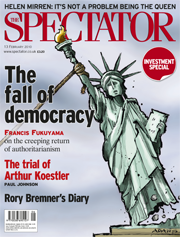 The cover of this week's edition of the major conservative UK magazine "The Spectator" announces in big black letters: "The fall of democracy".
Inside, the magazine carries an article by Francis Fukuyama titled "Is the age of democracy over?"
The article can be read free of charge here:
www.spectator.co.uk/spectator/thisweek/5766228/is-the-age-of-democracy-over.thtml
Lead: "Twenty years ago, Francis Fukuyama forecast the final triumph of liberal democracy and the 'end of history'. As pro-democracy movements falter from Ukraine to China, he revisits his thesis – and asks if history has a few more surprises to spring."
Excerpts: "Over the last decade we have seen the collapse or discrediting of not just the 'Orange' movement, but many of the other so-called 'rainbow revolutions' across eastern Europe: the 'Rose' revolution in Georgia, the 'Cedar' revolution in Lebanon [sic]. Then there's Vladimir Putin's transformation of Russia into an 'electoral authoritarian' state, the undermining of democratic institutions by Hugo Chavez in Venezuela, and the rise of China as a successful authoritarian moderniser. [...]
"Americans let the collapse of communism go to their heads. [...] They saw the events of 1989 as a triumph, not just for the cause of liberty but of loosely regulated markets at home and muscular self-assertion abroad, unconstrained by international institutions. [...] As the hegemonic power for much of the 1990s and 2000s, the United States was bound to incur a lot of resentment from countries and people who felt they had no way of holding the US accountable for what it did to them economically. [...] So the United State [sic] itself became an obstacle to the spread of its own ideals. [...]
"[D]emocracy remains, in Amartya Sen's words, the 'default' political condition: [...] today's would-be authoritarians all have to stage elections and manipulate the media from behind the scenes to legitimate themselves."
This shoddy little article is summed up nicely in a comment left by a reader: "I was immediately drawn to the interesting-sounding header of this piece. Then amazed at how it could be followed by such a boring, point-missing and turgid article!"
Francis Fukuyama is Bernard L. Schwartz Professor of International Political Economy and Director of the International Development Program at Johns Hopkins University.
Subscribe to:
Posts (Atom)

 Posts

