
Vittorio Bufacchi, "Sceptical Democracy" ("Politics", 21 [1], February 2001: pp. 23-30):
http://www3.interscience.wiley.com/journal/119018484/abstract
Abstract: "Two extreme philosophical positions pose a constant threat to democracy. Those who believe in the certainty of their beliefs (totalitarianism) and those who deny the existence of any truth (nihilism and post-modernity) uphold these anti-democratic positions. Squeezed between these two polarities we find liberal democracy. One of the distinctive properties of liberal democracy is its endorsement of a political definition of scepticism. The aim of this article is to explore the relationship between liberal democracy and scepticism."
Excerpt: "It is regrettable that for many sympathisers of liberal democracy, scepticism is a dirty word. The aim of this article is to suggest that the rehabilitation of scepticism is long overdue. If democracy is going to defend itself from anti-democratic threats, it is imperative for democratic theory to embrace a political definition of scepticism. [...] On one side, anti-democratic thought is entertained by those who attack the spiritual decay of democracy for its inability to ground society on infallible foundations. At the other extreme, democracy is dismissed for being at best a culturally relative notion, and at worst an instrument of Western cultural imperialism. [...] Nihilism, cynicism and relativism are as cancerous to democracy as the arrogance or nostalgia for certainty."
Bufacchi's article spurred a number of responses, among them Thom Brooks' "A Defence of Sceptical Authoritarianism" ("Politics", 22 [3], September 2002: pp. 152-62):
http://www3.interscience.wiley.com/journal/118915467/abstract
Abstract: "Vittorio Bufacchi argued in this journal that democracy was under threat from two extreme philosophical positions: totalitarianism and nihilism. Sandwiched between these polarities is liberal democracy. Bufacchi believes that one of liberal democracy's distinctive properties is an endorsement of scepticism, which he then attempts to illuminate. In contrast, this article will argue that an authoritarian government bound by a constitution permitting civil liberties might also adopt political scepticism. This removes the aforementioned distinctiveness of liberal democracy in this regard and, in addition, leads us toward a rethinking of the possibility of a more plausible consideration of democracy."
I haven't been able to access the full text of the latter article.
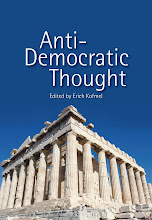
In 2008, Thom Brooks also contributed a chapter asking "Is Plato's Political Philosophy Anti-Democratic?" to my edited volume "Anti-Democratic Thought", published by Imprint Academic. The full text can be read here:
http://books.google.com/books?printsec=frontcover&id=KkMdJtaaeOYC#PPA17,M1
Vittorio Bufacchi is a Lecturer in the Department of Philosophy at University College Cork.
Thom Brooks is now Reader in Political and Legal Philosophy at the University of Newcastle.
Showing posts with label relativism. Show all posts
Showing posts with label relativism. Show all posts
13 February 2010

11 January 2010
Article: Is Democracy a Dictatorship of Relativism?
The Duke University Press journal "Common Knowledge" dedicated in 2007 a symposium of articles to the last homily Joseph Cardinal Ratzinger gave before his elevation to the Papacy.
Under the heading "A 'Dictatorship of Relativism'? Symposium in Response to Cardinal Ratzinger's Last Homily", the authors look at various aspects of relativism. Of particular interest may be an article by Jeffrey Stout called "A House Founded on the Sea: Is Democracy a Dictatorship of Relativism?" (13 [2-3], spring-fall 2007: pp. 385-403).
http://commonknowledge.dukejournals.org/cgi/pdf_extract/13/2-3/385
Excerpt: "In his homily of April 18, 2005, Joseph Cardinal Ratzinger issued a stern warning to his colleagues: 'Today, having a clear faith based on the Creed of the Church is often labeled as fundamentalism. Whereas relativism, that is, letting oneself be "tossed here and there, carried about by every wind of doctrine," seems the only attitude that can cope with modern times. We are building a dictatorship of relativism that does not recognize anything as definitive and whose ultimate goal consists solely of [satisfying] one's own ego and desires.' A day later, the cardinals chose the bearer of this message as pope.
"In an essay published originally in German in 1992, Cardinal Ratzinger had already remarked that 'the modern concept of democracy seems indissolubly linked to that of relativism.' A 'consistent relativism,' he declared, entails that 'there is ultimately no other principle governing political activity than the decision of the majority, which occupies the position of "truth" in the life of the state.' If moral truth is reducible to whatever the majority decides, democracy 'is not defined in terms of its contents, but in a purely functional manner.'
"In the 1995 encyclical letter The Gospel of Life, John Paul II himself drew attention to 'the ethical relativism which characterizes much of present-day culture.' Like his eventual successor, he took issue with 'those who consider such relativism an essential condition of democracy, inasmuch as it alone is held to guarantee tolerance, mutual respect between people and acceptance of the decisions of the majority, whereas moral norms considered to be objective and binding are held to lead to authoritarianism and intolerance.' Ethical relativism and democratic culture have, in the Vatican's view, become intertwined."
While I haven't been able to access the full text of this article, I managed to glimpse at the original essay by Ratzinger, "What is Truth? The Significance of Religious and Ethical Values in a Pluralistic Society", in "Values in a Time of Upheaval" (trans. Brian McNeil; Crossroad/St. Ignatius Press, 2006: pp 53-72).
www.ipgbook.com/showbook.cfm?bookid=0824523733
He writes: "The concept of 'truth' has in fact now moved into the zone of antidemocratic intolerance. It is not now a public good, but something private. It may perhaps be the good of specific groups, but it is not the truth of society as a whole."
Of course, being a German who has lived through National Socialism, he believes that democracy truly is still built on arguably universal values such as human rights.
Jeffrey Stout is Professor of Religion at Princeton.
Under the heading "A 'Dictatorship of Relativism'? Symposium in Response to Cardinal Ratzinger's Last Homily", the authors look at various aspects of relativism. Of particular interest may be an article by Jeffrey Stout called "A House Founded on the Sea: Is Democracy a Dictatorship of Relativism?" (13 [2-3], spring-fall 2007: pp. 385-403).
http://commonknowledge.dukejournals.org/cgi/pdf_extract/13/2-3/385
Excerpt: "In his homily of April 18, 2005, Joseph Cardinal Ratzinger issued a stern warning to his colleagues: 'Today, having a clear faith based on the Creed of the Church is often labeled as fundamentalism. Whereas relativism, that is, letting oneself be "tossed here and there, carried about by every wind of doctrine," seems the only attitude that can cope with modern times. We are building a dictatorship of relativism that does not recognize anything as definitive and whose ultimate goal consists solely of [satisfying] one's own ego and desires.' A day later, the cardinals chose the bearer of this message as pope.
"In an essay published originally in German in 1992, Cardinal Ratzinger had already remarked that 'the modern concept of democracy seems indissolubly linked to that of relativism.' A 'consistent relativism,' he declared, entails that 'there is ultimately no other principle governing political activity than the decision of the majority, which occupies the position of "truth" in the life of the state.' If moral truth is reducible to whatever the majority decides, democracy 'is not defined in terms of its contents, but in a purely functional manner.'
"In the 1995 encyclical letter The Gospel of Life, John Paul II himself drew attention to 'the ethical relativism which characterizes much of present-day culture.' Like his eventual successor, he took issue with 'those who consider such relativism an essential condition of democracy, inasmuch as it alone is held to guarantee tolerance, mutual respect between people and acceptance of the decisions of the majority, whereas moral norms considered to be objective and binding are held to lead to authoritarianism and intolerance.' Ethical relativism and democratic culture have, in the Vatican's view, become intertwined."
While I haven't been able to access the full text of this article, I managed to glimpse at the original essay by Ratzinger, "What is Truth? The Significance of Religious and Ethical Values in a Pluralistic Society", in "Values in a Time of Upheaval" (trans. Brian McNeil; Crossroad/St. Ignatius Press, 2006: pp 53-72).
www.ipgbook.com/showbook.cfm?bookid=0824523733
He writes: "The concept of 'truth' has in fact now moved into the zone of antidemocratic intolerance. It is not now a public good, but something private. It may perhaps be the good of specific groups, but it is not the truth of society as a whole."
Of course, being a German who has lived through National Socialism, he believes that democracy truly is still built on arguably universal values such as human rights.
Jeffrey Stout is Professor of Religion at Princeton.
Subscribe to:
Posts (Atom)

 Posts
Posts

