
Please circulate widely!
CALL FOR PAPERS
Anti-Democracy Agenda Symposium 2011
Organized by: Sussex Centre for the Individual and Society (SCIS)
Mode: Online by Google+ video conference
Date: 15-16 November 2011
The "Anti-Democracy Agenda" is the premier resource on the net for the study of anti-democratic thought and practice across the boundaries of various traditions and academic disciplines. First introduced by the Sussex Centre for the Individual and Society (SCIS) as a blog in January 2010, it has since been reconstituted as a circle (with associated public posts, much like a blog) on the new social network Google+. An archive of the blog is to be found here: http://anti-democracy-agenda.blogspot.com
For the new circle, see here:
https://plus.google.com/109507108125539761871/posts
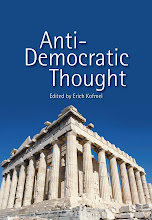
The Anti-Democracy Agenda Symposium 2011 will be the third event we organize to advance the research agenda on anti-democratic thought and practice as well as old and new criticisms of democracy. It will build up on a highly successful workshop on anti-democratic thought SCIS organized at the Annual Conference Workshops in Political Theory in Manchester, England, in September 2007, as well as the Anti-Democracy Agenda Symposium 2010, taking place at the Swiss Federal Institute of Technology (ETH) Zurich in November last year. Both events drew participants from the world over. The Manchester workshop led to the publication of an edited volume on "Anti-Democratic Thought" (Imprint Academic, 2008).
The Anti-Democracy Agenda Symposium 2011 is set to be equally international and interdisciplinary in scope. We invite affiliated academics, independent scholars, and doctoral students and candidates from a wide range of disciplines, such as Philosophy, Political Theory, Political Science, International Relations, Development Studies, Security Studies, Law, Economics, Sociology, Anthropology, Psychology, Literature, History, Classics, Theology, Religious Studies, Education, and so on. Papers may not only cover any and all aspects of criticisms of democracy and anti-democratic thought and practice, from perspectives including anarchism, libertarianism, conservatism, communism, Islamism, the extreme right, and others, but also related concepts such as authoritarianism, dictatorship, military rule, monarchy, chieftaincy, mixed constitution, the backlash against democracy promotion, terrorism, post-democracy, voter apathy, voter ignorance, etc. Have a look at the blog to see what might be of interest and falls within our remit. Papers may be theoretical and/or empirical in nature. Work in progress is welcome too.
This symposium may be the first academic conference to make use of the “Hangouts” video conference facility that is an integral part of Google+. Due to technical restrictions, the number of participants in the Anti-Democracy Agenda Symposium 2011 is limited to 10. All accepted participants will be required to create a profile on Google+ in order to be able to participate in the event. While we encourage the participation of scholars from developing countries, please only apply if you have access to a stable Internet connection. As in our previous physical events, over the course of two days, each presenter will have 60 minutes to present his or her paper and discuss it with all others. Due to the small size of the symposium, all participants are expected to attend both days fully.
As with all SCIS events, no fees will be charged from participants, and no funding is available to cover participants' expenses (if any). We will be glad to issue letters of acceptance on request to assist participants in securing leave from work. Detailed instructions on how to set up a Google+ profile and join the video conference will be provided to confirmed participants.
Please send your proposal to: erichkofmel@gmail.com
Deadline: 15 October 2011
Later submissions may still be accepted, but early submission is strongly advised and proposals may be accepted as they come in.
Cordially,
Erich Kofmel
Managing Director / Research Professor of Political Theory
Sussex Centre for the Individual and Society (SCIS)
https://plus.google.com/109507108125539761871
E-mail: erichkofmel@gmail.com
Postal address:
Sussex Centre for the Individual and Society
1200 Geneva
Switzerland
SCIS is an international association under Swiss law.
Founded 2006 at the University of Sussex.
Showing posts with label anti-democratic thought. Show all posts
Showing posts with label anti-democratic thought. Show all posts
16 August 2011

13 November 2010
Report on the Anti-Democracy Agenda Symposium 2010: Setting the example for the debate of the future
The first event held by the Geneva-based Sussex Centre for the Individual and Society (SCIS) in conjunction with its "Anti-Democracy Agenda" blog, the Anti-Democracy Agenda Symposium 2010, took place to great acclaim on 8 and 9 November 2010 at the Swiss Federal Institute of Technology (ETH) Zurich.
Keynotes to the symposium were contributed by Professor Doh Chull Shin, a native of Korea, director of the Korea Democracy Barometer, and core partner in the Asian Barometer Survey (an ongoing research project monitoring democratization in Asian countries), who is based in the Department of Political Science at the University of Missouri, a leading public research university in the United States, and Professor Kuldip Singh, Head of the Department of Political Science at Guru Nanak Dev University in Amritsar, India.
The Anti-Democracy Agenda Symposium 2010 attracted twelve papers submitted by participants from institutions such as the National University of Singapore, the University of the Philippines, the Technical University of Lisbon (Portugal), Ankara University (Turkey), the University of the Punjab, Quaid-i-Azam University (both Pakistan), the University of Central Oklahoma (USA), and the Islamic Azad University (Iran). Other countries and territories of origin or residence represented include Palestine, Hong Kong, New Zealand, the UK, Switzerland, Nigeria, Korea, and India.
Participants – from doctoral candidates to full professors – came from the disciplines of Political Science, Philosophy, Political Theory, Islamic Studies, Defence and Strategic Studies, Law, and Media Studies, giving theoretical as well as empirical presentations under the titles "Is Confucianism Anti-democratic?", "Islamic Philosophy and Criticizing Democracy", "Against Liberal Democracy", "Anti-Democracy Is Created By Means of Media", "Twenty-First Century Anti-Democracy: Theory and Practice in the World", "A Critique of Western Discourses of Sovereignty and Democracy from Chinese Lenses", "Reflecting on Anti-Democracy Forces in Arab Politics", "'Democracy' in Kazakhstan: Political System Managed from Above", "Pakistan’s Road to Democracy: Islam, Military and Silent Majority", "Democracy: A Form of Government or an Instinct?", "The Role of Ethics in Shaping Democracy: An Examination of Unethical Actions among House of Assembly Members in Nigeria", and "Pekan Anti Otoritarian: Some Observations on Anarchist Gathering at Indonesia".
After a workshop on "Anti-Democratic Thought" in Manchester in 2007, this was the second symposium on anti-democracy organized by the Sussex Centre for the Individual and Society and, once more, it opened up new frontiers for the study of anti-democratic thought and practice. Bringing together scholars from both sides of the debate, advocates of democracy as well as critics and opponents, it set the example for the proper academic conduct of a discussion that does not take place anywhere else, yet. Focusing on twenty-first century anti-democracy, rather than historical expressions and criticisms, it shone the way toward the most important debate of the near future. Asia will play as central a role in that debate as participants from Asia did in our symposium.
The Anti-Democracy Agenda blog and the Sussex Centre for the Individual and Society will continue to be at the forefront of these developments.

12 November 2010
Book: We Are an Image from the Future: The Greek Revolt of December 2008
"We Are an Image from the Future: The Greek Revolt of December 2008", edited by A.G. Schwarz, Tasos Sagris and Void Network (AK Press, February 2010):
www.akpress.org/2010/items/weareanimagefromthefuture
Publisher's description: "What causes a city, then a whole country, to explode? How did one neighborhood's outrage over the tragic death of one teenager transform itself into a generalized insurrection against State and capital, paralyzing an entire nation for a month? This is a book about the murder of fifteen-year-old Alexis Grigoropoulos, killed by the police in the Exarchia neighborhood of Athens on December 6th, 2008, and of the revolution in the streets that followed, bringing business as usual in Greece to a screeching, burning halt for three marvelous weeks, and putting the fear of history back into the bureaucrats of Fortress Europe and beyond. We Are an Image From the Future delves into the December insurrection and its aftermath through interviews with those who witnessed and participated in it, alongside the communiqués and texts that circulated through the networks of revolt. It provides the on-the-ground facts needed to understand these historic events, and also dispels the myths activists outside of Greece have constructed around them. What emerges is not just the intensity of the riots, but the stories of organizing and solidarity, the questions of strategy and tactics: a desperately needed examination of the fabric of the Greek movements that made December possible."
Endorsement: "This dazzling collection is not a book about the great insurrection of 2008 – it is a living piece of it that can become a part of us, and through us, it opens the prospect of a universe we might never otherwise have imagined possible. Future historians may well conclude that the Revolution finally began in 2008. If they do, this book will have played a crucial role in that realization." (David Graeber, Goldsmiths, University of London)
The book contains texts such as "Their Democracy Murders – The Polytechnic University Occupation" and many writings by the "Ego Te Provoco" counter-information group, including the eponymous "We Are Here / We Are Everywhere / We Are an Image from the Future" (pp. 165-8), "The media as part of the counter-insurgency" (pp. 169-72), and "A Bedouin Anytime! A Citizen Never." (pp. 197-8; translators not named).
Excerpts: "The other thing we put forward was a discourse against democracy, because many people were saying, what kind of democracy kills children, we need more democracy, and we were trying to deconstruct this whole notion of democracy, to claim that this murder is not an exception, it is the rule of democracy, the rule of the nation-state, the rule of capitalism." (p. 170)
"We despise democracy more than anything else in this decadent world. For what is democracy other than a system of discriminations and coercions in the service of property and privacy? [...] The bourgeois, with a voice trembling from piety, promise: rights, justice, equality. And the revolted hear: repression, exploitation, looting. [...] Our contempt for democracy does not derive from some sort of idealism but rather from our very material animosity for a social entity in which value and organizing are centered around the product and the spectacle." (p. 198)
A.G. Schwarz is the assumed name of a North American living in exile abroad.
Tasos Sagris is a member of the Athens-based Void Network, an arts and action collective established in 1990.
18 October 2010
Article: China model as alternative to democracy
The news portal "The Malaysian Insider" today published an article by its reporter Yow Hong Chieh titled "Dr M promotes China model as alternative to democracy".
The full text of the article can be read free of charge here:
www.themalaysianinsider.com/malaysia/article/dr-m-promotes-china-model-as-alternative-to-democracy/
Excerpts: "Former prime minister [of Malaysia] Tun Dr Mahathir Mohamad today called democracy a 'failed' ideology and held up China's model of authoritarianism as an alternative 'worth studying'. He said China's political model [...] showed that a nation could develop well even in the absence of freedom, liberty and equality [...]. 'If you find good people to run a country, even dictators can make a country develop and develop very well.' [...] The former premier also criticised the very premise of democracy, arguing that no issue could achieve total consensus, leading to an electoral split that will promote poor governance. 'Democracy ... has failed in many countries,' he said. 'It is not the perfect thing it is touted to be. You find that some of these democracies really cannot work. People cannot make up their minds.['] [...] 'We see a lot of democracies where leaders change every two years and the country cannot make any progress at all,' he said. 'Even the countries that have made progress find sometimes that democracies hinder the development of the country, make the country unstable and difficult to develop.'"
07 October 2010
Articles: Pakistan: What price democracy?
The article, "Is honeymoon with democracy over?", by Kamran Rahmat, an Islamabad-based resident editor of the Pakistani daily newspaper "Express Tribune", appeared on 30 September 2010 on the website of the daily newspaper "Gulf Times", operating out of Doha, Qatar.
The full text of the article can be read free of charge here:
www.gulf-times.com/site/topics/article.asp?cu_no=2&item_no=388927&version=1&template_id=46&parent_id=26
Excerpts: "Rumours have abounded about the imminent fall of government [....] 30 months after a transition to democracy from a long bout of military rule, the average Pakistani citizen wonders if that is what street battles in 2007 were waged for. [...] At the first glance, it seems to have gone all horribly wrong – the dream of a functional, sustainable democracy replaced by a sense of foreboding and despondency that seems all too familiar. But is it? Is everything really unravelling and devolving to the inevitable last-hope lure of the khakis doing another turn at 'saving' the country? Is all in the country headed for a point of no return that will usher in the much talked about political change; or is this merely a clever perception that is part willingly and part unwittingly being promoted by the media to a point where it becomes a self-fulfilling prophecy? An independent, pluralistic media that played a spectacular role in mobilising and achieving the transition to democracy was supposed to reflect and strengthen the citizens' aspirations and perspectives after popular governments were in place. And yet turn on a private current affairs TV channel any time of the day and the staple fare is prophecies of doom and predictions of a change.
"Not on a single private TV channel is an assertion of faith (or even hope) discernible any longer in the very democracy that the media had valiantly pushed for in 2007, along with other civil society actors. The honeymoon with democracy for the media seems to be over. Agreed the governments in both the centre and the provinces have been found woefully inept and wanting in delivering the dividends that democracy was supposed to usher in for all and sundry. [...] But what is more transparent than the disappointing performance of the governments and political parties now is the growing sense of entitlement of the media that it is the final arbiter of this performance [...]. For sure, they have a right to offer analysis and venture opinion on what is going on but this can only be based on news and events, not conjecture and theory [...]. This is exactly the kind of milieu that provides a space for the anti-democratic forces to manipulate the media and through it the perceptions that people end up embracing. [...] Instead of focusing on the citizens and their grassroots and street perspectives and being their voice, [...] today's media in Pakistan has gone from being a watchdog of public interest to being a virtual attack dog for undemocratic forces."
An example of this tendency may be provided by an undated column by one Khalid Saleem, "What price democracy?", published recently on the website of the daily newspaper "Pakistan Observer".
The full text of the article can be read free of charge here:
www.pakobserver.net/detailnews.asp?id=44095
Excerpts: "Democracy is the buzzword these days. [...] Ever since the then US President, George W. Bush, announced in his message to the Iraqi people on the eve of the Iraq invasion that, 'We are determined to bring (read: thrust-down-your-collective-throats) democracy to your country', the word 'democracy' has become something of a sine qua non in all statements emanating from the West. [...] Our own herd of liberal intellectuals has been weaned on Western propaganda. [...] In their estimation, any person wishing to be counted among those fit to be counted must needs be an admirer of the Western type of democracy or else. [...] Democracy, thus, is at best an over-rated system of government. Hullabaloo about the 'virtues' of democracy appears to have been blown out of all proportion. The Western propaganda notwithstanding, there is hardly any doubt that a system of government can be only as good, or as bad, as those administering it. Given dedicated, honest and well-meaning leaders, any system worth the name would be workable. On the other hand, if the leadership does not measure up, then no form of government will deliver the goods, whether democratic or otherwise! Come to think of it, what matters in the long run is how well a people are governed and not how the government in question came into being."
I can't figure out whether either of these articles appeared in print too.
The full text of the article can be read free of charge here:
www.gulf-times.com/site/topics/article.asp?cu_no=2&item_no=388927&version=1&template_id=46&parent_id=26
Excerpts: "Rumours have abounded about the imminent fall of government [....] 30 months after a transition to democracy from a long bout of military rule, the average Pakistani citizen wonders if that is what street battles in 2007 were waged for. [...] At the first glance, it seems to have gone all horribly wrong – the dream of a functional, sustainable democracy replaced by a sense of foreboding and despondency that seems all too familiar. But is it? Is everything really unravelling and devolving to the inevitable last-hope lure of the khakis doing another turn at 'saving' the country? Is all in the country headed for a point of no return that will usher in the much talked about political change; or is this merely a clever perception that is part willingly and part unwittingly being promoted by the media to a point where it becomes a self-fulfilling prophecy? An independent, pluralistic media that played a spectacular role in mobilising and achieving the transition to democracy was supposed to reflect and strengthen the citizens' aspirations and perspectives after popular governments were in place. And yet turn on a private current affairs TV channel any time of the day and the staple fare is prophecies of doom and predictions of a change.
"Not on a single private TV channel is an assertion of faith (or even hope) discernible any longer in the very democracy that the media had valiantly pushed for in 2007, along with other civil society actors. The honeymoon with democracy for the media seems to be over. Agreed the governments in both the centre and the provinces have been found woefully inept and wanting in delivering the dividends that democracy was supposed to usher in for all and sundry. [...] But what is more transparent than the disappointing performance of the governments and political parties now is the growing sense of entitlement of the media that it is the final arbiter of this performance [...]. For sure, they have a right to offer analysis and venture opinion on what is going on but this can only be based on news and events, not conjecture and theory [...]. This is exactly the kind of milieu that provides a space for the anti-democratic forces to manipulate the media and through it the perceptions that people end up embracing. [...] Instead of focusing on the citizens and their grassroots and street perspectives and being their voice, [...] today's media in Pakistan has gone from being a watchdog of public interest to being a virtual attack dog for undemocratic forces."
An example of this tendency may be provided by an undated column by one Khalid Saleem, "What price democracy?", published recently on the website of the daily newspaper "Pakistan Observer".
The full text of the article can be read free of charge here:
www.pakobserver.net/detailnews.asp?id=44095
Excerpts: "Democracy is the buzzword these days. [...] Ever since the then US President, George W. Bush, announced in his message to the Iraqi people on the eve of the Iraq invasion that, 'We are determined to bring (read: thrust-down-your-collective-throats) democracy to your country', the word 'democracy' has become something of a sine qua non in all statements emanating from the West. [...] Our own herd of liberal intellectuals has been weaned on Western propaganda. [...] In their estimation, any person wishing to be counted among those fit to be counted must needs be an admirer of the Western type of democracy or else. [...] Democracy, thus, is at best an over-rated system of government. Hullabaloo about the 'virtues' of democracy appears to have been blown out of all proportion. The Western propaganda notwithstanding, there is hardly any doubt that a system of government can be only as good, or as bad, as those administering it. Given dedicated, honest and well-meaning leaders, any system worth the name would be workable. On the other hand, if the leadership does not measure up, then no form of government will deliver the goods, whether democratic or otherwise! Come to think of it, what matters in the long run is how well a people are governed and not how the government in question came into being."
I can't figure out whether either of these articles appeared in print too.
02 October 2010
Book: Eternal Hostility: The Struggle Between Theocracy and Democracy
Frederick Clarkson, "Eternal Hostility: The Struggle Between Theocracy and Democracy" (Common Courage Press, 1997):
www.commoncouragepress.com/index.cfm?action=book&bookid=088
From the publisher's description (on Amazon): "Drawing on years of rigorous research, Clarkson exposes the wild card of the 'theology of vigilantism' which urges the enforcement of 'God's law' and argues for fundamentalist revolution against constitutional democracy."
Review: "Frederick Clarkson's Eternal Hostility provides a chilling road map to a growing movement whose roots go back to the founding days of the country. Clarkson asks the reader to consider what it would be like if having an abortion was punishable by death, if gays and lesbians were thrown into jail, or if our constitutional rights were replaced by biblical law. [...] Chastising liberals and the left for failing to recognize the depth of the threat to liberty, Clarkson argues that we must develop a coherent response to a well-organized effort aimed at overthrowing democracy. When he exposes the aims and strategies of such diverse Christian zealots as the 'Promise Keepers' and the Unification Church of Sun Myung Moon, remember that [...] Clarkson was also the first to expose how elements of the Christian Right were encouraging the formation of citizen 'militias' almost five years before the Oklahoma City bombing propelled the militia movement into general public awareness." ("Midwest Book Review")
Frederick Clarkson is an independent US journalist and book author.
25 September 2010
Article: Engaging Muslim Communities
Zeyno Baran's article "Engaging Muslim Communities" – an excerpt from a 2009 testimony before the United States Senate Committee on Homeland Security and Governmental Affairs – was published in "Defining Ideas" (no. 1/March 2010), a quarterly journal of the Stanford-based conservative public policy think tank Hoover Institution.
The full text of the article can be read free of charge here:
www.hoover.org/publications/defining-ideas/article/5380
Excerpts: "I have written extensively about the difference between Islam (the religion) and Islamism (the political ideology) and how we need to expose the extremists' cynical exploitation of the religion as a means of convincing the moderate majority of their fellow Muslims that the current conflict is religious in nature – and that the only solution is for Muslims to come together as part of a single nation (umma) following its own legal system (sharia) in pursuit of a new and antidemocratic world order. Why is Islamism a threat to democracy? Because, according to its interpretations, sharia regulates every aspect of an individual's life; moreover, because it is considered God's law, no compromises are possible. The holistic nature of Islamist ideology makes it fundamentally incompatible with the self-criticism and exercise of free will necessary for human beings to form truly liberal and democratic societies. [...]
"The Islamist movement is much stronger today than it was in 2001. And it will continue to get stronger over the next decade until we realize we are faced with a long-term social transformation project designed to make Muslims an angry and fearful people who can then be easily controlled. [...] Throughout the world, liberal democracy is once again being challenged as a political system and, more fundamentally, as an ideology and as a set of beliefs. Whether we like it or not, we are engaged in an ideological struggle – and the United States is losing ground. [...] Faced with authoritarian threats in both religious and secular forms, the United States should not be questioning whether to promote democracy but how to promote it. [...] If not, the United States and its allies will continue to grow weaker as their opponents strengthen.
"In general, the United States looks for short-term successes when a generational commitment is needed (as originally stated by the Bush administration). But because the United States had to demonstrate success quickly, it went for the 'low-hanging fruit' – at points even sounding as doctrinaire about democracy promotion as those who oppose democracy. [...] Since September 11, anti-American movements, groups, and leaders – from Russia to Venezuela – have come together in a shared hostility to the Western liberal system. [...] I believe having President Obama in office will grant the United States only short-term relief. Islamists are working on new narratives and searching for new grievances; their need to undermine the United States and its democratic vision is incredibly strong. [...] Clearly, the United States cannot do this cheaply, especially given how much everyone else is spending on antidemocratic agendas."
Turkish-born Zeyno Baran is a Senior Fellow at the Hudson Institute, a conservative think tank based in Washington, DC.
23 September 2010
Article: Toppling democracy
Thongchai Winichakul, "Toppling democracy" ("Journal of Contemporary Asia", 38 [1], February 2008: pp. 11-37).
The full text of the article can be read free of charge here:
www.sameskybooks.org/wp-content/uploads/2008/02/j-of-contem-asia-2008-thongchai-winichakul-toppling-democracy.pdf
Abstract: "Thailand's 2006 royalist coup is best understood by reference to the historical context of democratisation. The dominant historiography of Thai democratisation is either a simplistic liberal view of anti-military democracy or a royalist one that is ultimately anti-democratic. This article offers a serial history of democratisation that allows us to see the long duration of layered historical processes. As democratisation is fundamentally a break from the centralised absolute monarchy, the monarchy and the monarchists, despite their up and down political fortunes, have probably played the most significant role in shaping Thai democracy since 1932. Despite that, their role and place in history has been overlooked due to the perception that they are 'above politics.' This article argues that, since 1973 in particular, the monarchists have assumed the status of the superior realm in Thai politics that claims the high moral ground above politicians and normal politics. With distaste for electoral politics, and in tacit collaboration with the so-called people's sector, activists and intellectuals, they have undermined electoral democracy in the name of 'clean politics' versus the corruption of politicians. The 2006 coup that toppled democracy was the latest effort of the monarchists to take control of the democratisation process."
Excerpts: "The fight against corruption and money politics seems indisputably a good cause. It should contribute to democracy with no harm whatsoever. In the context of Thai democratisation of the past thirty years, however, the repercussions and consequences of clean politics against elected politicians significantly contributed to the coup in 2006. [...] To understand the effects of the discourse of clean politics on democratisation, I shall elaborate its four constitutive discourses and point out how each of them has ramified to become anti-democratic. They are (i) politicians are extremely corrupt; (ii) politicians come to power by vote-buying; (iii) an election does not equal democracy; and (iv) democracy means a moral, ethical rule. [...] If a 'communist threat' was the usual reason for many military coups during the Cold War, corruption has been the usual reason for coups after the end of the communist threat in Thailand since the early 1980s. [...]
"From the 1980s, people have believed that vote-buying is rampant at every level of election. It is considered a political pandemic. [...] Given the distrust of politicians and parliament's assumed lack of legitimacy due to vote-buying, Thailand's democracy has been seriously undermined. The public as well as many intellectuals question the legitimacy of the election as a trustworthy means to democracy. [...] While these public intellectuals may support civic movements or people's power, the supporters of clean politics adopted the rhetoric to undermine the electoral and parliamentary system. During the political crisis in 2006, the royalists and the anti-Thaksin activists alike often called the Thaksin government an 'electocracy' and his rule 'monetocracy.' After the coup, as critics of the coup insisted on electoral legitimacy in democracy, the coup defenders and apologists, including the royalist activists, military leaders and many leading intellectuals, kept repeating that the staging of an election does not equal democracy. [...]
"The distrust of elections in fact goes a long way back and is deeper than the rhetoric above. It is rooted in the nationalistic conservatism that distrusts democracy for being alien to Thai culture which honours hierarchical relations and venerates the monarchy as the highest authority in the land. [...] These conservatives often remind us that a constitution, thereby democracy as well, is merely a Western object. It is not necessarily good for Thai political culture. [...] In 2005 and 2006, the anti-Thaksin movement called for the return of power to the monarchy, arguing that it fits Thai political culture, unlike electoral democracy, which is an alien political system. [...] Not only could politicians and elections not be trusted, but democracy itself is also suspect. This is the ideological basis for the royalist distaste of elections. It is compatible with the anti-electocracy discourse of liberal intellectuals, thanks to their shared distrust of the existing 'democracy.'"
Thongchai Winichakul is Professor of History at the University of Wisconsin-Madison.
17 September 2010
Article: An alternative to the new wave of ecofascism
Micah White, a US activist and contributing editor at the Canada-based anti-consumerist magazine "Adbusters", is the author of an op-ed article titled "An alternative to the new wave of ecofascism", published on 16 September 2010 on the website of the British "Guardian" newspaper.
The full text of the article can be read free of charge here:
www.guardian.co.uk/commentisfree/cif-green/2010/sep/16/authoritarianism-ecofascism-alternative
Excerpts: "It is time to acknowledge that mainstream environmentalism has failed to prevent climate catastrophe. Its refusal to call for an immediate consumption reduction has backfired and its demise has opened the way for a wave of fascist environmentalists who reject democratic freedom. One well-known example of the authoritarian turn in environmentalism is James Lovelock, the first scientist to discover the presence of ozone-depleting chlorofluorocarbons in the atmosphere. Earlier this year he told the Guardian that democracies are incapable of adequately addressing climate change. [...] His words may be disturbing, but other ecologists have gone much further. Take for example Pentti Linkola, a Finnish fisherman and ecological philosopher. Whereas Lovelock puts his faith in advanced technology, Linkola proposes a turn to fascistic primitivism. Their only point of agreement is on the need to suspend democracy.
"Linkola has built an environmentalist following by calling for an authoritarian, ecological regime that ruthlessly suppresses consumers. Largely unknown outside of Finland until the first English translation of his work was published last year, Linkola represents environmentalism pushed to its totalitarian extreme. [...] His bold political programme includes [...] 're-education' in eco-gulags [...]. In Linkola's dystopian vision, the resources of the state are mobilised to clamp down on individual liberty. But there is no need to suspend democracy if it is returned to the people. Democratic, anti-fascist environmentalism means marshalling the strength of humanity to suppress corporations. Only by silencing the consumerist forces will both climate catastrophe and ecological tyranny be averted."
White calls for "the criminalisation of advertising" and "the possibility of death penalties for corporations". While he claims that this would be done "voluntarily and joyously", it is hard to see just how the measures he proposes are more democratic than those of the ecofascists. He too appears to be seeking to mobilize the resources of the (democratic) state to clamp down on consumerism.
Linkola, the son of a former Rector of the University of Helsinki and grandson of a former Chancellor of that same university, has had a "Fansite" dedicated to him:
www.penttilinkola.com/pentti_linkola/ecofascism/
On that site, he is quoted as saying (presumably originally in Finnish): "Any dictatorship would be better than modern democracy. There cannot be so incompetent dictator, [sic] that he would show more stupidity than a majority of the people. Best dictatorship would be one where lots of heads would roll and government would prevent any economical growth." / "A minority can never have any other effective means to influence the course of matters but through the use of violence." / "We will have to ... learn from the history of revolutionary movements – the [N]ational [S]ocialists, the Finnish Stalinists, from the many stages of the Russian revolution, from the methods of the Red Brigades – and forget our narcissistic selves." / "[D]emocracy and parliamentary system [...] are the most mindless and desperate experiments of the mankind ... [sic]"
The links on the website to other ecofascist resources and groups appear not to be working.
01 September 2010
Book: Nineteenth-Century Nationalism and Twentieth-Century Anti-democratic Ideals
Ieva Zake, "Nineteenth-Century Nationalism and Twentieth-Century
Anti-democratic Ideals: The Case of Latvia, 1840s to 1980s" (Edwin Mellen Press, 2008):
www.mellenpress.com/mellenpress.cfm?bookid=7319&pc=9
Publisher's description: "This study analyzes political writings of the Latvian intellectuals who pursued the ideas of national identity and liberation, over a period of nearly one hundred and fifty years. In addition to providing a better general understanding of intellectuals' behavior and influence, it illuminates the largely neglected subject of the differences between the political, social, and cultural influence of Western and Eastern European intellectuals."
Endorsements: "One cannot help but be struck by the intellectual honesty of the author, who is unsparing in her critical analysis of the often provincial, intolerant, and undemocratic strains within Latvian Nationalist thought. ... At the same time, the author acknowledges the dedication of these educated men and women to national liberation and to the cultivation of cultural identity in often difficult circumstances."
(Nils Muižnieks, University of Latvia)
"Without doubt, this thoroughly documented and well researched book is an original and significant contribution to scholarship. It combines new historical information with important sociological and political analysis by a native of the area discussed." (Paul Hollander, University of Massachusetts, Amherst)
"Providing the reader with a fresh outlook, based on a solid source base, the author offers an appealing examination of why, as was the case of many of the East Central European countries squeezed between colossal Russia and almighty Germany, nationalism at times seemed a synonym to liberation, and national culture safeguarding."
(Anna A. Mazurkiewicz, University of Gdansk, Poland)
Latvian-born Ieva Zake is Associate Professor in the Department of Sociology at Rowan University in the USA.
17 July 2010
Report: Indonesia: The Dark Side of Jama'ah Ansharut Tauhid (JAT)
The International Crisis Group (ICG), a non-governmental organization that surprisingly receives most of its funding from governments (54%, according to its own website), on 6 July 2010 released a report titled "Indonesia: The Dark Side of Jama'ah Ansharut Tauhid (JAT)" (Asia Briefing no. 107).
The full text of the report can be read free of charge here:
www.crisisgroup.org/~/media/Files/asia/south-east-asia/indonesia/B107-Indonesia%20The%20Dark%20Side%20of%20Jamaah%20Ansharut%20Tauhid%20JAT.ashx
Excerpts: "Jama'ah Ansharut Tauhid (JAT), led by Indonesia's best-known radical [Muslim] cleric Abu Bakar Ba'asyir, has been an enigma since its founding in 2008. An ostensibly aboveground organisation, it has embraced individuals with known ties to fugitive extremists. It has welcomed many members of the militant Jema'ah Islamiyah (JI) but clashed with the JI leadership over strategy and tactics. It preaches jihad against Islam's enemies but insists it stays within the law – though it rejects man-made laws as illegitimate. [...] It recruits through mass rallies and smaller religious instruction sessions in which Ba'asyir and other JAT figures fulminate against democracy, advocate full application of Islamic law, and preach a militant interpretation of jihad. [...]
"The [...] challenge for Indonesia is to manage the aspirations of the thousands who join JAT rallies for its public message: that democracy is antithetical to Islam, that only an Islamic state can uphold the faith, and that Islamic law must be the source of all justice. [...] Islamic teachings, according to JAT, are the absolute, most modern and most scientific truth and will be so until the end of time. Anyone who believes otherwise is a deviant, including followers of secularism, pluralism, liberalism and all other ideologies under their banners such as nationalism, communism, socialism and democracy. [...] For their own good now and in the hereafter, Muslims are required to live under a caliphate that applies Islamic law."
05 July 2010
Article: Australian Muslims told to shun democracy
The newspaper "The Australian" today published on its website an article by its senior writer Sally Neighbour (an investigative journalist and book author specializing in Islamic extremism and terrorism), titled "Muslims told to shun democracy", which reports on a conference taking place in Sydney yesterday on the topic of "The Struggle for Islam in the West".
The full text of the article can be read free of charge here:
www.theaustralian.com.au/news/nation/muslims-told-to-shun-democracy/story-e6frg6nf-1225887770169
Excerpts: "Leaders of the global Islamist group Hizb ut-Tahrir have called on Australian Muslims to join the struggle for a transnational Islamic state. British Hizb ut-Tahrir leader Burhan Hanif told participants [...] that democracy is 'haram' (forbidden) for Muslims, whose political engagement should be be based purely on Islamic law. 'We must adhere to Islam and Islam alone,' Mr Hanif told about 500 participants attending the convention [...]. 'We should not be conned or succumb to the disingenuous and flawed narrative that the only way to engage politically is through the secular democratic process. [...]' He said democracy was incompatible with Islam because the Koran insisted Allah was the sole lawmaker, and Muslim political involvement could not be based on 'secular and erroneous concepts such as democracy and freedom'. His view was echoed by an Australian HT official, Wassim Dourehi, who told the conference Muslims should not support 'any kafir (non-believer) political party', because humans have no right to make laws.
"Mr Dourehi also urged Muslims to spurn the concept of moderate Islam promoted by governments in the West, including in 'this godforsaken country' of Australia. 'We need to reject this [...] perversion that seeks to wipe away the political aspects of Islam [...] and challenge the proponents of this aberration of Islam.' [...] HT is outlawed in much of the Middle East but operates legally in more than 40 countries, campaigning for the establishment of a caliphate (Islamic state) modelled on the empire founded by the Prophet Mohammed in the 7th century. [...] Another British HT member, Salim Atchia, told the conference the West was attempting to 'beat the Muslims into submission' through intimidation and demonisation and by falsely portraying the aspiration for an Islamic state as dangerous and backward. Mr Dourehi said Muslims in the West must be at the vanguard of the push for a caliphate, which would govern all Muslim majority countries and lands that were previously under Islamic rule, such as Spain and The Philippines." (bold removed)
I can't figure out whether the article also appeared in print.
24 June 2010
Article: Somali rebel leader urges fight against democracy
Reuters Africa today posted an article online, written by its own Hussein Ali Noor, under the title "Somali rebel leader urges fight against democracy".
The full text of the article can be read free of charge here:
http://af.reuters.com/article/topNews/idAFJOE65N0TX20100624?sp=true
Excerpts: "Islamist al Shabaab leader Ahmed Abdi Godane has urged Somalis to reject 'the Devil's principles' of democracy, just several days ahead of elections in the breakaway Somaliland region. 'The reality is that democracy is something Allah made unlawful, and someone else cannot make it lawful,' the reclusive leader, also known as Sheik Mukhtar Abdirahman [or Abu Zubeyr], said. [...] Abu Zubeyr urged Muslims in an audio recording on the Internet to move away from areas that tried to build democracy. [...] 'If people fight ... till everyone is killed, that is much easier than legalising the devil's principles such as constitutions or making a ruler who governs against Allah's laws,' he said. Abu Zubeyr did not mention Somaliland specifically, but analysts said the timing of the message showed that it was intended to frighten people away from polling stations. [...] Somaliland police have arrested dozens of men linked to al Shabaab rebels in the last two weeks [...]."
14 June 2010
Booklet: Should Christians Vote?
Christians against democracy: David C. Pack is the author of the booklet "Should Christians Vote?", published in 2008 by the North America-based Restored Church of God, which operates a worldwide online ministry.
The booklet is available free of charge here:
www.thercg.org/books/scv.pdf
Excerpts: "You may have supposed that the governments of modern nations generally reflect God's way. This is almost everyone's assumption. Yet, while God does, in fact, establish and remove nations, this is not His world! [...] Christ would not vote, because He understands the origin of the governments of this world and who is behind them. [...] This world, with its ways and systems, is controlled by the devil! [...] Not only does Satan govern the kingdoms of this world, through his power and influence, but he also does it in an undivided, unified fashion with the aid of hundreds of millions [...] of demons. [...] Together they deceive, confuse and exert far-reaching influence over all the governments and activities on earth. [...]
"Christians never participate in the governments of this world [...]. It is not God's purpose that the 'better' people win. God determines the winners in advance. In the end, the 'will of the people' has no power or effect, because God is in charge of the outcome of elections. [...] For instance, what if true Christians are actively voting in Europe as the final beast of Revelation 17 arises? This great military, political, religious power is prophesied to come soon – and is already rising! By voting, Christians would literally be participating in establishing the final world-dominating counterfeit government foretold to deceive the world and fight Christ at His Return! [...]
"The practices of favoritism, endless debates and arguments, bribes, lust for power, corruption, lying and deceit, scandals and cover-ups, greed, exploitation, aggression, intense and relentless accusation, inefficiency, vanity, decisions based on polls, voter apathy, strife and back-stabbing are just some of the fruits of democracy [...]! Democratic politics are shot full of division and disagreement, over nearly every issue that any society might face. [...] Study the Bible from Genesis to Revelation and you will not find a single instance where an election was used to select a leader. Nowhere in the Bible can you find people electing leaders – and the Bible is the pattern that Christians are supposed to follow in all matters. [...] God's Word neither authorizes nor reflects any kind of pattern of voting. [...]
"Christ understood the corrupting nature of self-exaltation! He sees through the guise of phony 'concern' for the people whose votes these 'leaders' must get and/or retain to be in office. [...] To participate in a system in which men exalt themselves, in the seeking of high office, is to endorse – to validate – to agree with – a corrupt system, with terrible fruit, emphasizing vanity and pride. Democracy is completely opposite to what God expects of all people when He commands them to humble themselves! [...] Christians participating in the governments of Satan's world, through voting, [...] is far more serious than most realize. It is disloyalty – a form of spiritual fornication and spiritual treason – to the government of God and His complete authority over a Christian's life."
David C. Pack is Pastor General of the Restored Church of God, with headquarters in Wadsworth, Ohio, USA.
07 June 2010
Transcript: Condemnation of the Democratic Process, Voting, and the Islamic Stances on these Issues
"Condemnation of the Democratic Process, Voting, and the Islāmic Stances on these Issues" is the English translation of the transcript of an undated, but fairly recent Arabic audio recording of Shaykh Abū Qatādah 'Umar Ibn Mahmūd Abū 'Umar Al-Filastīnī (also: Abu Qatada [al-Filastini], Abū-Omar, or Omar Mahmoud [Mohammed] Othman/Uthman), the Jordanian-born presumed former spiritual leader of al-Qaeda in Europe currently imprisoned in the United Kingdom, being interviewed by At-Tibyān Publications, an online organization accused of spreading terrorist propaganda in the West.
The transcript can be downloaded free of charge here:
www.archive.org/details/CondemnationOfTheDemocraticProcessVotingAndTheIslamicStancesOn_865
Excerpts: "[E]lections are [...] an ideology [....] The meaning of an election is that I am satisfied with this one (individual) as a representative for me in expressing my will in declaring something to be Halāl [permitted] or Harām [forbidden], here in the legislation. And this, as it is clear, is in opposition to [...] the will of the Muslim who says 'I render myself obedient to Allāh [...]'. In other words, I do not accept anyone, in this issue, the legislation, I do not accept a legislator except Allāh. I do not accept as a ruler over me, (and) a ruler, not in the meaning of ruling in the meaning of implementation, but a ruler in the meaning of the right to issue commands, except Allāh. [...] But for, for you to vote for this one to be a god for you, then this is another issue, as you see, it differs with complete difference [...], because if you chose him as a ruler for you then you would have disbelieved."
Another, related At-Tibyān Publications title: "The Doubts Regarding the Ruling of Democracy In Islām" is a booklet whose author(s)
remain(s) anonymous, dated June 2004.
The booklet is (as of now) available free of charge here:
http://muslimsagainstvoting.files.wordpress.com/2010/04/the_doubts_regarding_the_ruling_of_democracy_in_islam.pdf
Excerpts: "Democracy [...] is a system, which is at odds with the very essence of Allāh's exclusive right of legislation and as such it steps outside the mere disobedience of Allāh into the realm of Shirk [idolatry], in that it seeks to elevate mankind to the level of the Legislator (i.e. Allāh). [...] And because the people are the ones who select the laws, by means of their representatives, these laws are based upon what the people wish and they are in accordance with the desires of the majority, rather than what Allāh has revealed. [...] And for this reason, Allāh, the Most High, referred to any person or system that does not rule by what Allāh has revealed, as a 'Tāghūt' (i.e. false deity) [...]. And if we conclude that these Members of Parliament commit Shirk and Kufr [disbelief] by legislating laws besides Allāh, then what would be said about the people who elect them for this job, knowing that this candidate will be engaging in the formation of man-made laws on behalf of the people who elect him?"
Two harmless texts.
04 June 2010
Article: Unemployment Linked to Dislike of Democracy
On 2 June, the science news site LiveScience.com published an article titled "Unemployment Linked to Dislike of Democracy" by staff writer Zoë Macintosh.
The article can be read free of charge here:
www.livescience.com/culture/jobless-opinion-democracy-system.html
Excerpts: "Individuals out of a job are more likely to harbor negative opinions about democracy and desire a rogue [sic] leader than their employed counterparts, a new study suggests. Using data from more than 130,000 people from 69 countries, scientists found that having or not having a job is enough to make otherwise similar individuals feel differently about the effectiveness of democratic political systems. [...] The results only showed correlations between these variables, but not cause-and-effect relationships. Joblessness was not linked to one's disapproval of how the country was run or the specific leadership in charge, only to discontent with democracy as a whole. [...] Across the board, those with greater wealth or education held significantly less negative opinions about democracy. [...] The results held even when scientists controlled for reverse causality (with political view causing joblessness) posed by 'political misfits' whose opinions about democracy go against the mainstream."
The article is based on a working paper by Duha Tore Altindag and Naci H. Mocan, published in May 2010 by the American research organization National Bureau of Economic Research (NBER).
Unfortunately, the full text of the working paper is not available without paying:
www.nber.org/papers/w15994
Turkish-born Duha Tore Altindag is a PhD candidate in Economics and Turkish-born Naci H. Mocan is Ourso Distinguished Professor of Economics, both at Louisiana State University.
02 June 2010
Article: The Really Creepy People Behind the Libertarian-Inspired Billionaire Sea Castles
"The Really Creepy People Behind the Libertarian-Inspired Billionaire Sea Castles" is an article by Mark Ames that was published today on the independent news site AlterNet.org.
The full text of the article can be read free of charge here:
www.alternet.org/story/147058/the_really_creepy_people_behind_the_libertarian-inspired_billionaire_sea_castles/
Excerpts: "The super-wealthy are already building their first floating castle, a billion-dollar-plus luxury liner that offers permanent multimillion-dollar housing with the best protection of all: moats made of oceans, keeping the land-based Americans they've plundered at a safe distance. The first such floating castle has been christened the 'Utopia' – the South Korean firm Samsung has been contracted to build the $1.1 billion ship, due to be launched in 2013. Already orders are coming in to buy one of the Utopia's 200 or so mansions for sale – which range in price from about $4 million for the smallest condos to over $26 million for 6,600 square-foot 'estates.' The largest mansion is a whopping 40,000 square feet, and sells for $160 million. [...] The floating castle is a longtime dream of libertarian oligarchs – a place where they can live their lives in peace free from the teeming masses of starving losers and indebted parasites and their tax demands.
"Since they've grown so rich off of America, they have enough spare change to fund projects like the Seasteading Institute, run by Milton Friedman's grandson, Patri Friedman, and financed by the bizarre right-wing PayPal founder, Peter Thiel. [...] Both Thiel and Milton Friedman's grandson see democracy as the enemy – last year, Thiel wrote 'I no longer believe that freedom and democracy are compatible' at about the same time that Milton Friedman's grandson proclaimed, 'Democracy is not the answer.' Both published their anti-democracy proclamations in the same billionaire-Koch-family-funded outlet, Cato Unbound, one of the oldest billionaire-fed libertarian welfare dispensaries. Friedman's answer for Thiel's democracy problem is to build offshore libertarian pod-fortresses where the libertarian way rules."
Whatever one may think of libertarian billionaires or seasteading, this article is a prime example of smear journalism posing as "investigative".
Mark Ames is an American journalist and book author, long based in Russia.
25 May 2010
Book: Maoism: A Critique from the Left
Just published: Prasenjit Bose is the editor of the contributed volume "Maoism: A Critique from the Left" (LeftWord Books, May 2010):
www.leftword.com/bookdetails.php?BkId=279&type=PB
Publisher's description: "What is 'Maoism'? What are its roots, and who are the forces waging a war in its name? The Indian Prime Minister characterizes them as our gravest internal security threat. The Maoists, on the other hand, claim they are the only revolutionary force in India today. The debate in India seems polarized between the hardline advocates of a military response to leftwing extremism on the one hand, and those who sympathize with the Maoists on the other. There is need, however, to look at the roots and origins of left sectarianism and critique it from a Marxist standpoint. In articulating a Left critique of 'Maoism', this book adds a crucial dimension to the ongoing debate in India. [...] P.M.S. Grewal makes a detailed, careful critique of the Indian Maoists' history, their programme and praxis. Nilotpal Basu unravels 'Maoism' as an anti-thesis of Mao Zedong thought. Vijay Prashad takes a critical look at the international experience of left extremism, especially in Latin America."
From the introduction: "Following independence, alongside the emergence of the Communist party as a major opposition force to the ruling Congress party within the parliamentary democratic set up, ideological debates also intensified within the Left on the road to revolution in India. [...] The Communist Party of India (Marxist) [...] arrived at a programmatic understanding that the [...] revolution, directed against the big bourgeoisie, landlordism and imperialism, is to be achieved by combining parliamentary and extra-parliamentary struggles. This overall understanding, however, was questioned by a small section, which considered participation in the parliamentary democratic process – just as the left sectarians did during Lenin's time – to be revisionist and non-revolutionary in principle. [...] Nilotpal Basu's essay [...] makes a robust critique of the anti-democratic practices of the Maoists and their hypocritical sympathizers. He also argues that Maoists can be effectively dealt with, not by means of imposing bans or security measures alone, but by ensuring their political isolation and addressing the developmental needs of the tribal areas where the Maoists operate."
Prasenjit Bose is Convenor of the Research Unit of the Communist Party of India (Marxist).
23 May 2010
Book: Democracy: A Religion!
Abu Muhammad 'Aasim (also: Asem/Asim) al-Maqdisi is named as the author of an undated (recent) booklet titled "Democracy: A Religion!"
(translated from Arabic by Abu Muhammad al-Maleki and revised by Abu Sayf Muwahhid). Apparently, this is a pseudonym assumed by the Palestinian writer Isam Mohammad (or: Muhammad/Mohammed) Tahir (or: Taher) al-Barqawi, a cleric and one-time spiritual mentor of the late leader of al-Qaeda in Iraq, Abu Musab al-Zarqawi. Al-Maqdisi has been called "the most influential living Jihadi [t]heorist" and "the key contemporary ideologue in the Jihadi intellectual universe". He currently seems to be imprisoned in Jordan.
The full text of the booklet can (currently) be read free of charge here:
http://muslimsagainstvoting.files.wordpress.com/2010/04/democracyreligion.pdf
Excerpts: "They distort the Truth with Falsehood, and mix [...] the Polytheism of democracy with the Monotheism of Islam. But we, with the help of Allah, replied to all of these fallacies, and showed that democracy is a religion. But it is not Allah's religion. It is not the religion of monotheism, and its parliamentary councils are just places of polytheism, and safe havens for paganistic beliefs. [...] We must destroy those who follow democracy, and we must take their followers as enemies – hate them and wage a great Jihad against them. [...]
[O]bedience in legislation is a form of worship, and must not be for any one except for Allah, since Allah is the only One who can provide legislation. Therefore, anyone who seeks to implement a legislation created by someone other than Allah, is in fact a polytheist. [...] If anyone transgresses the limits and does that, he makes himself a legislator, and he will be enacting the role of a deity. [...] Therefore, the legislators became gods to every one who obeyed and followed them, or agreed with them in this disbelief and polytheism [....]
"Be careful not to limit the word 'religion' just to Christianity, or Judaism and so on, because you may follow the other void religions and go astray. It includes every religion, method, judgment system, and law that the creatures follow and adhere to. All of these false religions must be left, and avoided. [...] This may include Communism, Socialism, Secularism, and other such innovated methods, and principles, which men invented with their own minds, and then satisfied these ideas to be their own religions [sic]. One of these religions is democracy. [...] The people in a democracy select representatives and each group or tribe will select a god of these disparate gods, to legislate according to their desires and whims, but according to the constitution's texts. Some of them select their god (their legislator), according to their ideology, or way of thinking, so there will be a god for this party and another one for that. Some of them select him according to the tribe, so there will be a god for this tribe and another for that tribe. And some select a religious god, as they claim, or a bearded god, or an unbearded one, and so on. [...] These representatives, in fact, are erected, engraved images and worshipped idols, and claimed gods that are set up and fixed in their temples, at their heathen sanctuaries (the parliaments). [...]
"Some ignorant people [...] called their putrid democracy a consultation (i.e. they are saying that democracy is the same as a Shura' – the Islamic method of consultation) – to show and imbue a legitimate religious tinge upon this fake religion – to approve it and to make it permitted. [...] The comparison of the democracy of polytheist people with the monotheists['] consultation (i.e. Shura), and the similitude of the consultation council, with the disbeliever's, sinful, disobedient [sic] councils is a vile similitude and false comparison. [...] The consultation is from Allah's decree, His religion, but democracy is a disbelief in Allah's decree and His religion. [...] The consultation must be in the matter that has no judgement, but when we have a text, an evidence, or a judgement, then there will be no consultation. [...] [I]n a consultation, people, or the majority is that who is under the obligation, commissioned to obey Allah and His Prophet (saw) than to the Muslims' leader [sic]. And the leader is not forced to accept the majority's opinion, or Judgement. The majority is forced to obey the leader even if he is wrong, unless he calls to the disobedience of Allah." (first italics originally bold)
22 May 2010
Article: Democracy vs Desire: Beyond the Politics of Measure
Andy Robinson's article "Democracy vs Desire: Beyond the Politics of Measure" was published in "Anarchy: A Journal of Desire Armed"
(issue 60, 23 [2], fall/winter 2005-06: page numbers not given).
The full text of the article can be read free of charge here:
www.theanarchistlibrary.org/HTML/Andy_Robinson__Democracy_vs_Desire__Beyond_the_Politics_of_Measure.html
Excerpts: "My contention in this article is that anarchy and democracy are incompatible, because anarchy is based on an active politics of desire whereas democracy is necessarily reactive and thus plays into the repressive logics of industrial society and especially, of contemporary capitalism. [...] Democracy and the politics of desire may seem complementary, but in fact they run contrary to each other. [...] That minorities be prevented from expressing themselves with wildness and immediacy – that they remain always the 'loyal opposition' within the confines of a system in which the majority gets its way – is a necessary part of the idea of democracy. For this reason, democracy goes against the emancipation of desire, operating simply as a particularly powerful ideology of recuperation with especially effective, and therefore insidious, ways of excusing social repression. [...] [D]emocracy is a specific instance of state power – and not, as implied by some anarchists, a critique of state power or a form of anarchy. [...]
"The people – the 'decent' or 'law-abiding' or 'hard-working' ordinary folk or 'citizens' invoked to justify crackdowns and repression – are the agent of repression, while the excluded, the new barbarians, defined as criminal, indecent, and 'anti-social,' are the object. It is thus 'rule by the people' at its most brutal – a violent tyranny by those who define themselves as the authentic people, over those who are excluded from it. It is also, of course, a self-policing of capitalism and industrial society – but this is unsurprising, since the 'people', after all, are not defined externally to this society but rather are constructed by it. [...] Reactive psychology, which expresses itself in the ethics of self-deadening 'shoulds,' transmutes the internal repression of desire (itself necessary for one to subordinate oneself to the majority) into a hostility against the expression of active desires by others, thus drawing social repression as the consequence of psychological repression. Where the majority have such character-structures, democracy can be nothing more than a dictatorship by bigots. Where they do not, democracy is unstable, undermined in its calculative finality by desires that overflow it. [...]
"Is it a coincidence that the same self-styled anarchists who identify anarchism with democracy are also often insufficiently rigorous in opposing the new form of capitalist control expressed through the crackdown culture? [...] Everywhere, 'class struggle' anarchists rally behind the calls to oppose 'anti-social' activities, even to the point of critically supporting crackdowns (always, of course, with the usual supplements, denouncing the existing state even while forming the working-class itself into a parallel state with its own repressive force and its own conformity-imposing closures). One thus finds these would-be anarchists cast as the last defenders of the state. For the state, in its last instance, is not the macro-social aggregate; it is the logic of control and policing of life from above, which is epitomised locally in policing agencies (whether those of the official state police or of vigilantes, snoops, and busybodies), and psychologically in repressively formulated ethics (whether those of a liberal or aristocratic elite, or those of a self-righteous 'decent people' fixated on its own decency). Without a rejection of the fixed identities and categories that operate as cops in our heads, there can be no destruction of the state – only its transmutation, fragmentation, and ultimate revival ih [sic] new, and maybe stronger, forms.
"The 'people' who rule must after all be a determinate entity, and in order to be conceived as such, the 'people' must be given fixity as what Max Stirner terms a spook – an ideological construction to which actual people subordinate themselves, and of which one is a part only to the extent that one conforms. [...] 'Rule by the people' thus turns out not to be self-determination by actual people at all, but rather, to be the tyrannical imposition of a normative conception of an essence of peoplehood by those whose own identity is constructed around this category. What is excluded is the 'un-people' to misquote Stirner – the flows of desire and activity which exceed and overflow the fixed category, which are unspeakable in terms of its representations. [...] The adherents of anarchy, the opponents of despotic gestures of this kind, must necessarily be on the side of the excluded, indeed, among the excluded, and thus, against the imposition of conformity, and radically exterior to the imagined 'community' their fixed categories construct. [...]
"Democracy is not an inclusion of all those who vote; it is a means of silencing those who are left in the minority. [...] Active desire is not capable of accepting the a priori insistence that it conform to the result of a majority decision. [...] Thus, desire is minoritarian not simply in that it can often end up in the minority when a vote is taken; it is minoritarian in that it is non-denumerable, it cannot be reduced to something to be counted and weighed on a scale with other desires or with other entities of whatever kind. To reject the aspiration to be the majority – not only in the numerical sense but in the ideological sense, to reject the aspiration for one's own desires and contingencies to be classified as decent and normal to the exclusion of others – is a logical extension of active desire. Active desire, wildness, is unconditional and irreducible. It cannot, therefore, find expression in a system which reduces it to its representation, as one among many elements to be counted."
Andy Robinson is a Leverhulme Fellow in the Centre for the Study of Social and Global Justice at the University of Nottingham, from which he holds a PhD in Political Theory.
Subscribe to:
Posts (Atom)

 Posts

